I’m still struggling to see how I’m the one being UNobjective?
Loading is the essence of a knot; I think you’re aiming at
something logically prior that, which we might call a “tangle”
–but which I’ve had trouble seeing as really being free of
loading or anticipating loading.
In any case, I don’t find the consideration of loading to
sacrifice objectivity.
(But there are certainly fuzzy boundaries, as have been noted,
in shifting geometries coming with vagaries of dressing.)
Yes, that is funny !  I believe that the “proper” collar is an indispensable element of the bowline (albeit only the secondary one, after the nipping loop). You do not believe this, but you are ready to accept a more relaxed definition of the collar, and see collars where I do not…I explain it as following : I pay much attention to the collar, the particular “proper” collar of the bowline, where the second leg, after its U turn around some segment of the standing part, re-turns into the same opening it exited from, now pointing to the opposite direction. Paying much attention to this “restricted” kind of collars, it is natural and expected to distinguish the “proper” forms from the “generalized” forms you have in mind, and use this restricted definition to eliminate other loops from the bowline group ( like the ABoK#1033, the Angler s loop, the Myrtle…)
At the end of the day, incorporating the “proper” collar into the essential elements of the bowline group, leaves us with much fewer “bowlines” than you are ready to accept, and, given the plethora of them we already have, that is a good thing, I believe ! You are left in an indifensible position, to deseparetely try define as “bowlines” many knots that nobody will ever name like this, believe me. You might succeed to reduce their number a little bit, by the clever "direct / indirect " distinction of the feed of the nipping loop tension into the eye, but your net result will still be far greater than wanted !
Mine too ! I do not say that the Gleipnir is an element of practical knots, I say that it is the purest knot that incorporates the “basic element” of the practical knots that is the nipping loop. I say that “the Bowline is related to the Gleipnir more than to the Sheet bend”, because we relate knots to knots, not knots to basic elements of them. We explain knots by analysing them into basic elements, and the basic element of the Gleipnir is the nipping loop, exactly as it happens in the bowline. I think we are on the same page in this, for once…
Well, to walk on a tensioned rope is a difficult exercise…Good luck !
Just a minute ! I said about THE TEST LOOP that I submitted to Derek Smith, that the standing part there brings 50% of total tension into the eye ! ( The other 50% is brought by the combined presence of the two legs of the collar.) And I was talking about the Standing part AFTER the other structure of the compound knot, the mid line TIB loop I had used - to show that the two legs of the collar can be almost parallel to each other and to the standing art, yet the collar works. This was made in an effort to offer a counter-example to Derek Smith, who sees, in the one-sided loaded bowline, segments of rope perpendicular to each other, and so he relates the bowline to a hitch, the hitch element of the Sheet bend.The two legs of a collar can be almost parallel to each other, and this collar works : when the two legs of a hitch are parallel to each other, this hitch doen not work !
I characterize as “standing part” the segments of the rope before, within, and after the nipping loop, and also the eye leg of the standing part. I do not characterize as standing part the “rest of the knot”, that is : the eye leg of the bight, the first leg of the collar, the second leg of the collar, and the tail - i.e. the segments of the rope that come “after” the standing part. According to this characterization, the lowest point of the bight separates the standing part from the rest of the knot : The sailor should tie the topologically-equivalent-to-the-unknot structure on the former, and pass through it the working end / tail of the later. So, when he unties the bowline, i.e. pulls the tail out of this unknot, the standing part is left with no knotted structure on it, and that happens even before the rope gets out of the ring or the bollard- a necessary requirement for the mooring line.
What is your difficulty with the symmetry argument ? It is a local symmetry, of course, not a symmetry of the whole knot ! Locally, in the proximity of the nipping loop, the segment of the rope is, from the one hand, the standing part end, and, from the other, the eye leg of the bight that belongs to the standing part. When the rabbit reaches the nipping loop, it does not have to think/choose, in advance, from which end it will pass through : And, after it passes through, it does not have to think/choose around which particular end of this nipping loop - around which segment of the standing part - it will make its U turn. It just makes the U turn around the only leg it can ( Otherwise, it will form a loop that will slip through the nipping loop, so the rabbit will be eaten by the fox, and it will not survive to describe to us its definition of the bowline… :)) I think that the bowline should be defined independently /without any reference to the particular side the working end / tail it passes through, ( be it as in the common bowline, or as in the Eskimo bowline ), and the collar should be defined independently / without any reference to the particular side the working end / tail passes around the standing part segment of rope, in the vicinity of the nipping loop. See the picture of Reply# 82 : No indication which is the “front” or the “back” side of the nipping loop, no indication of which is the segment of the standing part inside the eye ( “after” the nipping loop) and which is the segment of the standing part outside the eye ( “before” the nipping loop). So, the bowline mechanism is defined with the fewer possible references to particular thoughts/choises of the rabbit, and only with references to the locally, symmetrically positioned knot structures in front of it, where the rabbit has no choice at all - if it does not wishes to be eaten by the fox, of course, i.e. if it wishes to form a collar loop that can not bedeformed/untied by a pull of the eye leg of the bight.
P. S.
Oh, my dear Dan Lehman, your debt to me is now reduced by 100 worthless US dollars ( to -2650 $…) , just because you have mentioned QM, Excluded Middle, and all that, however erroneously you interpret them ! ( US congress will not solve its debt problem with this gain of yours, but it is a positive sign nevertheless…) If you keep going like this, you will be free of debt in just a few dozens of dozens years !
I would LOVE to talk about those things, because I have spent 35 years of my life, into the mud, studying them ! When you were studying and tying knots, I was trying to un-tangle the various interpretations of QM, Brouwer s constructivist/intuitionstic interpretation of mathematics in relation to the Platonic/realistic one, and all that…However, I leave you to be beaten by roo this time :), because those things have no relation to practical knots whatsoever. Truth, that beloved and betrayed goddess, has indeed, and it is that truth we are here to unveil, I believe. ( I would be glad to discuss any questions about interpretations of QM and Constructivist/Intuitionistic logic and mathematics, through e-mail).
Neither is it mine, and mine is also not an endless quibble about unimportant matters. If you were not focussed upon quibble, you might have understood that my remark was not about priorities.
Xarax, I’ll try to write slowly in hope that you might understand:
I told you that I pointed out the turNip feature first, in order to remind you that I am not unaware of its importance in the Bowline. It is you, nobody else, who starts a “mine is bigger than yours” battle. Please chill a bit, it is not that important. You may choose any definition you want for your bowlines, I really don’t mind at all.
Well, let’s first be clear that my comment was not singling you or xarax out as being unobjective. My comment was that you had easily found how deficient to most an unambiguous and non-subjective (clear boundaries) definition could be. By the way, I do not see objective = good and subjective = bad in our present circumstances.
I mean, we are talking about nomenclature here, so, there are going to be choices to be made regarding Hierarchy of Criteria as mentioned by alpineer* and from there boundaries (likely fuzzy) to be set. I might ask if the Hierarchy of Criteria* is obvious to all (apparently not) and before one does that, is it obvious to all to whom this definition should be viable/useful?
DDK
“My” bowlines ? ? “Yours” are different/bigger ?
Well, I can reply to this evaluation of my efforts to try to understand what the bowline is - not “my” bowline, not even yours… :)- by the infamous Knot4u dictum : “I think I can live with this…”
“What defines a Bowline?”
At one extreme we have a single knot - #1010 (in the left hand and right hand variants)
http://www.motorboatsmonthly.co.uk/imageBank/b/bowline-cover.jpg
www.motorboatsmonthly.co.uk
“ABoK 1010. The BOWLINE, BOWLING, or BOLIN KNOT, sometimes called
BOWLING’s KNOT. The name is derived from bow line, a rope that
holds the weather leech of a square sail forward and prevents the
sail from being taken aback. As the line or rope that provided the
knot is no longer in use, the BOWLINE KNOT is nowadays very apt to
be termed merely the “BOWLINE,” the word knot being dropped.”
An alternative definition of this one knot, based upon its active components is - A loop knot made with two active components - A bight component (sometimes referred to as a collar) - and a nipping loop which ranges with loading from a simple hitch component to a half hitch component. As the normal loop mode is for legs to be loaded roughly 50/50, I believe my original definition of simple hitch component should be amended to Half Hitch Component (HhC).
The other end of the spectrum of definitions is - The Bowline is a Loop Knot…
And yes, we have all seen a host of loop knots - rightly or wrongly - called a Bowline or an XYZ Bowline. I have even seen the Overhand TIB loop called a ‘Bowline’ (meaning - loop knot, or simply - LOOP).
Then, in between these extremes, there are knots which hold a strong similarity to #1010 in terms of components, functionality, etc. and others which simply seem to have a ‘lookalikeness’, tying method, or historical naming reference etc.
How can we pull any sense or consensus out of a muddle that has been hundreds of years in the making? Because the situation is such a mess, only taking an extreme stance is likely to make any sense. We could make the rather inane modern response of “Whatever” and leave it all as it is and let it continue to fester. Or we could make the drastic stand that ONLY #1010 is a Bowline and some ‘re-tucked’ variations are ‘Security extensions’, but not really genuine Bowlines. The problem of moving to any other cut off point is - where to draw the line - and that really is so subjective as to warrant the apt situation of ‘how long is a piece of string?’
NB. I have looked at the Eskimo, and indeed, (by my offered definition) it is NOT a Bowline because it contains a Bight Component and a Carrick Component, instead of the necessary Bight Component and Half Hitch Component.
@ Dan, I addressed your Myrtle question back at the end of post #70. By my proposed definition, it is NOT a Bowline because it contains a Simple Hitch Component and a Turn Component - i.e. it is also lacking the Bight Component.
Derek
I have tried to figure out something that can serve as a simply and unambiguously defined distinctive feature that will separate the nipping loop of the bowline, from the nipping loop of the Karash loop…other than the Dan Lehman s somewhat vague “direct / indirect eye feed” feature . No luck. The closest thing I could think of is a distinction based upon the inclination of the plane of the nipping loop, in relation to its ends. The most effective nipping loop is the flat one, where the two ends and the bight are on the same plane. Then, the nipping power of the nipping loop, on any line(s) that passes through it, is maximum. As the nipping loop gets more “twisted”, and its plane more inclined, it is nipping the line(s) that pass through it less effectively - because some tension is “wasted” on friction around the crossing point of the two ends. When it makes a 180 degrees twist, we have a pure crossing knot. Somewhere in between, the pure nipping loop is turned into a nipping loop/crossing knot hybrid, and, at the very end, into a pure crossing knot. Where ? I have no idea…We have to measure the nipping power on the mainline(s) that pass through it, and see if there is a point of maximum rate of nipping power deterioration…From then on, we should speak of a crossing knot, not a nipping loop, and exclude from the bowline group the end-of-line loops that are based upon such crossing knots.
Not a very simple nipping loop / crossing knot distinction, I am afraid…
Ashley uses the term “crossing knot” in a number of ways. He will not hesitate to call “crossing knot” the Clove hitch and the Constrictor, as well as many other hitches around poles. He shows the “common” Crossing knot at #206, #365, #1071-1074, #2077, #2090. The knot shown there is a little different from the “twisted nipping loop” of the Karash single loop, (shown in the attached pictures), but there is no doubt that there is some similarity, indeed, that enables us to characterize this loop as a crossing knot, or part of a crossing knot. It is not difficult to see a hitch there, at the end/leg of the nipping loop that makes a right turn around the other, i.e. to see the crossing knot as a “nipping loop + hitch” compound knot.
Incidentally, I have discovered a point where the great Ashley makes the same mistake as Derek Smith : At ABoK#1420, he describes the Double Harness bend as a compound of two crossing knots, when it is clearly the compound of two hitches - the tails of those hitches are not loaded, as they should, were they crossing knots.(See the third attached picture)
Derek, you keep publishing the same picture, over and over again, as a picture of a bowline, when it could well be a picture of a Sheet bend! If a bowline is loaded, ( 50/50, or else), it can not resemble this picture. The sheet bend can, be it loaded or not. This picture might be a picture where the one end goes to the St Peter s church in the Vatican, the Great Wall, the Great Barrier reef, you name it, and then returns and pop up itself again, as the second leg of the eye of a bowline ! So, based on this misleading picture, you believe that there is some relation between the bowline and the Sheet bend, while the picture itself proves that there is none ! The bowline is a knot where three (3) ends are loaded, while the Sheet bend is a knot where only two (2) ends are loaded! Big, Huge difference. You are talking about of “Forces” and all that, and you are ready to compare two completely different structures, because, WHEN THE ONE IS NOT LOADED, it superficially resembles the other, that might be loaded or not !
Derek, you are confused here… :), but I do appreciate your efforts ! The last elimination of the Eskimo bowline from the group of bowlines would make Dan Lehman happy…but it will not change its name, I am afraid, neither its other features, which are similar to the common bowline.
The problem with the image is that it does not depict a Bowline in use, but is a schematic view that shows how to correctly tie one.
The bowline ideally should be loaded equally on both legs of the eye almost in line with the standing part. The nipping turn then takes the form of a turNip, which is different from the nipping structure in the sheet bend. The forces that oppose the spiral of the nipping turn to open come mainly from one of the loop legs, the one that returns through the nip, and the collar U-turn that holds against the standing part, with the end returning through the nip. Below is an image thought to illustrate the Bowline works. A substantial difference is that the continuation into the eye leg from the standing part after taking the turn is not nipped by the standing part, but it is the load on the eye that holds the nip in the turn.
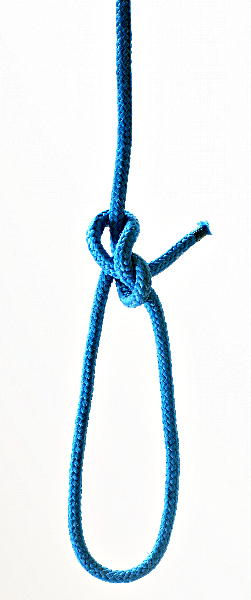
@ Derek Smith : See the three attached pictures. The first is of a loaded bowline, tied around a large diameter object. The second and the third are of a (loaded or not, does not matter) Sheet bend.
If you insist to see similarities in knots, regardless of how many, and which, ends are loaded or not, as you do in the case of the common bowline and the Sheet bend, why THOSE two knots are different ? Why you say that the same hitch structure, that is present in the Sheet bend, is not present in the Eskimo bowline ? The pictures tell a different story…
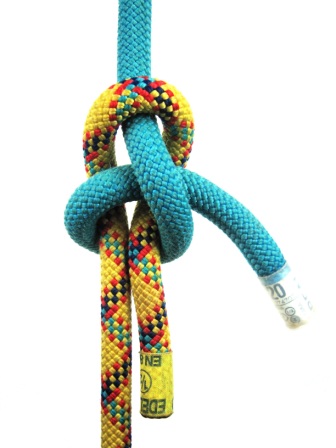
No, the first is a beautifully laid out image of a circular - UNLOADED - Eskimo bowline that you have previously presented to us.
No, the second is a core - it is not a working knot as it has no input and output loading assigned to any of its four legs.
Yes, the third image is indeed as you state a sheetbend (probably unloaded or only lightly loaded)
Could you now please restate your question ?
@ Inkanyezi
What is this?
http://igkt.net/sm/index.php?action=dlattach;topic=3233.0;attach=5516;image
I guess that before we can get down to defining a Bowline we have to reach some agreement on how a Bowline should be dressed and set. I have climbed on the bowline for a number of years and I would NEVER have dreamt of climbing on a knot so shoddily dressed. I have however seen knots at the waterfront where the collar has been hugely distended and the half hitch has rotated to nothing more than a turn. I had always assumed that these (to me failed) examples were either the toll of time or just shoddy knotcraft.
Now I have to ask in all seriousness - Is this how you nautical types genuinely dress and set the Bowline?
Sorry to everyone for going backwards here, but we need to be sure that we are in fact talking about the same constructions, and certainly, this ‘Bowline’ that Inkanyezi is promoting is like no Bowline I would ever have made.
Derek
Hi Xarax,
While we are waiting for a resolution of ‘How to dress a Bowline’, could I just pick up on the comment you made about #1420
http://igkt.net/sm/index.php?action=dlattach;topic=3233.0;attach=5514;image
Technically, although I have used common names for some of the components ( such as Half Hitch Component, Simple Hitch Component…) - none of the components are knots, so they are neither hitches, bends, nor anything comprehensible in the world of complete (i.e. functional) knots.
So I would agree with the Ashley description, except that I would say that the crossing knot is in fact the Carrick Component, and so #1420 is a bend created by combining two Carrick Components
Derek
Take a beautifully laid out picture of a LOADED bowline, tied around a large diameter object. It would resemble to this picture 99.99%.
Take a a beautifully laid out picture of a, loaded or unloaded, Sheet bend. It would resemble to those two pictures 99.99%.
Now, compare those two sets of pictures, like you had compared the UNLOADED common bowline picture, with the (loaded or unloaded ) Sheet bend picture.
Do you see any difference ? If you do, how do you manage to do this NOW, and you have not been able to do the same PREVIOUSLY, when you had presented the misleading, unloaded common bowline picture, and the Sheet bend picture, to show/prove that the knots those superficially similar pictures represent, are related ? Why were the common Bowline and the Sheet bend related, and the Eskimo bowline and the Sheet bend are not ?
…but you do this to “prove” only the theory about the supposed common bowline-Sheet bend relation, and you forget to do the same with the Eskimo bowline-Sheet bend relation ! So, you try to eliminate the Eskimo bowline from the bowline family, when this bowline has exactly the same superficial resemblance with the Sheet bend, that the common bowline has with the same bend …The same resemblance with the same knot, the Sheet bend, can lead you to altogether different classifications of those two knots, the common bowline and the Eskimo bowline ! A Janus miracle !
You should not compare the superficially pictorial characteristics of the three-loaded-ends common bowline, with those of the two-loaded-ends Sheet bend, as arguments in favour of a supposed relation between the common bowline and the Sheet bend. However, if you do this, as you have already done, you should be consistent, and do the same in the case of the Eskimo bowline and the Sheet bend. I have shown to you pictures that can help you to do this. And if you do this, you will see that there is no more difference between the Eskimo bowline and the Sheet bend, than between the common bowline and the Sheet bend. If you call bowline the former, you should do the same with the later…unless you owe Dan Lehman a Huge amound of worthless US dollars !
Could you now please restate your answer ? Because, if you continue to insist that the common bowline is related to the Sheet bend, while the Eskimo bowline is not, and the Eskimo bowline should be renamed to Eskimo loop, you are wrong in the first answer, inconsistent in the second, and naive in the third !
As Ashley is mistaken on this - because those two structures that form the Double Harness bend are not crossing knots, but hitches, and you are also mistaken to consider that the bowline incorporates a hitch component, it is only natural that you agree with him !
However, I , too, agree with you on this ! (even if Ido not know exactly what you mean by this cryptic “Carrick Component”…I decipher it as “the hitch component incorporated in the Carrick loop” we were talking about the oyjer day - or in the Carrick bend.) The ABoK#1033, the Carrick bend, the Angler s loop, all those knots do have a hitch component, indeed, they have segments of standing part lines perpendicular to each other, crossing knot components, etc…in fact, all those things that are completely absent in the bowline !
Of course this is not what the Bowline would ever be dressed like, but I first tensioned it, and then opened it, so that the parts should become more visibly separated. unfortunately we cannot se three-dimensional images on the screen.
What I try to point out is that whichever way you try to dress the bowline, when it is in use, the nipping turn takes a spiral form resembling that of the Gleipnir, and the forces within the central part of the knot are different from the Sheet Bend. When the Sheet Bend is loaded, the free end of the hitch points at an oblique angle somewhat in the direction of its own standing part, while the collar nips it against its standing part. The Bowline on the other hand does not nip the similar part in the same way, but it is almost in line with the standing part. The “knot” in the image is deliberately opened, so that the collar is very loose, but it is to show the works of the knot, its central feature, the nipping loop, that is almost straight, almost in line with the standing part.
The Bowline always takes that form under load, when heavily loaded or with the load repeatedly applied. Even when you dress it very neatly, if the load is heavy, the bight that forms the collar will be drawn out a little and the former HH made in Sheet Bend fashion will form a turNip. Provided the two legs of the eye are not too widely apart, it will not collapse further.
A neatly dressed Bowline will be snugger, but I eased the bight of the collar, so that the turNip should be more clearly seen.
Post Edit: Below I inserted a photo of a Bowline that was first beautifully dressed, just as in the Motorboaths Monthly image, but then was exposed to heavy stress by loading it with repeated jerks. Invariably it takes the “sloppily dressed” form, drawing out the collar and orienting the nipping turn almost parallel with the standing part. Note the direction the end takes. This is typical for the Right-handed Bowline.
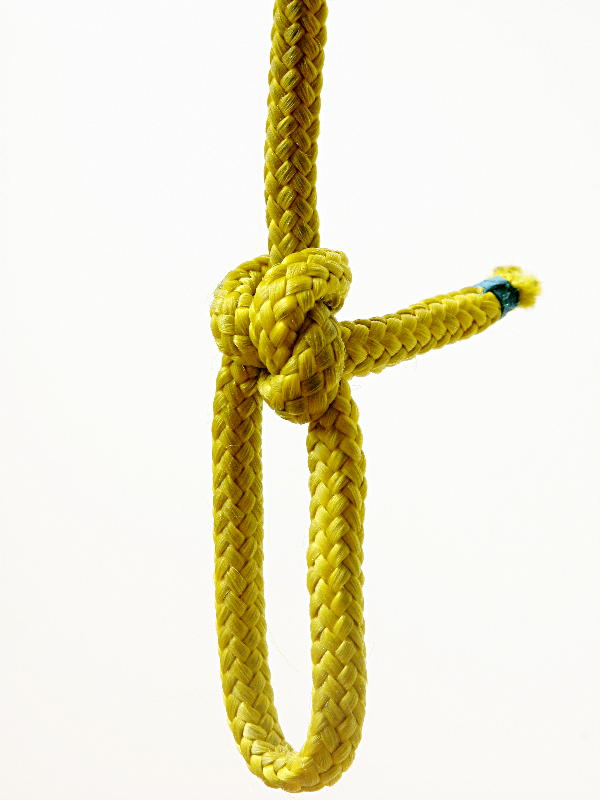
YES ! This is a detail of a picture of a properly dressed and tightened bowline. The loadings of the standing end, the eye leg of the standing part and the eye leg of the bight happen to be equal.
Make an educated guess : Is it a commn bowline, or an Eskimo bowline ?
Derek, give up… There is no way to distinguish if this is a detail of common bowline or a Eskimo bowline ! Why then the one is a bowline, and the other a non-bowline loop ?
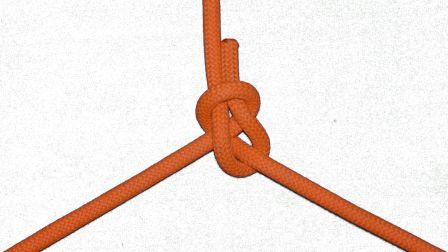
Whoever is able to untie this Gordian knot, and solve the riddle of the previous post, is kindly requested to exercise his abilities in the following, too. ;
Does the attached picture show a detail of a common Janus bowline, or a detail of an Eskimo Janus bowline ? Does it happen that the “first” collar is tied around the standing end, and the “second” collar is tied around the eye leg of the bight, or the opposite ? Which is the standing end, and which is the eye leg of the standing part ?
If we can not distinguish, due to the local symmetry of the knot s nub, the former from the later, why the one should be called a bowline, and the other simply a “loop” ? “Janus bowline” and “Janus loop”, sounds like a very “Janus” situation to my ears…
http://igkt.net/sm/index.php?action=dlattach;topic=3233.0;attach=5526;image
120 degree Eskimo
http://igkt.net/sm/index.php?action=dlattach;topic=3233.0;attach=5530;image
120 degree Janus Eskimo
But these are only games - now dress, set and load your knots and lets see if they behave the way Inkanyezi has demonstrated.
If we can show that the ‘correctly’ dressed, set and loaded bowline regularly takes up the Turn Component instead of the Half Hitch Component, then my proposed definition will need to be amended a third time.
Derek
They are not games ! They are made by three tensioned/loaded legs, two of whom can be well connected and form a loop, as in a “dressed, set and loaded” common bowline or Eskimo bowline,. without any change in the detailed pictures !
You proposed this theory, you have the burden to test it…Tie your own knots, because you will not believe me, anything I show to you ! If you wish to test your “ability to force square pegs into round holes”, go on, use more carefully chosen words, like this [u]“games…”/u, to try to make my arguments look ridiculous…
Why does knotting makes this thing to honest, decent people, I wonder…I , for myself, I will not continue along this slippery road. I already wrote thousands of words because I respect you, and I ,really wanted you to look on the matter more closely. Either you have not read them, or you read them but believe they are not worth reading… which is about the same thing. Eitherwise, it seems you have not understood, or wished to understand, anything at all.
Good luck, Derek, and enjoy knotting ! I have already forgotten the whole issue.