This is a query that came into me today from Walter Vaux, he would like to know if there is an official name for the study of knotting. I have told him that if there is one then someone on this forum will know what it is, so don’t let me down please.
Walter asks: For years, I have been seeking a work that means ?The scholarly study of knots?. The word Vexillology is the scholarly study of flags. Is there a comparable word for the study of knots?
Hmmm - the word for “knot” in Greek is also represented by the Greek word pronounced thileia according to one on-line dictionary and would produce the word thileiology - do we have any Greek speakers on the forum?
“Knot”, in ancient/classic Greek, is “desmos” (δεσμος), and in medieval/modern Greek “komvos/kompos” (κομβος/κομπος). “Bound”, “tied”, is “desmion / desmotis”, so the bound on a rockTitan hero Prometheus - who was punished by the god Zeus for giving fire to mankind - is “Prometheus desmotis” (the title of a classic ancient Greek tragedy) (1).
The word “thileia / thilia” (θηλεια /θηλια), is a synonym of the ancient/classic Greek word “brokhos / bronhos / bronhus (lat.)” (βρογχος), that means “noose”. ( from “bronhos” comes “bronhitis”) . Curiously perhaps (?), the word “thileia”=noose, comes from the word “thilys / thilykon”= female .
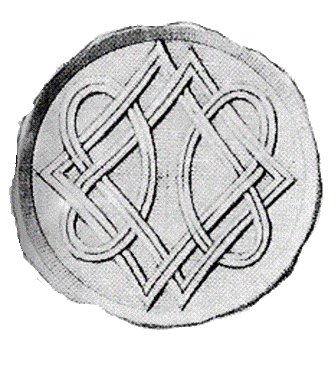
(The earliest text / description of practical nooses, by Heraklas (2) from the first century A.D., uses the word “brokhos / bronhos / bronhus (lat.)” collectively for nooses, hitches and some bends. See the attached picture for an an early seal-impression on clay of a knot, from 2200 B.C., at Lerna (3).)
http://en.wikipedia.org/wiki/Heraklas
“Heraklas on Knots: Sixteen Surgical Nooses and Knots from the First Century A.D.”, World Journal of Surgery 32 (4): 648-655
A search through various online disctionaries shows that “kompology” means braggadocio, empty boasting (though how that came about is not clear) - it has nothing to do with knotting even though that is the root.
Kompos, in ancient /classic Greek, meaning knock, noise, sound. ( for example, k. of teeth )
( 8th century B.C., Homer, Iliad, Λ 417, M 149, M 151 ) http://en.wikipedia.org/wiki/Homer
Metaphorically, also in ancient/classic Greek, kompos, kompasmos, meaning making-noise-about-oneself, boast, bragger, bluster, swagger.
Pindar, 6th-5th century B.C.. http://en.wikipedia.org/wiki/Pindar
Komvos. in medieval/modern Greek, meaning knot. Today it is pronounced as “kompos” ( consonant pair mv turned into mp), so this is probably what causes the confusion. From the same root, the word “komvion”, now pronounced as “kombi” or 'koombi", meaning button.
( 5th century A.C., Hesychius) http://en.wikipedia.org/wiki/Hesychius_of_Alexandria
The ancient/classic Greek word for “knot” is “desmos”.
Homer,
Iliad, Z 507,
Odyssey, A 204, N 100, Φ 241
For a somewhat more recent use of the word, see : http://en.wikipedia.org/wiki/Desmodromic_valve
The problem is that English has adopted Kompos as a root for Kompology whereas as you say Komvos would be the correct root to describe knotting and in English the word would be pronounced as written thereby distinguishing the two. As far as I can tell there is no such word as komvology already in use but that doesn’t mean we have to invent one - I am not convinced of the need for an “ology” other than for academic purposes and even then it seems otiose but as we have settled on nodology let’s stick with it.
It is not a big deal if we have a word for the study of physical knots, to distinguish it from the study of mathematical knots ( Knot theory). Nodeo-logy , or Nodo-logy ( a Latin + a Greek word/root) is fine, as fine would be the Desmo-logy ( two greek words/roots).
 .
.