What is this adjustable hitch?

Ah, okay, now I see it. I was making the wrong loop the standing part. So Ashley’s 1444 depiction is the same as my right hand image if it is rotated upside-down and viewed from the other side. So that tells me which way to go in reverse, and yes, I just tried it out and straightening the actual standing part and pulling the other bits into place does duplicate the original hitch. And wow, there is roughly zero chance I ever would have spotted that connection. I had a hard enough time figuring out which way to orient the standardized Carrick formation to get it to line up. This is why I’m crap at finding knots.

So, having established this topological connection, does this have any particular significance, or was this mostly presented as an interesting sidebar?

I notice Ashley gives the 1444 bend a skull-and-crossbones rating. For the hitch form, that seems rather harsh. Do you think he was aware of this permutation?
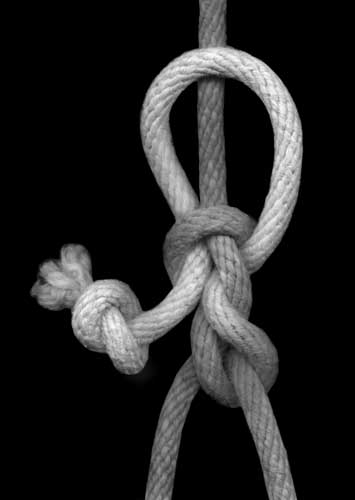
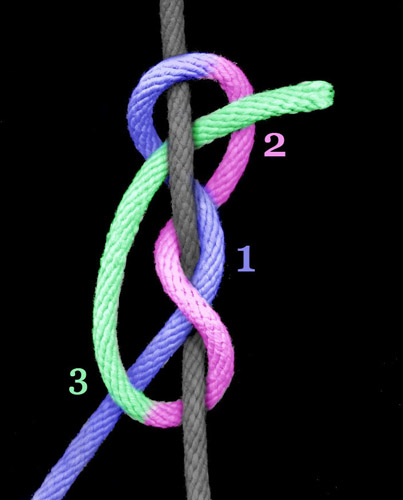
There is no special significance, other than to decompose a particular knot structure, as you correctly stated above, and associate it topologically, with a more recognisable, simplified form, (which may be located in Ashley’s), within the realm of exploration.

As for the skull and crossbone rating, in my opinion, that goes strictly for the bend, because the hitch structure is a far cry from the bend geometry, with different components or loadpaths.

Moreover, at this point, i’d like to add an enhancement, as an interesting feature that may be implemented to any, non-TIB, one wrap hitch, like yours for instance.

All one has to do, is to feed the working end back through the nub, parallel to Spart, developing a two wrap, TIB, bull-like, EEL hitch (another example would be the buntline with Xarax’s bull clove).

From the attached images you may notice that there are plenty of options here…

1] By pulling whichever of the SPs out of the nub, you get a couple of non-TIB, one wrap hitches (one of them is your original).

2] By shrinking whichever of the two wraps you get a couple of TIB, one wrap, hitches.

3] By closing the two wraps like you are closing a book or the opposite way, you get a couple of two wrap, TIB, bull-like, EEL, hitches.

I think I’m following what this modification entails, but the part I’m fuzzy on is what it accomplishes. Is this a practical enhancement that adds or increases functionality in some way, or is this more like an enhancement to theory, perhaps in generating new structures to experiment with?

From what I can tell, running the free end alongside the SP on this particular hitch decreases its gripping strength. I do, however, like the basic idea of feeding the free end back into the hitch to form a loop. One of the things I like about the Blake’s hitch is that the free end can serve as a handle to pull the hitch upward when it is not loaded. This hitch lacks that feature, but I feel like maybe it could be added if the end could be secured in the right attachment point–forming a loop which could serve as a handle, or a hook-on or tie point for pulling the hitch from a distance. I’ve done this a few times, with varying success, but I’m still experimenting to try to find the best attachment point. I’m including an image of the current leading candidate. It doesn’t seem to interfere with the clamping action of the loaded hitch too badly, but when unloaded, pulling upwards opens the top loop slightly, which seems to make sliding the hitch a bit easier.

Ideally, I’d like to find a simple way to add a handle–or maybe two–that could make it easy to pull the hitch in either direction, whereas this loop only works for pulling it upwards (opposite the direction the hitch would be loaded). Even so, I can imagine a few situations where this might be useful enough to be worth the extra effort of forming the loop.


loop_handle_1.jpg

Well, now I’ve put the two cases above to heavier loading
via a (lousy) 5:1 pulley, and the HMPE held but the CoEx
didn’t. --not sure how much remedy remained to putting
in more curve; in fact, though, I took OUT some curve for
the CoEx on thinking that maybe somehow it would work
better, as had the HMPE where the S.Part was damNear straight !
(but it didn’t)

So, a YMMV knot. (There’s a fair amount of such things.)

–dl*

I knew the OP hitch didn’t work on lariat rope. I guessed there would be others. This is a problem with knots that don’t have a track record.

Did you have any sense of how much load induced slippage? Or an opinion on the likely cause of grip failure? (Too stiff? Too slick? The way it is laid? Something else?)

Have you run across a slide-and-grip hitch that works well on this kind of rope at high loads? I’ve noticed with the Blake’s hitch that sometimes the very act of sliding it seems to set it up to continue sliding once the load is re-applied. I haven’t figured out what causes that.

There’s a hitch I sometimes use when I need a bit more grip force. (image attached) I expect it doesn’t have the holding power of, say, an icicle hitch, but I like it because I can tie it in about five seconds, and it has never jammed on me. It kind of looks like it ought to be able to function as a grip and slide hitch, but on most ropes, it is really not good at the sliding part. But I’ve always wondered whether it might become a usable grip and slide on a more slippery rope..


Holdfast ver 1.jpg

This is an excellent adjustable noose hitch. It can find immediate employment as an adjustable foot stirrup for fixed rope ascending (pairing it with a 'Jumar' mechanical ascender). It grips when loaded - and then releases and slides relatively easily when unloaded.

Mark, Can you please show some pictures, how you use the adjustable noose hitch. Thanks.

What are the advantages of this hitch vs. e.g. Midshipman’s or Adj. Grip or Farrimond’s?

Bearing in mind these have some function-differences (e.g. the Midshipman’s is the best at slipping in one direction, or the worst at holding against being pulled in either direction, and the Farimond is the only one of these four expressly designed to be a quick-release adjustable hitch), I would say the largest usefulness-difference for my situation (most-commonly involving medium-stiff braided utility ropes in the quarter- to half-inch dia. range) is that the As-Yet-Unidentified hitch here has the lowest engagement threshold of these 4 (i.e, how tight the hitch has to be before it will auto-tighten under a load). So while all four of these hitches can be tied when the attaching rope is already under some tension (the Midshipman’s excels at this) the AYU hitch is the front-runner for any slack-line situation, where the hitch has to be tied, dressed, and made-ready to hold a load, before any load is applied. Which also means the AYU hitch is the quickest and easiest of these 4 to dress in slack-line situations.

With the ropes I use, there is also a slight performance advantage when it comes to releasing, sliding, and taking a load again. The Chisnall has sometimes elongated under loading into a configuration which doesn’t release so easily once unloaded, and both the Midshipman’s and Chisnall have sometimes had a problem where sliding them in the load direction makes them more prone to continue sliding once the load is re-applied. (I haven’t figured out what causes this, but so far, I haven’t had it happen with the AYU hitch.) I don’t have enough experience with the Farrimond to know how it is for sliding and holding.

Like with Sailor’s hitch, you can add grip of the hitch by adding some initial rounds. There are 4 rounds instead of 2 in the dressed knot of this image, tied with a bight.

I find the gripping power of modified Sailor’s hitch better on rigid smooth pole than of this one, but it seems to grip just fine as part of a loop.

Not sure what I’m looking at here. Does this arrangement put the coils in compression?

You may be interested in p. 266 of the ABoK as a few constructs there are not that dissimilar from your hitch. It’s easy to overlook as it’s in the bends section.

p.s. Also from personal, admittedly not well tested, experience I find Blake’s hitch sans one turn (which I think is the same as #1470 with an extra turn) to work reasonably well on many types of utility ropes and cords. The second last turn can be tucked under the last one in the Midshipman’s fashion, which may (or may not) increase its grippiness. There can also be at least 2 variations of it, depending if the final tail tuck is under one or two initial coils - I’m not sure which one works better - common sense suggest that the former may be better for slick ropes and the latter for stiff ones, but ropes may not be aware of it…

In this gripping hitch the coils are under tension, just like in gripping Sailor’s or Icicle hitch when being pulled in the ‘right’ parallel direction, which I think may be more effective than piling them on top of each other as in e.g. Camel hitch or the Tautline.

I think it adds some elbow to the standing part. One extra turn might suffice. Using the bight ending adds some turning, too.

By the way, the knot seems to have good grip even when only two of the three legs of the of the knob are loaded. By legs I mean the legs of the loop and the working part.

Might still be early to be calling it my hitch, but yes, quite similar in appearance, and not just those. Some in this thread have pointed out other near look-alikes. There are a large number of hitches which have the general form of a line-in, a line-out, and two wraps, with all the variation being in which passes go over, under, or through others, or on which side of the object rope they pass. And you have to figure that for each one of those that made it into general circulation, many more were tried. This is a very well-developed space, so I started this thread with the expectation that this would turn out to be a known hitch–even if I couldn’t understand, if it was known, why it wasn’t well-known.

And I’m also not requiring an exact match. A mirror-form would obviously count as the same knot for example. You can also have augmented forms (as you noted, adding turns to Ashley’s basic #1470), degraded forms (a bowline with the tail to the outside, or a Carrick with the ends on the same side, or a sheet bend with the ends on opposite sides) and derivative forms (where a pass difference doesn’t appreciably change the overall function). But it is also quite common for a small difference in structure to result in a large difference in characteristics. A square knot and a granny knot are significantly different, as is a clove hitch and a constrictor knot. But the matter of when differences are large enough to be considered significant is a grey area, which was another reason I thought it best to consult the experts.

In this gripping hitch the coils are under tension, just like in gripping Sailor's or Icicle hitch

Coils typically resist sliding by constricting around the object rope. I don’t think this hitch operates by that principle. It seems to operate more in a wedging fashion, like roller clutches. I think that’s why it has such a remarkably low threshold at which auto-tightening will engage, and why it releases so easily. I haven’t experimented with adding coils (on my ropes here, it doesn’t slip), but just for purposes of identification, I figure the simplest basic version is the preferred way to go.

As a point of interest: there is an arthroscopic knot published by a Thai Uni that relies on similar mechanics. I also think is not that different from the working of HFP Slippery 8. https://www.sciencedirect.com/science/article/pii/S2212628714000541

There is also a discussion started by Xarax on arthroscopic knots used on ropes as friction hitches here. I can’t find an example of the hitch that started this discussion, but there is a plethora of publications on arthroscopic knots which is one of the few active knot research fields - perhaps it’s hiding somewhere there… https://igkt.net/sm/index.php?topic=4107.0

Yes, another in that general area. But the Chula is two passes different from this hitch. There is another hitch I use (a friction-multiplier hitch) that is right in-between–one pass different from the Chula, and one pass different from this hitch. But that one pass difference makes a huge difference in the way it works.

I also think is not that different from the working of HFP Slippery 8.

There is no wedging element in that knot. On my ropes here, the name “slippery” is apt.

there is a plethora of publications on arthroscopic knots which is one of the few active knot research fields - perhaps it's hiding somewhere there...

SS369 made basically the same suggestion at reply 11. Having now examined about a dozen such knots, and looking at what they are designed to do, my sense is that this hitch would not make a very good arthroscopic knot. So I would be surprised if anyone is using it for that purpose when there are so many better candidates available.

I think that for many arthroscopic knots the idea is that they need to slide down the loop and then ‘lock’ (capsize) by pulling the tail, rather than continue being adjustable. The Chula seems to do that quite nicely given its simple form.

There is no wedging element in that knot.
There isn't in the Slippery 8, but there isn't either in the Chula, until it's locked.
There is another hitch I use (a friction-multiplier hitch) that is right in-between--one pass different from the Chula, and one pass different from this hitch.
Could you show or describe it?

Sure. First image shows side-by-side the progression from the Chula, to that particular friction-multiplier, to the as-yet-unnamed adjustable hitch.

Second image show this FM hitch coupled with a lobster buoy hitch (#1714) as the root hitch which will provide the friction to be multiplied. Actually, the lobster buoy itself can serve as a less-aggressive friction-multiplier, but on some of my ropes even three LB’s in row aren’t enough. The configuration on the left shows it in a progressive mode, where the hitches can still be slid (in the direction of load) under low loads. As the load increases it will grip tighter to compensate. The configuration on the right is same hitch turned up-side down. This is not progressive, but it is a good emergency backstop. Both of those configurations are ready-to-go as depicted. They do not need to be dressed or made any tighter than shown prior to loading. The panic-stop config will engage and hold almost instantly even under a hard jerk (-on my ropes. I’ve never tried these on super-slippery ropes.)

Ashley mentions what he calls “jamming hitches” (pg. 325) which can slide very easily when loose, and then you lock them by giving a firm tug on the free end. These have a similar function, except it is the load itself which activates them.

Many thanks for this! BTW, awesome photography - any tips as to how to achieve similar effect? Cheers!

Really? I was just going for clarity. I would never have guessed that “starkly utilitarian” was a style.

Okay, well, it’s definitely not a difficult style to duplicate if you have the right equipment. I arrived at it by being the sort of person who favors solutions that are simple, easy, and get the job done–even if they are sometimes a little unorthodox. So when the digital camera is busted, but the flatbed scanner works…

(Okay, I also do a little post-processing to clean the scans up. I leave the lid up for a background that is dark enough it can be auto-selected, then turn it full black. And my Epson scanner has a slight top-lighting bias, so if I think underlit would be clearer, I rotate the rope on the bed, then unrotate in post.)