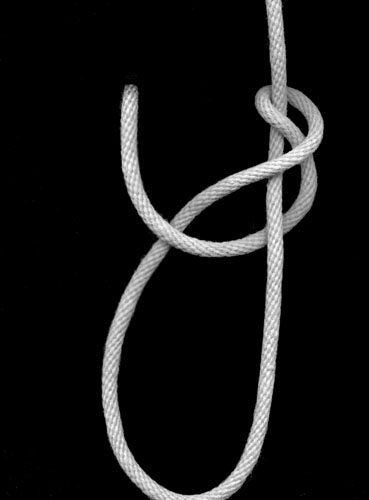
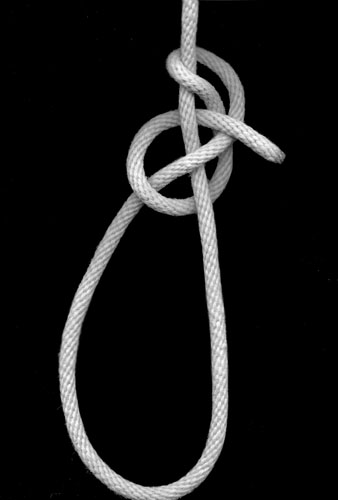
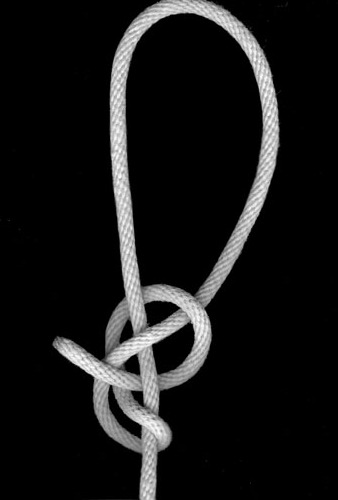
Does anyone recognize this slide-and-grip hitch? It’s one I came up with on my own, so I don’t know what its common name is. I haven’t found it in Ashley’s or online, but I’m not good at searching by knot shape. If someone can identify it I’d be grateful for the information. Thanks.
The form around the standing part is very similar to the Sailor’s Hitch (ABoK #1688). Such usage is described on the linked page. I wouldn’t be terribly surprised if performs nearly the same.
Thanks for the suggestion. The general tying sequence is indeed similar. In that illustration, where the adjoining rope first crosses itself, if it had passed under instead of over, it would have been the same as the hitch I’m asking about.
But even if it would not surprise you if a similar-looking knot had similar performance, I’m guessing it would also not surprise you that similar-looking knots can sometimes have significantly-different properties. In this case, on the ropes I have here, the Sailor’s Hitch seems to be more prone to capsizing, it isn’t as effective at self-tightening under a load, and doesn’t release and slide as easily. Whatever merits the Sailor’s Hitch may have for tying onto a rigid member, it would appear to be not so good as an adjustable slide-and-grip hitch. So I’m hoping the hitch I’m asking about has its own distinct name, as I wouldn’t want to use a name that leads people to a less-suitable knot.
Thanks for the feedback. Now I don’t feel quite so inept for not having been able to find it.
There are obviously better-known adjustable hitches for life-critical applications, but I came up with this one as a small, quick alternative for simple stuff like load tie-downs or short-cycle applications–where something like a full ascender hitch would be kind-of overkill. It has worked well for me, but my experience with it is limited to a few weights of braided utility rope. If this should turn out to be an unknown hitch, that would also make it an unproven hitch, so I wouldn’t be able to suggest it for other applications.
This is an excellent adjustable noose hitch.
It can find immediate employment as an adjustable foot stirrup for fixed rope ascending (pairing it with a ‘Jumar’ mechanical ascender).
It grips when loaded - and then releases and slides relatively easily when unloaded.
If this was a claim of originality, it should have been posted in the section intended for that purpose?
#409 Poachers noose is employed routinely in life critical applications - but unfortunately it is not ‘adjustable’.
Rope access operators use it routinely to form their customised lanyards - the #409 noose cinches very tight to abut a carabiner - which holds it firmly in the correct alignment.
Unfortunately, it has a tendency to jam.
Your presentation cant be used in the context I described above - but that doesn’t mean it isn’t a worthy creation.
I would have no hesitation in recommending it as an adjustable foot stirrup as part of a fixed rope ascension rig.
  Interesting knots, Xarax have tie the similar knot long time ago, no body pay any attention, included me.
 See the first picture and #3 on second picture.  Topic: True Adjustable Loop Knot or TALK for short
  https://igkt.net/sm/index.php?topic=5247.0
 Third picture is #1 on second picture.
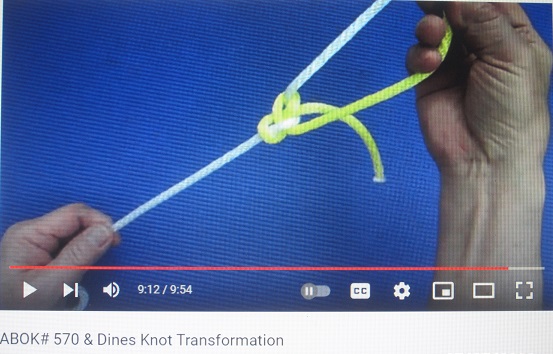
 Forth Picture, not long after I post the knot, I do aware Mark already post it in his analysis paper long before, just didn't
 have chance to correct it, have time I will clarify few more knots that some one have tie before me.
 Also See Non Slip Adjustable Eye Knots. https://igkt.net/sm/index.php?topic=6822.0  and Firth picture/
 Thanks.
I would be pleased if this hitch turned out to have usefulness beyond the simple utility application I use it for, but such would be outside my narrow range of experience, so I’ll have to leave it to others to determine whether it has any fitness for other uses.
If this was a claim of originality, it should have been posted in the section intended for that purpose?
I did come up with this hitch on my own, and I wasn’t able to find it in Ashley or online, but I’m not good at searching based on knot shape (having to take into account mirror versions, distorted versions, and views from all sides), and I’m no knot expert, plus I was able to find many similar-looking and closely-related knots, so surely it would have been the height of presumptuousness to make a claim of originality at this point. The odds that I failed to find a known knot seemed much higher than the odds I was the first to find something this simple in an area that has been so well developed. I’m still more than half-expecting someone to come up with a previous reference to it.
I do have to admit, though, if this is a known knot, I don’t know why it would be so obscure, given how well it has performed for me.
I think I might have misunderstood some knot nomenclature again. My impression was that an adjustable loop would be one that could be resized, but which operated like a fixed loop otherwise, but several of those loops don’t look like they would be very easy to resize.
The interlocking loops of the Anti-Mytles look familiar. I make something similar by capsizing a constrictor knot around a crossing line to turn it into a crossing knot.
That helical loop hitch is not like the hitch I’m asking about here, but for such a small hitch, it’s got a feisty grip, even in the slipped version. Also looks like it would resist capsizing or jamming. I like it. I think that’s going onto my short list of useful hitches. Thanks.
Your offering looks like an arthroscopic eye (loop) knot. There quite a few to search through and various angles to see (upside down, backwards, loose and tightened). Too many for me to go through to find a name for you.
Here is something relevant with your adjustable structure directly from Ashley’s.
Tie a 1444, Single Carrick, initial dressing state, as an eyeknot (loopknot) of course, starting from an S nipping loop ( reverse the overs and unders).
Ashley demonstrates it in a Z based form, but i would recommend to tie it in a mirror fashion in order to get an exact copy and coordinate with your original structure.
If you load it, what you get is a helical SP component stabilised with a returning crossing knot.
If this configuration doesn’t look familiar so far, then try to straighten the SPart helix, using a flexible rope, getting the exact adjustable form you showed at your original post.
It is very likely to end up with your form, if the knot is subjected to high strain.
The structures and load paths are quite different.
Provided that you have followed exactly the steps from above, the knots are quite the same in a topological sense, with a slight difference from a geometrical point of view (straight/helical Spart).
Actually, IIRC that’s one of a half-dozen knots I had
tested ca. 1985? by some Irish IGKT member who’d offered
testing service --and my “56” (or a “prime” of that #,
to show derivation from something else " 56’ ").
My design goal was to have a gradual bend in the S.Part,
which it does --only it behooves one to guesstimate how
MUCH of a bend to set (and likely in some materials,
it will slide at high forces).
Another knot tested with it --and testing the same
(65% or so?)-- is the Dbl.BWL with the round turn
re-dressed to be a gradually reaching-towards-eye
curving of the S.Part and then a reach back to be
the Outgoing Eye Leg. --a surer knot to use, as it
has this “U-turn” aspect.
The OP knot resembles some of the things I’ve seen
in commercial-fishing trawlers’ dock lines in heavy
rope, capsized --my surmise, vs. being dressed &
set so-- from some sort of BWL.
Ditto :: I just manually stressed the knot in some
urethane-coated (I think) 5/16" Dyneema (HMPE)**, which
is pretty slick (though not always showing this at
low loads); I think it might hold better than the
other main knot (“my ‘#56’”) cited in this thread
–both are decent.
** also some 3/8" CoEx laid rope --quite firm cross section.
I think I see the reasoning here. This hitch does have some similarity in general form to the ground state that a Carrick-like bend might decompose into. But if some Carrick-analog can decompose into this hitch, then presumably by reverse process, we can un-decompose it into a standard Carrick-like configuration to see which analog it might be. So, I did that, and I’m attaching the resulting image paired with its mirror twin. (The S parts descend from where they meet.)
Looking at the Carrick-related bends depicted in my edition of Ashley on pg. 263, I’m not seeing where Ashley depicted either of this pair. But perhaps he has more Carricks depicted elsewhere. I’ve never quite understood Ashley’s organizational system.
If that is the hitch in the image file named “Simple adjustable helical loop” that one has to be more snug before it will engage and auto-tighten, but on my utility ropes here, once it bites in, it has a pretty tenacious grip under heavy loading. The biggest difference between that hitch and the OP hitch is in what it takes to get them to budge after they’ve been loaded. The helical loop takes considerably more persuasion to get it to loosen its grip so that it can be slid to a new location.
Take a closer look at your rightmost dressing state of your attached image at reply#17 and compare it with Ashley’s 1444, i think they are the same.
Most certainly, you took a step further and depicted its mirror, at the left side of your attached photo, which is exactly the one that leads to your original adjustable structure, provided that you tie it as an eyeknot of course and load it ;).