What knot to use to tie a ligature to remove a skin tag?

I have developed an unsightly skin tag beside my left eye, and am desirous of removing it. I have consulted my doctor, who says that their practice doesn’t have cauterising facilities, and plans to refer me to a community health centre where they do have such facilities.

I have done a bit of research on the interweb, and have determined that a preferable option to cauterisation would be ligation … ie tying a length of dental floss tightly around the base of the tag to cut of the blood supply. Apparently this causes the tag to shrivel and fall off within a week or so. The tag is in fact vascular btw, and about 2mm in diameter at the root.

I would be much obliged if anybody could point me in the direction of a diagram or animation of a knot which would be applicable for this process. It needs to be something where I could form a loop, “lasso” it over the tag, pull both ends tight and job done. I would not want to be fumbling around threading and poking once the loop was in situ.

I am really hesitant to reply on this subject, since it could be considered medical advice, and I am not licensed to practice medicine. I can give you advice about knots, but practicing medicine should be left to the professionals.

I think what you are looking for is a knot that takes the least amount of space, and that means the fewest turns around the subject. A single turn around the subject will leave you with two choices, and Overhand Knot, or variant, or a Truckers Hitch, or variant. I wouldn’t trust the overhand knot to have lasting hold, even if you tie a second Overhand Knot, and turn it into a Square Knot. The Surgeons Bend might be considered, but you won’t have the option of adjusting the tightness of the knot after you have tied it. The Truckers Hitch can get kind of lumpy, and may also be subject to hold issues over time.

The next smallest knot would be two turns, which is like a Clove Hitch, and variants. One variant of the Clove Hitch is called the Constrictor Knot. This is where you add an overhand Knot under the middle part of the knot, and when you pull the ends, it will tighten snugly, and it will be extremely difficult to untie. Below is a picture where I have blown up a detail from a knot board I made. This is some Three Strand Coach Whipping that has been terminated with a Constrictor Knot on the left, and a Clove Hitch on the right. Both would be suitable to be used as a ligature, but the Constrictor Knot would have much better staying power where the knot might be subject to being worked, or stressed.

I have used a constrictor knot for many years in different applications, and I have never seen one come loose when I didn’t want it to. Unlike a Truckers Hitch, where you have to pull against the subject being tied to tighten the knot, with a constrictor you pull the ends in opposite directions with the knot in the middle. Where I have used the Constrictor Knot as a permanent installation, I have been able to cut the ends very close to the knot without the knot coming undone.

Having not read any literature on the use of a ligature in this fashion, if you do need to tighten the knot in the future, and you leave yourself enough ends to grab onto, you will be able to continue to repeatedly tighten a Constrictor if the subject becomes smaller.

Pat
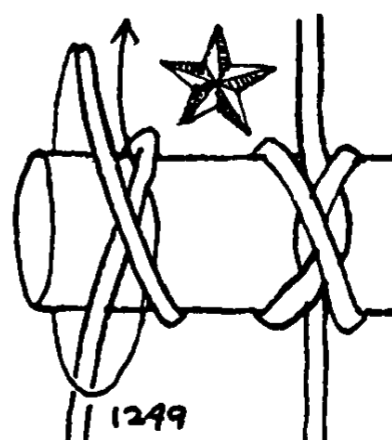
With respect for your situation I post a basic constrictor knot illustration that you tie first and then slip over the tag. Your web research has shown this is a legitimate procedure and if kept sterile should atrophy the tag.


ABOK-Constrictor.gif

Good day murrmac.

I can not fathom a doctor or medical practitioner not having the means nor the knowledge to help you with this challenge. Your physician should know something of ligature tying regardless. Doctors use constricting ties all the time, but more importantly, they monitor and help prevent infection(s).
Any infection near or in the eye could end up being a disaster.

I strongly recommend that you insist that a physician help you in your endeavor and learn knots for other uses.

Good luck!

SS

SS you remind me of a story. Back in the 1980’s, I was sailing on a Barefoot Cruise in a faraway land of cheap rum, and I was tying Turks Head bracelets for many of the other guests. I tied so many bracelets, I ran out of superglue to finish them, so I was terminating them with a Constrictor Knot, and giving instructions of how to finish the knot with superglue when they got home. I was done tying a bracelet onto a girl who was too young to use superglue without supervision, so I was explaining to Dad how to finish the knot.

When I was done with my explanation, I threw a Constrictor around the two ends of the of the knot, and cut all of the loose ends short, right up against the Constrictor. Now, when I tie a Constrictor, I tie it in hand with a little twist of my hands, put it around the the cut ends, and pull tight. For me, it is a well practiced motion, quick and easy. For Dad, it was a magician pulling a card out of thin air. He asked if the line, (three strand #24 cotton) would fray out and make it difficult to superglue. I assured him that the knot was holding up on other guests, even with the wear and tear of different beach trips and the other activities that one does aboard a three masted boat. He asked how I tied the knot, and wanted to know more about how well it holds. While I was teaching him my method of tying the knot, he asked ‘Do you think I would be able to tie this knot while wearing Latex gloves?’

It turns out that Dad was a surgeon. Sometimes he has to secure things in a permanent fashion with thread, and he thought that the Constrictor Knot might be a solution to a specific problem he encounters. He wanted to study the knot, and maybe use it in his work.

We lived far apart and did not exchange contact information, so I never did hear back if he studied the Constrictor Knot as a medical application. But as I said, I am not medically trained, so I don’t know if they teach knots in medical school. I wonder if there is a medical reference that indicates knots and their uses?

Pat

Pat

There have been a few discussions involving knots used medically (often with their own name when used this way) - I suggest a search for the word “arthroscopic” on the Forum first (you should get a number of hits).

Barry

I’m not so sure I would tie it as a first choice, but if I were to do so, I would probably go with a constrictor, as suggested above. But before I did that, I would google “skin tags vinegar” or “skin tags home” for possible effective home treatments that people seem to have success with, and which medical professionals rarely, if ever, suggest. I have killed warts and successfully treated corns with duct tape, of all things, and cured athlete’s foot (which I had been battling with prescription and non-prescription medication for years) by simply applying borax (20 Mule Team) once a day for several days.

Just my two bits worth…

JP

Thanks to all for replying , and I see that the constrictor knot is the implement of choice.

I will deputize a second pair of hands to do the tying, as I will have to hold the tag and extend it to enable the ligature to be tied at the root.

I appreciate the alternative suggestions, but this is really a ligation job.

If you tie the knot around a tweezer or hemostat, you can use that tool to retract the skin tag, and then slide to knot over the skin tag to get a good purchase. definitly helps to have another set of hands to assist. Good luck!

Pat

Just to say that the “operation” was a total success, although it took a couple of weeks for the tag to atrophy sufficiently to fall off.

I tried to do the constrictor knot, but my ex couldn’t quite decipher the diagram, so we ended up doing a clove hitch and pulling it real tight, and then tying what I suppose was either a granny knot or a reef knot on top of that to keep it from slackening off.

Worked a treat.