I’ll probably end up buying AboK at some point if I get more interested, but for now I’m wondering if there is a gentler/more structured introduction which introduces the sorts of things which are assumed knowledge?
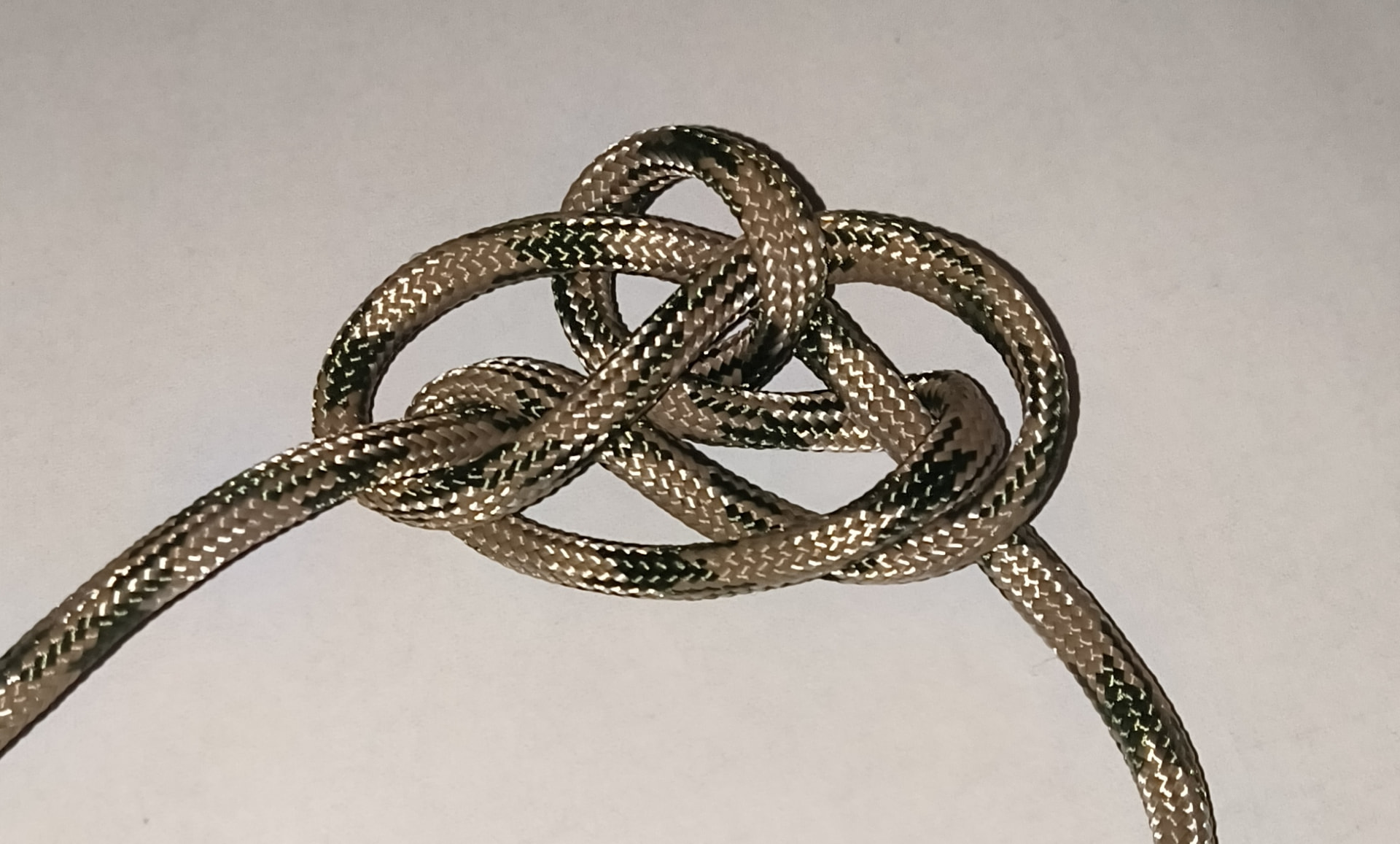
I’m playing around with the Diamond Knot (AboK 787), but not finding it very helpful. I tied it with two equal lengths, tied the resultant working ends and standing ends respectively together (to form a mathematical knot), and then loosened it up to try to see what’s going on, but mostly all I noticed was a tangle which seemed almost symmetrical in some arrangements, but never quite. I didn’t see a way to splice it into two non-unknots, is it prime? It intuitively feels like there ought to be an arrangement in 3d space which displays radial symmetry, but I can’t find it. I drew both spliced parts into a bight, which resulted when tightened in a knot which looked like a mistied diamond knot, but made from a single continuous strand, not 2. I expect not all places to pull out a bight result in the same knot (mathematically splicing out the unknot does nothing, of course, but the mathematical definition seems to abstract away some information which is relevant to differentiating real knots)
It seems like there are two broad types of knots, those which have 1 loose unknot representing rope going into/out of the knot, and those which have 2 unknots representing the same?
Another thing I don’t understand, is chirality. Whenever I hear it explained I can’t understand why it’s not just different perspectives on the same thing (like S and Z tetrominoes which are identical if you allow reflections)
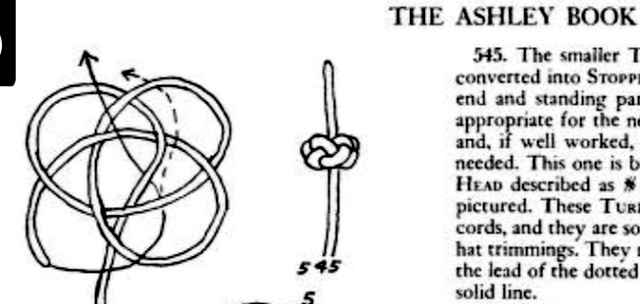
and ABOK#787 is in the category ‘two-strand lanyard’ knots.
this video shows how a 3x4 ring mat is translated to a two-strand lanyard knot.
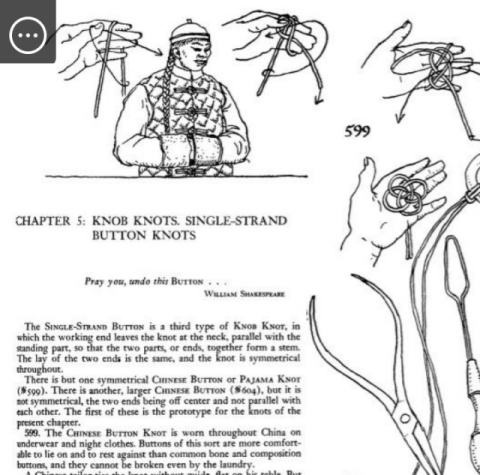
and it’s different from a button, which is terminal.
each end (colour) is brought around the standing part of the other colour to complete the knot,
which causes what seem to be extras in it all when examined.
i think that’s what you were looking at
(i had issues adding video or abok pic links so i split the reply)
i started with the Knot Book by Geoffrey Budworth,
a great general paperback
yes, i think you could describe it as that!
specifically a 2-strand lanyard knot.
2 cords starting at one end of the knot and exiting at the other end.
also, have a go at capsizing the knot; these ring knots can be turned inside out; if it didn’t work, try turning it inside out in the other direction