What's the typical aircraft tiedown knot called?

Hello everyone,

This looks like a great forum and I’ve read several engaging threads. Here is a question that has been bugging me for a long time.

I fly small airplanes, and the normal way to tie down outside is to loop the rope through the plane’s tiedown ring and run a few knots to secure the working end to the standing end. This knot seems pretty standard, and is basically a half-hitch with another throw through that is positioned and tugged to snap under the first throw, kind of locking it. The working end is then run down several inches and another knot made. An illustration and some further discussion of this knot is available at

http://www.flysundance.org/news_dec_2008.html#tiedown

The above article calls it an “interlocking half hitch”, but that doesn’t sound right to me. I’m perplexed that I’ve never seen this knot documented in various knot sources especially considering that I use it frequently enough for other things. I haven’t read ABOK exhaustively but I didn’t run into it there at least not yet. Among its virtues is that it’s quick to tie and extremely easy to untie even after heavy loading. The act of tying it helps take up slack in the line because you’re pulling in the tightening direction, and the offset kink introduced in the standing end by the interlocking tug takes up a little more slack.

A single one of these could shake loose easily, but that’s addressed by setting a few of them in a row and ending with a safety knot of some kind after the last one. I usually use a half hitch snugged up to the last in line, but is there a better way?

So, I guess what I’m asking is whether this knot has a canonical name, and what its history is.

Since this is my first post, let me introduce myself. I’ve always been casually interested in knot tying, and began studying more seriously after exposure to the basic knots required for my recent primary training as a firefighter. I moved from Manhattan to southern Vermont a few years ago. Practical knotwork—as part of various gardening, husbandry, firewood, and light building tasks—compliments my interest in old machines, hand tools, manual methods, and the traditional knowledge areas that go with those things.

Best regards, and thanks for any advice,
Jason
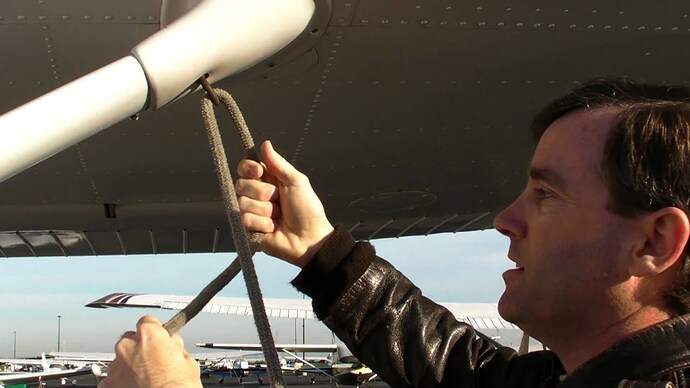
The best way is to tie them off using a Trucker’s Hitch. There’s a very short and crude video on you tube that shows a man tightening one side of his plane off with the Trucker’s Hitch.

Thanks! That is an interesting suggestion. I’ve never heard of anyone using a trucker’s hitch in this application but it does seem like an attractive option. Perhaps you’re looking at this video

http://www.youtube.com/watch?v=1qinEa2PN7A

I worry that the trucker’s hitch multiplies the force applied by the knot tier, and in this application, that’s not necessarily a good thing. Particularly with the wing tiedown points, applying a lot more force than is necessary to take up slack could damage the wing’s load-bearing structure. I wouldn’t pull that hard myself, but it’s a good thing that the double/locking half hitch knot is fairly standard because it’s what pretty much every student (in the US, anyway) learns.

The danger is not just by the force applied during tying, but from that initial force PLUS the tension imposed as the airplane is buffeted in the wind. It seems a potential way to overstress an airframe that is unlikely to be discovered prior to an in-flight failure. Worst case scenario is probably way below that threshold for most aircraft, but I don’t feel comfortable eroding any margin by using a force-multiplying knot in place of one that has been standard in this application for a long time. (Technically, the knot I described is also leveraged, because the working end goes through the aircraft’s tiedown ring which acts as a pulley… but a trucker’s hitch on top of that leverages it one step further, like adding another pulley to a block-and-tackle setup.)

I wouldn’t be so concerned with a low-wing airplane as shown in that video. But with a high-wing airplane, since you’re standing under the wing with the anchor above shoulder level, it would be easier to put excessive tension on the rope inadvertently.

Just to clarify, though, I’m not looking for an alternative to my locking/double half hitch knot, so much as seeking to find out any history or nomenclature attached to it outside of this specific modern context.

Thanks, Jason

I won’t contribute to the knot that is asked for in the first place.

Wings should not be firmly tied down. The plane should be able to move, but without being able to pick up momentum enough to yank the spikes from the ground. Reason being that small jerks through a taut line will work the spikes lose sooner or later.

So a knot that works on a line with a bit of slack, ought to be used.

Good point. Many tiedown locations are sunk in concrete, but I do also sometimes use less trustworthy screw-in anchors. And I know it’s hard to assess the integrity of many pre-existing anchors from a casual look on the surface.

Outside of extreme weather events, I suspect that a permanent ground anchor that has been there for some time and shows no obvious sign of motion would be more than sufficient to withstand forces that could harm the airframe, and so my inclination would be to take out slack and remove impact momentum from the potential stresses on the airframe.

If the anchor is going to move, then the question is whether repeated impacts or constant tension will move it more. I’m not sure if a ground anchor is more susceptible to constant tension or to intermittent/impact forces. My intuition is that a constant tension would be more secure, because numerous impact + relaxation cycles could let soil granule arrangements shift more than would be possible under a constant tension.

For a portable anchor in fresh soil, I have no idea which would be better but in that scenario you may well be correct.

In the majority of conditions within temperate climates, the conventional knot for this application serves fine, and tends not to loosen whether or not there is slack, as long as the final hitch is secured by a knot that won’t allow the final locking throw to work loose, compromising that final knot and introducing slack upstream that could compromise the next in line etc.

In any wing tiedown anchor that could move, the opposite could also move thus introducing twice the expected slack. Seems to me less slack to start with is wiser, but you may be right.

Jason

Jason, it’s seems to me you’re more of a teacher in this thread, rather than a student. Thank you for the input.

Haha thanks for the compliment but as it comes to knots i’m a beginner. I’m amazed by the knowledge I’ve seen on this and other online resources, really fun and inspiring!

I’m sure those more experienced than me will find mistakes in my yammering up to this point, and I’m happy to learn from any comments.

Cheers, and thanks to everyone who has taken the time to reply.
Jason

The knot questioned is the structure leading to what is
variously called “rolling hitch”, “magnus hitch” --and likely
some few other names as well. The jamming of the 2nd
(and futher) turn against the initial turn does often
help to put a bend/deflection into a flexible hitched
object, boosting tightening slightly. (Putting successive
turns away from this point --i.e., making a helix along
the object-- is also a means to forming such a gripping
hitch --and is the other structure commonly confused
with the same names.)

Good to see it recommended to follow this initial hitching
structure with another like it --maybe just a single turn–,
and then see about tying off the line with a sure knot
(even a clove hitch will do, at this point). I’m not
sure what they have in mind with "a simple overhand"
–that could be a hitch around the anchored part. I’d
rather a half-hitch finished with a bight that itself
was tied off with a slip knot (which will keep it from
slipping back through the H-H and yet be quickly
untied by pulling the tail). The good point is that one
can build up grip via more than one such gripping
structure (as opposed to making that one structure
larger with more wraps). For some quick securing,
the structure as shown can hold, in some materials --YMMV.

The rationale goes against the recommendation : anything that
doesn’t hold the plane firmly will enable the very movement
and momentum that is feared! Using somewhat elastic material
–or having a unit within a compound structure that is elastic–
can help with load surges.

–dl*

Jason,
In the video of the man using the Trucker’s Hitch, notice he never once tightens the knot itself…which I found unusual after watching but didn’t comment on it. After reading your other posts, it makes perfect sense why the man in the video didn’t crank down on the Trucker Hitch. Used in this method, it would seem to still be a perfectly good option.

He simply ties off the working end with the two traditional half hitches BUT never actually utilizes the mechanical advantage aspect of the knot. I guess that’s to allow some freedom of movement because otherwise it would be harmful to the airplane.

This is dangerous thinking. The video is for edification, and shows
its structure simply made for the sake of formation; but to believe
that a mechanical-advantage structure is chosen but NOT used in
that specific function --i.e., getting tightening advantage-- goes
beyond the pale in trust! One might question the structure’s
limitation of the single-strand span, which will be what stretches
most, the doubled span half as much.

This other video

is even worse, IMO. The tyer hauls a turn/loop of tail
around SPart to put the loop into the SPart; I thought
that this was going to lead to a bowline with the
subsequent maneuver, but … no. So the SPart is
left with a small-diameter turn, and the line hardly
all so tight. (I had last night played with putting
in that SPart-loop but then hauling the tail to
gain tightness, before adding finishin loops/half-hitches
in it; but it seemed like working against myself
(one needs to press against the SPart’s loop
and pull opposite the tail).)

–dl*

My goodness, that video was awful Dan. I too thought the guy was headed for the bowline but he…well I don’t know what in the hell he did to be frank. Don’t listen to him either, his descriptions of what he’s doing is terrible.

Is this a fair summary? To tie down an airplane, the cord should not be so tight that it damages the plane, but should not be so loose that the plane can gain momentum and loosen the anchors and/or knots. A preferred method is to use cord with elasticity and proper tension to satisfy both objectives.

That’s my understanding too, how about two HH at the plane’s anchor point and then loop through the ground’s anchor point and tie off in a rolling hitch?

Dan, Thanks for the names. I remember looking at the rolling hitch while I was searching, but I guess I didn’t look into it thoroughly enough. I saw a diagram of Rolling Hitch ABOK 1734 and passed it by because it doesn’t describe what I’m doing. The riding part doesn’t cover all turns, it snaps in between the outer turn and the standing end as in the Rolling Hitch 2, ABOK 1735 which I didn’t see. So there’s my answer!

Looks like the Magnus Hitch is a 1734 but tied off with a half hitch in the opposite direction. Close—but when I tie off, it’s in the same direction.

Knot4u, I would agree with that. I’ve never heard any discussion of the type of rope in this application. I think it’s usually polyester, definitely braided. If it has any stretch, it’s not a lot. With elastic rope, I’d wonder about how the stretch and strength characteristics are affected by UV, and many cycles of wet/dry. Sometimes you see chains instead of ropes, which seems unduly hard on the people and the airplanes. Not to mention ugly…

TMCD, what I like about putting the rolling hitches up top is you’re working closer to your arms and head when you’re standing. Also, should the security tie-off fail, gravity will tend to keep the bitter end where it belongs rather than trying to untie the knot. More of an imaginative than a practical concern probably. Finally, I suppose the series of knots makes the rope a bit more visible for when you walk away then look back thinking, “I didn’t forget to tie down did I??”

Good discussion, and thanks for the help everyone!
Jason

Just to point you at a few other related things in ABOK… The knot illustrated in the original link is actually considered a “complete” temporary knot called the Awning Knot by Ashley. Its stability in this state is dependent on the type of rope (some not being suited at all) and also being well-tensioned and worked up tight. There are several index entries for this, but #1854 is a typical one and contains a bit of information about how it was used for crowd control aboard passenger ships. If one keeps hold of the end and maintains tension, it also can be useful as a temporary belay when there is only a ring or some other object that can’t be used directly for the belay.

Ashley shows a few alternate finishes for the Midshipman’s Hitch, several involving seizing the end to the standing part. (e.g. #1027 & #1728). And to follow on Dan’s comments about the variety of ways of finishing these friction hitches, take a look at page 298. They are shown made around another rope, in the style of a Rolling Hitch, but some might be applicable for use in an adjustable loop form. And many’ more have been used/suggested since Ashley’s time…

Just as a side note, both the Awning Knot and Midshipman’s Hitch seem to have fairly good coverage in the ABOK index. However, this is not always the case.

I think the typical aircraft knot is called “a tangle”. In my experience most pilots know (and care) less about tying a knot than anything else. For anyone interested in seeing some ‘knots in the wild’, spend some time at a flying school looking at the tie downs that the last pilot of a training plane accomplished.

Even a CASA article on this subject is worse than useless when it comes to knots: www.casa.gov.au/fsa/2006/apr/48-50.pdf

Firstly the photo at the top seems to show someone trying to tie an original knot.

It recommends the reef knot as an alternative to the bowline but is not explicit as to what situation. Should the reef knot be recommended in any situation?

Also the diagram of a bowline has to be the most confusing ever produced (but would be interested to be proved wrong on this). The use of a striped rope gives it the appearance of one of those pictures designed to distort your perception.

Fortunately, most pilots who own aircraft use ratchet straps, or chains if it is a permanent tie down.

I always used a bowline through a floating ring on the ground peg and a round turn and 2 half hitches around the circular end of a wing strut. If it was a low wing aircraft with tie down rings on the underside of the wing I reversed these knots - usually because the ground end was tied onto a cable or a large ring in concrete and you couldn’t get 2 turns through the ring on the wing.

I did have an ultralight plane get free once in gale force winds but it was because the pegs, which were short fence posts, pulled out of the sandy ground.

Flight school airplanes unfortunately are subject to all kinds of neglect at the hands of students and instructors alike.

Reef knot is used when the tension will be on the long ends, and you want to be able to spill the knot by tugging on a short end. This doesn’t sound like an appropriate application.

A permanent tie-down, what could be sadder? Get out and fly that thing! :smiley:

Sorry for the delay following up, I got sidetracked reading a large totally unrelated thread. This forum is dangerous.

Jason

Also, dfred thanks for the references, which I’ll look into next time I get my hands on an ABOK.
Jason