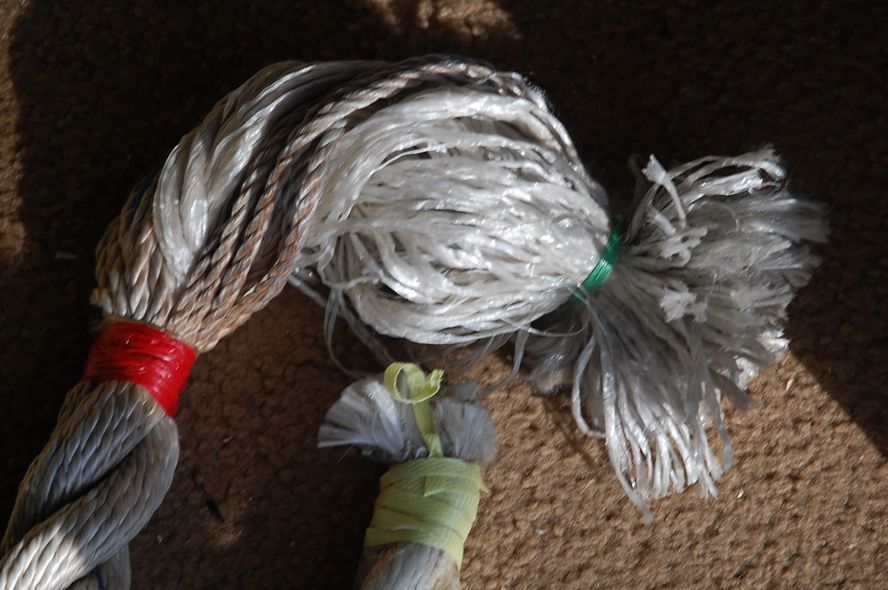
Looking very good after that amount of time Ink!
SR
Looking very good after that amount of time Ink!
SR
For the last few days I have resumed work on “Om knutar” by Hjalmar Ohrvall (sorry about the name, the forum doesn’t do UTF-8)
Anyway, here is what Dr Ohrvall has to say about whippings (sv. taglingar):
Man l?gger ena sladden av garn?ndan p? trossen i dess l?ngdriktning, s? att garn?ndan skjuter ut ett gott stycke utanf?r trossen. Sedan l?gger man garnet i upprepade, fast ?tdragna rundt?rnar i riktning mot slagningen omkring trossen och den p? densamma liggande sladden av garnet, i det man b?rjar ett passande stycke fr?n trossens ?nda och fortskrider mot denna.Swedish ... kind of.
One puts one of the yarn ends on the cable in it lengthwise direction, such that the yarn end sticks out a good deal outside the cable. Then one lays the yarn in repeated, firmly seized round turns in the direction against the lay around the cable and on it same laying end of the yarn, in that one starts appropriate bit from the cables end and continues to this.English ... sort of
I have here used cable for both “tross” and “kabel”. Please correct me. Image by Elli Ohrvall is well in the grey area of copyright infringement, but attached all the same.
I think “cable” should be reserved for cable-laid rope, and would say that Ohrvall’s “tross” would simply be “rope”. There is confusion also in Swedish about what “tross” is, as the ropemaker would use it for the full 220 m length of rope in the ropewalk, while cut lengths of rope would be “lina” or “rep”, while the 220 m “rep” tightly coiled for storage is a “trossbunke”. In the Swedish Royal Navy, “tross” is used for a certain large size of rope. I think that Ohrvall too is confused about the terms and should have used “taag” (a doubled as there is no å in the forum).
Actually, now I took the time to read what I’m working on … Ohrvall mentions the Frendh word “trousse” to mean bunch. A “tross” is a rope with a circumference of 2,4cm (almost one inch) and larger. “Kabel” is generally that large too. He says a “kabel laid” rope is manufactured the same way but is harder, and the ducts are now made up of “trossar”. Oh well, This is to be continued in a different thread.
However, what I found interesting about the quote was that he defines “against the lay”, but not why.
Here are a couple cases where whipping has been employed to repair
some broken tool, much as Inkanyezi repaired his flute; I show my
whipping of very flat-fibre strips of the cheap, littered polypropylene (PP)
(or is it polyethylene (PE)?) “baling twine” which comes in white, red,
orange, blue, and green (at least).
The knife had a short shank, perhaps no longer than the whipping,
and so had much leverage to break through the surrounding plastic
of the handle. I think I had a piece of the broken plastic, maybe(?)
I employed some glue (what the heck…), but I relied on the tight
whipping to do the real work. It is a translucent white twine fibre
beneath the showy red. No particular technique was employed,
but there were parts of the “reverse groundline hitch” back’n’forth
half-hitching, some sailor’s-whipping locks, and so on. The nice
thing about this twine (and nb: it’s just fibers of the twine)
is how thin yet strong it is, and so one can wrap atop other wraps
without gaining much bulk --and some knotting lends itself to this
while other doesn’t. (E.g., the back’n’forth half-hitching for the
RGHitch fits exactly; the same-direction half-hitching of French
whipping not so --esp. not closely (crossing & next crossing) so.)
On the scissors, I first whipped (and maybe also employed glue,
which might be done more for the sake of soaking & locking the
whipping wraps, which were of …) with cotton tea-bag strands (!).
Yeah, well, why not? I collect a lot of these, and being a wee bit
knotty (not always pronounced as it’s spelled, huh?!) it just seems
a reasonable fun thing to do. Cotton is more frictive, non-flat,
and not so strong; a sailor’s whipping bury will see cotton break
before overwraps snug down well, so a French Whipping and my
alternating HH/overhand variation on it are better candidates.
The cotton whipping then served as a foundation for the overriding
fibrillated-twine whipping.
So far, so good (bit of give in the scissors, which are mine; unsure
of the (friend’s) knife’s disposition.
And I thought you weren’t into Decorative knotting Dan. (-.-)
Should we move this ?
:
SS
A tad late, but I may as well add my 2 cents worth: On the tall ships I volunteer with the standard operating procedure is to whip the ends of the lines with two (2) palm-and-needle whippings. You won’t see a common whipping unless it’s just a quick fix until the palm and needle can come out. The lines are all three-strand nylon usually 3/8", 1/2" or up to 5/8". The reason for the two whippings is understandable when you consider the whippings are likely to be done by a trainee and may not be of the highest quality, the lines are very likely to be often trod underfoot &/or generally abused in every way, so having a backup whipping only makes sense.
I don’t understand why one should prefer such whipping over those
posted in my Reply#6 here –multiple strangle knots (+ sailor’s whipping)–
in monofilament nylon fishline or mason line?! I think that the tools
used by me are more common : pliers, forceps (though both can be
replaced --by a hammer or like, & a short tiny sling (for purchase),
respectively). --especially for the rope sizes mentioned above!
Bookerman - good to hear from you and I think the idea of insurance is a good one if you do have any concerns about how long the whipping will last. Our ships (Dana Point Tallships, CA, USA) lines, used by kids in fourth and fifth grades, are also whipped with insurance like yours because the kids on board are not nearly as thoughtful as Dan and his referenced fishermen are. When a member of staff or volunteer here sees that one piece is coming loose to prying fingers or to being trodden underfoot (esp. after they have been told that this never comes undone - a challenge to the brighter, younger minds) it is a relatively simple thing to tie a new one behind the second. Dan, I respect your challenge - I will instruct one of our volunteers to tie one of your (albeit aesthetically ugly) multiple strangle knots + sailor’s whipping noted using mono-filament nylon fishing line and another using mason line, both using pliers, and we will report back on how long each lasts. BTW Dan, your Reply #6 had several (25+?) whippings noted in your photos, and it was difficult to sort out exactly what it was among your four photographs you were recommending, so thanks for simplifying your post - clarity rules!
SR
?! No fishermen were cited re whippings, for mostly I don’t
find their stuff whipped, other than w/black electrical (or ?)
tape --which seems to work well. Sometimes there is a steel
hog ring, and once I found what I at first thought was a
constrictor but then saw was a (darn tightly set) clove
hitch extended with (I think) one half-hitch. --in cord
like mason line around mere quarter-inch line (!).
As for their thoughtfulness, hmmmm, let’s not bank on that.
As for kids’ making mischief, there are other “whippings” to redress
that!
;D
Dan, I respect your challenge - I will instruct one of our volunteers to tie one of your (albeit [u]aesthetically ugly[/u]) multiple strangle knots + sailor's whipping noted using mono-filament nylon fishing line and another using mason line, both using pliers, and we will report back on how long each lasts. BTW Dan, your Reply #6 had several (25+?) whippings noted in your photos, and it was difficult to sort out exactly what it was among your four photographs you were recommending, so thanks for simplifying your post - clarity rules!
Ooops, yes, my reference should be to the last two images,
of the 5/8" blue CoEx PP/PE, like-sized white 12-strand nylon(?),
and --in one pic-- yellow arborist rope.
“Aesthetically ugly” ??? Really, the monofilament whipping, esp.,
looks like a very clean, neat, heat-sealed binding. You must be
referring to the other things, which … , well, “beauty’s in the eye
of the beholder” --YMMV on exact form & appearance, there (I’m
in part having some play with the spiral binding technique used
with binding cord, taking advantage of the very thin-flat material,
where overwraps accumulate little bulk). Hey, it’s colorful! (This
is the commonly found PP(?) “baling twine” fiber. Its lack of
stretch can be an issue if the whipping ever gets some slack. But
it’s nice to put what otherwise was litter/trash to some use, and
being so thin/small but w/strength it can work well on whipping
really small stuff.)
So, the multiple-strangle knot + sailor’s whipping finish (note
the hyphen) has these needs/aspects, to be clear:
My “multiple-strangle” knot usually has TWO embedded twists,
not the usual one (and this affects how many overwraps are best for
extending sufficient to cover these); but one can be briefer.
The strangle knot will be tightened post-tying, rather
than requiring wraps to be put on under desired tension
–this is a nice feature, with acceptably slick whipping material.
The use of a slipped (multiple-) strangle is done so as not
to have much waste of material --one sets the tail short, maybe with
a stopper for added security of purchase for tightening, and the
builds the knot, finishing with a bight so as to not yet need to cut
anything.
Given this finishing bight, the sailor’s whipping is applied with it,
nicely locking off one end of the strangle, which should be sufficient
to keep that knot from loosening, ever.
I use forceps for a nip-&-wrap purchase of the stoppered (maybe)
short end in opposition to an amply sized bight end opposite (which
could tie a pile hitch onto something for tightening); one might use
instead a short cord sling girth-hitched to (or sheet bent by) the tail
Working with short ropes, I typically orient the strangle such that
the short end is at the whipped rope’s end, bight end (& sailor’s whipping)
towards the rest of the rope --but I can haul the entire line through each
wrap of the sailor’s whipping, which is impractical on a long line;
one can make the finishing bight very large and enable it to wrap around
your stock of whipping twine,
or one can reverse the overall orientation and have the sailor’s whipping
part end-wards where forming it is straightforwards (as in [u]ABoK #3443).
The pliers then serve to help distribute tension throughout the strangle
–from the initially very tight ends of the wrapping coil inwards (and it
might be that some of the apparent equalizing of coil tension comes
from simply loosing some tension out the ends --but, trust me, those
whippings I’ve shown are darn tight! This function could be met by
rolling or pounding the knot with something hard.
For mason line, I find 5 wraps perhaps ideal, 4 just enough, 6 fine,
and more than that; with the monofilament shown (op cit), it is more
like 8-7-9/10, the embedded twist seeming to bend with smaller helix
angle (hmmm, seems some confusion re definitions of this ; I mean
LESS curvature, angle of helix to axis parallel to rope). One way to
go larger in whipping material is to go double --use the material
in twin form, rather than getting something bigger (which is often
done in commercial-fishing binding work); this also keeps the
radius-wise profile small --i.e., it stays close to the rope, spreading
but not bulging, so to speak. (My mason line is laid nylon, and
if I unlay it and use twin strands, I have still much strength but less
bulge off of the whipped line. (I’ve seldom done this, though.))
In any case, the two cut-of whipping tails are roughly adjacent,
at the same end/side of the binding --nice when this is running
out amid the rope’s fibres, given my usual (and shown) orientation.
Back to aesthetics, if one likes that strands-crossing-wraps look,
it can be achieved by pulling some of the whipped rope’s fibers
back over the strangle part, tucking beneath the wraps of the
sailor’s-whipping closure (hauled tight prior to final tightening
of the whipping finish), and you can make whatever pattern
you fancy, within constraints of this binding (and, with the
orientation that has the sailor’s whipping finish away from
the rope end). And THIS ensures that the whipping cannot
be pulled off of the end of the rope, for one! --something
of use in small stuff where one’s surface area of the whipping
is reduced, and of necessity the whipping material must be
smaller & weaker & thus tightened with less force.
And one can think of other ways to use the bight-end of the
slipped strangle for creative whipping, such as pulling it
through the rope and making then a wrap before hauling it
tight, also to prevent the whipping being forcibly slid off of
the end. … possibilities …

Sorry, Dan. I won’t be using the multiple-strangle knot + sailor’s whipping finish too complicated and too many tools (2 x pliers, forceps). All I need for the palm-and-needle whipping is my roll of whipping twine, sailmaker’s palm, needle and knife. The needles get stowed under the bill of my ball cap and everything else I stow on my square-knotted belt where it’s readily at hand for whippings or mousings as we rig up the ship.
???
That’s funny misreading of what I took some time to explain:
that in fact neither forceps nor pliers (and just one of either)
were needed --substituting, respectively, some other twine
and just something hard (or just live without distributing
the tension forcibly; it might work its way there in time).
But most people have the tools I mentioned; fewer, a palm
and needle which are expressly for such a limited use.
There are many ways to skin this cat, but my main point
was to question the oft’-asserted superiority of palm-&-needle,
as though somehow other whippings were falling short.
(I mostly do not make two whippings.)
Attached is a photo of some other novel whippings
–with some kind of flimsy red flat stuff, more of green
baling twine (a few wraps of more substantial quantity
of the fibres), and for the heck of it the use of binding
plastic tape (!), all on a poly-Dac hawser. No application
for the Good Housekeeping seal of approval was harmed
in the process.

Of course around the shores of the world one could find just any odd way of trying to keep rope from unraveling, as well as scores of examples of failing to do so. There are occasions when I have to do a quick fix temporarily, and in those cases I mostly use just one double constrictor, which I pull as tight as possible with available means. The material might be a yarn from the same Irish pennant, and tools can be just anything that comes at hand, cutlery, sticks, screwdriver or whatever.
But as a rule, I do it only as a makeshift measure, intending to do it right when I have the time and right tools at hand. I never had to do anything like that on my own lines, but a few times I have done it with salvaged stuff or on other people’s lines. I don’t always carry palm and needle, so such a temporary measure might be taken now and then when I go sailing with other people in their boats.
I would never do anything more laborious than the double constrictor for a makeshift whipping.
The whipping needs to fit the material at hand in such
cases. I think that multiple-wrap whippings such as the
strangle variation I use and multiple constrictors require
a relatively strong & slick material, to be able to be hauled
tight within wraps. Frictive material will not flow well,
and if it’s not strong, expect breakage. For such material,
a French whipping, which pulls tight & locks each
individual wrap (I sometimes try alternating half hitches
with overhands), can be more effective.
But as a rule, I do it only as a makeshift measure, intending [b]to do it right[/b] when I have the time and right tools at hand.
Which begs the question as to what makes right !
I find my whippings done right, along with some done in
some other-handed quality --but that’s a cost of experimentation
and learning, and … “variety is the spice of life”, recall.
I think the answer might be a bit recursive, pointing to the first post in this thread.
http://igkt.net/sm/index.php?topic=2225.msg15607#msg15607
http://igkt.net/sm/index.php?action=dlattach;topic=2225.0;attach=2310
I usually do not bother with whippings. I do not like frizzed ends. With nylon, polyester, polypropylene, and polyethylene, I melt the ends. I try to apply heat slowly so that the melted surface is thick. I melt back about one rope diameter from the end. I shape the material while it is still soft so that I do not have a ball on the end. When I cut a rope, I fuse the surface where I want to cut, make the cut, and then fuse the exposed fibers at the end.
For fibers that do not melt, I work epoxy or superglue into the cord and then make the cut. When I shorten shoelaces and want to get a tight, round aglet like the factory puts on, I work in some epoxy where I want the cut and put some shrink tubing over it. I cut away the shrink tubing after the epoxy has set.
That’s not an answer, but the question above, begging for the answer!
Let me re-phrase, then : What is the rationale for regarding the
palm-&-needle whipping as the only correct one?
I take note of the longevity of one (or most)) of your whippings;
but mine, too, endure (hardly with any great usage that might put
them to test --but what would that be? (no kiddie pinkies are going
to have the slightest effect (beyond gunking them w/food residue)) ).
Mine are much tighter than other whippings; the nylon monofilament
whippings can be like heat-shrunken fitting.
The making of the whipping via my advocated method is simpler,
requiring no tools (but benefiting from those mentioned previously);
and for laid rope, the bury of the double overhand twisting fits nicely
into the lay (w/appropriately sized material; otherwise, go against it,
for binding friction).
Maybe I need to make my multiple-strangle+sailor’s-finish whipping
bigger? --maybe toss in a couple Thumbs-UP graphics!
ps: I left the bit of pinkish whipping, top, in this crop of an earlier-posted
photo; it is Ashley’s #1253, which I find more stable, more resistant to
being rubbed into deformation.
I think our difference here is in the realm of opinions. Mine was declared at the start of the thread.
I also have had bad experience with whippings that were not sewn and eventually came loose.
And that I think is the better answer. A double constrictor might hold for the trip, but it is not expected to endure through years of service, while a well done palm and needle whipping is very unlikely to fail at any time. Moreover, as it does not give all the way to failure when it is worn, but only a bit at a time, it can easily be inspected for wear and replaced when needed, I have replaced worn whippings a few times, before failure. When the frappings are worn out, it is time to replace the whipping. It won’t come loose when only one of the frappings is lost, but it is a sign of wear that should not be ignored.
The thing is that a palm and needle whipping will endure really hard service through many years.
I also object to the practice of fusing, for the same reasons as Brion Toss. The sharp and hard edges of a cracked fusing are not easy on the hands, neither is molten synthetic fibre when you try to shape it. I have treated burns that resulted from the practice of fusing. The little brush that sticks out of a whipping is not ugly, and it is soft to the touch and does not impede reeving. Fusings will not endure the rough handling that a palm and needle whipping can withstand. For these reasons, I cut off the fused part when I have put a good whipping on the end of the rope.