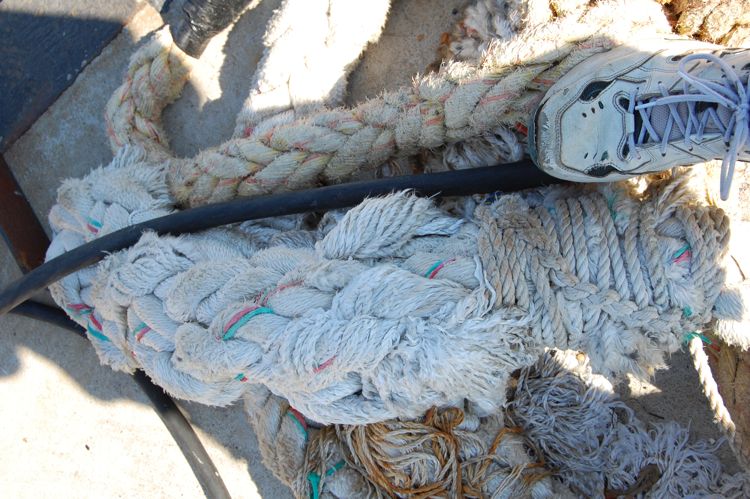
Whippings?

I borrowed Budworth’s “The Ultimate Encyclopedia of Knots & Ropework” at the library a couple of days ago, and I was amazed to find that he shows several ways of making a “Whipping”, none of which is really worth the while. Only in a secondary paragraph on the “Sailmaker’s Whipping” does he mention that “in braided rope” it can be sewn. Budworth writes “wrap neatly and tightly”, but fails to convey that “tightly” should be really tight; if wrapped as in the images in the book, it serves little more than a napkin ring.

There is in my opinion only one whipping that merits its name, and that’s the palm and needle whipping, which is also the first method described by Brion Toss in “The Complete Rigger Wire and Rope”. Most of what I see on the web as well, when it comes to knotting and other rope handling is without whippings. Am I the only one to always make palm and needle whippings, sewing through the strands?

http://igkt.net/sm/index.php?action=dlattach;topic=2225.0;attach=2310

I do sewn whippings when I chase a classic look. For general use I embed a bight with which I pull the working end inside after finishing. Then again, I hardly ever do practical stuff. But on those rare occasions, I backsplice.

I mostly heat seal rope ends.

Hi Ink,

Well done putting a sewn whipping in place each time! A worthy endeavor and one that I also follow. An interesting point that I would like to make here about whippings on laid lines - most, if not all, book references to whippings show that whippings are made against the lay of the line. I have never understood this until I came to see that those old salts took a whipping to be a merely shortened serving over the line and therefore followed the mantra of ‘turn and serve the other way’ without applying too much common sense. I have tried, and I now recommend after literally hundreds of trials and at least a dozen years of practical applications, whipping the ends of laid lines WITH the lay. This does two things:

It tightens the end of the line as the whipping is being applied, keeping the whipping secure
It produces a better working stitch in the wormed portion of the whipping

If anyone has any reasoned and practical advice to the contrary of this (I found that common whippings came undone rather readily when wrapping against the lay and I thought I was applying them too loosely) I would like to hear of your experiences.

SR
PS (BTW - in my first book, The Complete Guide to Knots, I make particular note of this phenomenon and, as far as I know, I am the only author ever to do so)

After a search on Wikipedia the other day, I saw a whipping with the lay and got confused. I don’t know where, but I am almost certain I have read somewhere (that I can’t find, I tried) that the whipping should be against the lay. Something in the back of my head says that whipping against the lay makes the natural lay, when relaxed, trying to tense the whipping. If ever I can find the source, I’ll try to post it.

I was about to “correct” the Wikipedia article, but I can’t guarantee that I haven’t dreamed it up …

Never tried to do it with the lay, but in a way it does make sense to do it against, considering that the wrapping is very tight, and the twine is tensioned. Then it has a tendency to pull the lay tighter, although that might be of minor importance.

For braided line it won’t matter of course.

http://igkt.net/sm/index.php?action=dlattach;topic=2225.0;attach=2312

I.p., he presents : Common, “Perfected”, West Country, & Sailmaker’s whippings.

... none of which is really worth the while.
???

Why do you dismiss these whippings?

(Missing from his set is the venerable “French” version which is a
series of half-hitches.)

Budworth writes "wrap neatly and tightly", but fails to convey that "tightly" should be really tight; if wrapped as in the images in the book, it serves little more than a napkin ring.

Of course, if one goes by the images in this (and many other such
pretty-photos knots books) book, all sorts of silly things happen!

There is in my opinion only one whipping that merits its name, and that's the palm and needle whipping, which is also the first method described by Brion Toss in [u][i]The Complete Rigger Wire and Rope[/i][/u].

You have quite limited yourself in skills, if that’s the case. (Well, you
deny other bindings the merit of the title “Whipping”, but don’t say
you wouldn’t employ them if lacking time & tools to do what you prefer
–point taken in that.) One certainly needs a method that works out in
the field, w/o handy tools, however that might be viewed in the grand
scheme of things re titles.

What I see of commercial-fishing gear and much other stuff is not much
whipping beyond “electrical” tape (black), which seems to work well enough.
And some of the fancier whipping often is lacking tightness. Your work,
e.g., appears what I might call “medium tight” (but I don’t have the benefit
of holding it in hand, etc.).

I tend to whip ropes using a modified Strangle knot with a sort of what
Budworth above calls “Perfected” whipping for a tail bight. I orient my
stock of whipping line with short end, stoppered for purchase, towards
the rope-to-be-whipped end, and finish the Strangle with TWO overhand
buried crossings of this end with bight of the (endless, say) material; the
I will “Perfect” whip with that bight end, hauling hard and then trimming
at the rope-end side of things --both literal whipping ends are here.
(Yes, this end-bight method requires that either the rope be short enough
to pull it all through the Perfect whipping wraps, or that those are brought
out around my store of whipping line (might be a clump of masonline or
monofil fishing line).) I have sometimes reversed this orientation (which
makes the finish easy, but the tightening of the Strangle trickier).

I haul the strangle whipping hard, and iteratively compress it in hopes
of distributing tension of wraps more evenly (it will be concentrated at
the two ends) --with pliers, or some striking object or other pounding
(this might equalize a bit simply by letting tension escape, I admit).

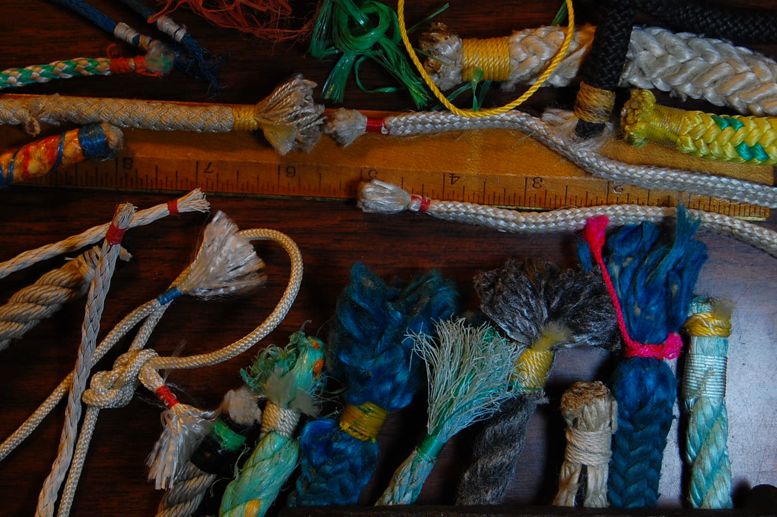
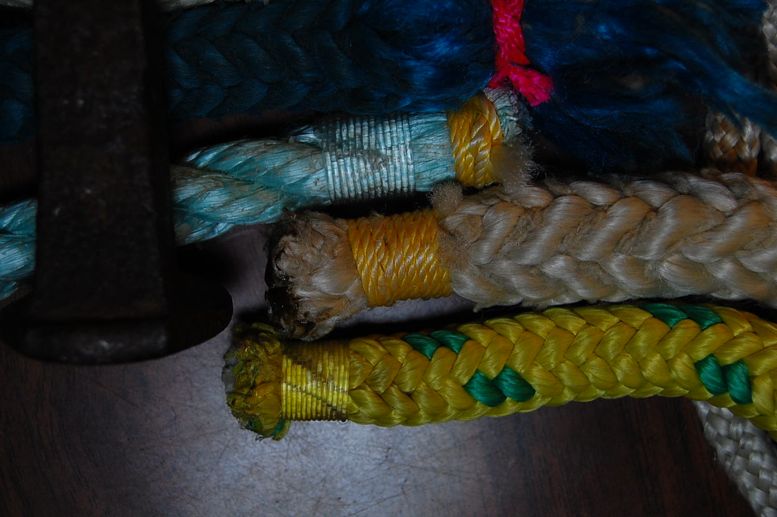
Attached are some photos of various whippings. Besides what I’ve just
described (look how tight the masonline & monofil is!), I use the fibrillated
strands of polyprop/ethylene twine to fashion whippings with series of
half-hitches & reverse groundline hitches; this material is relatively strong
and so flat-thin that structures with overwraps bulk hardly at all.
Sometimes I embed material through the rope/cord to help secure it
on the material against being pulled of (say in fiddling/untying knots).
I also use the constrictor and esp. the #1253 variation.
And I’ve played around with alternating half-hitches & overhands, thinking
that the each makes a better nip of the other’s feed (end) into it ; eh, this
might be more illusion (delusion) than reality, but it still seems adequate.

I once found some com-fish. quarter-inch rope that appeared to be whipped
with a constrictor --darn tight-- but it turned out to be a clove hitch with
ends further half-hitched, hauled tight.

–dl*

[edit to add …]

postscript

I should mention that the golden masonline whipping on the blue
(CoExtruded (“copolymer” --misnomer, strictly) PP/PE “Polysteel”?)
flat-fibre (5/8"?) rope was put on after the bit of extension of this
rope past the transparent monofil whipping showed itself to be
too much of a pain in impaling me or otherwise making knotting
fiddling difficult ! Rein in that stuff, give it the WHIP !
I do know other methods, and I have tried them, which is why I discard those other ones. Of course, YMMV, and I have worked a couple of years as a rigger in Benn’s in Stockholm, where we always made palm and needle whippings on all our work for customers.

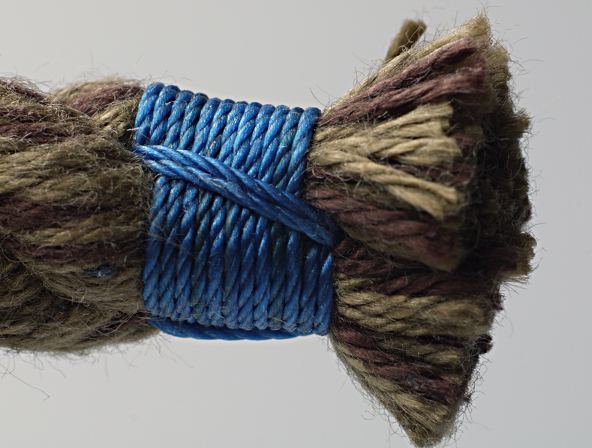
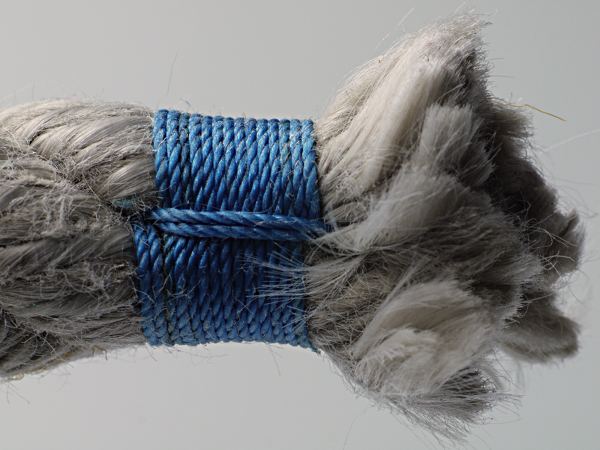
The images below is a flute that I got in Bolivia in 1972. It is a very good flute, with a mild and strong tone, and I was sorry when it cracked, but I fixed it with monofilament fishing line, with the “Common Whipping” first described by Budworth. I learned it as a wolf cub about 1955, but later I found it not very durable for rope. In the first post, the rope in the middle, the 8-plait, has been in use for about twenty years.

Of course, if I don’t have tools at hand and need to secure an end, I use a knot, mostly a double constrictor, but later I go over it with palm and needle. Usually I do it with spun nylon fishing line, the blue whipping in the first image is such line. I pull it tight till I fear I will break it, and then I hammer it a bit when it’s done, to round it off. The three mm stuff is whipped with polyester sewing thread, but that’s more for the looks. I couldn’t pull it very tight, because the thread isn’t very strong.

I should add that when I use non-strangle whippings that are some
how a series of half-hitches, overhands, or reverse groundline hitches,
I now finish off the end with an overhand stopper set as snug to the
whipping as I can get it (and I favor the overhand precisely because
it can be set fairly snug),
as I’ve seen unstoppered cases eventually start to (un)ravel.

“couldn’t pull very tight, because ” : this is a problem
with the smaller lines, which have the smaller & weaker whipping; and
thus I will seek to embed the material somehow.

Although polyester seems to be the more commonly recommended (yes?)
whipping material (it has maybe the best UV resistance), nylon offers
stretch AND contraction by wetting (which I think is one of the helpful
things for binding cord structures --it’s not that the stuff is tied so
tightly but that it gets wet and shrinks 10% or so!).

I like putting the littered PP or PE binding twine fibres to use,
and have also used strings from tea bags on some things ! :smiley:
Going in the other direction (i.e., thicker rope), I’ve used twin
masonline whipping, and some thicker cord.

I, too, have employed whipping in non-conventional settings : one plastic
grip on scissors was broken/loose, and along with some glue I put on
whipping, first w/tea-bag (or other) cotton string, to give some better
frictional foundation, then with that thin-but-strong fibrillated PP twine.
And, electrical tape around a splice in some electrical cord got some
whipping to keep it on (as it had started to peel loose).

Btw, I once thought that whipping offered a means for rockclimbers to
mark the centers of their ropes, which is helpful in setting up abseils;
but whipping puts such constriction on the rope that it doesn’t bend
well, and so it would cause problems in belaying. (Some climbers sew
in dental floss.)

And then --see attached photo-- there are cases I think you’ll find that
don’t lend themselves to palm-&-needle, but for Paul Bunyan … !!

–dl*


I came to think of it; in the video, where I make an eye splice, http://www.youtube.com/watch?v=CM5cLpkW3x4&feature=related, I have prepared the line to splice, by putting constrictors on the individual strands, and then on the reassembled end. It can be seen a bit into the clip how I cut the constrictor to open up the strands of the rope. The sound is in Swedish, but it might be interesting to see the start of this splice, which is the same as Brion Toss presents as “Pro Splice”. (There are step by step instructions at http://web.comhem.se/~u77479609/eyesplice.html.)

Usually when I do an eye splice, I don’t make any whippings at all; they are there only for the demo. The individual images in the step by step instructions are more relevant. As the line is passed entirely first, there’s no need for any stopping where the line is to be opened, it stops naturally where it emerges from under the strand of the rope. The video is slower than the splice usually is done. Neither the video nor the webpage show any thinning; I think I’ll make another set of instructions and another video for that.

http://web.comhem.se/~u77479609/images_eyesplice/03_eyesplice.jpg

My poor eyes see no whippings on the site link pictures.

How well do the plastics thimble hold up?

The temporary whippings are only on the videoclip.

The plastic thimble, polyamide, is crap imho. Nevertheless, there are many people that want them. They wear rather fast, and they cannot stand high loads. After a couple of seasons with lots of sunlight, they get brittle. Maybe I shouldn’t have used it, but metal thimbles aren’t a lot better. They do protect the rope better, as if the load is too high, they just deform, collapse, but they will not even in collapsed form chafe the rope.

These are mostly used for mooring lines, and mooring lines are usually much stronger than the loads they are exposed to, and even these plastic thimbles can withstand the normal powers in mooring, if there are no sharp jerks. But a galvanised or rusty loop on the jetty will wear through the thimble, while a knot with an extra round turn or a cow hitched long eye would not be chafed. People often think higher of what they are used to than what is best for the purpose.

Just an example of untraditional use of whippings :wink:

I was supposed to use this lighter on the mountain to light my portable stove (primus) http://upload.wikimedia.org/wikipedia/no/2/24/Fm8.jpg

The lighter is very thin, the wheel and button are small and the handle is very slippery. Not ideal to use with cold and stiff fingers.

My solution was to make a sailor’s whipping to make the lighter thicker and less slippery.

And a West Country whipping would have provided even
additional roughness for grip, but the problem I have
with the WC variation is that it requires a good guess of
material length, or starting with two sources of whipping
knotted at their ends (to be worked as needed and then
able to both be neatly tied off & trimmed) --or else waste.

Similarly “untraditional”, I have replaced the lost /worn-away
rubber “foot” of clip-on sunglasses with tea-bag-string whipping
for padding the metal leg’s contact area w/glasses.
(And so I’m probably the only one with such adorned clip-ons!)

:smiley:

Thanks for acknowledging my seemingly obsolete routine.

I tried making a whipping with the lay now, and I am not convinced. As I never did it before, I had no idea what the outcome would be, but after hammering to even out tension, I noticed that a distortion that I hadn’t experienced before had occured. It seems as when the tension in the wrappings is released by the pounding, it contracts, and then the worming, or frapping, parts are not tightened, as when it’s done against the lay, but they take a shorter route over the wraps, thus with less frapping action. When the tension of the wraps distort the frapping in the whipping against the lay, it gets more tensioned. I think I will stick to what I am used to.

Edit: I made a third picture after putting one of my usual whippings on that same rope. This is what it looks like after some pounding. The one that is done with the lay maybe is good enough, but I think against the lay is neater.


against the lay.JPG

with the lay.JPG

Hmmm, I thought that Ashley’d recommended such direction for whipping,
but as it appears to be only as you report of other books --it is shown but
maybe not verbally specified!? (I’m also now surprised that whipping doesn’t
appear in [u]ABOK until p.546 !)

I have tried, and I now recommend after literally hundreds of trials and at least a dozen years of practical applications, whipping the ends of laid lines WITH the lay. This does two things:

It tightens the end of the line as the whipping is being applied, keeping the whipping secure
It produces a better working stitch in the wormed portion of the whipping

If anyone has any reasoned and practical advice to the contrary of this (I found that common whippings came undone rather readily when wrapping against the lay and I thought I was applying them too loosely) I would like to hear of your experiences.

If you notice my Extended Strangle + Sailor’s Whipping (finish) in
my 4th/bottom photo --the close-up of two whippings, in monofil & mason line–,
the buried overhand crossing of the ends lies in the groove between strands;
the right end of the strangle-knot part is 4 wraps from the right side. Those
4 wraps are of the sailor’s whipping finish, whose effective end lies in the
groove below & out of sight here. At the 5th wrap from the right is where
the strangle ends with one leg of the bight-end (here the bight-end was put
on the rope-end side, more difficult to work with, slightly, IMO) wrapping
away, against the lay, opposite the strangle’s wrapping with the lay.
Note that, however, in my usual orientation of setting the stoppered (for
tightening purchase) short whipping end towards the rope end, one wraps
around against the lay.

.:. In the end, either way, one hauls the strangle hard tight : I don’t see
that it will matter how this whipping’s put on --it will be very tight.

Btw, with mason line, I find that 4 overwraps is mininal to cover the double
overhand crossing that is buried, and 6 starts is about the limit before one
starts to seem too many; with monofilament, the crossing must be more
extended (stiffer), as 8 wraps seems about right (and is what is shown
on the blue CoEx rope --to which the sailor’s whipping finish adds another 4).

Lindsey’s rationale seems reasonable. I’m surprised at Ink’s test & finding
of a difference, given tightness of his setting. (That blue rope is likely
more independent, as the CoEx is stiff and holds its lay.)

I have come to doubt the effect of frapping turns – they might bear
hard on the very edges of what they wrap, but otherwise they can
have little pressure on all internal wraps they “frap”. AND, further,
in the case of laid rope, if they are able to hold the whipping’s wraps
down into a groove of the lay, then that whipping must be WAY WAY
less tensioned than anything I would put on --there is no pulling down
the span from strand-top to next-strand-top of a tight whipping’s wraps.

With a lot of “play ropes”, I have lots of chances to explore different
whippings --in form & material (esp. with the flat strips of PP twine).

–dl*

Hi Ink,

I notice that in all three of your whippings the first turn around the line does not seem to pinch or nip the line , thereby reducing its diameter. Did you start at the standing part and work toward the working end or did you start at the working end and work toward the standing part? As a comment, I am interested in your method of applying a whipping by ‘hammering to even out tension’ - what tension are you referring to and why is it being hammered? I have always applied my whippings tightly by hand and have never had to resort to hammering. I’ll try to post some close-up photos of my own whippings for comparison.

SR

I start from the standing part, and I pull as tight as I dare. The pounding is not really needed, but I have mostly done it, as a habit, but sometimes I dont care to do that. it becomes a bit rounder after pounding, and it also shrinks a tiny bit. Maybe it is the elasticity of the polyamide that gives a bit at the ends of the whipping.

The turns are tight. I have tried to make as in the ABoK #3446, but the needle will not pass diagonally when a whipping is tight, so the stitches are per #3447. Formerly, I used a single twine, but after working at the riggery, I always use doubled, as that’s what we did there. The twine we used at Benn’s was sailmaker’s twine, same type as dental floss but somewhat larger, waxed polyester floss. So far, none of those whippings has come loose. On the line that I used for the last samples, there was still one of those old whippings from twenty years ago, that I now cut away. The frapping was worn through, but it was still firm. That’s the one on the picture below. And no, I didn’t whip the thinner line.

http://igkt.net/sm/index.php?action=dlattach;topic=2159.0;attach=2210

Me too, but I should learn whippings for the knowledge.

When I worked in the riggery, I made lots of tailsplices, wire to fibre rope. They are still rather popular here, and sometimes people wanted to change a tail that they thought was old. Hence sometimes, rather good rope was destined for the dump, but I have always had an economic mind, so I saved quite a few of those discarded tails.

The one here is one that I salvaged from a halyard, and that I have used as a sheet for about ten years. It is rather stiff, and I made those whippings in 1989. The wax in the twine is long gone, it has not only seen sun and salt, but also the washing-machine several times. The rope is 12 mm double-braid polyester, and I guess that the first owner had it for at least ten years before he handed it in to change the tail.