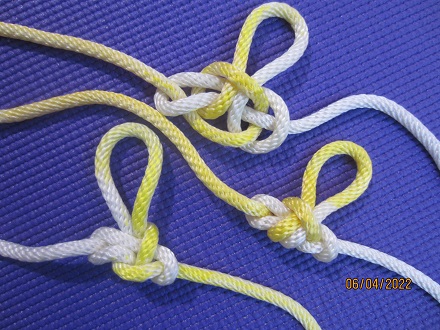
Yet another midline eyeknot

… and that’s a SINGLE --not “bi”-- axis, yes!?

Not by my definitions
? Curious... #1053 Butterfly does not involve a unification of 2 separate ropes (a rope join) - the knot is formed from one rope (and is TIB) However, #1053 derived Butterfly bend does have a unification of 2 ropes (ie, an 'end-to-end' join) This concept seems simple enough to grasp.
Again, in seeing knots as arising from tangles, I put a cookie-cutter ring around the knot ("nub") and count all parts leading out of this as "ends"; so, a "joint" is a knot of 2 pieces of material, canonically 1-2 & A-B, where 1 is loaded opposing A and 2/B are unloaded (and an eye knot of this tangle includes 1 -vs- 2+A, and so on). (And the joined parts need not be --cookie cutter blinds lifted-- separate lines, as you know.) .:. It's a formality, working from *tangles*.
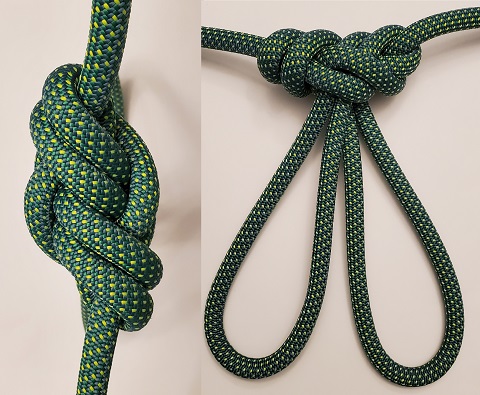
Some math wizards who addressed this term came to the conclusion that it is, rather BI-axial; I'm happier with some note of *three*, and maybe thus "3-way". Be that as it may, the [b]abused [/b]term

Tri-axial is a natural extension of Bi-axial.
I don’t see that as an ‘abuse’ of terms.


The abuse is in treating the situation as being
“triaxial” as you do --they insist that this 3-way
loading springs from 2 axes, not 3.
–dl*

I am not a moderator but…

I am of the view that further discussion about loading profiles should be directed to a new and separate topic post.
This thread has drifted too far from the content/subject of the original poster (tsik_lestat).

I see some aspects of loading profiles as conceptual (and developing) - rather like knotting terms (eg ‘eye’ versus ‘loop’) - and always open to interpretation.
For me, I find it easier to conceptualize mid line eye knot loading in terms of axial, biaxial and traxial. But, probably best for another topic thread elsewhere…

A TIB Ashley’s Bend (1452) Double Loop

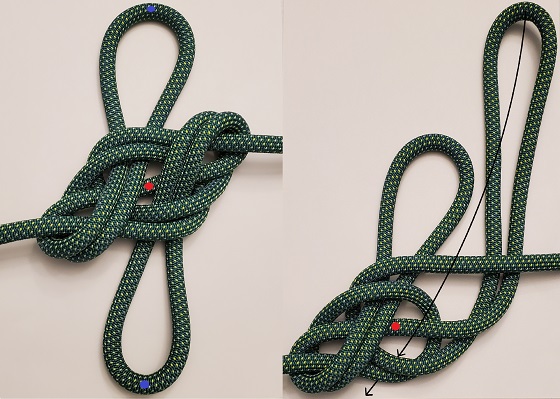
As shown in its “Dressed” state below, this is only one of a number of possibilities for producing axially symmetric TIB Double Loops from the Ashley’s Bend. As an example, conceptually, the working ends of the bend can be extended and made to follow (“railroad track”) their respective ropes back toward their respective standing parts to various degrees prior to being “fused”. If we are producing axially symmetric TIB Double Loops, the “fusing” of the working ends will always be at the axis of symmetry. As shown in the “Loose” state below, this point of “fusing” is at the red marker. The Ashley’s Bend can be recovered from this Double Loop by removing that section of rope in this Double Loop between the two blue markers and which passes through the middle point (red marker) located on the axis of symmetry, see the “Loose” state below. In this example, the working ends/double loops are tucked akin to ABoK 1406.

Alternatively, as noted by others, one can start with two bights of the same rope and tie any bend, all of which will be TIB Double Loops. Or, one could start with two ropes each of which has a loop as its working end and tie any bend. This is not unlike the “slipping” of a knot where one uses a loop instead of the working end for the final tuck. Once the completely “slipped” bend has been tied, the working ends can be fused (conceptually) to finish the TIB structure. The advantage of starting with two ropes and two loops is that the weaving of the working ends may be modified to investigate different TIB structures. One can also use one loop and one working end to tie a bend and produce a single loop, some of which may produce asymmetric TIB structures.

As a guide for the “fusing” process, for axially symmetric bends like The Ashley’s, Carrick, etc. the axis of symmetry is void of rope. Their symmetric TIB Double Loops will have just one point of rope on this axis, that is, the point of “fusing”. For bends with central inversion symmetry like the Thief, Zeppelin, etc., their center point is void of rope. Their symmetric Double Loops will be “fused” at this center point.


TIB Ashley Bend Dbl Loop Dressed.jpg

TIB Ashley Bend Dbl Loop Loose.jpg

Thanks DDK,
Very interesting new line of thinking.

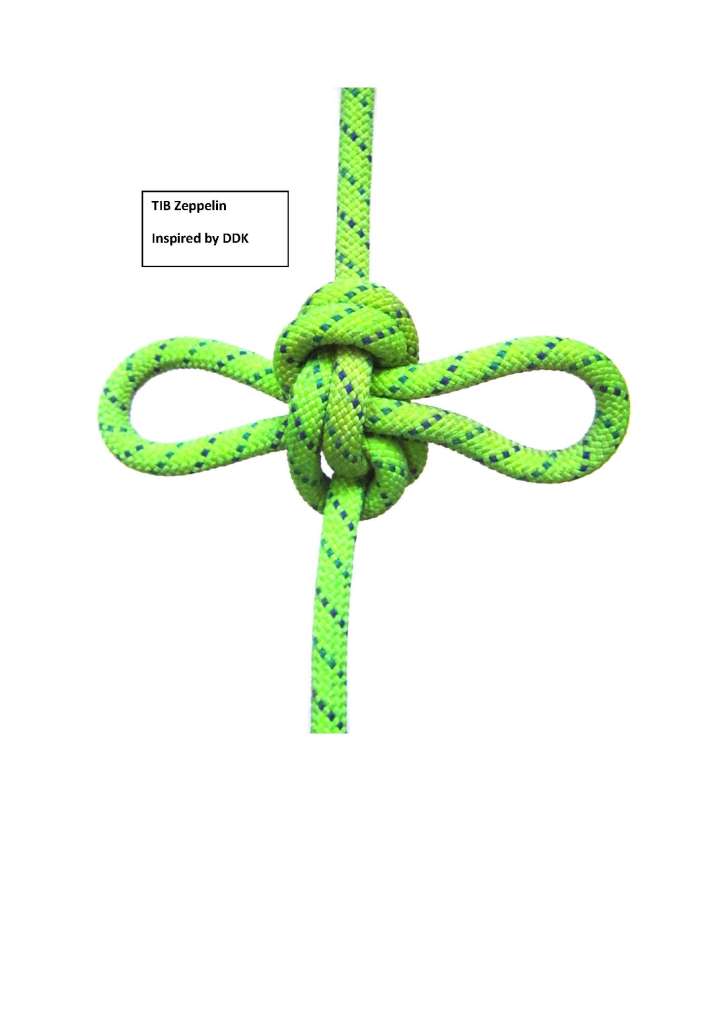
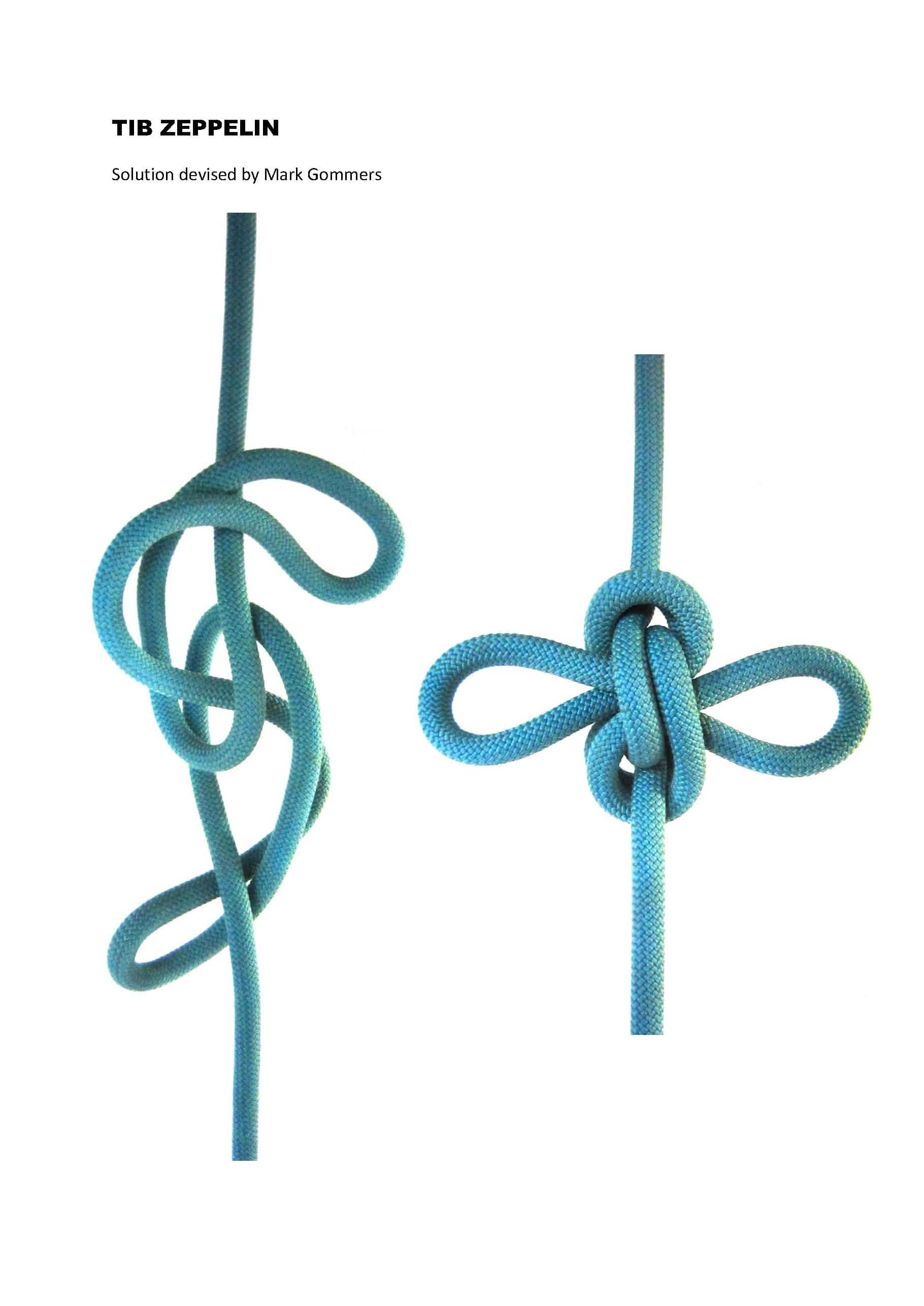
Am now applying the concept to a TIB Zeppelin (I previously had simply tied the Zeppelin bend with bights).
When applying DDK’s concept to the Zeppelin…the residual rope segment existing between the bights needs to be resolved in a simple and efficient way… (ahhh..think I’ve solved it!).

I wonder if Xarax is right now launching into a new line of new discoveries?

EDIT NOTE:
Hopefully Xarax is asleep in Greece and I beat him to tying and presenting this TIB Zeppelin?
See image… :slight_smile: :slight_smile:


Zeppelin_TIB.jpg

ZEPPELIN_TIB_Tying_WEB.jpg

Thank you all gentlemen for your valuable feedback and contributions as well.

Agent_smith, i am also dying to see a TIB Zeppelin like structure, tied in the way DDK is advancing, and i am working in that field too.

I have also tied a similar structure like the one you have attached, (after DDK’s post) but is it going to jam if loaded from the bights? I’ll have to give it some thought about the best loading profile.Maybe, you could provide a loose state? Thanks.

DDK, perfect quality photos.

Right now, it’s 12:00 noon in greece, i doubt, if Xarax is asleep… Beware!!! :slight_smile: :slight_smile:

@agent_smith

Nicely done.

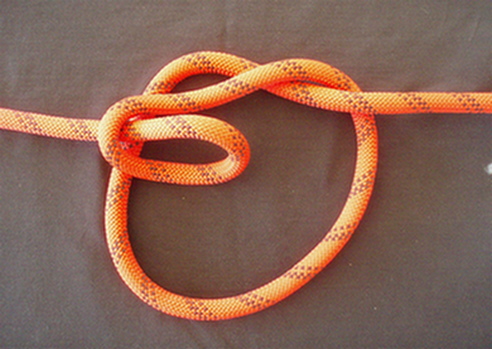
Central Inversion Symmetry bends are my favorites. I notice with some of these TIB Double Loops that the two loops “communicate” fairly easily as there is not much friction on the rope section that joins them. I guess a salesman would call that a “feature”. :wink: The Thief Knot has a nice solution with seemingly less “communication”.
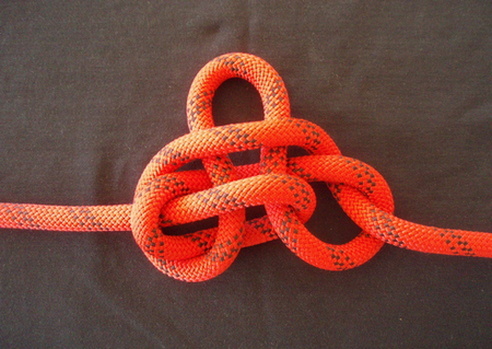
@tsik_lestat

Thank You.

Just received from Master Xarax - via special instantaneous courier from Greece:

I like the general way DDK describes his method ? because I like methods, I guess ! This reminds me of a few other instances, where we had discussed something like that in the Forum. 1. Starting from a stopper, any stopper, and doubling the line ( i.e., following it with a second line, or just turning back the tail(s), and re-tracing the nub ), we can arrive at a symmetric bend ?based?, in a way, on this stopper ? and vice versa, of course. I have noticed that this procedure might had led to the Zeppelin bend in the first place. DDK now notices that something similar can lead, from a symmetric bend, any symmetric bend, to a double loop ?based? on this bend. 2. Replying to a solution to the midline-to-midline bend problem, offered by knot4u, I had noticed that : ?Due to their high symmetry, many of the TIB single or double loops are very interesting knots, and they can be used as bases for loops and bends, as you have noticed.?

https://igkt.net/sm/index.php?topic=3020.msg21724#msg21724
https://igkt.net/sm/index.php?topic=3020.msg21727#msg21727

DDK now reminds us that the exact opposite is also true.

Also this link: http://igkt.net/sm/index.php?topic=3020.msg21737#msg21737

And so it seems Xarax had been exploring these concepts at least as far back as 2012.
However, it seems he didn’t figure out and present the TIB mid-line Zeppelin?
Although it is interesting, I find that it has a large footprint and isn’t easy to tie (even after tying it multiple times, I still have to fiddle and think and fiddle…).
I don’t think these type of knot structures will gain widespread popularity - and will likely remain in the realm of knotting enthusiasts!

IMO, this is better used qua "twin eyes",
the point being that if an eye is loaded in isolation,
it can collapse-contract the unloaded collar; but
with both eyes loaded (as one), that that collars
the then-effective SPart will not extend so much
and deny the other eye from doing so.

[edit 2021-07-12]
The red text is confused.
What I mean to say is that with loading the two
eyes together then the eye pulling on the collar
of the UNloaded end/through-SPart
will not be able to pull down & tighten the collar
of this unloaded end/SPart --the security of the
other eye, whose SPart is loaded now, will inhibit
the extension of the twin eye.
[end edit]

Yes, this is a neat way to doing such multi-eye
knots from some of our familiar ends joints.
(In a somewhat similar manner, one can form
single-eye knots from #1408, …, but getting
an asymmetric knot (one side d/double, the
other single, collar(s)).

Thanks,
–dl*

Indeed, Xarax and Dan_Lehman, had already shown through their constructive debates, that they had a firm grip on this double loop generator concept, advanced by DDK.

Relative quote by Xarax and Dan_Lehman…

Quote from: Dan_Lehman on February 12, 2012, 05:15:14 AM
One can, e.g., elaborate on Ashley #1408 & 1425 (and more) schemas, out of the *middle*, for interesting "twin-eye" knots --as I envision them (where the two eyes are roughly adjacent and used qua one, so to get assured behavior when loaded in either direction (as contrast w/e.g. the butterfly's asymmetry)).

That is something very interesting, which had not crossed my mind till now…We tie a symmetric bend - any symmetric bend - with a double line. Then, we connect the two lines/tails of each link, to make two bights. Then we connect one standing end of the one link to one standing end of the other link. We thus end up with a TIB double loop. ( Equivalently, we can also make the two loops in the reverse way, by connecting the two lines/standing parts of each link, and then form the TIB knot by connecting one line-tail of the one link to one line-tail of the other link.)
Ouaou…Many new possibilities emerge…I knew that the double midline loop chapter would be quite long…

https://igkt.net/sm/index.php?topic=3783.msg22136#msg22136

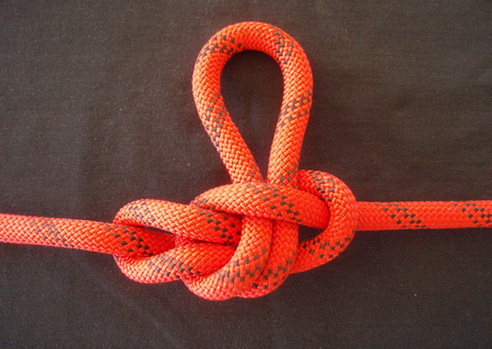
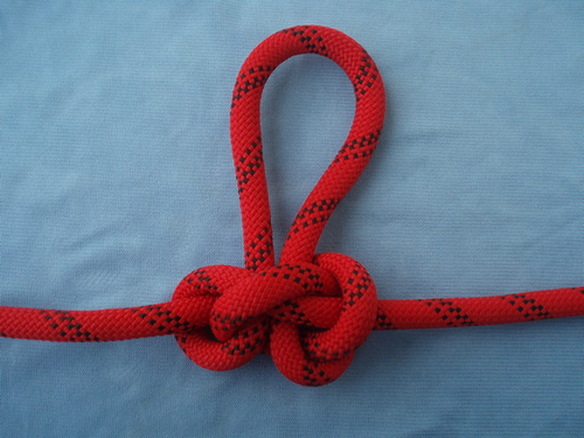
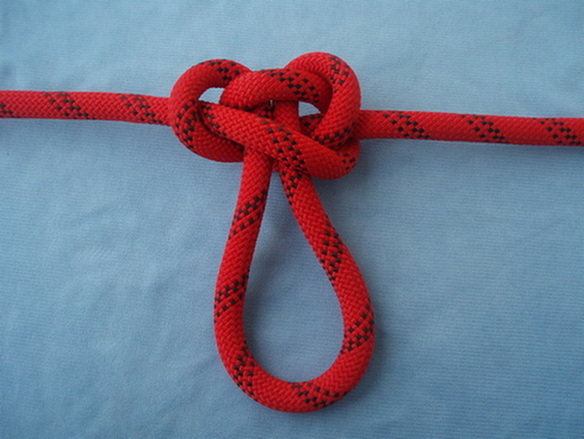
Getting back in the single loop inline concept, i’d like to include a TIB tying method of the midline, eight-like knot at reply#36, as i’m highly satisfied with its very stable, jam proof, BTL profile.

Things might be tricky with the eye loading profile, especially with respect to the crossing knot Spart continuation, but it works properly when tri-axially loaded in anchor applications.(loading from the other Spart appears to be a more stable approach).

  1. Form a crossing knot and a reversed S loop. The loop will be the final eye so it’s good in this stage to adjust its size (first image).

  2. Pass the rightmost SPart loop continuation under the crossing knot (second image).

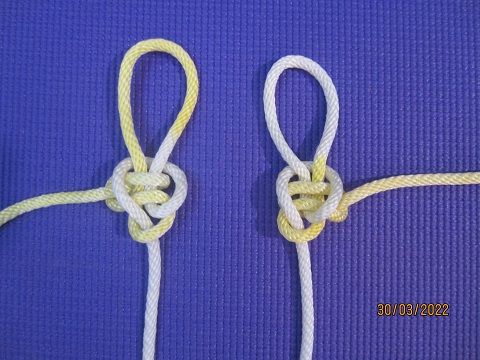
  3. Pass the loop (bight) through the crossing knot and under its continuation, in particular over, under, over, under (third image).

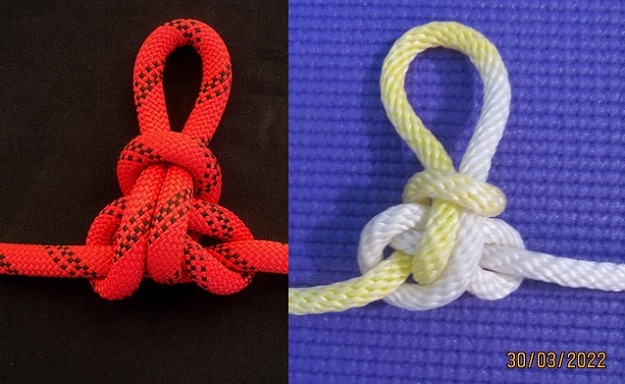
  4. If you load the knot from the SParts, it will rather reshape to take the form of the fourth image, which is more preferable to me. I think the corresponding asymmetrical bend, will work too.


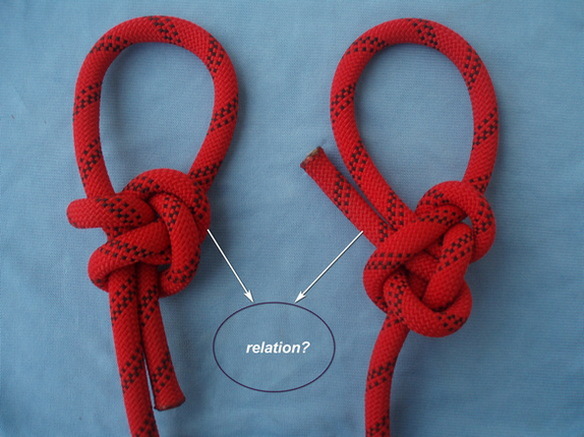
What is the relation between first image secure bowlines?

The answer is not so obvious, because besides their cowboy-like, bight structure orientation, there seems to be no other geometrical resemblance at their core nubs.

The leftmost one is a larkshead based, janus-like TIB bowline, with parallel SP, tug end orientation, while the other one secures the tug end by placing it side by side with the on-going eye leg, under the SPart (non TIB).

The answer is that they both point to the same inline knot, as shown in the next three images.

In a topological sense, one has to work the TIB bowline variant in order to transform it in the depicted inline configuration, while the other non-TIB bowline knot, is just another loading profile of this very midline structure.

It was its ultimate extend of stability in every loading direction, that made me include this inline knot in this demonstration, comparable to, dare i say, that of the butterfly knot.

However, there is a disguised overhand lying there at the complex link, which is rather expected to affect its jam resistance, especially in the eye loading direction profiles.


Hi All,
I have two loops here, may be ok I hope, just don’t have time try to find a way to tie it with the bright yet.

      Have a look at Greg's knots, I suggest we should give a 180 degrees twist on the bright and let it side in
      in the right place, hopefully it can improve it little more this way. 
     
      Hope we have a peaceful world, and God bless us. Thanks.

Midline loop  1  &  2.JPG

munter_midline 2 side B.jpg

    Two more loops here, I think is fine too.  Thanks.

Just tried one of them, and indeed it looks “fine”
–Tugboat BWL-ish SPart curves, and staying
easily loosenable.
Nice!

:wink:

Hi All,
I have a few more very interesting midline loop variations here.
I think it is another step closer to what I am dreaming of.
There is a lot to do here. I will do it a little bit at a time. Try again tomorrow.

      Dan, Thanks you very much for replying and glad you like it.
      Thanks.

Hello Alan, i do welcome your valuable contributions!!!

Indeed, it appears that the knotting scheme {overhand/figure eight + crossing knot} can be synthesized in multiple ways to form various TIB profiles, tied in the middle of the line (or tugboat style knots because you leave a short tail).

I’ m calling to mind that the overhand or the figure eight, are in the form of (crossing knot + nipping turn).

I used to tie them with parallel eye legs, but i do like your dressing too. SParts ,do not appear to have an axial alignment, but the BTL loading, is a bit more stable that way.

Having tested only the end of line structures, even from the figure eight/overhand component side, i’m confident to claim that i wasn’t able to induce any jamming. Hopefully, the same stands for the inlines too.

Having tied all of your variations, i’d like to add a very easy " in the end", tying method, for those familiar with knots like flash bowline or single dragon.

One can tie those knots in a slipped form (first capture SP, then feed a bight through the crossing knot), passing then the working end down through, or up through this very bight, without disturbing the tibness, in order to form either an overhand or a figure eight or an unknot component.

Best loading option for me, is to keep both Sparts under tension, and load the eye too, in other words tri-axial loading.

      Hi Greg,
                  Thanks for replying. Here is how I tie these knots. I think it is easy to tie and easy to inspect too.
                  Thanks        https://www.youtube.com/watch?v=ibCawU1N9h4&t=116s&ab_channel=alanleeknots
                                    https://www.youtube.com/watch?v=0VX67PU362c&t=114s&ab_channel=alanleeknots

Thanks Alan, these links are just fine.Quite easy to follow through and inspect TIB tyings methods, illustrating distinctly the TIB route.

I was kind of sceptic about the angler’s variation loading it from the angler’s overhand side, and indeed, it was quite difficult to loosen the knot, as expected.

In my opinion, the continuations of both collars should be under continual tension when the knot is loaded, for best performance, and the best way to achieve this, is through the end of line profiles (the Sparts change into eye legs).

I strongly recommend, knot enthusiasts, to re -examine/evaluate the attached structures, for their functionality.

My personal test data, show that they are jam proof right up to their MBS yield point, resistant to cyclic loading/slack shaking, with an adequate level of security.

  1. https://igkt.net/sm/index.php?topic=6961.msg46034#msg46034

  2. https://igkt.net/sm/index.php?topic=6622.msg44093#msg44093

Hi, Greg,
I have another midline loop here, may be ok, have not a test on it yet.
You had tie many of these type of loops, just to be sure, so I check on your knot on my channel.
a surprise!!! surprise !!! I find you Tugboat midline loop. Wow, very interesting scenarios.
Amazing this Tugboat and Anger also can turn into more midline loop variations too.
The add-on Overhand knots are good too, I assume it can hander a lot of weight,
I know it will work, because I had tie Overhand knot with this situation, and it can hander more weight.
Thanks.
https://www.youtube.com/watch?v=Ws1WDnvOHVg&ab_channel=alanleeknots


Midline   Loop -.JPG