Hi All, I have 2 videos here, hope you like it,
ABOK # 1074 https://www.youtube.com/watch?v=FN42aesI_B8
ABOK # 1035 https://www.youtube.com/watch?v=CH6bFvlOmxM
謝謝 alanleeknots
I’m glad to see I’m not the only one who uses a coil on the hand method for the Perfection Loop. My method/approach is pictured here for reference:
https://notableknotindex.webs.com/perfectionloop.png
I wonder if the loop was originally stumbled upon by such a method. It seems so natural.
Hi All,
roo, Thanks for sharing your tying method, yes the coil on hand method, it seems more natural to me too.
謝謝 alanleeknots
Nice work again Mr Lee 
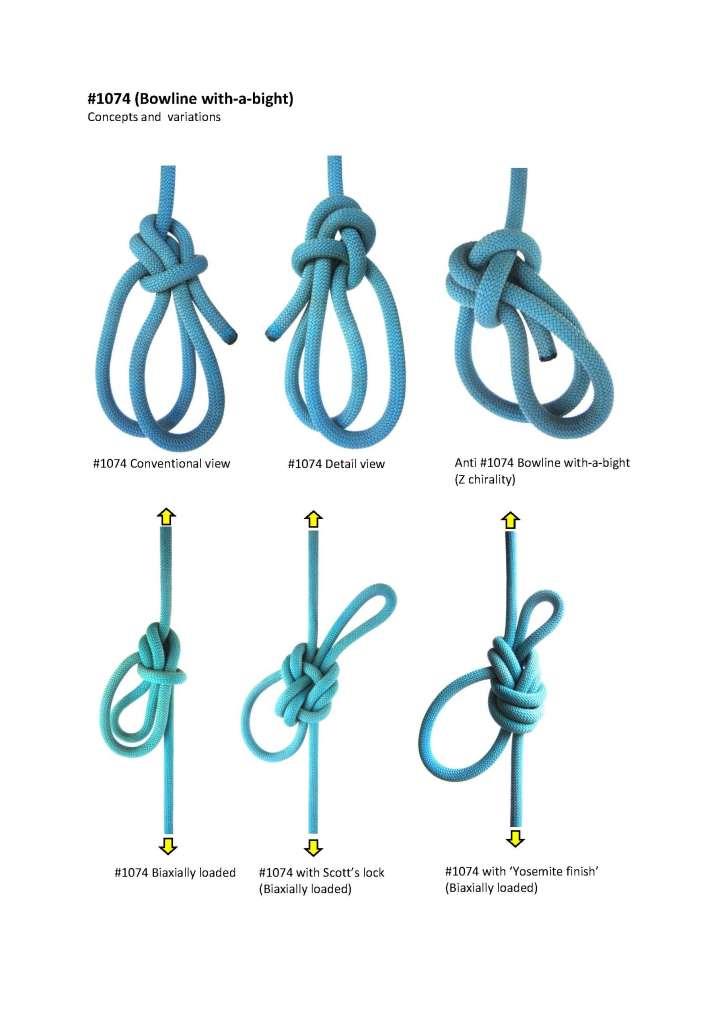
I am very interested in #1074 Bowline with-a-bight.
There hasn’t been a lot of attention given to #1074 over the years…and I think it has some remarkable properties.
It is ‘TIB’ and can be biaxially loaded (through loaded from SPart-to-SPart).
These properties set it apart from other ‘Bowlines’.
I was hoping that you could work your magic and come up with some creative variations of #1074?
I have already applied a Scotts lock and also a ‘Yosemite finish’ to lock down the structure - but, I’m sure many other simple/elegant variations exist.
This knot shares its name with #1882,
but that knot shares its geometry not with #1074
but #1016 --which is nameless.
I suspect that the rationale given for #1074
is what motivated the inclusion of the other knot(s)
into those old works, and that the illustrator got it
wrong --and nOnElse bothered to correct it!
That rationale for #1074 is that an eye knot that
takes a hook from a tackle (or any other…) for
a hard pull should have double bearing (= 2 eyes)
for easing wear. And then the other, singlEye
knots are said to have been recommended for
just such with-a-tackle use!
–dl*
Ashley was right not to identify #1016 as a ‘Bowline’.
The collapsing of the structure neutralizes the nipping loop - so it is no longer loaded at both ends.
I think this is a clue that Ashley did have a notional understanding of the importance of the nipping loop and how it is key to defining ‘Bowlines’.
Although he never explicitly spelt it out.
The inversion and collapse of #1074 / #1882(a) is interesting - and correlates to #1016.
I was hoping that Mr Alan Lee can work his magic and create some new and innovative variations of #1074?
He was neither right nor wrong : he wasn’t playing the
Is this a bowline? game here, but rather unhelpfully
parroting something seen in a book --presenting IMO
a botched illustration with a supposed purpose devoid
of rationale. How can one write that recommended use
without giving a reason for it --or at least remarking at
it and opening the question?! (By omission, we might
believe that he had no awareness of the knot otherwise
–from personal observation or hearsay/interview.)
One should think that a knot deserving that recommended
strong use would have a good following!
The collapsing of the structure neutralizes the nipping loop - so it is no longer loaded at both ends.The presented collapsing of an eye ... I suspect is pure illustrator's doing, not seen in reality, on ship or elsewhere. As for "loaded on both ends", that becomes a tenuous criterion over the realm of *bowline* candidates. The [i]mirrored bowline[/i] --cow or clove base-- can be just so, the between-loops crossing span pulled out as an eye!
I think this is a clue that Ashley did have a notional understanding of the importance of the nipping loop and how it is key to defining 'Bowlines'. Although he never explicitly spelt it out.And he goes against it in his discussion at, which, #1043/45 ?! [<<--yes, it's like knots #1057...] But, yes, I think that Ashley'd be on board with much of our thinking regarding *bowlines*.
The inversion and collapse of #1074 / #1882(a) is interesting - and correlates to #1016.#1882 = #1016. (I'm not w/book to examine "a" aspect.) #1074 gives a rationale for why the others are wrong.
There are single bowlines in-the-bight by various means,
but to the extent that they mimic a sheet bend on through
loading --SPart-2-SPart, not eye–, I worry about their
slipping, or lesser strength.
–dl*
Quote from: agent_smith on July 11, 2019, 09:55:27 AMAshley was right not to identify #1016 as a 'Bowline'.per Dan Lehman:
He was neither right nor wrong : he wasn’t playing the
Is this a bowline?
True - but…I find it very interesting that #1016 begins as #1074 ‘Bowline with-a-bight’ - and then it undergoes a transformation.
Ashley wrote; “… gave this knot, based on the Bowline…” in his description.
He did not go so far as declare it to be [a] ‘Bowline’.
In my view, this is an important clue as to Ashley’s conceptualization of what [a] ‘Bowline’ is.
As you point out, Ashley never attempted to define the #1010 Simple Bowline or any ‘Bowline’ in his book. But, all of the presentations that carry the title of ‘Bowline’ in the description have one thing in common: They all have a ‘nipping loop’, or a ‘double nipping loop’ that has chirality (all with Z chirality in his book).
Note: Some of his double eye/loop Bowlines are depicted with S and Z chirality due to the nature of the knot geometry (eg #1087 has both).
The dominance of Z chirality leads me to believe that Ashley was right-handed.
I believe that Ashley did not have a concept of loop chirality.
In my view, this is one of the key geometrical characteristics of a ‘loop’ which distinguishes it from an ‘eye’.
Only a loop can have a particular chirality.
When a person ties [a] ‘Bowline’ - they will create a nipping loop with either S chirality or Z chirality.
Ashley appears to favour Z chirality in his book.
And he goes against it in his discussion at, which, #1043/35 ?! But, yes, I think that Ashley'd be on board with much of our thinking regarding *bowlines*.I would rather point to illustrations #1057 and #1058. In my view, Ashley went astray here. These eye knots are [u]not [/u]'Bowlines'. It is either a typo error or a simple mistake that wasn't caught during the proof reading before going to print.
One has to keep in mind that Ashley published his book in 1944 - before computers and the digital age.
It is a remarkable achievement - but it contains a number of (forgivable) errors.
#1882 = #1016. (I'm not w/book to examine "a" aspect.)That's my invention... there were 2 illustrations under #1882. The 'a' simply refers to the first drawing. I could just have easily wrote #1882(i) and #1882(ii) !
…
I would also point out that #1033 Carrick loop (confusingly named in my view) escaped his attention as actually being a ‘Bowline’.
I am of the view that #1033 is in fact a ‘Bowline’ based on a single helical nipping loop.
Ashley did not recognize #1033 as being [a] ‘Bowline’.
He seems to have ‘confused’ (or mistaken) #1033 for [a] #1439 derived eye knot.
Note: All bends have corresponding eye knots - I am simply referring to one of them.
Hi All,
Mark, I cannot find anything that good for bowline nipping loop.
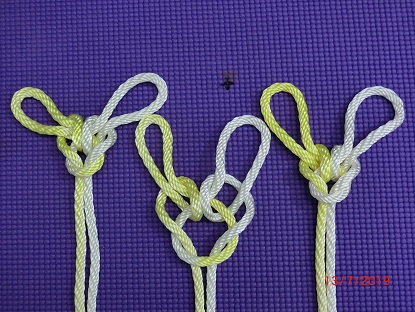
Anyway I have 3 loops here, V1 and V2 may only good for loading with both standing parts and eyes.
V3 may be good for loading with either standing part or eye.
Haven’t have the chance to test it yet.
Three videos show how I tie the loops, please see my channel alanleeknots at Youtube.
謝謝 alanleeknots
Hi All,
This class of knots is very unique, it dose look good, but it will jam, I will test it, and find it jam threshold.
also very complicate to tie too. The reason I share it with, because it does exist in the knots land library.
謝謝 alanleeknots
Another v1 variation, I don’t why I don’t like it when I see it the first time it have one rope sharp turn.
But, again, he was merely parroting something he found
–and that’s lousy of him to do so; he sometimes will
challenge others’ assertions! In any case --disregarding
presumed motives–, he (and they, so far as I’m aware)
gives no rationale as to why #1016/#1882 is supposed
recommended for the stated use. --all too typical of knots
literature, alas.
Hardly such an oversight, IMO. Rather, he simply wasn't playing the game you're so hard at in narrowly/strictly per-your-own-definition identifying *bowlines*; and in these, he felt some merit.And he goes against it in his discussion at, which, #1043/[4]5 ?! But, yes, I think that Ashley'd be on board with much of our thinking regarding *bowlines*.I would rather point to illustrations #1057 and #1058. In my view, Ashley went astray here. These eye knots are [u]not [/u]'Bowlines'. It is either a typo error or a simple mistake that wasn't caught during the proof reading before going to print.
I would also point out that #1033 Carrick loop (confusingly named in my view) escaped his attention as actually being a 'Bowline'. I am of the view that #1033 is in fact a 'Bowline' based on a single helical nipping loop.But you are also presenting the knot as I argued for --so to well effect that nipping [u]loop[/u]-- rather than in what I believe would be the more naturally drawn up & set ("SS369'd") [u][I]crossing=knot-based eye knot[/I][/u]!! To the extent that one can discern Ashley's pathetic scribble of the completed knot, it is of this latter geometry and not the nice open one you show.
Ashley did not recognize #1033 as being [a] 'Bowline'. He seems to have 'confused' (or mistaken) #1033 for [a] #1439 derived eye knot. Note: All bends have corresponding eye knots - I am simply referring to one of them.(One could try setting the knot via the [I]carrick bend[/I] capsizing method, but then it's not exactly that --or not the full such knot usually wanted.) Some have more --to wit: [url=http://www.zillow.com/homedetails/1439-Ashley-Loop-Reidsville-NC-27320/70149146_zpid/]www.zillow.com/homedetails/1439-Ashley-Loop-Reidsville-NC-27320/70149146_zpid/[/url]
–dl*
Hi all,
All these are ‘TIB’ , seem like Double Loop # 1 to Double Loop # 7 can be biaxially loaded
Just so busy with other issue, hopefully can find some easy way to tie these loops. and test it too.
謝謝 alanleeknots
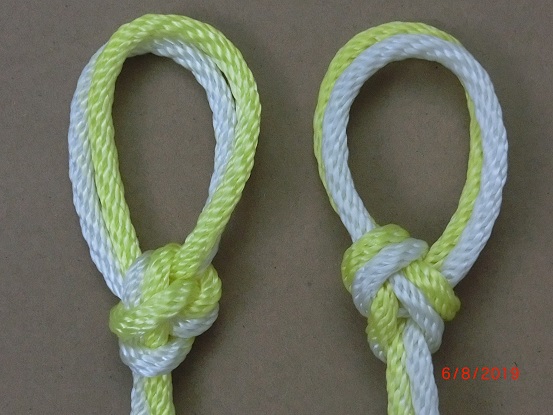
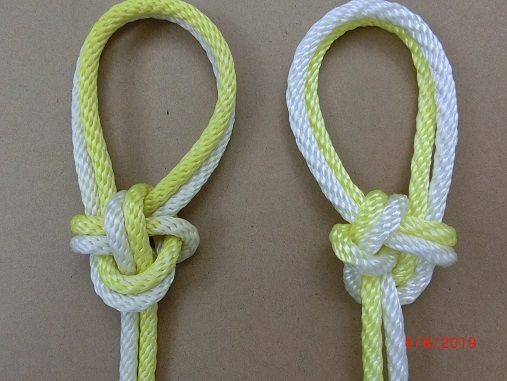
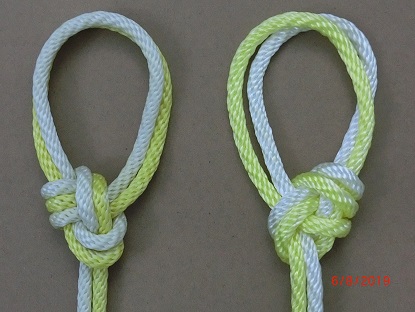
More Loops.
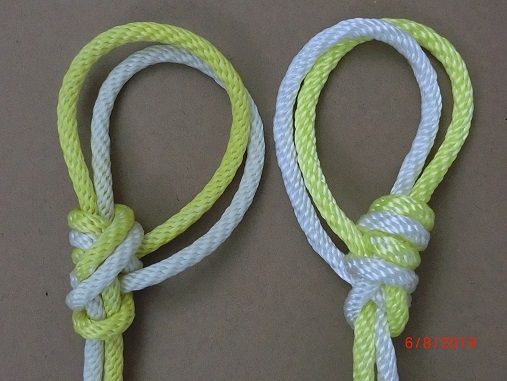
More loops.
Rename Double Loop # 9 to Double Loop # 3-3 and Double Loop # 10 Double Loop # 3-4 (date edit, Aug-8-2019)
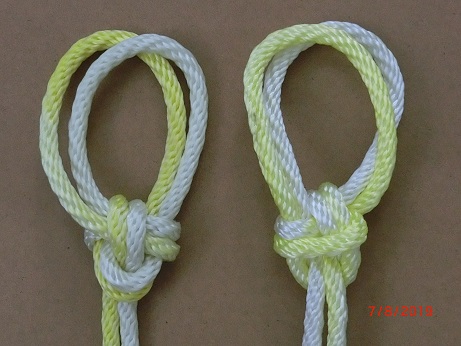
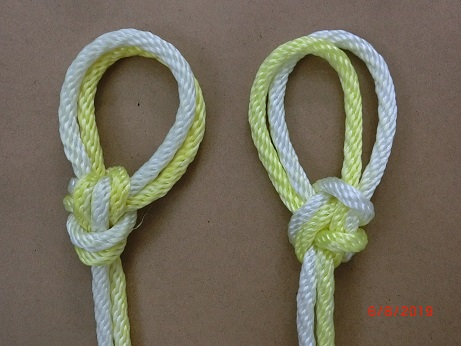
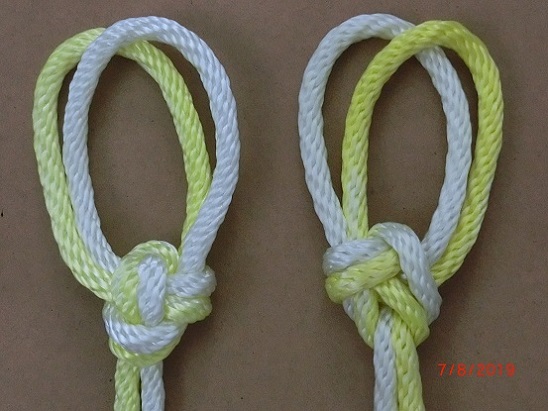
Thanks Alan, I like some of your latest double eye (loop) knots.
Although looking for a tying method that is relatively easy.
…
The following comments are potentially off-topic but are in direct response to Dan Lehman at reply #10…
per Dan Lehman at reply #10 in relation to #1057 and #1058:
Hardly such an oversight, IMO. Rather, he simply wasn't playing the game you're so hard at in narrowly/strictly per-your-own-definition identifying *bowlines*; and in these, he felt some merit.
An interesting comment that I just noticed… possibly either a cryptic reply or an exercise in obfuscation?
You might do better to just write in clear and unambiguous language if you believe #1057 and/or #1058 to be deserving of the title ‘Bowline’.
Unless my eyes are deceiving me, there is no nipping loop in either of these structures which means they are automatically disqualified from being ‘Bowlines’.
And the term nipping loop has a special meaning…which includes the following properties:
TIB
loaded at both ends
has a specific chirality
takes the form of a helical loop (if it is to be regarded as being a primary / first order Bowline - and not something else - such as a virtual Bowline).
Note that all of the ‘Bowlines’ illustrated in ABoK have a nipping loop that take the form of a simple helical loop or double helical loop - with the exception of #1057 and #1058 which are an anomaly or an error. And if you believe that #1057 and #1058 are in fact deserving of the title ‘Bowline’ - this would open up the field for many other structures to also be reclassified as Bowlines - and would give rise to a whole new hypothesis underlying what a ‘Bowline’ is.
The language is perspicuous, but you insist on a perverted reading.
YOU are all gung-ho about YOUR notion of “bowline”; Ashley, I surmise,
was less so --and he offered that these cited knots “had a better claim”
to “bowline” --for which HE does NOT give a set of criteria. YOU impose
yours, and then call Ashley mistaken : heckuva way to run a contest! :o :
Unless my eyes are deceiving me, there is no [b][i]nipping loop[/i][/b] in either of these structures which means they are automatically disqualified from being 'Bowlines'.By us; but this is now, and that was then & Ashley's unknown thoughts.
And the term [i]nipping loop[/i] has a special meaning...which includes the following properties: [ ] TIB [ ] loaded at both ends [ ] has a specific chirality [ ] takes the form of a helical loop (if it is to be regarded as being a primary / first order Bowline - and not something else - such as a virtual Bowline).Who voted on "TIB" --you & X. ?! I can understand that being a desideratum for "bowlines" --even for this component--, but it's not (yet) mine; so I accept the "cloverhand" & fig.8 mid-flype structures; as I struggle re the "back-side" (was "anti-") bowline structures where the arguable *loop* so leans out towards *helix* which IMO is not so *nipping*/compressing-within as is wanted --a circumstance actual, in-real-rope #1010 BWLs can achieve, even!!
(One can also presume that TIB is a sine qua non for mid-line
eye knots, but then what to do with non-TIB ones, which might
well be preferred for some reason and put in in the more tedious
tying, but serving well thereafter --likely sans any tie-it-in-a-hurry
situation where TIB plays trumps!?)
“loaded at both ends” will prove to be at times more seemly
than physically actual. As I’ve noted, if the mid-span part
between mirroring “nipping loops” is drawn out, it can exist
as an eye --w/o tension, thereby revealing something about
the apparent “nipping loop” (per your criterion) structures feeding it!
And if you believe that #1057 and #1058 are in fact deserving of the title 'Bowline' - this would open up the field for many other structures to also be reclassified as Bowlines - and would give rise to a whole new hypothesis underlying what a 'Bowline' is.
Yes, quite. I do NOT; what Ashley had in mind is another question.
–dl*
So as not to completely de-rail Alan Lee’s good work, I have started a new topic thread here: https://igkt.net/sm/index.php?topic=6525.msg43389#msg43389
The debate about #1057/58 is not in alignment with the original topic of this thread…
Hi All,
Thanks Mark. So far I already got it figure out how I would like to tie most of these knots, still have a few tough one waiting to be resolve. Most these knots are easier to tie and dress with softer rope. and it is very hard for climbing rope. well it end up quite a big project for me, I am happy to do it, but free time isn’t always on my side, I guess I have to take my time, do it one thing at a time. If any reader have interest to find a good way to tie these loops, you are more then welcome to post it here.
I have two more loops here #10 and #11, both are no good for biaxially load, #10 is fine for normal use, #11 may slip on heavy loaded. 謝謝 alanleeknots
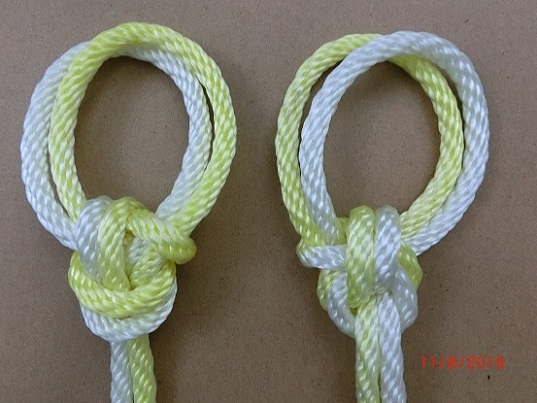
Try to modify and Name change one loop on page below the " Re: ABOK # 1074 and ABOK # 1035 Video
? Reply #13 on: August 07, 2019, 08:56:07 PM ? ", I accidentally hitting the Remove, that page no longer
there.
Here, restore the two loops and with name change from Double Loop # 1-3 to "Bowline on a bight
(ABoK #1080) Variation "
Aug-13-2019 add this Double Loop # 2-1 to this page, I think this loop is good for biaxially load.
Hi Alan,
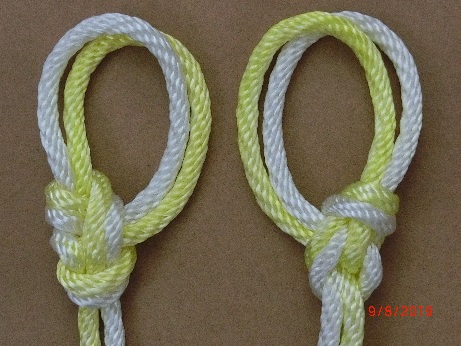
I’m interested in your #1080 variant.
Am having a little difficulty trying to tie this to match what I see in the right hand photo…
Can you show this in a loosely dressed state please ?