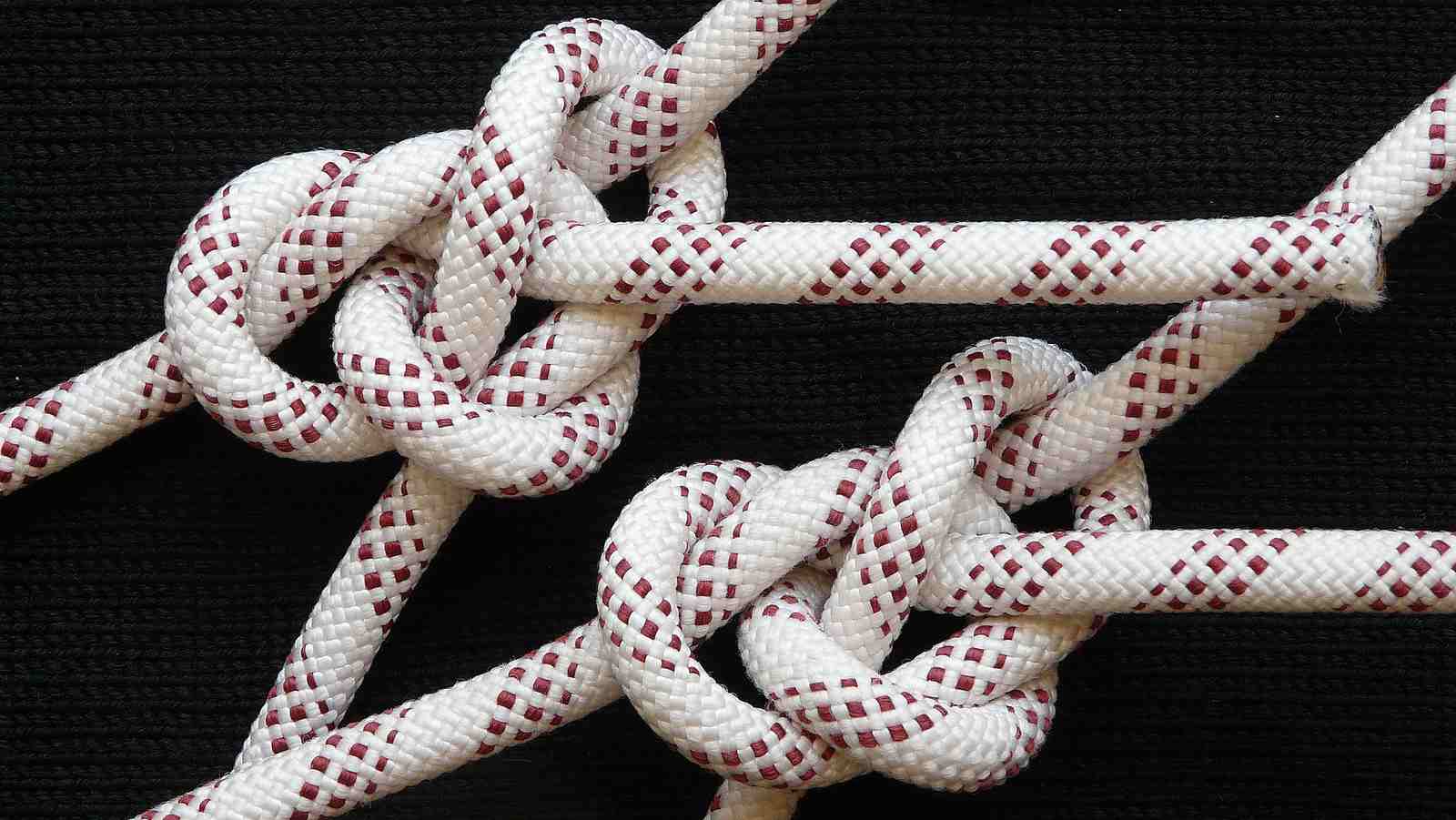
How do you know where line typically breaks?
As you have surely read (ABOK/Ashely, e.g.),
that is precisely where the break is said to occur
–or even “slightly outside of the knot”!! (?!)
My take on the “outside” observation is of a double
mitigation, so to speak : (1) that the actual breakage
has been started within the knot, and it only seems
that “the break” occurred outside (I think that this is
partly what you argue, elsewhere); and (2) that the
broken area has been grievously weakened when
inside, and only later broke though it had moved
farther from that point.
My observations suggest that compression at a bend
plays a big role, with the inner / compressed fibres
being what break (first). In one case of slippery, HMPE,
the break seemed to come well inside, which I credit
to the material being able to deliver high tension
–w/o mitigation /“off-loading” via friction-- much
father along the SPart’s path (this seemed to be
past the SPart’s U-turn, of all things!).
And I think that (single strand!) spaghetti is not a good
model for normal cordage! Monofilament might suffer
some of the same problems for representing rope.
Perhaps I had not expressed what I was thinking clearly enough. I wrote that :
, meaning that, as I had read and seen in many pictures of broken knotted lines ( for example, in the pictures of ruptured loops by Alan Lee, presented in this Forum ), the line typically breaks before “the entry of the continuation of the Standing End into the nub”, not “right after” it, at the point of maximal curvature, as we would had expected.
I think that a severe weakening of the line can only happen during the last stages of the tightening, when any slack that could had been consumed by the pulling of the Standing End(s), would had been consumed already, and the knot s nub would have been shrank to near its most compact form. So, during those last stages, there can be no such “further movement” of a point, to the degree it can transport a point which was in the “inside”, to the “outside”.
You had expressed this theory before, but now you use a more careful language : you do not claim any more that it is compression that is the cause of the breakage, as before, but that "the compressed fibres are the fibres that break (first)" - a different thing. It can, indeed, be the case, that the real cause of the breakage ( which, IMHO, is the tension, combined, perhaps, with torsion, NOT the compression ! ) generates a cascade of effects ( elevated temperature due to friction, vibrations due to the enlargement and propagation of already existing micro-cracks, etc. ), and that those effects, for some unknown ( to me ) reason, are especially efficient when they are applied on the compressed fibres. In short, that the compressed fibres are the weak links, in a temporal, spatial, and material chain of complex phenomena - and, as weak links, they break first. Perhaps the compression plays a smaller or bigger role in which fibres break first, but this does not mean that it is the cause of their breakage, as you were claiming till now.
This may be used as an evidence supporting your argument, indeed - but, to my view, it is only an ad hoc effort to somehow fill the GREAT voids of it… This effect can well be explained by a number of other arguments : If friction is low, the amount of temperature that would be sufficient to melt the fibres can only be accumulated further along the Standing Part s path, where it will also be enhanced by some contribution of the temperature generated by friction between other segments of the knot. Also, it may be the case that, in this particular material, sharp bends can tolerated much less than in the case of other synthetic fibres - so the breakage point is closer to the point of maximum curvature, which is located deeper in the nub, not at the “outside”. We do not even know if the mechanism of the breakage itself does not depend on the friction coefficient of the rope : perhaps a theory that would be able to explain, and predict with numbers, the breakage of manila ropes, would not ne able to explain the breakage of “ordinary” synthetic ropes - and a theory that would explain the breakage of the very different, very slippery HMPE materials, would also be very different ! Friction is a very complex phenomenon, which is not very well modelled / explained, and this also happens with the effects of temperature on synthetic macromolecules - so we can imagine what happens when we try to deal with both of those problems in one go !
I will repeat here what has made a great impression on me : the exact path of the line in an overhand stopper, even in the case of ideal knots, with perfectly cyclical cross sections and no friction at all, is NOT known yet ! If the mathematics of the most simple knot is not known, we can imagine what happens with the physics !
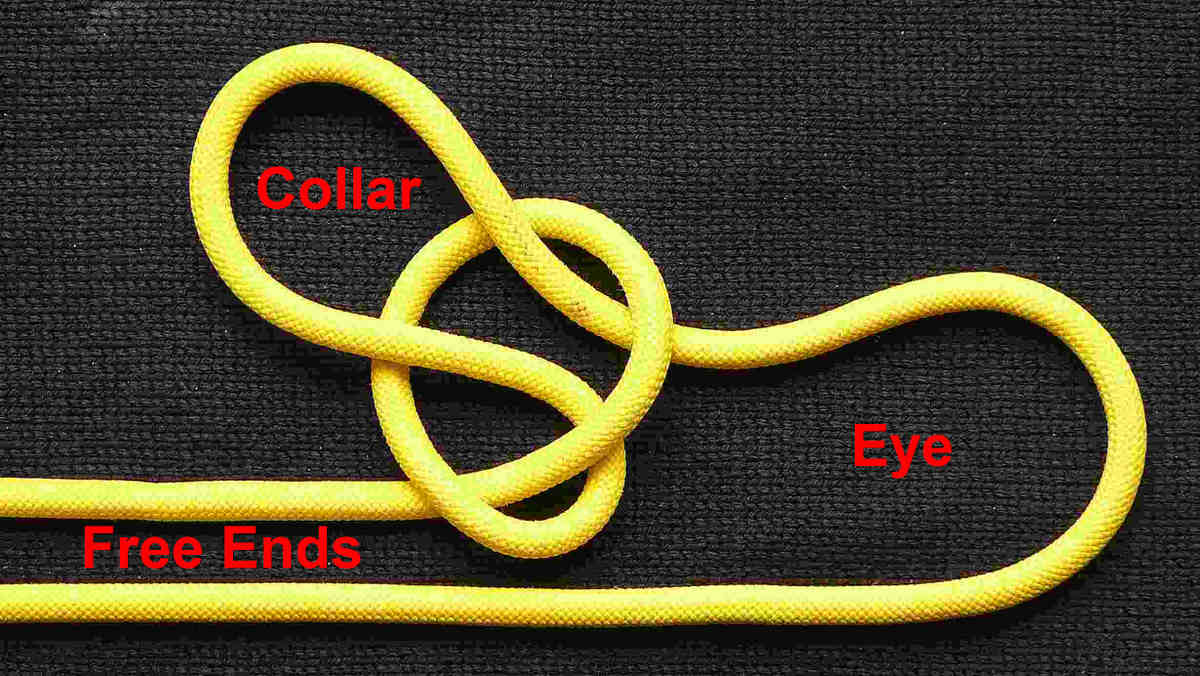
In this post I will try to illustrate with another example what may appear as a “knotting magic”, but, in fact, it is nothing more than the result of the simple reeving of the whole knot through a bight of it.
At the first attached picture, we see the bight of the eye of a loop, with a slipped overhand knot tied on one ( the “upper” one) of its free ends. The bight which is slipped through the overhand knot in not encircling the pair of the free ends - or, in other words, the pair of free ends does not go through / does not penetrate this slipped bight.
At the second attached picture, we see the SAME knot, where the slipped bight does encircle the pair of the free ends : it has became a collar around those lines. Now, in contrast to what was happening in the previous stage, shown in the first picture, the pair of free ends does go through this collar, does penetrate it. How did this knotting miracle happen ?
No miracle whatsoever, unfortunately : if we are not confused by the tangled wording and the image of the tangled lines, we can easily figure out that, in order to pass from the knot shown in the first picture to the knot shown in the second picture, we have to just reeve the whole knot through the slipped bight, which will now become a collar. Doing this, all the lines of the knot will go through the collar, so, if we will move some of them to the right, what will be left at the left :), the pair of free ends, will now be encircled by the collar.
In the case of the Ampersand bowline, I have described this simple trick with those words :
When we want to transform the geometry of a knot without altering its topology, this simple trick is the easiest and first thing we try. However, I do not know a word / term which can describe it. The interested reader is kindly requested to imagine something.
The procedure reminds me the sequence of moves which turns a glove inside out - perhaps the term “turn the collar inside out” , for the reverse procedure ( the move from the stage where the collar does encircle the free ends, shown in the second picture, to the stage where it does not, shown in the first picture ), would be able to offer a useful mental image of it.
At the third and fourth attached pictures, one can see the same thing in the case of tying the Ampersand bowline in-the-bight. The third picture corresponds to the shape of the knot after stage 3b, and the fourth picture corresponds at the shape of the knot after stage 4, that is, just before the Ampersand bowline is drawn taught in its final form.
That is the reason I had chosen to present this particular tying method, and not another one ( starting from a slipped overhand knot ), which is faster. After we form the twisted three times initial bight ( three times, as one should had memorised by now… :)) and the right-handed nipping loop, and after we reeve the upper part of this twisted bight through this nipping loop, from “under” to “over”, we reach to the final stage. All we have to do from now on, is to perform this elementary knotting magic, and make this reeved upper part of the twisted bight be encircled by - and so become a collar around - the free ends.
Imagine we have agreed to use a term for this trick ( if it is possible to agree on anything ! ). I denote this term as : <term?> . Then, to tie the Ampersand bowline in-the-bight, one has to :
1. Twist a bight three times / three 180 degrees turns, clockwise ( righty-tighty ). 2. Form a right-handed nipping loop on the “upper” one of its two free ends. 2. Reeve half of this twisted bight through the nipping loop, from “under” to over". 3. <term?> this reeved half of the twisted bight, to/on/around/ (or whatever proposition describes it better) the rest of the knot.
1. Twist a bight three times / three 180 degrees turns, clockwise ( righty-tighty ).
2. Form a right-handed nipping loop on the "upper" one of its two free ends.
2. Reeve half of this twisted bight through the nipping loop, from "under" to over".
3. this reeved half of the twisted bight, to/on/around/ (or whatever proposition describes it better) the rest of the knot.
Using the two pictures from reply #18 and adding picture #4 (Stage 4) Does the trick.
The key is to take the bight of the half twisted, opening it and bring it over the bottom of it all and place it at the collar location, then dress it.
I had not presented the picture#4 at Reply#18, on purpose : I thought that I had first to show the turned-inside-out-collar trick in a simpler case, and ask for a proper term for it. This reeving of the whole knot through one bight stemming out of it, although it is conceptually elementary, it looks quite complicated in pictures ! Picture#4 seems too complex, if it is not seen as a mere implementation of the trick after the under/over half-reeving of the twisted bight through the future collar.
I do not believe that this is the term you propose… What about the “turn a collar inside-out”, or “turn a collar outside-in” ? Any other idea ?
What about the "turn a collar inside-out", or "turn a collar outside-in" ? Any other idea ?
It could work, but it is not quite a collar yet. Turn a to-be collar… nah.
It is an open bight that has to be positioned in the collar location after it has been pass over the rest of the tangle and I don’t know of a term for it yet. It is like what we do when we tie a bowline on a bight that results in a double eye.
Also, it would be great if we had a term that could describe both transformations : a future, to-be collar turning into a collar, and a collar turning into an ex-collar - even with an adjective, as “reversed”, or a negative sign (-), in front of it.
When you do work upon a rope it’s temperature may well go up, but heat is mobile. An increase in temperature will cause a heat gradient and that heat will conduct away. If we apply a load gradually, any heat generated will conduct out of the rope. By loading a rope sufficiently slowly, its temperature can be maintained at any chosen value, so heat, i.e. elevated temperature, cannot be the cause of that rope to fail, yet fail it eventually will - but it won’t be through temperature melting.
A twist to this argument, is that as you stretch a rope, much of the work done is being stored in the fibres as potential energy. This energy will be released as heat when the fibres are allowed to contract back to their un-stretched length. So, as a fibre breaks and snaps back in length, it suddenly sheds it energy as heat, but that heat is released along the length of the contracting fibre. In this way, heat is released into different parts of the knot than the part where the first fracture occurred. Fibres stretched around an outer radius may be taken beyond their breaking strain and so fail, and then dump their released heat into a different part of the knot as they shrink back under the released tension.
The second and most often ignored aspect of failure is pressure or compression. If you take a guillotine or a knife to a cord, it is the point pressure hugely magnified by the tiny area of contact that ruptures the fibres. All organic fibres are polymers and at some pressure they will flow and deform. It is not heat but pressure that has this deforming effect. However, most polymers are very temperature sensitive. So, if we have a fibre under sever compression, but not enough to cause it to deform, and then suddenly an adjacent fibre releases a load of heat (because it just snapped), then the compressed fibre absorbs some of that heat. If the consequential temperature rise takes that fibre above its flow point, then it too can rupture, releasing it’s stored energy as it shrinks back to unload length. Again, the released energy will be ‘piped’ into other parts of the knot.
The failed fibre, not only releases its stored energy into the cord as heat, it also has two other effects. First, the load it was carrying is now instantly transferred to the remaining fibres. It might only be a tiny incremental increase, but it is an increase, driving all the other fibres nearer to their failure paints. The second and potentially far more sinister effect is that because that fibre has lateral frictional contact with the half dozen fibres around it, it transfers its tension selectively into those fibres, along with its released energy as heat. We now have a tiny bundle of fibres, already under tension, suddenly subjected to an increase in tension and an increase in temperature for some distance away from the break point of the first fibre. Any weak points in those heated, sections under additional tension are likely to fail and so start a chain reaction of failure, heat release and transfer and further localised load increase.
Hence, we should expect to see, and in fact do see, a scattering of fracture points occurring throughout the knot, as a storm of failure fires throughout it, transferring heat, load and pressure into different parts of the cord and the knot. We should also expect to see the ‘gross’ failure of a knot at some point other than the weakest point that actually initiated the avalanch of failure.
When you do work upon a rope it’s temperature may well go up, but heat is mobile. An increase in temperature will cause a heat gradient and that heat will conduct away. If we apply a load gradually, any heat generated will conduct out of the rope. By loading a rope sufficiently slowly, its temperature can be maintained at any chosen value, so heat, i.e. elevated temperature, cannot be the cause of that rope to fail, yet fail it eventually will - but it won’t be through temperature melting.
I understand to a limited place what you’ve written and can see the point(s) you make.
I don’t know how you can have pressure without temperature and perhaps that is my confusion, if I am confused.
Yes, the heat is mobile, I agree, but there seems to be a limit as to how fast the surrounding material can allow the transfer. If it is not fast enough, then there is a build up of surplus heat. It follows, in my mind, that if the surplus is there long enough, the chemical bonds could be effected. What I have read about polymers, this heat can influence the bonds, perhaps weakening them.
I previously posted a link to video of a tensile test involving two Fig.8 eye knots. http://www.youtube.com/watch?v=s3fHYGY3YTo The tester used thermography to view the heat within the knot till failure. The friction and pressure (my term - crushing) heat building does seem to be greater than the the material’s ability to allow it to escape quicker than it builds. From this I can hypothetically conclude what I stated.
Perhaps we should not take anymore away from the OP. Possibly start another knot breaking thread? Again.
This eye knot deserves a good deal of scrutiny as it seems to be quite sturdy in many aspects.
As the “right-handed” Ampersand bowline and the “left-handed” Scot s TIB bowline are the one the “reversed” eye-knot of the other ( here, the “reversal” is referring to the swapping of the Standing and the Tail Ends ), it should had been expected that their “other-handed” forms would retain the same properties / relations : indeed, they are also TIB, and they are also “reversed” to each other. In this thread I had shown only the “right-handed” Ampersand bowline, because I think it is simpler, visually and structurally - and that, as it is a two-collar ( = double collar ) “secure” bowline, it does not suffer from the instability during ring-loading the common, “right-handed” bowline does. The interested reader is advised to tie the “left-handed” Ampersand bowline, too, and convert it to the “right-handed” Scot s TIB bowline, shown at (1)-(2).
{ I would also like to mention here that, after I had “swallowed” and “digested” the TIB tying method of the Ampersand bowline presented at (3), I tie the Scot s cow, sorry, TIB bowline, following the same method - so, I start from a triply-twisted bight, and not from a slipped overhand knot, as JP does in (4).)}
I always tie the knots I want to study in detail on very soft and on very stiff ropes, to see if they have any drawbacks which I had not noticed, but which may be revealed, somehow, this way. See the attached pictures for the left- and the right-handed Ampersand bowline(s), tied on the most stiff rope I have : its diameter is 11mm, but it should be filled with a peculiar stuff, because the sharper curve I can bent it, between my thumb and my index fingers, can not be less than 2 rope diameters…( but I should say I am no weight-lifter… :))
In the left-handed Ampersand bowline the second leg of the “upper”/first collar follows a curve which turns around the same, always, direction : the “bridge” that joins this collar ( the U-turn around the pair of the Standing and the Tail ends ) and the other, the “lower”/ second collar ( the U-turn around the rim of the nipping loop and the eye leg ), is an almost straight segment. In the right-handed Ampersand bowline, this same second leg of the “upper”/first collar makes an S-turn before it reaches the “lower”/ second collar. This may mean ( :-\ :-\ :-\ ) that, in this S-shaped segment, the differences in the stretching of the "inner’ and the “outer” threads at each turn are smoothed out, so the material of the collar structure is used more evenly. I would be glad if I could see, literally, what happens inside the core of the rope at each turn, how the individual threads are loaded, and transfer the various kinds of the forces acting on them along the axis of the rope, and to each other ! Is it better to have two U-turns joined by a straight segment, or by an S-shaped segment ? This is a general question, of course, which concerns the “bridges” ( the segments between the two collars ) of all the Janus bowlines, and then some… Only KnotGod knows.
However, after I had loaded both eyeknots lightly, with about half my weight, all the O-, the U- and the S-shaped turns had been smoothed out to the same degree ( see the attached pictures ), and this tells me that the there is no great difference in the amount of strain which forces the segments of the rope in the two similar structures to bend - against their will !
I had luck in transforming the right-handed Ampersand Bowline in the left-handed Scott’s TIB Bowline, and vice versa, but I have not had the same luck in transforming the left-handed Ampersand Bowline in the right-handed Scott’s TIB Bowline:the second link(the collar) of the left-handed Ampersand Bowline is (unlike as is the case of the right-handed version) not an un-knot,but is topologically equivalent to an Overhand knot,then I am not able to transform it into the nipping loop of a right-handed Scott’s TIB Bowline(and I must say that,despite the fact that both links of the right-handed Scott’s TIB Bowline are topolgically equivalent to un-knots,I could not get something similar to an Ampersand Bowline starting from this loop).What I’m missing?
Nothing !
First, I should better re-post something I said some time ago, although in a more restricted sense :
So, regarding TIBability, the particular path the second leg of the collar of the “left”-handed Ampersand bowline follows through the nipping loop does not matter : the resulting eyeknot is a TIB, in both cases.( See the attached picture, where, in the red circle, we see the second leg of the collar going “over” the first ).
I had shown the “left”-handed bowline in its one form, where the second leg of the collar passes “over” the first, for three reasons : 1 : because I think that so it is tied in-the-end in a more straightforward way, that is, more easily/quickly. 2 : because that this way the second, “lower” collar becomes wider, as it goes around the returning eye leg, so it encircles three rope diameters. And, 3 : last but not least, because, during ring loading, I believe that, this way, the nub will remain more coherent and compact, so it will behave better.
Those advantages, and the fact that both knots are TIB, had lead me to show this form and not the other, where the second leg of the collar goes “under” the first - and where this “second link” of the knot, this “collar structure”, remains topologically equivalent to the unknot. Strictly speaking, the other form is what should be named as “left”-handed Ampersand bowline, corresponding to the “right”-handed Scott s TIB bowline - but I though that this almost negligible, geometrically, difference was not worth the loss of the advantages I had described above, and the trouble to explain all this. Well, in that last, it seems that I was wrong ! I am glad you had noticed it and you had offered me the opportunity to clarify the matter - as you always do ! Thank you.
In this particular case of the two forms of the “left”-handed Ampersand bowline, we KNOW why they are both TIB : to tie them in-the-bight, the only thing we have to change, in relation to the TIB tying method of the “right”-handed Ampersand bowline, shown at (1) and at the attached picture, is the twist of the collar. In the “right”-handed Ampersand bowline, the bight that will become the first/“upper” collar should not be twisted. In the “left” handed Ampersand bowlines we have to twist it 180 degrees clockwise or counter-clockwise. If we twist it towards the one or the other direction, the second leg of the collar goes “over” or “under” the first. So, both eyeknots, tied in-the-bight this way, are TIB, and we now know why.
I believe that this “proof” can be generalized, and we can always justify the observation about the TIB ability of both forms of the TIB bowlines described in the previous post, because the two bowlines that we want to know why they are both TIB, can always be tied in-the-bight by a similar tying method, where only the orientation of the twist of the bight that will become their first/“upper” collar will change.
A picture of the two forms of the “left”-handed Ampersand bowline, tied on my most stiff rope. Regarding their differences, one can distinguish the slightly wider second/“lower” collar of the knot at the right ( where the second leg of the collar goes “over” the first", so this collar encircles three rope diameters ), but not much else. If it is anticipated that the eyeknot would be ring-loaded, I would prefer the one shown at the right - although it is not the corresponding to the “right” handed Scott s TIB bowline. Perhaps another reason is that this was the form I was tying right from the start, because it looked more streamlined and coherent, before I discovered the correspondence…
Hi All, Xarax no longer here, his works and contribution still here with us, I like his well secure Ampersand bowline,
I have a quick way to tie these knots, see you guys like it or not ?
alanleeknots at YouTube.
謝謝 alan lee.
I don’t like it, for from-the-start separating the crossing
of the nipping loop, such that it begins loading already
halfway into a (significant) helix vs. contracting circle.
(And with soooo many other bowlinesque eyeknots to
choose from, why … ? !!)
Hi All,
Dan, you have said “soooo many bowlinesque to chose from” can you please show me some of them,
are they PET and TIB knot ?
Xarax already described some advantages of the Ampersand Bowline in here" http://igkt.net/sm/index.php?topic=4877.0"
see if you can find anything you like, if you happan to find something you like, Please share it with our reader,
of cause incleded me.
Oh, Just about to foget to asK you, Do you like the way I tie this well secure Ampersand TIB bowline?
謝謝 alan lee.
 What about the “