The Bowline is the King of Knots because it is strong, secure, and versatile, as kings should be. And simple, as kings generally are.
- Brion Toss
This aspect of simplicity is certainly an ingredient in my definition of bowline.
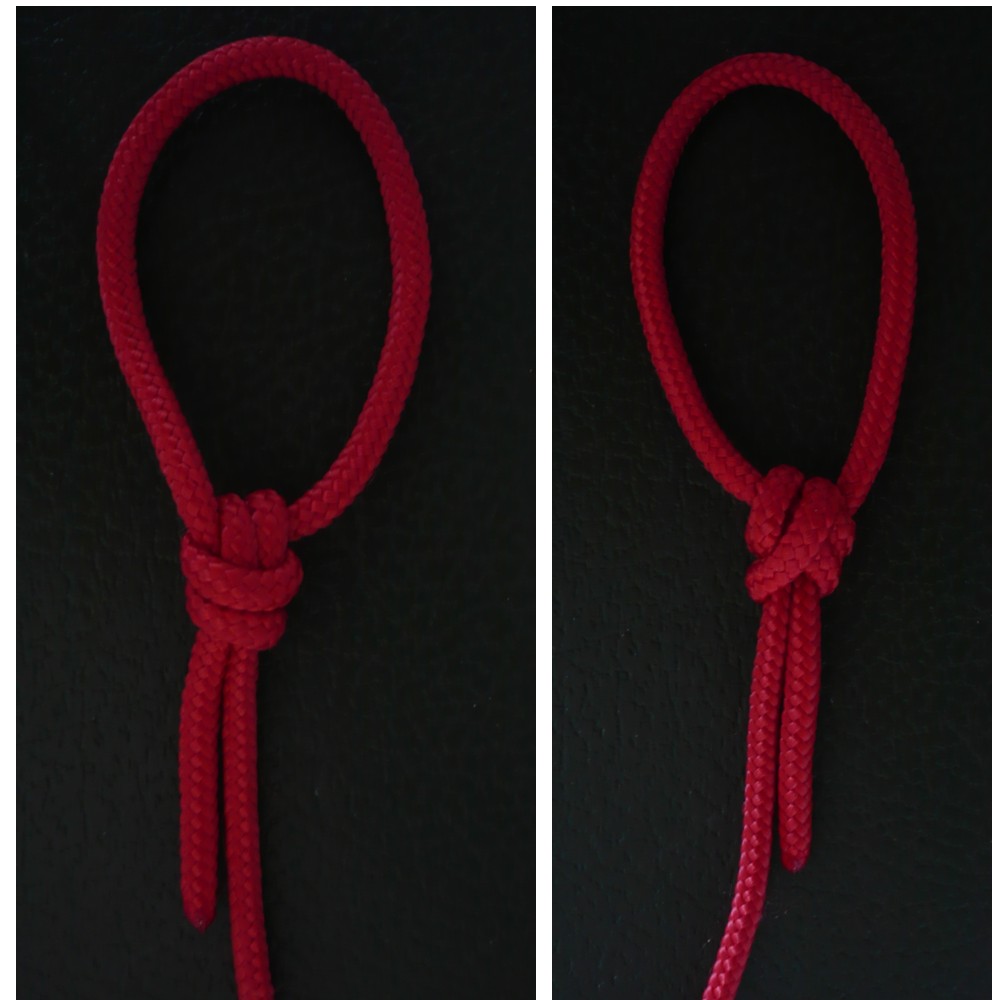
- A bowline forms a standing eye.
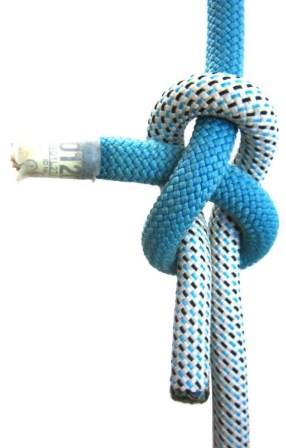
- A bowline has a nipping turn
- and a collar
- and it?s simple to tie, use, and untie
Dan writes:
Before we go further, we should ask What is the purpose of this ("bowline') definition?
and Derek writes:
This leads me to the conclusion that there are two audiences we need to consider.The first is the Common Usage / Layman group, wedded to the historical names.
The second is the vanishingly small group of people interested in structure and workings of knots, who almost certainly need a new perspective and lexicon in order to clear out the clutter of history.I belong to the latter group, but I feel this thread belongs to the former, and more importantly, it wishes to remain in it. Rather than being constructive, contact between the two appears to be antagonistic to both.
Is the purpose of our bowline definition soley for Derek?s second group? Or perhaps is a definition stringent enough to satisfy the latter group useless to the former group? As a member of both groups, I think there is middle ground, and merit in looking at the question of ?defining bowline? from both perspectives. They are not antagonistic to each other, or mutually exclusive IMO.
Perhaps it would help to remember that a bowline is simple. And to some degree, this simplicity is at the heart of it?s usefulness.
btw Derek, I believe ?clearing out the clutter of history? to be a fool?s errand. By and large, the knots we have today, and the names of those knots are a messy product of messy history. Live with it  accept it, it?s not gonna change by decree of the IGKT (or any other way)
I think part of a solution that appeals to me regarding which knot is “bowline” and which isn?t, is the one Dan proposes
One might make "bowline" narrower and then resort to "bowline-like",
A definition must have boundaries, it?s inhererant. To me, to make a definition useful, it must be precise. A definition should provide some clarity, and too broad a definition doesn?t do this. So my aproach would be to limit ?bowline? in certain meaningful concrete ways, and other knots that are similar but lye outside the delineations would be ?bowline like?
ok then
#1 A bowline is a knot with a fixed eye.
This seems so obvious as to perhaps not need to be included, but it was pondering the difference between sheetbend and bowline that brought me to include it. Axiomatically, a sheetbend is not a bowline, therefore the difference between the two should be included as part of the definition. The fixed eye may be composed of one or two fixed loops. (maybe three)
#2 A bowline has a nipping turn.
I think we can all agree about this, but the devil seems to be in how to define nipping turn.
Mark writes:
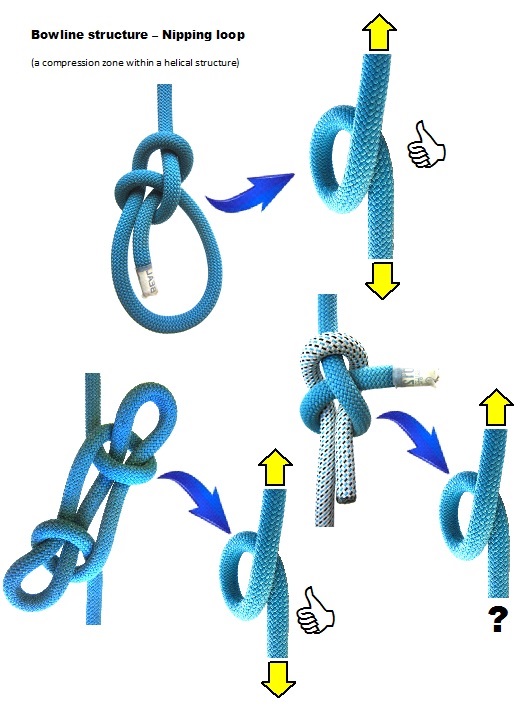
In my view, for a structure to be regarded as a 'nipping loop', the following criteria must be met: 1. There nipping loop must take the form of a helix or have a helical structure; and 2. Both ends of the nipping loop must be loaded; and 3. There must be a compression zone within the helical structure ?
I would further limit (#1) as a nipping turn should have only a helix structure of one or two turns. More than two turns isn?t simple. And nipping structures that aren?t loops (helix) are near bowlines, but not bowlines (myrtle bowline, crossing turn nipping structure, etc)
I disagree that a nipping loop must be loaded on both ends. I see this limitation as primarily a means of excluding the sheetbend from ?bowline?. I don?t think a nipping loop is exclusive to ?bowline? and I think a sheetbend has one. The primary purpose and defining feature of a nipping loop is the act of compression.
#3 a bowline has a collar.
And I think it only has one collar. More than one and it?s ?bowline like?
#4 a bowline is SIMPLE
Adding locking tucks to add security to a bowline is clearly part of what bowlines are in the 21st century, with all our slick and stiff modern cordage. I?m not sure where to dawn the line, but I do think a line should be drawn when it comes to how many added locking tucks are two many for ?bowline?. Perhaps two. I would consider a double bowline with a yosimite finish and a lee?s lock a bowline, but to me this knot would be right on the line of what is ?bowline? and what is ?bowline like? maybe two locking tucks it too many? Maybe it should be only one? Certainly the resulting knot may not even be obvious that it?s a bowline at first glance. Not obvious is not SIMPLE.
lastly, in reply to Dan:
Of course, I challenge this. (Some things are hard to see.)  In some orientation, #1033 is the epitome of *bowline* --so emphasizing, showing the nipping loop in effect But one must not draw it up (don't SS369 it!) but leave it so that the loop stays a loop and not a crossing knot. Done just so, the knot is perhaps most resistant to jamming? The sort of collar of the S.Part flows into a collar of the "ongoing eye leg" and ... no jamming.
If I have to dress #1033 ?just so? it fails my SIMPLE criteria of ?bowline?. I?ve played with this knot, looking for your bowline in there, but must not have your vision.
here is an attempt at a one sentence definition:
A bowline is a simple knot composed of one collar and not more than two nipping turns, which forms an eye composed of one or two fixed loops.
Lastly, Mark, good luck with the paper, looking forward to seeing it.
cheers
andy