I invite all interested persons to download, review and then make critical comment on the paper.
Comments can be made in this post.
Please keep in mind that this is merely a draft paper - it is not complete and it certainly is ‘not set in stone’. Constructive criticism is more likely to be acted upon… and if you want your contribution to be acknowledged in the paper, please advise accordingly.
Photos of knots are always welcome, however they must be of a suitable quality. No dark or shaded backgrounds will be accepted (must be white/transparent). Photos of knots must include ‘front’ and ‘rear’ aspect and must clearly show the knots structure.
IMPORTANT NOTICE ON COPYRIGHT This document is supplied in good faith and is freely available for download in the public domain. Any person choosing to contribute photos forfeits all copyright claims including forfeiture of any royalties or payments. Contributions are understood to made for no monetary gain, reward or profit - and are made as a contribution to world knowledge. PACI Pty Ltd (the owner of the website) and Mark Gommers will not be held liable for any claim in relation to any contributions made.
A good suggestion indeed. Unfortunately, 2 things will stop me from doing this:
Time; and
Resources.
I am doing this project on a shoe string budget and in-between work and other life commitments (like supporting my daughter in hockey and also field archery).
I must also point out that the paper isn’t really intended as a step-by-step knot tying guide… its about documenting bowlines and examining the theory of their structure.
Maybe someone else could use this paper as a starting point for another more detailed paper (like a PhD thesis)?
…
Speaking of which, thanks to those who have decided to message me personally (particularly X1) - I am re-writing page 10 and making and other changes - including getting rid of a few typos…
A new draft VER 2.0 has been uploaded and is ready for review and comment.
Change list:
changed foreword - rewritten
added contributors page
page 3 - removed ‘E’ and also capitalised letter ‘t’ in tail to Tail - also expanded information on the collar
page 5 - re arranged para 3 to place emphasis that the nipping turn is the key component of all bowlines
page 8 - same as page 5, re-arranged wording to place more emphasis on the nipping turn
page 9 - re-wrote information on ‘Eskimo’ bowline
page 10 - emphasised lack of nipping turn (bold red font)
page 11 - complete re-write (many concepts changed and/or added), including capstan effect at SPart - needs further review
page 12 - added call-out boxes to draw attention to whats happening to the collar
page 14 - added emphasis on the fact there are 3 rope diameters inside the nipping turn (Lee’s locked bowline)
page 15 - re-wrote information about Scott’s locked bowline
page 16 - significant re-write of the Water bowline - needs more work
page 23 - added more information about the ‘anti’ / Myrtle characterisation
a few typos and images were fixed here and there…
I would be pleased to list additional contributors in the paper (also need to know your nationality).
Congratulations, Mark. Your paper gets better by the day !
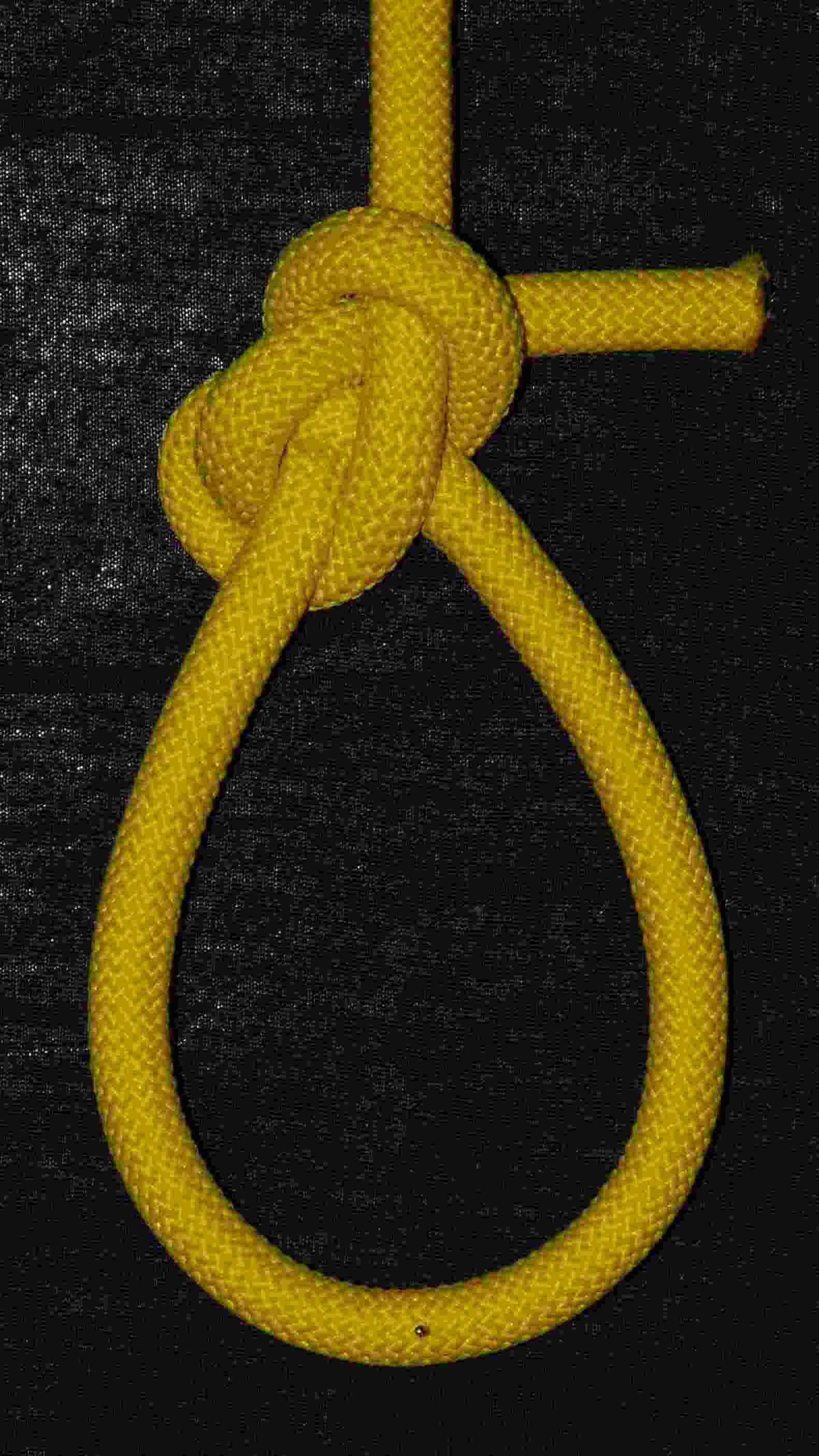
I would like to propose two most slight “modifications”, almost at the level of splitting hairs, in the two “locked” bowlines you show at page 15. In fact, the knots remain the same, but why we should not try to improve something even slightly ?
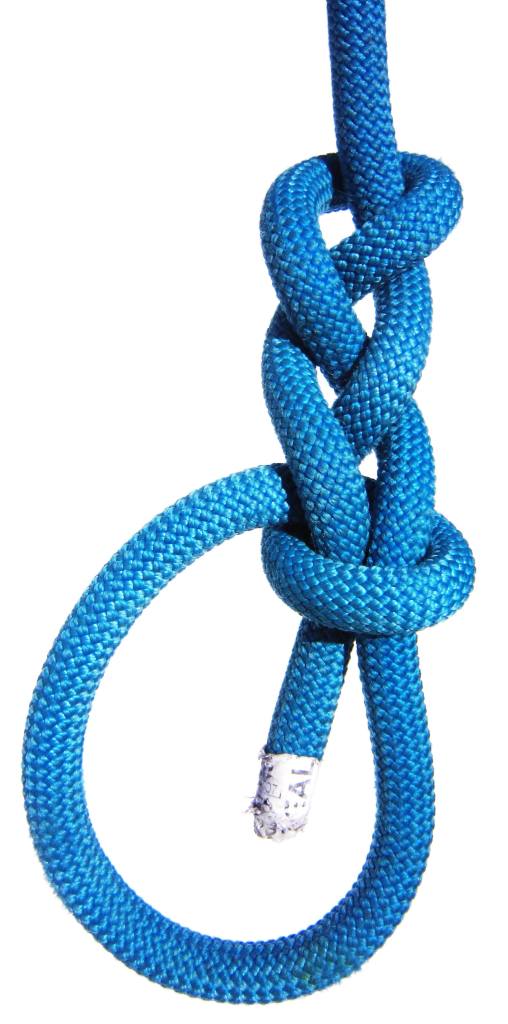
In the first locked bowline you show, I had re-dressed the “Lehman s lock” in a slightly different way, by forcing the tail to settle to another orientation, perpendicularly to the Standing Part ( See the first two attached pictures, and read (1)). Does it matter so much ? No, but if there is a difference, it would be beneficial rather than detrimental to the knot, I believe. The meeting point of the Tail and the Standing part is the last line of defence against slippage of the knot, so I think that if, at this point, the two segments meet at a right angle, they can “bite” harder into each other s body - and this enhances the generated friction forces.
Now, perhaps much more interesting, is the fact that this bowline is TIB, and, moreover, that it can be tied by the same simple “three bights” method many other simple TIB bowlines do - although, in this case, the result should be dressed a little more.
Believe it or nor, I had completely forgotten this bowline - I can not even remember if it was on all your previous papers. Evidently, I was not much impressed by it - but the fact that it is TIB, and can be tied as a midline loop, makes it much more versatile and really useful. I had (re-)discovered it when I tied all the possible TIB loops that can be tied by this method, and rearranged their strands in every possible way. I had presented it in a new thread some weeks ago, still ignoring that it was essentially the same knot as the locked by the “Lehman s lock” bowline - and neither Lehman himself noticed and/or commented on this ( he might well had noticed and/but not commented, so I write and/or ). It was only a few days ago, when I was reading your new version, that I had realized the identity.
So, I think it would be better to present it in the slightly different form I show, and also characterize it, emphatically, as a TIB bowline - there are not many TIB bowlines in your collection !
The second “modification” / hair splitting is also as slight as the first one. ( See the last two attached pictures, and read (2)).The “Scot s locked bowline” can be tied so that the tail will follow a wider path, around three rope diameters - there are stiff ropes that would resist to follow a turn as sharp as in the knot you show, especially if the segment which should make the turn is a tail - that is, it is loaded only from the one side. SS369 himself had seemed to approve this “modification”, but he may have forgotten it now ! I believe that, when tied on stiff static ropes, the tail will remain in place easier in the knot tied like this, and it will not sag between the Standing end and the rim of the nipping turn at any time.
Thanks X1 - and yes, I still have some way to go with this paper.
I am motivated to get it right and, to also achieve general agreeance on the content of the paper.
There are areas of work that I am still unhappy with - particularly with the ‘anti’ bowlines, the ‘eskimo’ bowlines and bowlines based on crossing hitch nipping turn structure. I am struggling to rationalise these classes of bowline. In particular, I may be totally wrong in what I have labelled as an ‘anti’ bowline. But, I thought it best to just put the paper out there in the public domain to solicit feedback.
As with your latest bowline images, I really would appreciate some high quality photos (front and back) which clearly show the structure. Its starting to become a bit overwhelming for me to photograph everything - and I am running out of time. It would also be nice to get some comment from SS369 on these variations too.
If I had high quality photos from contributors, it would speed things up considerably
…
Current changes that I have made (ie errors fixed):
fixed all references to bowlines that have 3 rope diameters inside the nipping turn. Deleted ‘reduces’ and inserted ‘increases’. The 3 rope diameters increase the radius of the nipping turn.
fixed the reference to eye knot based on ‘Riggers bend’ at page 10. The core (aka ‘nub’) of the knot is not actually a riggers bend. Reference now states that the eye knot is based on 2 interlocking overhand knots (removed any reference to riggers bend)
a couple a grammatical errors have also been fixed
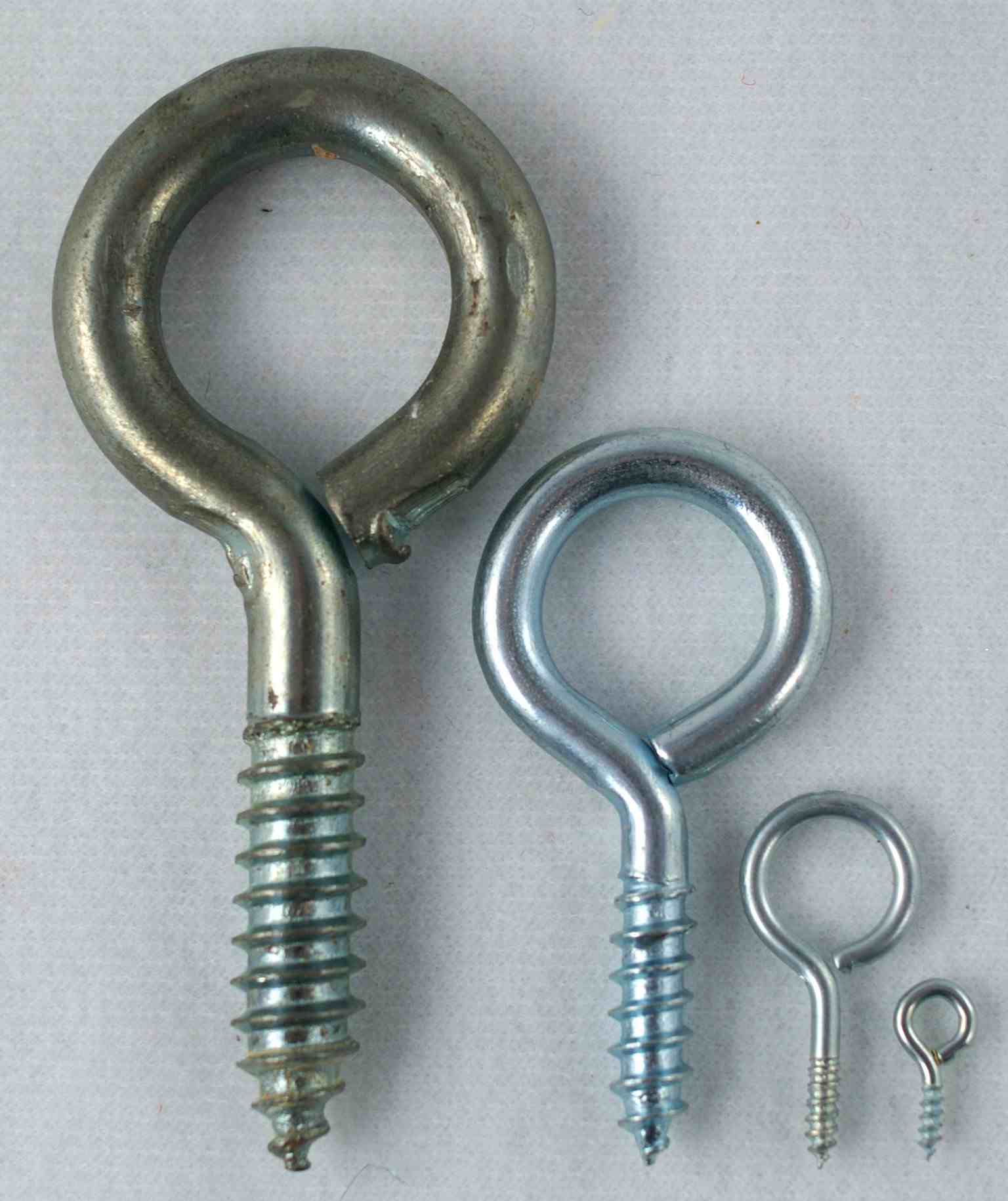
have also added an image of an ‘eye bolt’ to show the reasoning behind calling bowlines ‘eye-knots’ instead of loop knots. For example, if I went into a hardware/tool shop and asked the salesperson for a ‘loop bolt’ or a ‘bight bolt’ - I would probably get puzzling looks. However, if I asked for an ‘eye-bolt’ it would be easily understood. The eye of the ‘eye-bolt’ is the connective component - just like the ‘eye’ of a bowline is also intended as a connective component.
But loops come in many different sizes, not just eye size or eye proportion. When it gets big, will you call it a “hoop knot” and show a picture of a hoop as “reasoning”?
Eyes come in many different sizes, too ! The “eye” can mean a shape, independently of its size. If we have something hollow, and more rounded from the one side, but more pinched from the other, we tend to call it an “eye”. Also, hollow places in the middle of extended flat regions are called “eyes”, too : In meteorology, the central regions of vortices in the clouds are called “eyes” : The eye of the cyclone, the eye of the storm, the eye of the tornado … For yet bigger eyes, see (1)(2).
But in flexible rope, big loops end up looking very long, floppy, curvy and not very eye-like at all.
This all dances around the larger issue of why anyone would want to abandon widespread and long established terminology (and names!) that prefer “loop”.
Not when they are loaded, attached on a pole, a bollard, a ring, a hook, the waist of the climber, another eyeknot, etc. Do eyes themselves end up looking very eye-like, when they are closed ?
The word “eye”, in the sense of a “closed” hook, is widespread and long established, too : I was told about the eye of the needle from my grand mother, the wiser human being I had ever met - who lost a needle, that fell into the carpet, on which I stepped on, bare footed - the needle was broken inside my left foot s sole, and it was removed only after an operation in real vivo, without anaesthesia, for some looong minutes ( it was still dangerous to perform anaesthesia to very small children ). I still remember my horror, as four men were holding me on the chair while the surgeon was digging, I still have the scars, and I will never forget what the eye of the needle is !
I am an advocate of neither neologisms, nor new names for things already name, without a reason. I was convinced about the usefulness of a more descriptive, as it really is, and less ambiguous name in this case by dan Lehdman - although his persuasive ability on me, and/or my ability to be persuaded for something by him, are very limited, indeed ! Now, nothing will be carved in stone ! Even if this term is “established” ( if a knotting term can ever be established - there are so many different names used for the same things, and so many things that have no names, that we should not worry too much about it…) , we can not predict if it will survive into the flow of time or not, or how much later it will be replaced by something else. Also, we do not know which language will be the lingua franca of the world - in other words, we do not know the shape of the eyes of the people that will speak this language !
Instinctively, when I tuck a working end through a small opening of an already half-tied nub - something I do very often - I feel as I drive a thread through the eye of the needle - and as I grow older, and my sight deteriorates, I feel it more vividly ! So, the word “eye” makes more sense to me in this case, than the word “loop”. Also, the word “eye-knot” is more descriptive, in my mind, than the word “loop knot”. However, as my knowledge and experience of English is rudimental, I can not have a say on this issue - on top of so many issues I imagine I can say something, and that something will be heard by somebody I will simply follow the consensus of the community, whatever that might be. There is no better article on the most important end of line eye-knots/loop-knots we have, the bowlines, other than this one by Mark Gommers - and I doubt that somebody else will write something else in the foreseen future. Of course, I would like to listen to the learned opinion of Derek Smith and Dave Root, and I had already suggested to Mark Gommers to ask them about this. However, my primary concern is to find a way to distinguish the set of the crossing knot / hitch based bowlines, from the subset of the “Eskimo” bowlines, for example, i.e. issues that have to do with the structural differences between “similar” knots, and not the names of knots !
P.S. When we speak of the generic shape of an eye, we tend to imagine, i.e. " something hollow, and more rounded from the one side, but more pinched from the other " - AND, we tend to imagine that, in a human face, the more round sides of the eyes would be close to the nose, and the more pinched sides close to the ears. See the eyes on a human face where we can say that what really happens is the exact opposite . Bird s eyes are also more round, and the eyes of nocturne birds, like the owls, have the more peculiar shapes of all.
This is getting silly, but does suggest that the document’s
image goes in the wrong direction for rationale : i.e., it is
NOT really the shape but the logical notion of “eye”
that is intended; for this, I suggest showing not an eye bolt
but an eye splice --which is precisely from where use comes.
(The close shape too much suggests the wrong rationale.)
As for going against popular nomenclature: yes, that’s a good
consideration; the choice to do so notwithstanding usage
is that “loop” means too many things --i.p., rockclimbers
et al. make “loops” by tying ends of a single line together
(which might also be called “runners”, “slings”, “rings”(?)).
And the bowline is said to be the marriage of a “loop”
and bight. (And we should note that “bight” has odd
implications of contrast between the “halved”/folded
rope (into, um, would that be like a “loop”?!) and the
rather UNcrooked/straight mid-section of line
–between “with a bight” and “in the bight” !!)
Although I agree that it is better if the document had shown an eye splice, all the other “reasoning” of this paragraph is, apparently, wrong ! One can easily shift the goal posts just a little bid, and ask : And why has the eye splice been called an “eye” in the first place ? It is the shape, and nothing else, that was the initial reason for this moniker.
When I saw the “closed” form of this “eye bolt”, I searched in the “Google Images” to see if this name is also used for the “open” similar screws I had in mind. It is, but I do not know if those screws are also known by any other name, or not, and what comes to the average person s mind with the name “eye bolt”. In the relevant Wikipedia article, the “eye bolt” is shown in its “open” form. (1). See the attached pictures.
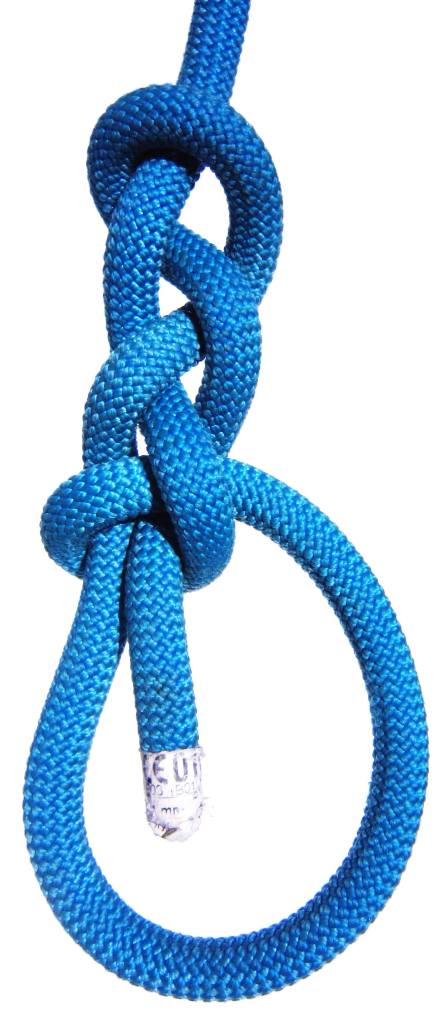
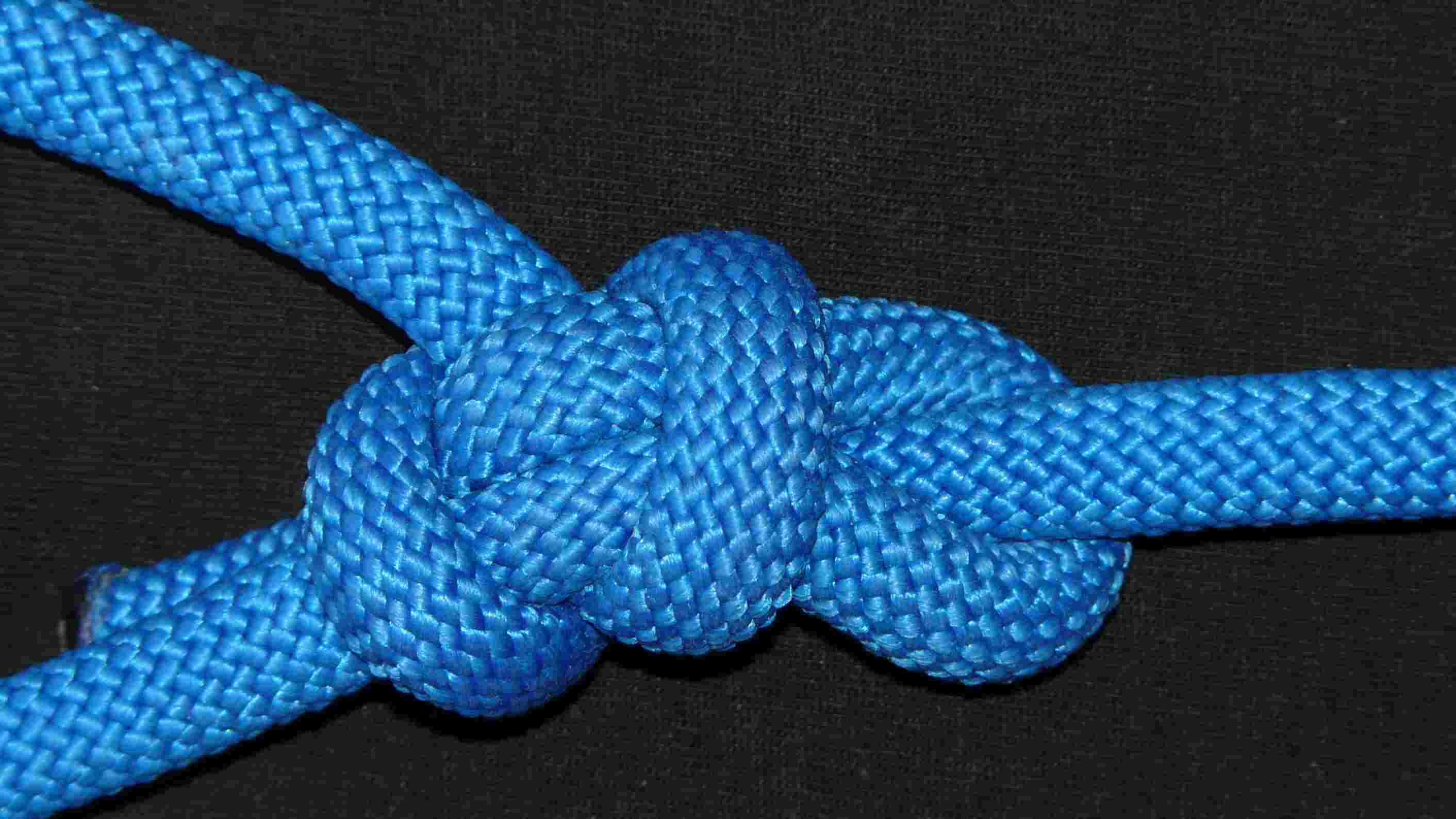
I have attached some photos of your creation (Bowline - Scotts collar-weave).
Couldn’t send via ‘personal message’ as I couldn’t figure out how to attach images… also, not sure of your correct email address.
Had a bit of trouble dressing these knots - found that I had to pay attention to pulling down the eye-legs to achieve the desired symmetry. I also edited the colour saturation and tonal levels to achieve a richer blue. To accommodate the limitations of this site, I had to compress the images. if you want high resolution images, I’ll need you email address…
As for its inclusion in the ‘Bowlines Analysis paper’ - it is definitely worth the effort. I have not field tested this knot so can’t comment on stability and security. However, at first instance, the weave structure does appear to inhibit tail movement. This is an interesting take on achieving a lock - as it tackles the problem pre-insertion through the nipping (ie by altering the collar structure) rather than post insertion through the nipping turn.
According to theory postulated in the paper, it must be a Bowline because it has a nipping turn (a key component of all Bowlines) and that nipping turn grips and stabilises the bigh component. The difference in Scott’s collar-weave to the fundamental “#1010” is the collar structure. Creating the weave pattern appears to inhibit tail movement. Further study is required…
Not sure how much more time I can spend on this project…
Change:
changed foreword (intro) page - opening paragraph modified after Dan Lehman suggestion
Tidied up some image of the girth hitch bowline
pages 5, 6 & 7 all new (new expanded info on concepts of PET and TIB) - needs more work
page 17 - new images of Yosemite Bowline (warnings)
page 20 - added new image of #1012
page 27 - tidied up images
page 28 - Added new images of Scotts woven collar bowline
modified definitions of anti versus Myrtle bowline structures (pages 9 and 12)
I find that dressing is not so difficult if one grabs the tail and its accompanying leg and pulling them as you hold the nipping loop. I have found that this works with the stiffest of ropes that I own.
The knot does not need to be super tight to do its work.
As for the high resolution pictures: Thank you, no need, I have the “real thing”.
To email me or any member of the Forum, just click envelope icon under the member’s nick-name.
The paper is a labor of love and it shows. Thank you for your efforts.
Its late at night… briefly; several typos have been corrected and have also rooted out all the lingering errors with anti-bowlines and crossed-bight bowlines.
Also rooted out typos/grammar errors with regard to the nipping turn / closed helix structure.
The TIB page showing how #1047 can be tied in the bight versus re-threaded is partly fixed. I have to take yet another photo of the the first stage (#524) but without the harness. VER 2.1a still shows the F8 being re-threaded through a harness which may confuse some readers… once the harness is removed from the image - it will just show an F8 eye-knot being tied in the 2 stage method as a single-strand.
I am also intending to include another obvious simple lock - that being a strangled double overhand knot around the eye leg (its simple and it works).
Although this is, unquestionably, the most naive way one can lock the Tail, it was probably one of the first and the most used - so I think it will not make any harm if you include it in your collection. It is not “simple” in any way, regarding the knot per se : it consumes more rope length, it makes the knot more extended, it requires more tucks of the working end (= it requires more time to be tie and untied), and the path of the working end is more convoluted than in most other secure bowlines. However, conceptually, and for somebody who has not yet understood the working of the bowline in much depth, it is the simplest idea - that, as you say, works.
The same happens for an even bulkier secure bowline, the Double collar ( two collars) Girth hitch based bowline - the “Mirrored” bowline. Although it is not “simple” regarding the knot itself, it is simple conceptually : the Tail makes a second U turn, around the eye leg this time, and then returns back, going “upwards”, following the same path it had followed going “downwards”. Moreover, the base Girth hitch used as its double nipping structure is very easy to tie, and the tucking of the working end is straightforward, because the line penetrates both nipping turns at the same time, in its path “downwards” as well as “upwards”. Therefore, I believe that the pink boot it was given in your article, which, in Ashley, denotes a knot that is mainly of a decorative value only, is not fair. The “Mirrored” bowline is a fine knot, very easy to understand, very easy to tie, stable, secure, non jamming - from the Double collar ( = two collars ) + Double nipping turn bowlines we have, iI think it t is one of the best.
Would it be fair to say then, at least from how I understand the paper, that the standard bowline is to be avoided in life/injury threatening applications, and is actually inferior to the ‘cowboy’ bowline?
I don’t want to discount the fact that this would increase the bowline’s security and make for an easily-inspected knot, but the backup double overhand knot around a leg might not be as secure in certain types of line as it might first appear as it lacks some structure to press firmly against to prevent springing open.
Similarly, when people try to make a double fisherman’s knot less jam-prone by putting a reef knot in the center, it really reduces overall security.
About the Reversed Water bowline / Reversed Clove hitch based bowline, Mark Gommers writes, in “Analysis of Bowlies” " In this variation, the Clove hitch structure has been tied in reverse.The Clove hitch structure may be prone to jamming (testing required to confirm)."
As shown also in (1), the Clove hitch may look a very simple, very weak hitch, but when tied around compressible materials, as the ropes are, it can clinch very hard, and jam. On the Contrary, the Girth hitch does not jam, so it is a preferable solution in all its uses : As “normal” or “reversed” nipping structure, in a “common” as well as in an “Eskimo” variation (2).
I have tested this bowline a number of times, under moderate but cyclic loading, and I believe I can confirm Gommer s statement : Indeed, this reversed Clove hitch structure jams, and jams badly : Therefore, most probably, it is not suitable as nipping structure for a secure bowline that can be used by rescue workers and climbers.
We may say that a Reversed Clove hitch works like a non-Reversed Constrictor - and jams for the same reason, at the same place : the “lower” collar, around the eye leg (3). Both hitch structures, when tied around the legs of the bight component, are too tight, so they not suitable as double nipping structures for the bowline, I believe. When we try to improve the security of the bowline, we are walking a fine line : We should use a more complex and a more tight structure, but not beyond some limits : a too complex, bulky and difficult to tie structure, and a too tight one, prone to jamming, should be avoided.
(See the attached pictures)
My point has always been it’s a matter of finding the right balance between improving security and overly compromising any of the good traits present in ABoK #1010 - simplicity, quickness and ease of tying/untying, PET, TIB …etc. The multiple-loop Tresse structure intrigues me as it appears to hold that promise.