Dan, can you help me out here.
I am trying hard, honestly I am, but I am struggling to understand this last post.
Could you have another go at rephrasing for me please - sorry for being a thickie.
Thanks.
Derek
Dan, can you help me out here.
I am trying hard, honestly I am, but I am struggling to understand this last post.
Could you have another go at rephrasing for me please - sorry for being a thickie.
Thanks.
Derek
Hi knotsaver,
as a cerebral exercise, that is a great solution.
http://igkt.net/sm/index.php?action=dlattach;topic=4480.0;attach=20326;image
One thing it tells me though is - if I want a midline loop, I would be best to stick with the Alpine Butterfly
Well done tho’
Derek
Hmm, okay.
My main point was that there is a contrast in these
“definitions” between having one that is particular
to the bowline vs. one that is more general, that
serves for determining a bowline --for constituting
the "genus bowlinenus" (to sound scientific [no, I’m not Latin]).
And that I’d simply begun my writing in thinking to cast
your definition in sort of straightforward terms (vs. those
of your “component” terminology), and then mid-way
into this I just left off without the specificity of your
definition --which I think might be to just #1010, if
not that and allowing the “left-handed” version (but
SBComponent I think is taken as “same-side” version,
which is specific).
So, I ended up with --as you asked-- a recipe (perhaps)
for constituting the set of bowlineS --#1010 and friends.
Because after specifying the central nipping loop, I allow
whatever else completes the knot so long as it maintains
the integrity of that loop. And I suggested that my
definition, e.g., allows the water & double bwls., as they
in different ways continue from the nipping loop
–the latter by repetition of turning and the former
in repeating the loop (i.e., making a 2nd one). And the
Myrtle qualifies in that it maintains the integrity of
the loop, too.
Although we can see cases in which loose dressing and
great forces (maybe elastic material is all the more
deformable and thus problematic, geometry morphing)
challenge “the integrity of the (central nipping) loop”
to various degrees --threatening to become a helix or
worse (capsizing)!
Thank you Dan for your patience. I now understand, and going back to your previous post, I see that is exactly what you were describing.
To make things slightly easier for me (I have a problem calling anything other than #1010 a Bowline), might I suggest that we drop the term Bowline for the moment, and concentrate on assembling a set of characteristics that includes #1010. Eventually, you might choose to call this set the Bowline Set, but in getting there it might prove advantageous to forget names and simply look for group characteristics.
There are many ways of listing the characteristics that are required for membership of this set. One way was from the purely operational direction I offered in the previous descriptions.
A working knot - i.e. it handles load
A fixed loop knot .
Containing the SbCore loaded as per #1010
But as Dan points out, this is too restrictive a description because the set only contains one member - #1010.
In contrast, Dan has offered a more encompassing set (if I might paraphrase) :-
A working fixed loop knot
Containing a stabilised turNip component loaded between the SP and one loop leg.
This set encompasses #1010 together with a significant array of other turNip containing fixed loop knots. This set might legitimately be called the turNip Loop Knot Set - or, because it contains #1010 you might even be comfortable in calling it the Bowline Set, even though it might contain knots that challenge any sensible association with #1010 and could just a s legitimately be called the Myrtle Set…
I think the point here is, being a member of the turNip Loop Knot Set, is exactly that, and nothing else - it does not mean that a member of the set is a Bowline. Rather, it is a member of a set that shares some of the characteristics / properties / methods etc. of the Bowline.
Yet others have defined the set as :-
A fixed loop knot with a collar around the SP.
Again, it is a completely legitimate set, and we could call it (amongst many other names) the Bowline Set.
But this leaves me with questions: -
WHY?
What have we gained by describing these sets?
What can we infer or project about members of these sets from the set characteristics?
It seems to me that we are falling into the realm of the kiddies colouring book, seeking pretty patterns - just because they look nice. We are at risk of pushing working knots into the blasphemy of Decoratives…
Or is there a practical reason for seeking a rational Set that includes #1010? If such a reason can be identified, it might point more clearly to the characteristics we need to identify in order to define the Set.
Derek
Even Ashley’s #1034.5 (“left-handed”/tail-outside bowline) ?!
But this leaves me with questions: - WHY? What have we gained by describing these sets? What can we infer or project about members of these sets from the set characteristics?X. would respond that the point (should be obvious; "I must say again...") is to have knots that don't bind (such as an [i]overhand[/i]-based one might) and don't *linger* upon untying (such as leaving a [i]fig.8[/i] after pulling out the tail part, and then ... SOMEtimes it has caused careless rockclimbers problems, pulling this end-w/knot line and getting it stuck --oops/curses).
But I suspect we can find jamming knots that fit the definitions,
and things that aren’t quickly tied, and so on.
Or is there a practical reason for seeking a rational Set that includes #1010? If such a reason can be identified, it might point more clearly to the characteristics we need to identify in order to define the Set.Yes, as just noted : sure grip & quick tying & easy untying & decent strength ... --are sometimes-#1010 qualities sought in derivatives. And the [i]left-handed bwl.[/i] and [i]"carrick loop" bwl. #1033[/i] deliver these, both with more resistance to capsizing, IMO.
But can one write a definition that ensures such qualities
in qualifying knots? --or doesn’t get bogged down in the
reality of materials & forces … ?!
Probably not, but maybe the effort to form such a group
at least gives a reasonable set of things to offer for those
wanting such qualities, neverminding that the set should
be seen as stocked with much else.
It seems to me that this is starting to go in a circle - picking knots to define the group. Not particularly useful as a tool to project characteristics, or propose ‘missing’ combinations.
Also, depending on how you draw #1033 up, its most stable form (drawing up the SP and its opposite corner loop leg) is a Carrick input component, stabilised by a turNip between a loop leg and the WE (i.e. the SP does not feed the turNip, which is only loaded one side…). This would fail just about all the proposed characteristics of a member of the Bowline Set.
Shame really, because Fixed loop knots which start with the load entering via a Carrick Component are generally strong, stable, and esy to untie.
Derek
Derek
I just went back to the original document and spotted that by the Set descriptors now being used, the three knots on page 10 fail to belong.
The first is the Myrtle, it does not have a loaded collaring bight, instead it has a second turNip (plus, I think the image is of one of the ‘false’ Myrtles, this one I think has two ‘S’ twist turNips instead of an ‘S’ and a ‘Z’ - can you check pls. Dan.).
The second is the Eskimo, which as soon as it is loaded dresses itself correctly as a Carrick input Component.
And the third, although it has the correct loaded bight collar, the nipping turn has been replaced by a Carrick Component.
One step forward, two steps back…
Derek
This just shows some bias of familiarity/unfamiliarity :
the bowline --our seed exemplar, here-- can also be cast
as a “carrick component”'d knot --just SS369 it as you suggest
for #1033. Yes, loading works against even such hard-set
tying, and the “carrick component” thus realized is reversed
in orientation (S.Part has in one what “ongoing eye leg” has
in the other, of this “carrick component”), but still, it’s all there.
(To see this in the bowline, you might try setting by pulling
ongoing eye leg vs. tail --yeah, hardly normal, I know.
But I suggest this because doing the same --same parts,
but more naturally positioned for such opposition–
with #1033 will set things quite nicely for a bowline
–which I only just realized in considering this post!
(Hmm, well, one can go too far in this setting; doing it with
some moderation, though, has the effect of drawing down
the (half-)collar around the S.Part, and cannot fold the
ongoing eye leg into the “carrick component” position
–but going too far will do that to the S.Part!)
)
In short, one must realize that the bowline (#1010) has
this quite-UNsnugged “collar” bight, as we call it. And
that is so ingrained in us that we might be overlooking
the oddity of it, as we elsewhere want to snug things
up into “most stable” forms, and so on.
As for determining the group by some “seed” knot,
or working the other direction --of having a group in
mind after collecting desired fruit–, it gets back to one
of the fundamental questions, about the whole point
of such classification; about how one wants “to speak
of … things”, and so on.
I’m at least happy enough to let ideas develop in an
iterative manner of proposition, seeing what follows,
and tailoring refinements based on desire. In that I
surmise that we are building a sort of tool and not
mining Trvth. 
But we should already realize at this point that the
vagaries of setting and geometry changes via that
and forces upon various materials makes cataloging
knots by geometrically determined/defined components
a challenge, to say the least. I’ve suggested “appearances”
in hopes that some canonical point of assessing these can
lead to some reasonable classification, even admitting that
in practice, significant changes can occur --the “loop” can
be opened into a “helix” or folded into a “carrick comp.”
and so on. I don’t think we can do much about that
other than recognize it.
Btw, re snugging up the bowline et al or not ::
I have various small cords tied to my keys ring
(in theory for occasional knot fiddling or use; in practice,
I don’t like to mess with these and have other bits of
cordage for use), and the main one --of small binding
cord (hollow braid nylon)-- is joined with a zeppelin
bend, for decades(!!). The small (3/16"?) solid-braid
nylon (“hardware store”) cords have had moderately
well-set grapevine bends loosen, and most recently it
was an offset 9-Oh that has now twice/thrice loosened.
So, I thought about how IMO the mirrored bowline
–that “Janus’d” variation with a larkshead base–
although not set tight (not “SS369’d”) nevertheless seems
resistant to loosening much, and so I tied a corresponding
twin bowlines bend --one with each tail reeved through
both turNips. Seems darned loose, yet no looser than tied;
now to see how long it so endures … .
ps : no “20-30inches” of snow, YET; but my world is whitened.
A chap called Wordsworth once wrote –
“For oft, when on my couch I lie. In vacant or in pensive mood,. They flash upon that inward eye. Which is the bliss of solitude;”
Well, I don’t know about the Daffies or the couch bit, but I can certainly accord with that ‘flashes upon that inward eye’ moment. Bron has often come crashing through my mental cogitations with - “Derek ! are you twiddling again ? ? ? Isn’t it time you got on with -------- (insert any item from ‘The List of Things that Women Think are Men’s Duties’)”. And yes, I was probably sitting there with a vacant expression on my face and a favourite length of twiddling cord in my fingers…
And what was I doing? Yes, you got it, I was Knot Bothering… I am a Knot Botherer… and I think, on this Forum, I am in good company.
That was perhaps a tedious preamble to get to the point that fellow KBs will all be totally aware of the fact that we can take virtually any knot, and after a bit of twiddling, transform it into any desired form plus a tangle. Yes, I can rework a #1010 into a Carrick component plus a tangle. I can go yet further and work the #1010 into a Noose plus a tangle. I can take the simplest of completed knots - the OH Knot - and with the minimum of change, I see it is but the Carrick Component with a tucked tail.
But - if I dress and set a #1010 I do not get a Carrick Component, and if I dress and set a #1033 into its most stable form, I get the SP leading straight into a Carrick Component.
Our dilemma, I would suggest, is that as KBs we both know that a totally different knot is only a twist and a flick away… Yet, although this transform might only be subtle, it means the death of one knot with the creation of another. As the turNip in #1010 gently elongates, the Fixed Loop Bowline is destroyed and a Noose is born in its place.
You and I know these transforms are so close, so subtle, so hard to ignore, but I would suggest that the knot does not know this… it only knows what it is and in order to find as simple a means of classification as possible, I would suggest that we have to see the knot ‘as it is’ and not as ‘what it might be’. We need to turn a blind eye to our knowledge of ‘what might be’ and adopt the KISS approach.
#1010 as it is intended to be, meets our definition of belonging to the Bowline Set.
#1010 as it might become, does not meet our definition and does not belong to the Bowline Set.
#1033 in its simplest and most stable form does not meet our (present) definition, and so does not belong to the Bowline Set.
Eskimo Bwl. does not meet the (present) loading pattern, and so does not belong to this Set.
Having said that, I have to fully agree that this Set Definition we are constructing, is not some Fundamental Truth, rather, it is simply an agreed set of characteristics which might allow us to draw some common characteristics about its members and perhaps, map in ‘missing’ members. But then, as we have not even agreed a purpose for such a Set Definition, we could just a easily ignore the ‘working knot’ aspect and declare the Set to include any knot that looks remotely Bowlinesque, has ever been called a Bowline, or any of a myriad of subjective aspects.
My personal preference would be to start with a reasonably simple and essentially rational definition such as the one already outlined based on the SbC and a defined loading pattern, then see what problems it creates and work from there…
PS - what is SS369ing
PPS - I hope you are well stocked with provisions - it looks pretty grim in your ‘neck of the woods’.
Derek
Speaking of Carricks…
#1010 as it is intended to be, meets our definition of belonging to the Bowline Set. #1010 as it might become, does not meet our definition and does not belong to the Bowline Set. #1033 in its simplest and most stable form does not meet our (present) definition, and so does not belong to the Bowline Set. Eskimo Bwl. does not meet the (present) loading pattern, and so does not belong to this Set.
I’m not sure that I entirely agree.
Clearly, a fundamental property of a Bowline is that it is an ‘Eye knot’. If there is no ‘eye’ - it is automatically ruled-out as a Bowline.
There must also be a nipping structure (ie nipping loop - or you seem to like the term ‘turNip’ which I should point out was disliked by many on this forum). In my personal view, there are 2 further qualifying requirements:
So for me, the Sheet Bend (#1431 ) does not have a functional ‘nipping loop’ - as it fails to meet the qualifying elements.
I am also of the view that there must be a ‘collar-capstan’ structure. Indeed, if this structure is absent - it again automatically disqualifies it from being a Bowline. A further qualifying requirement is that the ‘collar’ must form around the SPart. If it forms around an eye leg instead of the SPart (eg an ‘ongoing eye leg’) - this earns it the title of ‘Anti-Bowline’. So the badly named ‘eskimo’ bowline is an ‘anti bowline’. So the difference between a Bowline and Anti-Bowline is with respect to where the ‘collar-capstan’ is formed.
…
An example of a non-functional (ineffective) ‘nipping loop’ is with the Carrick eye knot (#1439 derived) prior to being transformed.
Compare the transformed image - Carrick Eye knot #1439 derived - does this structure have a functioning (effective) ‘nipping loop’?
It has similar form to a munter hitch - and indeed reminds me of the nipping structure in the ‘Karash loop / eye knot’ in its single eye form.
Another interesting point is that the ‘collar-capstan’ is not formed around the SPart…it is formed around an eye leg - in this case the ‘returning eye leg’ - similar to an ‘anti-bowline’ (aka poorly named ‘eskimo bowline’). Although I should point out that in the ‘anti-bowline’ - the collar forms around the ‘ongoing eye leg’ and not the ‘returning eye leg’.
And of course - does the Karash eye knot have a functioning ‘nipping structure’ (ie to be functioning and effective - it must have a compression zone)?
Edited: Grammar and text changes to make it clearer…
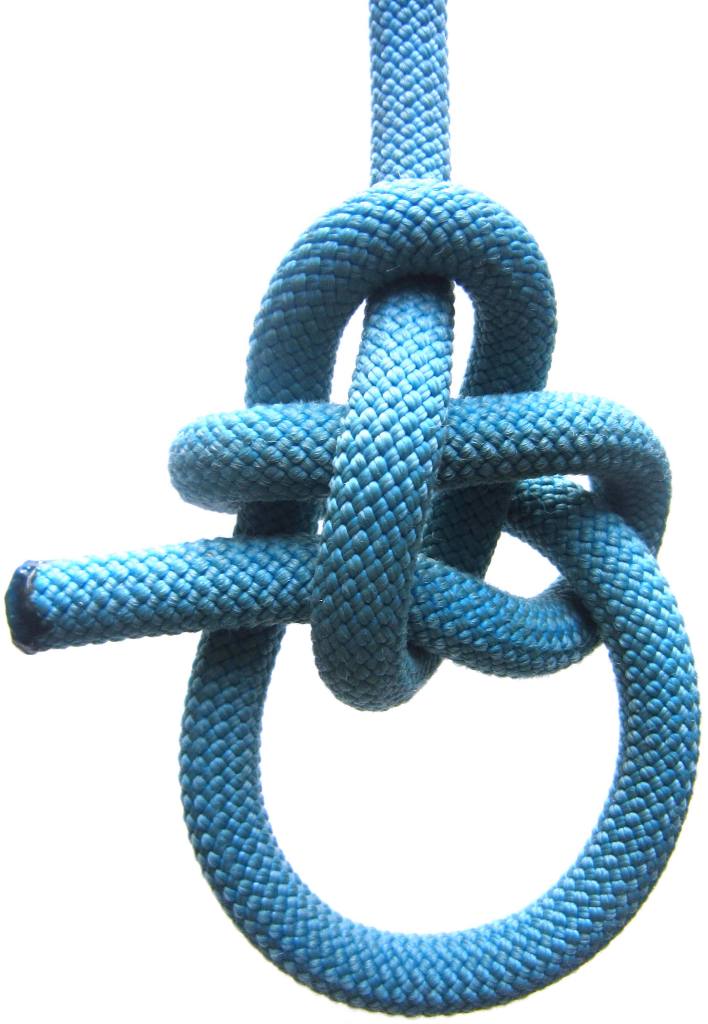

You might take X’s view of having a “proper collar” --something
Derek seems to favor–, but note that I look only for the (infamous?
–“many dislike …” : really?) “turNip” --“central nipping loop”
and am happy at that. We can see what each criterion allows and
disallows.
But please note that you abuse my term “anti-bowline” :
it is defined by the side of the nipping loop that the returning
eye leg enters, NOT by what it might (and hold that it need
not) collar. The Eskimo bowline is an “anti-bowline” because
in brings the returning eye leg in from the opposite side to that
of a bowline --at which point it can only collar the other
eye leg; it could, however, otherwise make a Mytle-like turn
around the nipping loop.
An example of a non-functional (ineffective) 'nipping loop' is with the Carrick eye knot (#1439 derived) prior to being transformed.?! I don't see this as non-functional, but our minds might be partially so :: one can set the lattice form of the (inchoate) [i]carrick loop[/i] by loading first the (newly envisioned) [i]turNip[/i] so to achieve a *bowline* --what I might struggle to classify and call a "[i]quasi[/i]-anti-bowline", since the [i]turNip[/i] really takes on the *tilt* towards helix typical of them but is held in check by the rest of the knot, yet the returning eye leg (rudely!) ignores the [i]turNip[/i] in its eagerness to collar the S.Part! Enter from one side, or enter from the other, OR NOT AT ALL?! --well, eventually, something gets through the nipping loop and binds it all together, but not directly. :o
Compare the transformed image - Carrick Eye knot #1439 derived - does this structure have a functioning (effective) 'nipping loop'?It has similar form to a munter hitch - and indeed reminds me of the nipping structure in the ‘Karash loop / eye knot’ in its single eye form.
Although I should point out that in the 'anti-bowline' - the collar forms around the 'ongoing eye leg' and not the 'returning eye leg'.NO, you should not point this out --that's wrong, as explained above. "anti-" is used as for "anti-cyclone" : a reversal of direction in like movement otherwise.
But please note that you abuse my term "anti-bowline"
Perhaps…
But I did not wish to go into myriad of detail - other than the observation that I have yet to see an ‘anti Bowline’ that has a collar-capstan formed around the SPart! Indeed, I dont think it is possible?
Yes - with the collar-capstan formed around an ‘ongoing eye leg’ - it is obvious that to perform such a maneuver, one must do everything back-ass-wards (or in an anti direction) relative to a standard #1010 Bowline.
For the so-called ‘Myrtle’ maneuver this is somewhat different…since I might have surmised that one doesn’t need to do everything in the ‘anti’ direction (relative to #1010).
"no, a nipping loop doesn't collar itself
Is that an absolute definition?
You have seen it, for I’ve shown it somewhere @IGKT// (IIRC).
But look before you type : before decrying/defaming
the Eskimo bwl just extend it as you seem to desire,
and put the darn “proper (‘capstan’?) collar” around the S.Part
–the tail is waiting, Janus calls!
"no, a nipping loop doesn't collar itselfIs that an absolute definition?
You have seen it, for I've shown it somewhere @IGKT// (IIRC). But look before you type : before decrying/defaming the Eskimo bwl just extend it as you seem to desire,
Yes - of course I am aware of the ‘Janus Bowline’ (aka double bight Bowline) - but this is not what I had in mind. And I am not decrying/defaming the ‘Eskimo’ Bowline…i am simply stating that i dont like the name. The knot structure is a different matter - I bare no ill will against it - and i have nothing defamatory to say about it either!
The initial collar-capstan is still formed around the SPart as per the standard #1010 Bowline - is it not?
Its just tail maneuvering which forms another (second) collar-capstan around the ‘ongoing eye leg’ (and also adds a 3rd rope diameter inside the compression zone of the nipping loop) - there is nothing ‘anti’ in the initial stages of tying Prohaska’s creation. Its all bog standard #1010. Things only go ‘south’ in the forming of the second collar-capstan. But I guess if you think Prohaska’s creation is fully deserving of the ‘anti bowline’ moniker - I guess thats your prerogative.
By the way - where are you going with all this?
What is your point?
…
Have you had a detailed examination of the photo I provided of the #1439 carrick bend eye knot derived Bowline (in its transformed state)?
Is there a functioning nipping structure?
In its pre-transformed state - I do not find the nipping loop to be functional - it is seized/held in check. Do you see otherwise?
I’m still not sure what value I can bring to this thread.
It seems that Mark is attempting to create a catalogue and analysis of ‘Bowlines’, but in order to do this, first he must set in place a list of the parameters that define the ‘Bowline’ Set.
Trying to get a feel for the problem, I believe that the first challenge is to establish a useful ‘Scope’ to the Set definition. Set too tightly and the set contains but a single member i.e. #1010 - The bowline. Yet set too loosely, the set has the potential to encompass the great majority of knotting possibilities and so has no value to Mark in limiting the number of knots he has to include in his analysis.
Of course, it is Mark’s paper, and he is at liberty to include any knot he wishes, but it is a technical analysis, and could easily find itself the subject of derision if he included knots which the general knotting world could not countenance as ‘Bowlines’ unless his Set definition was based on very sound, rational, knot logic. That is, the Set descriptors can be substantiated and are not subjective.
Doing this against a background of historical name usage, and in a field where the terminology is still in turmoil (nipping loop vs turNip vs hitch, vs loop vs eye vs ring …), is fraught. But perhaps if we allow ourselves to be a little less precious over the terminology (a loop = an eye = a ring …) and if we relegate historical naming convention to the back seat rather than automatically giving it front row priority, then we might be able to help Mark find a Set definition that can help him and at the same time give a reasonable justification for the knots he eventually includes in his analysis.
With this in mind, could I start then with what I consider to be the most obvious parameter - that all ‘Bowlines’ are Working Knots - that is, they are force machines and it is their nominal dressed working structure that we are classifying. This automatically eliminates all ‘artistically’ (i.e. sans active force) manipulated structures, even though these shapes may be utilised in decoratives and knitting circles.
[b]1. All members of the 'Bowline' Set are working knots whose structures are defined under a nominal loading pattern.[/b]
Second, again stating the obvious - all ‘Bowlines’ are fixed loop (eye, ring, etc.) knots where both legs of the loop are nominally loaded at 50% of the SP load. That is, both loop legs are nominally equally loaded.
[b]2. All members of the 'Bowline' Set are fixed loop knots.[/b]
Third, as this is a working knot, features of it’s creation and destruction can rationally be included. An important feature of the foundation knot #1010 is that it can be post fix tied, that is, the knot can be tied in its entirety after the end has been passed around or through the anchor point. Of secondary importance, the foundation knot decomposes completely after the WE has been released. This has started to move into the subjective, but in my opinion, it is worth including.
[b]3. All members of the 'Bowline' Set are post fixing tyable and decompose to nothing after the WE is released to pass through teh anchor point.[/b]
Fourth, again sticking with the undisputed - all ‘Bowlines’ have a loaded helical nipping loop. But here we need to start being careful to distinguish function from decoration. In essence, the defining function of the nipping loop is to clamp the WE with sufficient grip such as to allow the ‘capstonisation’ (if such a word exists) of the applied forces, into the body of the knot , thereby preventing them from drawing the WE out of the knot and destroying it. To achieve this, I would suggest that it needs to be loaded on one side by the SP in order to be able to drive significant compression force into the nip. This defining functional characteristic of the ‘Bowline’ Set also declares the primary weaknesses of this set, namely, loss of nip leads to loss of knot integrity, and concentration of load into such a short length of cordage seriously compromises knot strength over other, stronger, knots.
[b]4. All members of the 'Bowline' Set have a fully loaded (i.e. SP load vs loop load) helical nipping loop, whose function is to provide end locking of the WE, (and following from this, the WE must leave the knot via the nipping loop)[/b]
Fifth, the helical nipping loop is notoriously unstable and must be prevented from morphing into an open helix. In the #1010 of course, the helix is stabilised by a bight held taught by the opposing forces of the loop and the SP. This effect is achieved by a long bight collaring the SP and extending through the nipping helix and into the main loop. Other means of stabilising the nipping helix are possible though, and here we step firmly into subjective territory. I can find no rational argument to support expanding the set by including all other possible means of stabilisation or even including specific alternatives such as a second nipping helix as in the example of the Myrtle Loop knot. So, I will set this one as bight stabilised at the moment and leave it open for someone to come up with a logical argument for including different methods of helix stabilisation.
[b]5. All members of the 'Bowline' Set have the nipping helix stabilised against opening by a long bight retained tensioned by loading between the loop and its collar around the SP.[/b]
I think that those five definitions are all logically sustainable and of course, they define a Set which includes #1010. The question is, is it wide enough to encompass the set of knots that Mark would LIKE to call Bowlines?
Derek
Can’t remember where/when; but i first learned of the ‘eskimo’ as a ‘jacked-bowline’.
.
As most lacing structures the eye of the Bowline is meant to pull along it’s length,
and then too along the ropes length/not ‘splayed’.
.
eskimo/jacked thingy professedly would have it’s locking mechanism turned, so then be more apt to then be able to have pulls across eye/perpendicular to line.
This for me came to be in use for
loading a pulley with (red)line loaded in it
-from the ground to lay over the target branch it will hang on
-with the eskimo /jacked (blue line)as the eye of a bowline holding the pulley placed on the pulley system top and around it’s lowers
-then inverting the deal on a branch overhead;
-to leave the bowline choked like a sling, with the (blue)length of the line for removal to the ground
-holding the pulley/(red)rope for rigging.
.
this can take a lot of line especially for an 80’ height, loading in not just single redirect/1st class lever pulley system,
but advancing to 2 or 3/1 systems etc.
because the systems and holding line already take a lot of line;
but then would need 2x that much to have the pulley system lay across target support, both ends on the ground!
.
using the blue/bowline line as sling would put a spread apart force on the bowline eye/not pulling down the length.
So ‘jacked’ position by 90degrees would then lock when the pulls themselves where 90 degrees different
(being horizontal rather than vertical)
.
using the blue/bowline line as sling would put a spread apart force on the bowline eye/not pulling down the length. So 'jacked' position by 90degrees would then lock when the pulls themselves where 90 degrees different (being horizontal rather than vertical)
Yes, this has been pointed out before by others.
You are describing ‘ring-loading’ - this particular ‘anti-Bowline’ (aka poorly named Eskimo Bowline) structure - when ring loaded - mimics the function of a Sheet Bend. It is resistant to the effects of ring loading .
In contrast, #1010 standard Bowline is vulnerable to the effects of ring loading.
The same can be said of #1034 1/2 (L/hand Bowline) - it too is resistant to the effects of ring loading - although not as effective as the ‘anti-bowline’ because there is no collar-capstan. The presence of the collar-capstan in the ‘anti-bowline’ in its ring-loaded configuration boosts its performance.
Trying to get a feel for the problem, I believe that the first challenge is to establish a useful 'Scope' to the Set definition. Set too tightly and the set contains but a single member i.e. #1010 - The bowline. Yet set too loosely, the set has the potential to encompass the great majority of knotting possibilities and so has no value to Mark in limiting the number of knots he has to include in his analysis.
The reference to ‘loose’ and 'tight ’ - I have previously preferred ‘narrow’ versus ‘wide’ - per legal construction used by Judges in a court of law. Creating too wide a definition of certain issues in legal proceedings is problematic.
I would prefer if you avoid suggesting that this is my issue or my project alone. I have seen this matter as a problem waiting for a solution for a long time now…and I can actually see a tiny little light appearing down the end of a very long tunnel.
Of course, it is Mark's paper, and he is at liberty to include any knot he wishes, but it is a technical analysis, and could easily find itself the subject of derision if he included knots which the general knotting world could not countenance as 'Bowlines' unless his Set definition was based on very sound, rational, knot logic.
Yes, it is ‘my’ paper - but I usually see myself as ‘editor’ first and author second. I am relying on input and advice from several sources - chiefly from amongst the IGKT.
I have a vision that it will be important to showcase certain knot structures to illustrate the core function of a Bowline.
For example, I am of the view that the following knot structures must be compared and contrasted against the #1010 standard form:
#1431 Sheet bend
#1033 Carrick loop
#1152 Sheepshank
anti-Bowline (with collar-capstan formed around ongoing eye leg)
karash loop (single eye knot version)
I will be exploring the core function of a Sheet Bend - and closely comparing it to the core function of a standard #1010 bowline.
I will also be exploring various ‘nipping structures’ - which stray from the #1010 standard helix form.
I would suggest that it needs to be loaded on one side by the SP in order to be able to drive significant compression force into the nipI was reading very carefully to learn what your position is with respect to how the single helix 'nipping loop' is loaded (ie SPart side alone or [i]both [/i]ends loaded).
I of course am compelled to ask the million dollar question…"Is there a Bowline in existance that has a nipping loop that is only loaded at one end - ie the SPart end loaded (not both ends loaded)?
If there is, where and what is it? I would like to see a detailed photo please.
//////////////////////////////////////
Other than that, I am in general agreeance with your 5 points…except for the remark that the …“The WE must leave [exit] the knot from the nipping loop”. It could of course also exit/deviate via the collar-capstan in parallel to the SPart.
Read carefully, please.
“IT” is NOT --and that was the point.
You can take what you replied, and then cut the
returning eye leg and fuse it to the tail, that will
get you what I remarked at --and the anti- certification!
(In fact, that was how I came upon some very interesting
bowlines, if not this one itself, which sometimes I think
I prefer to the non-anti one, but I’m not sure why. By
looking at a diagram and re-connecting parts to different
parts --something that can happen accidentally, too!
(We proudly call that serendipity, unless no one is looking,
and we claim ingenuity later.  ))
))
Have you had a detailed examination of the photo I provided of the #1439 carrick bend eye knot derived Bowline (in its transformed state)? Is there a functioning nipping structure?In its pre-transformed state - I do not find the nipping loop to be functional - it is seized/held in check. Do you see otherwise?
And from the lattice form of your 2nd-of-four images,
I can load the S.Part & on-going eye leg so as to lock
in that apparent nipping loop and satisfy my desire for
a bowline --just as done w/#1033 (which thus formed
is IMO a knot worthy of much better awareness & usage!).
(But a dislike : the nipped part of this surprise bowlinesque
eye knot makes the S.Part turn around 1dia, effectively,
as the would-be 2nd actual strand nipped aligns with
the axis of tension. This can be altered in some ways.
One could look upon the significant aspect of your Point 3 as defining,
and see what it garners as a set. So, I don’t understand why you
“find no rational argument …” for this, and instead want to limit
the set by further criteria? --to what point? There might be some,
but I hope that people can see a point to defining this broader set
–whether called “bowlines” or something else, which would be
said to include bowlines–, as it has such a character to it.
As for “helical loop”, I feel Occam wanting to slice away a seemingly
gratuitous adjective : do you have other “loops” in knotting?
I can conceive of doing clever things with hollow-braid (loose)
cordage by tucking through the braid, but, in general, one
would rather oppose “loop” and “helix” --neverminding the fact
that the former is an extreme(ly tight) case of the latter.
(Indeed, one might think of “anti-helix” where the turn comes
back vs going away, so that the “crossing point” feels pressure
of its adjacent strands --making this canonical, as practical forces
will often see the “loop” open, lose such contact. Canonically,
though --and I’m thinking this applies to my “apparent”–,
that would be a separator perhaps of “anti-bwls”!?)
As for #1033, let’s look at this more intelligently than forcing
into a lousy form. (Egadz, Ashley’s drawing of the supposed
set knot is rubbish!) As an eye knot for resisting capsizing
and for being easy to untie, it’s quite good, in a form not
hauled tight --just as one doesn’t haul #1010 tight. I’d
like to see this tested!