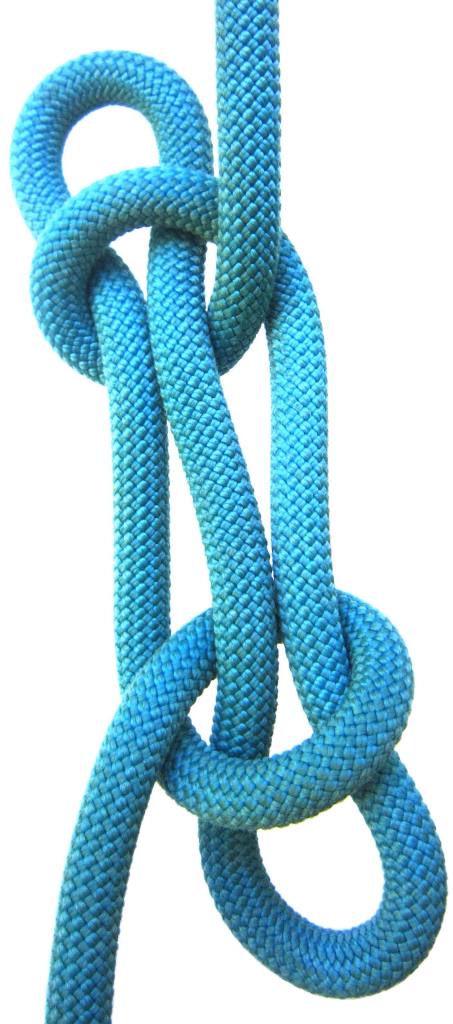
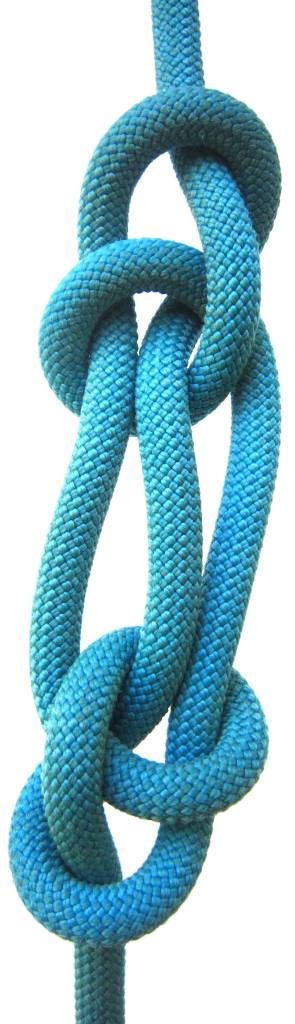
Analysis of Bowlines paper uploaded for review and comment (PACI website)

Dressed and Set

A working knot does not, indeed generally cannot, function as intended until it has been Dressed and Set.

One of the reasons I would never use a bowline as my primary tie in is because of its propensity to Un-Set and Un-Dress itself. Put simply, the Bowline is not designed to be ‘self competent’. The Constrictor is ‘self competent’ because once Dressed and Set it has a self clamping function that prevents unravelling. The Carrick is ‘self competent’ because any loading automatically causes the knot to Self Dress and Self Set. [In this respect, the Carrick is genuinely the King of all working knots - or should that be Queen, because it is just so damn good looking?]

But the Bowline relies on the tier to dress and set the knot, then load to maintain the nip which in turn is the only way the knot can remain intact and prevent the WE from escaping.

I tried your experiments using a PUL110 with 11mm Kernmantle dynamic. It was impossible to dress and set the bowline because the natural stiffness of the rope kept the nip open and the absence of a dressed collar allowed the nip to open further. Yes, every time I tensioned this ‘open’ knot, the WE flowed easily out of the open nip and around the SP. However, once I manually closed the nip, the negative cogging of the bight legs immediately arrested flow through the nip and movement around the pulley collar ceased.

So, I repeat my claim - ’ in a dressed and set Bowline, there is no Capstan flow in the collar '.

This image demonstrates three things :-

http://igkt.net/sm/index.php?action=dlattach;topic=4480.0;attach=20421;image

The first is that there is no capstan effect - otherwise you would have seen one collar leg under more tension than the other as the ‘suggested’ capstan effect gripped the SPart, passing load into it and leaving the other side less loaded.

Hopefully that is now the death of the Capstan argument.

The second thing this images shows, is that the collar is not the key of the bight component, rather, it is the legs of the bight that are responsible for stabilising the nipping helix. The partial load from the returning loop leg, negatively cogging into the WE, makes this tensioned pair a turning load on the nip, which extends through the nip and is in turn partially stabilised by the flow of the bight legs into the collar which retains the bight in place.

The third and actually the most important thing this image shows is the critical importance of Dressing and Setting a working knot. In fact, I would go so far as to say that this image is not a Bowline because it us not yet correctly dressed and set.

Derek

http://igkt.net/sm/index.php?action=dlattach;topic=4480.0;attach=20415;image

This is not only a Bowline, it is also a Work of Art !!!

You know the way sometimes you look at something and first impression is Eue - that’s ugly… well that is how this first hit me - then I looked closer.

As Alpineer explains, it is a #1010 with a HH top and bottom and a final tuck of the WE into the Eye.

Looking at this knot it is dawning on me that its creator is a person who lives and works with working knots. I would like to get to know them because I think I could learn a lot from them.

The first HH around an eye leg and then tucked through the tightly dressed collar, secures the WE without risking jamming the knot when it is heavily loaded. The HH made tightly against some other component or object is essentially the nipping turn (hitch) found in the Sheetbend, it is surprisingly ‘self competent’, particularly with the WE further secured within the collar.

But this knot does not stop there, it continues to build on the easy application of another HH behind the well dressed collar. The result is to further stabilise the collar against the often seen deformation under load.

But it is the final two twists that nearly give me goosebumps. The first HH closed the gap between the two loaded legs of the eye, so taking the tail and wedging it against the side of this HH, it forces the sides of the eye apart, so the load on the eye ‘squeezes’ the end, holding it gently, yet firmly while giving even more competence to the HH. And the goosebumps !! look how exactly the tier has judged the amount of rope needed to just fit that tail into the pinch, without a flapping tail to get caught up, yet pinched so gently that nothing is going to bind up with heavy loading.

I’m putting these images into my ‘Admiration’ Scrapbook.

Derek

??!
I report doing what you do and you reply to that and
ask if I can repeat … ?!? WE DID THE SAME THING!
–except for different pulleys (I like yours!), and I had
my pulley eventually INdependent of the S.Part, as
–as written above-- it seems to me that in some
configuration --i.p. y/ours-- there is the effect of
pulling the collar bight (from nipping loop)
which is a different thing than normal bowline action.

So, see if YOU can repeat your testing by arranging for
the knot to assume a decent starting point --i.e., the
colllar-pulley making good effect on orienting the central
nipping loop-- AND THEN LOADING THE S.PART vs. an
anchored eye --the point being to if anything be
pulling the knot upwards, and towards the pulley and
not pulling it (by loading eye) away from the collar.

Now, I did go repeat … and I am further convinced that
the movement that we have seen is attributable as I’ve
just said : of the knot being pulled away from the collar
and so the less-secured part --viz., the tail-- is what moves,
rotating our pulleys. But if one works to avoid this
unnatural loading of parts, to have the collar remain
unbiased so to speak, and to load the knot from
the S.Part end mostly, or otherwise arrange for the
pulley’d collar to move with knot, one will not see any
movement betraying some “capstan effect”.
Now, in defence of the CE-exists position, I will concede
that we inevitably allow for the nipping turn to become
pretty parallel to the axis of tension and thus turning
the collar legs more perpendicular to it
and thus putting that bending as resistance to their
movement.

Furthermore, I’ve tried achieving a good knot form
and then holding just the “ongoing eye leg” in making
tension on the knot and then pulling away on the
collar pulley :: BOTH bight legs are pulled through
a sort of rotating nipping loop, and I don’t see any
movement of the pulley (which would occur were
the collar legs pulled at different rates).

.:. I don’t see evidence to support a “capstan effect”
to any degree of significance. It remains just some
conjecture, IMO, and not one I share.

–dl*

Just advising that I am currently undertaking a re-write of the Bowlines paper - and adding a lot of new content plus several additional knot images.

Some quick FAQ’s - I have received emails from several individuals - and some people seem to be arriving at their own conclusions regarding what the paper is or isn’t. Some of the claims made are wildly inaccurate and just plain wrong.

  1. Firstly, this paper is not about discovering and/or analyzing the next new and fabulous tie-in knot for climbing/mountaineering. So if you think that the primary thrust of this paper is to find and promote a new Bowline tie-in knot - you would be wrong.
  2. The paper is certainly about Bowlines - and it attempts to find the core components/elements that entitle a knot to awarded the title of ‘Bowline’
  3. Along the way, some new ideas and concepts are explored and discussed.
  4. Some major players - who have been active in the IGKT forum and in particular contributing to this topic - will be quoted (I am sifting through the many pages of written replies and extracting key concepts…).
  5. I see myself as the principal architect and editor of the paper - but not the principle knotting expert or theoretician. i see others in that role (not me personally). I like to ask questions and then wait for the responses - and then ask another bunch of questions…and so on - until I can get some sort of clarity on the subject matter. For example; with regard to the ‘capstan effect’ - I make no decisive claim either way - I just ask the question. I did perform some simple experiment - and it was inconclusive (however, what is conclusive, is that I could observe no capstan effect once the compressive force of the nipping loop was operating. Any ‘slippage’ that was observed only occurred during initial loading - but even that was ‘inconclusive’ - in that, sometimes I noticed a little tail creep around the SPart/collar and other times I did not. But I never observed any tail creep around the SPart/collar during moderate or higher loading). Be that as it may, there are some who are strong advocates for a measurable/observable capstan effect - and I need to make sure that their voices are heard too).
  6. There are some strong personalities and equally strong opinions that I am trying to work with. I try to be fair to all parties - and be inclusive rather than exclusive when documenting ideas and concepts.
  7. Over the years that this project has been crawling long - it has demonstrated to me that there is no uniform agreement over what constitutes a ‘Bowline’. So i just keep plugging away - sort of like the Egyptian pyramid builders who chipped away at huge granite blocks…you just have to see the bigger picture :slight_smile:

Mark

But is should go to some good effect to set out how
various things that might fall under the casual reference
to “bowline(s)” can be quite different, with consequent
differences in behavior --leading to, naturally, different
conclusions about “the bowline” and showing thus how
the failure to recognize distinct knots causes confusion.

For example; with regard to the 'capstan effect' : I make no decisive claim either way; I just ask the question. I did perform some simple experiment ... [and I too echoed your effort] // Be that as it may, [u]there are [i]some[/i][/u] who are strong advocates [b]for a [i]measurable/observable[/i] capstan effect[/b] --[u]and I need to make sure that their voices are heard too[/u])
Here I --and I surmise also Derek, and it should be you yourself(!) and others(!!)-- will call you out on this and demand some evidence beyond mere conjecture! SHOW US THIS OBSERVED MEASUREMENT! --or else, please do NOT give it credence in publication. (And we must presume "some" to be "someONE", whom we've some extensive experience with --with making unfounded speculations, strongly.)
- and [my testing of the alleged "capstan effect"] was inconclusive (however, what is [b]conclusive[/b], is that I could observe [u]no [/u]capstan effect once the compressive force of the nipping loop was operating. Any 'slippage' that was observed only occurred during [i]initial [/i]loading, but even that was 'inconclusive', in that, sometimes I noticed a little tail creep around the SPart/collar and other times I did not. But I [i]never [/i]observed any tail creep around the SPart/collar during moderate or higher loading).
And so too did I initially see, like you, significant tail slippage, but found a rationale for this (viz., pulling collar away from the nipping loop), and adjusted my test configuration so as to avoid this pulling : and then I saw no tail slippage.

(One idea occurs to me now, to try to redress the effect
of removing loading of the put-into-pulley would-be collar:
make an effective collar --so to achieve natural disposition
of the nipping loop-- out of a separate piece of cordage,
anchoring to the “on-going” eye leg. The point here is
to give less “deflection”/curvature to the would-be collar’s
bight legs, to make them more vulnerable to alleged slippage.)

6. There are some strong personalities and equally strong opinions that I am trying to work with. I try to be fair to all parties - and be [i]inclusive [/i]rather than [i]exclusive [/i]when documenting ideas and concepts
Stepping aside from personalities, be disinterested and just ask [i]What is the [u]evidence[/u] ?[/i] : so far, we have seen the two of us try to find evidence; what else --esp., from who so strongly asserts the "capstan effect"?! You do understand science's demand for repeatable results?!
7. Over the years that this project has been crawling long - it has demonstrated to me that there is no uniform agreement over what constitutes a 'Bowline'.
However, one can be confident is showing what [u][i]the[/i][/u] [i]bowline[/i] is, and then note other things as sharing this or that aspect, without purporting to be making a definition of a set, but just showing how some things (e.g, the [i]turNip[/i]) from the agreed venerable knot are used in other knots, and to what effect. Others can cite the exposition in making their own claims to this or that.

–dl*

Just announcing that VER 2.4 (10 Feb 2016) is ready for download.

Link: http://www.paci.com.au/knots.php (located at #2 in the table)

I have undertaken a significant re-write of the content.

Again - please keep in mind at all times that this is still a work-in-progress.

I welcome your considered feedback.

If you require changes to be made - please try to be specific - eg page numbers, the particular text that is a source of irritation etc. And then provide new content so I can copy-paste it!

Of particular interest to me are pages:
page 7 (a rationale for showing the ‘detail’ view of a Bowline)
page 11 (examines the difference between loops and turns) - I need further technical feedback to improve this page please…
page 15 (ring loading) - I have significantly re-written this page
page 17 (capstan effect) - a significant re-write (oh dear!)
page 22 (Myrtle) - new content - need further technical feedback to improve this page please…

and a few other amendments and enhancements…

Mark G

Hi Mark,
(IMHO)

  • p.11, maybe it’s better to distinguish the right-handed loops (turns) from the left-handed loops (turns) (for reference see Asher, The alternative knot book p.22, I can post a picture about that). In your pictures the “underhand loop” is a right-handed loop, but if you turn it upside-down it does become an “overhand loop” (but always a right-handed loop), doesn’t it?

p.22 about the Myrtle, it is stable if the nipping loop and the tail loop (tail turn) are one right-handed and the other left-handed (or vice versa).

ciao,
s.

Hi Mark,

I have to echo Knotsaver re the Myrtle on p.22.

A Myrtle requires one helix to be ‘S’ twist and one to be ‘Z’ twist otherwise it is not stable.

It does not matter which side of the nipping helix the return loop leg enters, provided it’s twist is opposite to the twist of the ‘Nipping Turn’.

If you take the knot shown as being unstable, leave the entry direction the same, but reverse the twist from ‘Z’ to ‘S’, you will see the knot is quite stable.

This is a rather neat example of the importance of the requirement that in the Myrtle, the helix components must have opposite twists.

NB I see you have added

Note: This author disagrees that there are ?twin nipping loops? and argues there is only 1 nipping loop

I guess this harps back to the earlier insistence that a ‘Nipping Loop’ / ‘turNip’ / ‘Nipping Helix’ must have both ends loaded. Yet that definition was made without thought being given to any acceptable degree of differential loading.

In the case of #1010 the loading is ca 2:1 SP:Loop leg.

So, at what point is the differential in loading unacceptable and the ‘Nipping Loop’ ceases to reflect this apparently critical aspect?

Further, the definition fails to stipulate where this ‘loading’ comes from. Obviously, it must resist the load from the opposite end of the nip, but must it be externally generated? Or can it be self generated as when that end is nipped or clamped by some other part of the knot?

And what is some percentage of the load is external and some is from clamping? When does the definition no longer apply?

Obviously, a ‘Nipping Loop’ / ‘turNip’ / ‘Nipping Helix’ has to be loaded at each end, otherwise when load was applied to one end it would simply flow and exit the knot. Any force applied to the end will be amplified by the Capstan effect of the turn and so create the compressive nipping force. But that force can come from clamping the end as well as external tension.

I contend that both components in the Myrtle are ‘Nipping Loop’ / ‘turNip’ / ‘Nipping Helix’ components, but you have dismissed one of them from this group. What then would you have us call the second functional nipping helix? And perhaps more importantly, how are you proposing to handle the infinite array of variations of load differential and combinational loading sources?

Derek

A bight has two legs, and as the following image shows, they are critically important in the stabilisation of the Nipping Helix in this loop knot -

http://igkt.net/sm/index.php?action=dlattach;topic=4480.0;attach=20421;image

By contrast, the ‘Collar’, claimed on p.5 to be “an important component of a Bowline” is shown to be trivial, little more than the means to return the second bight leg to its partner, in their joint stabilisation of the nipping helix.

The bight legs are important in their role of stabilising / resisting the turning moment of the loaded nipping helix, while the role of the collar is trivial.

We have at last put to bed the imagined (yet strenuously argued) role of the capstan effect in the collar, but we are still hanging on to the claimed ‘importance’ of the collar in the Bowline functionality.

OK, if it is more important than the stabilising function of the bight legs, then let someone post here either proof or logical argument of this importance.

Yes, it can add a small amount of counter rotational stabilisation to the nipping helix, but as this image shows, it is trivial to the extent that the knot can handle all the loading without significant help from the collar torque.

Derek

Hi Derek,
what about if you use a carabiner ticker than the one in the picture? (you can consider it a “micro” ring loading).
I think the nipping loop will be not stable any longer! I think the collar helps to stabilize the nipping loop (see the components under load (p.28), what happens without the collar?).
In the Sheepshank the nipping loop is stabilized by the bight and by the torsion determined by the other structure (second bight and second nipping loop).
In the Gleipnir the stabilization is determined by the two ends entering the nipping loop from opposite sides (and by their tension).
I think the collar is an important component for the stabilization of the nipping loop.
ciao,
s.

But it matters definitionally as to whether the formed knot
is a “Myrtle” (or else an “anti-bowline”, one sometime called
the “Swedish bwl.” & " bollard loop" per an IGKT article
–and is the Myrtle in reverse (i.e., loaded tail qua S.Part)).
In the latter case, I’ve seen like-handed knots, and the tail
is nicely presented for seizing/taping to the S.Part; set well,
the knot is stable --more so than for the Myrtle.

NB I see you have added
Note: This author disagrees that there are "twin nipping loops" and argues there is only 1 nipping loop

I guess this harps back to the earlier insistence that a ‘Nipping Loop’ / ‘turNip’ / ‘Nipping Helix’ must have both ends loaded. Yet that definition was made without thought being given to any acceptable degree of differential loading.

In the case of #1010 the loading is ca 2:1 SP:Loop leg.

So, at what point is the differential in loading unacceptable and the ‘Nipping Loop’ ceases to reflect this apparently critical aspect?

Derek


One might consider that if the main “nipping loop” actually
nips then the nipped would-be-loop parts canNOT --for
they are nipped and immobilized thus!? They do have effect
in the unloaded but set knot in keeping it tied/secure,
but on loading, one could even see space open within the
“would-be” loop’s enclosure --I know this to be true of the
“end-binding” loop of the EBDB, and so try to set that quite
tight in anticipation of such opening (which comes as loaded
parts that it surrounds diminish in diameter).

–dl*

VER 2.4a (12 Feb 2016) is uploaded.

Significant changes made:

page 11 (re-written with new images)
pages 18+19 swapped
page 20 (new page and new content)
page 25 (Myrtle) re-written

Keep in mind that this is still a work-in-progress.

I am starting to run out-of-time again.

I am happy with the way the paper is progressing… a big improvement over the original content from 2013.

I welcome any constructive and considered feedback.

Mark G

Hi Mark.

Thank you once again.

I’ve no constructive criticism, just an appreciation of your good work!

I think that Alan Lee should be added to the contributors list on Page 3.

I am of the opinion that the ABoK #1010 is “the Bowline” and if an eye knot does not contain its basic configuration, first, then it is an eye knot of some other name/descriptor. I believe it should be that simple.
Possible exceptions that could include the “bowline” moniker are where the nip turn and or collar is doubled, or tied with a bight.

The theory of multiple diameters within the nip turn reducing breakage (Strength increase over the original) has not been proven to my knowledge. I suspect that there will be an increase of torsional, etc., movement within and more rope deformity that can lead to destructive force.

I agree that strength increase is not a particular requisite and that the main gain of the multiple passes through the nip structure could lead to better security, mainly because of increased collar stability and tail capture.

Just some of my thoughts on it.

Thank you.

SS

Mark,

You state on p.17 that “The role of the Collar is very important in a Bowline”.

If it is so important, it will presumably be relatively easy to catalogue its functions and how loss of these collar functions destroys the viability of the knot.

I can offer - The Bight is very important in a Bowline because it counters the turning moment created by the loaded Nipping Helix. The bight collaring the SP offers a small degree of stabilisation of the Bight in low load situations.

I certainly can not think of any reason to claim the Bight Collar to be important, while ignoring the Bight legs.

While I am happy to continue to contribute to the discussion here on the Forum, as you persist in stressing the importance of the collar without first justifying this claim, I feel it necessary to ask you to remove my name from your document.

Derek

as you persist in stressing the importance of the collar without first justifying this claim, I feel it necessary to ask you to remove my name from your document

Hmmmmmmmmmmmm…

I am not used to being given ultimatums.

I can say that I am not a miracle worker; this paper is difficult to write and difficult to get technically correct.

Someone once told me… “You can please some of the people some of the time - but you can’t please all of the people all of the time”.

I am presently working on content to prove the importance of the collar as follows:

  1. All Bowlines have a collar structure - I am unable to find an example of a Bowline where it is absent.
  2. The Sheepshank does not have a collar - and as load increases, the scissor-like action of the nipping loop causes the bight to fold/kink. As load continues to increase, the Sheepshank becomes unstable. I find this interesting…this suggests that the SPart acts as a ‘bracing post’ - in that the collar is braced against the SPart. If the sheepshank had a collar (ie 2 collars - one for each bight) it would mimic the function of a Bowline - but, since it has no collar structure, it degenerates and becomes unstable.
  3. If I tied #1010 but left the bight in free space (with no U turn around the SPart) - no collar - would it still be a Bowline? (refer to attached image).
  4. I posit that the collar acts as a stabilizing element for the bight - when there is no collar, the bight component is unstable.

I would ask that you consider the attached image… Is it a Bowline?

Furthermore, you are demanding that I supply proof of the importance/significance of the collar in a Bowline - that is, you are placing the onus of proof on me. I would like to reverse the onus of proof. I draw your attention to the Sheepshank and to the attached images as the basis for argument.

Mark


Sheepshank_no-load.JPG

Sheepshank_Bowline_Morphed.JPG

VER 2.4c (12 Feb 2016) is uploaded.

Significant improvements made:

page 2 (re-written)
page 14 (new content examining the role of the collar)
pages 34-40 (alterations and enhancements + some additional new content)

Derek Smith has been deleted as a contributor.

Alan Lee has been added as a contributor (please advise if you want to be deleted).

Keep in mind that this is still a work-in-progress.

I welcome any constructive and considered feedback.

Mark G

WOW! I cannot believe I’m reading this!

So, Derek, you’d happily put your life on a collarless
–but with pair of “bight” legs-- bowline and … ?!
–rap off of Yosemite’s famous walls,
moor your just-won-in-the-lottery yacht,
or even tie up a pet dog ?!

Heck, I know that a great many knots books present
the sheepshank as a once-used (and potentially
still useful, though How…? is typically not articulated!)
knotted structure,
but I’m way chary of even employing that --though have
done so, on a short line I step to haul on my pulley (if
things go bad, my foot has a short fall to the ground).

Just when I thought X’s musing about some “capstan effect”
was dimming in the view of others, you seem to have ruled
out ANY effect for the collar! :o
Quick, someone, turn on the lights! 8)

–dl*

Dan,

I would appreciate your considered feedback on VER 2.4c.

I am starting to bog down… my eyes are bleeding and I am worried about DVT (deep vein thrombosis) from sitting motionless for far too long and pounding a key board.

Anyhow, I am still trying to understand Xarax’s private emails re the ‘capstan effect’ and ways to devise a better test rig. Be that as it may, my test rigs have proved either inconclusive or that there is no capstan effect once the compressive force of the nipping loop has engaged. I would have thought that the rotating drum (sheave) of a pulley would reveal a capstan effect (ie slippage ought to have occurred) if it existed - but it did not.

However, my observations lead me to believe that the collar is nevertheless important as a bracing post for the bight component. Please look at the images on page 14.

I also posit that the attached image is not a Bowline - because there is no collar.

EDIT: I might add that without the collar - as load increases, I found that not only does the bight fold down, the nipping loop also is vulnerable to collapse - in that once a certain load threshold is reached - the helix degenerates and collapses.

Mark

The shocking news in the past couple? --just-- years
about supposed bad effects of sitting (not a new thing
to do, after all!) came w/o any good indication of Why…?
–but I surmised it must have to do with circulation.
To that end, at least get up and do some squats (which
might prove beneficial otherwise, too!). Some folks arrange
to be able to “pound …” whilst standing.

Anyhow, I am still trying to understand Xarax's private emails re the 'capstan effect' and ways to devise a better test rig.
Which implies that HE hasn't (tested...) ! Frankly, I was impressed we both got into it, and IMO did a fair job --you needed to separate the attachment of the pulley from the S.Part, which pulled it away ... . I'll be happy to hear of other testing. (Big news currently is that seeing/hearing/*feeling* of bent space-time per Einstein after black holes collided?!)

:wink:

Hi Mark,
IMHO (I don’t want to reinvent the wheel :wink: but…)

without a collar it’s unstable the nipping loop, not the bight.
We are able to stabilize the nipping loop (in ABoK #1010) by the whole bight (legs + collar).

To my mind the first 3 key components are:

  1. a nipping loop
  2. a (nipping loop) stabilizer
  3. a fixed eye

The term “fixed” hides something: how do we obtain a fixed eye?
I think by a stabilized nipping loop!

About the Myrtle (p. 26) you say: “The structure is stable…This occurs when the ‘returning eye leg’ enters the nipping loop from the SPart side (in the same way that a standard #1010 Bowline is formed).”
Please look at the attached picture: in this (wrong) Myrtle the ‘returning eye leg’ enters the nipping loop from the SPart side, but it’s unstable. because the 2 loops (turns) are both right-handed…
That holds (mutatis mutandis) when the ‘returning eye leg’ enters the nipping loop from the same side as the ongoing eye leg - rather than from the opposite SPart side: we can obtain a stable (quite stable, more stable…I don’t know) structure by 2 loops one right-handed and the other left-handed.
(this reminds me the ‘Boobash’ (Boobashley? Boobasher? :slight_smile: ) ABoK #1445).

ciao,
s.