Is this knot a bowline? or not? If it is, why is it? If it’s not, why not?
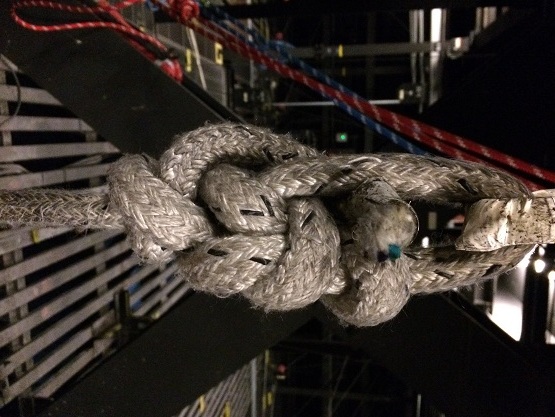
Is this knot a bowline? or not? If it is, why is it? If it’s not, why not?
It’s the standard #1010 Bowline secured with a Half-Hitch on the returning Eye Leg, tail then passed through the collar, followed by a second HH on the S.Part, finishing with the tail passing (pointlessly?) back through the Eye.
So yes, it’s a Bowline… with additional tail maneouvers to enhance security.
To any interested IGKT members…
I have uploaded VER 2.2 of the Bowlines Analysis paper (31 Jan 2016).
Its a PDF file and its unlocked - not password protected.
Go here to download it: http://www.paci.com.au/knots.php
I welcome constructive criticism.
If you want your name deleted from the paper - please let me know and I will do so.
There are undoubtedly going to be typos and other technical errors. Its a work-in-progress. So abusive remarks and/or comments of a defamatory nature would be unwarranted and unwelcome.
I have acted in good faith at all times…I just want to get this technically correct/accurate. I also would like to acknowledge those persons who have posited / theorized / shared their knowledge. Xarax is absent - so I had to take some educated guesses at his theory re the ‘proper collar’.
I look forward to improving the paper with your considered feedback.
Mark
Mark,
Well done on producing such a professional document.
I have a couple of points I would like to discuss, but first up, a safety issue, the Myrtle you show on P18 is not a Myrtle, I think Dan has called it a ‘False Myrtle’.. it is made from two Z nipping loops which are subject to positive cogging.
The Myrtle MUST be made from one S helix and one Z helix, it is the only safe form. Two Z or two S are both positive cogging.
I believe in the example you give of coiled springs, the S form is what you have called ‘Left Hand’ and the Z form you have called ‘Right Hand’. Is there a rationale for calling them ‘Left’ and ‘Right’?
Derek
OK, responding to version 2.2. I see a significant reference to the ‘Capstan Collar’. Reading back, I see this seems to have been sold to you by Xarax.
While Constant was technically correct in holding that the turn of the bight around a static object (the SPart in the case of the Bowline) can exhibit the Capstan effect, in reality, in the Bowline, this does not exist.
If you take a turn around a static object (a capstan), and load both ends equally, there is essentially(except - see Note 1) no capstan effect. The capstan effect comes into play when the ends are differentially loaded, then the coefficient of friction and the ‘amount of turn’ come into play in shedding a proportion of the differential force into the static capstan.
You might be tempted to argue that indeed, one leg is loaded with 50% (from the loop), while the other is the WE and so is zero loaded. However, the reality of the situation (in normal CF cordage) is that the nipping helix (containing a nominal two cord diameters) holds essentially all of the returning force from the loop leg, so in reality, the collar sees only a tiny fraction of the loop load and so there is no differential loading for the capstan effect to come into operation.
In fact you demonstrate this nicely on page 20 where you show that the loop force was unable to penetrate the nip in order to tighten up the collar, and you make the point that “Even at 1 metric ton, the collar can still be manipulated”. This would not have been the case if any significant amount of force had escaped the nip and brought to bear a capstan effect around the SPart.
I am sorry, but in the case of #1010 the assertion of a working ‘Capstan Collar’ is a seriously misplaced application of cordage science, and using the term ‘Capstan Collar’ is likely to provoke disagreement with use of the term or the functionality it implies.
Derek
[Note 1. Where a bight collar exists around a static object (capstan) and both ends of the cord are loaded equally, the capstan effect comes into play in that the loading is shed progressively into the static object, such that the loading in the cord at the mid point of the bight collar is slightly lower than the applied load. If the cord takes multiple turns around the static object, the the centre turn will be significantly lighter loaded than the applied loads.]
The ‘Bight Component’
First up, a bight has it two legs laying adjacent. If they are crossed, you are heading towards a new (nipping) loop. So in some of the examples you give when the collar legs enter another object from different sides, this is no longer a bight. [NB Bight legs are significantly Negative Cogging. If the legs are arranged to approach from opposite directions, they become Positive Cogging. The difference is significant.]
Dan recently took me to task over redundancy in using the term ‘Nipping Helix’, when any turn has to be a helix. But I had used the term deliberately in order to stress the fact that this object is a helix, that is, it is not symmetrically loaded, and under load it creates a lateral force which attempts to ‘open’ the helix. Any knot that uses this ‘Nipping Helix’ component, needs to compensate this tendency, and in the case of the Bowline this is accomplished by the loaded Bight Component.
If I may reproduce, with your permission, part of your image of the #1010 on page 6, in order to demonstrate my point :-
http://igkt.net/sm/index.php?action=dlattach;topic=5593.0;attach=20417;image
The Bight Component, is essentially strung out, loaded loop leg one side and collared SPart the other side. This tensioned Bight acts to resist the turning moment of the loaded Nipping Helix. In fact it is the Bight legs, trapped by the Nipping Helix that deliver the counter turning moment. As mentioned in the previous post relating to the ‘Capstan Collar’, very little force escapes the Nip and so the Collar only plays a minor role in stabilising the Nip, but of course, it does play a part in maintaining the Bight component at times when the loading is trivial.
Remember also, that Bight legs are negative cogging, so in the nip, force is transferred from the loop leg into the WE and both Bight legs contribute to supplying the necessary moment to stabilise the Nipping Helix.
My point is that it is the whole of the Bight, not just the collar that provides the all important ‘Nipping Helix’ stabilisation force.
Derek
Finally, and then I will shut up.
On page 15 you use a decorative Carrick mat to demonstrate that #1033 is a Bowline.
Although you start this document talking about using the Bowline in a working environment, your list of defining characteristics does not mention that these forms are not decorative constructions, but are working, loaded, force machines. Perhaps you omitted this because this is self evidently your intention to discuss working knots.
Why then have you used the decorative form of #1033 to argue that it fits the definition when, in use, it takes up the form of an entry Carrick component stabilised by a turNip??
An page 13 then we have #1033, a Carrick based knot - the Karash, a Bight stabilised Carrick - #1439, a Carrick stabilised Carrick, and the Lee Zep - which is a Myrtle with the WE wrapped and tucked (at least it is a legitimate Myrtle, with one S and one Z).
Of note, on page 17, you mention that the Karash double loop - “remains easy to untie even after heavy loading” - doubtless this is courtesy of its central Carrick component - renown for its strength and resistance to jamming. Just a shame it is not PET.
Derek
Agent_Smith: Congratulations on the latest edit of your impressive bowline paper.
One small note, your paper expresses uncertainty regarding the origin of the Yosemite Bowline, see this relevant link:
http://igkt.net/sm/index.php?topic=5357.msg35736#msg35736
Certainly a small point of improvement 
Regarding my previous post #340 and alpineer’s reply:
It's the standard #1010 Bowline secured with a Half-Hitch on the returning Eye Leg, tail then passed through the collar, followed by a second HH on the S.Part, finishing with the tail passing (pointlessly?) back through the Eye. So yes, it's a Bowline... with additional tail maneouvers to enhance security.
I dub this knot the “if-you-can’t-tye-a-knot-tye-a-lot Bowline” and I posted it to raise the point of efficiency in tying. A characteristic of what has made the bowline the “king” of knots, is it’s general utility, a part of which is the feature that it’s easy to tie and untie. And therefore it’s easy to remember, and correspondingly hard(er) to mistakenly tie erroneously. Adding an extra tuck or turn to improve the security of the classic #1010 is certainly not a new idea (see ABoK #1015) and slightly complicating the tying method for an improvement in security has merit, but…
what amount of piling on tucks and turns impedes the utility of the bowline to such an extent as to outweigh any gain in security?
my two cents
again, Mark, great job on the paper
cheers
andy
Derek, an excellent logical criticism of the (mis)use of “capstan” as it applies to the collar structure of a bowline.
I believe in the example you give of coiled springs, the S form is what you have called 'Left Hand' and the Z form you have called 'Right Hand'. Is there a rationale for calling them 'Left' and 'Right'?
I believe the rational comes from the lays of stranded rope.
http://www.animatedknots.com/images/ropelay.jpg
cheers
andy
Except consider the sheepshank which bears striking resemblance
to the bowline except that its corresponding-to-“collar” bight
surrounds nothing and thus gets support from nothing (but
the firmness of the cordage).
Moreover, consider that many bowlines at least when set
with a not-loose if not snugged collar will not be doing
much immediate opening toward a helix as doing
the sort of compressing of the nipped parts that Agent_Smith
views as a defining characteristic of a “nipping turn”.
(Or consider bringing a line to a rail with a series of
such nipping turns (an extended clove hitch, so to speak).
With the rigid surrounded object, one doesn’t have
helical aspects, right? --or with softer stuff, so long
as the proper tilt of that turNip is maintained
–but that is a maintaing (IMO) the precedes taking force
against the helical opening. (Or is this too much play at
the specific angles & forces? --yes, whatever goes on
will if not checked lead to … helical opening.)
ps : Yes, I too was bothered by the “capstan…” wording,
which was putting a lot of focus on something not so worthy.
(I suppose in slicker stuff there can be the draw & turning
of collar part around the S.Part, with some slippage at the
entry into the nipping turn and so needing the turn and
further nip of the tail!? I’d offered the sheepshank as some
counterpoint to this assertion, as well.)
Which concurs in your point …
... relating to the 'Capstan Collar', very little force escapes the Nip and so the Collar only plays a minor role in stabilising the Nip,
Thank you for the feedback guys…I am working right now to make corrections and will upload the next version later today or tonight (Australian East cost time).
I agree that the ‘capstan effect’ is overstated…but, i have to juggle different viewpoints. I am in direct contact with Constant Xarax and am presently digesting his comprehensive email to me.
i am trying to find some ground ‘half-way’ (or middle ground) here… having reviewed some early feedback and also going back to the drawing board… the ‘capstan effect’ plays a role during initial stages of loading but, the compressive power of the nipping loop takes over and dominates.
So the middle ground here is that there is a ‘capstan effect’ - but, it is not a significant factor at higher loading where the compressive power of the nipping loop is the dominant force.
I have some more photos of a Sheepshank which will be included in the mix…
I would like to quote directly from Dan Lehman and Derek Smith - directly publishing their position statements in the paper (and of course - to bring balance to the force - I must also include Xarax).
Thanks,
Mark
VER 2.3 is uploaded for comment.
Please remember that this is a work in progress.
Added page on Sheepshank.
Changed page on Sheetbend.
Added another eye knot - total of 5 knots to examine and contrast to test Bowline theories.
A few other typos and corrections made.
Downplayed role of capstan effect (hopefully I have found the ‘middle-ground’ here)… Clarified that it plays a role during initial stages of loading before compressive action of nipping loop becomes the dominant force.
Am still to add quotes from key IGKT members…
Wow Mark, I am impressed, that is quite some significant rewrite (restructure) – for an encore you require two Oil Rig anchor hawsers and a length of Space Elevator ribbon…
I am starting to feel a little bit ‘picky’ now, but on a principle issue, I feel it is probably valuable. The issue is this ‘Capstan Collar’ which you have now relegated to ‘inhibits tail slippage during initial stages of loading’, which I must presume is distinct from the initial stages of dressing and setting.
It is very hard discussing this ‘through a proxy’. Would Constant be in agreement with your posting the salient parts of his email conversation here, so we can at least see his rationale?
To demonstrate the issue of principle I have with according the collar any capstan effect, can best be explained by using the example of a simple lever. If we set up a lever fulcrum system to give us a 2:1 advantage, then it does not matter how large of small a force we apply to the handle, we always get twice that force at the lever end.
Taking this to the cord equivalent, if we have a nipping loop loaded 1000lb one side vs 500lb the other side and 500lb on a cord through its nip. If the CF is sufficient that the nipped rope cannot slip, then effectively we have made a cord lever - the grip exceeds the force attempting to withdraw the nipped cord. The lever principle applies then across the whole range of applied forces - drop it to 200lb vs 100lb + 100lb, and it will still grip because we have reduced the load as well as the grip, but we have not changed the ration of grip to load. Even right down to 2lb vs 1lb +1lb the ratio still stays in favour of the grip beating the load.
So long as the CF is sufficient to give a favourable advantage of grip over load, the nipped cord cannot slip under any load from zero up to the failure point, assuming, as I stated at the onset, that the knot is dressed and set - i.e. ready for work. [ of course, this explanation also shows that it is the bight legs that are the critical aspects of the bight, the collar is nearly trivial]
And while I am on the topic of ‘Dressed and Set’, I see that on pages 16 and 19 you still carry the decorative forms of the Carrick mats as arguments for structure. Please, dress and set them into their working forms, then consider your classification.
Derek
Wow Mark, I am impressed, that is quite some significant rewrite (restructure) -- for an encore you require two Oil Rig anchor hawsers and a length of Space Elevator ribbon...
Thank you…the pen is mightier than the sword.
Some of Xarax’s words are just Greek to me… but, from what I can glean, a good analog of his feelings toward to you can be found in ‘Monty Python and the Holy Grail’ film starting at 26 min 30 seconds. Have a look to get a feel for it…
Mark
Oh, I wonder what I have done, or what he thinks I have done, to warrant such an opinion. I thought he was a friend…
That is your problem, then! The issue at hand isn’t what
anyone thinks so much as what IS. Anyone can conjecture
this or that, but some things can be better analyzed, and
in this case one could better think about this “myth” (shall
we call it?). Try testing the conjecture with a pulley for
the collar, pulley anchored in parallel with S.Part (so to keep
collar at a reasonably matching aspect to what it would
have in the knot, and having that turNip-stabilizing effect)
and then loading it :: see any “lack-of-capstan-effect” effect?!
–that would be cordage moving around the frictionless
pulley, if the conjecture has merit.
Trying this myself, in reply, with 1/2" solid-braid nylon
(old but pretty sort & flexible, moderately slick?) and
a 5"-dia clothesline pulley (as measured from rope centers),
I see turning upon loading, but it seems to me that this
much comes in some effect of pulling the pulley’d collar
away from the turNip, and then of course the tail is much
less secured than the loaded-in-eye eye-leg collar part,
so the tail is pulled up into the pulley. With some little
adjustment to try to stem such seeming mis-match of
loads on S.Part & turNip & pulley’d collar, I get little or
no movement.
I do NOT see movement of the eye leg through the nip.
If anything, it is at higher forces that some slippage of
the collaring eye leg can occur and for which there could
be seen some effect at the friction & bending at the
collar; but this could be hard to measure-discern vs.
simple resistance from the nipped tail --i.e., tension
on the collar legs coming equally by the S.Part pulling
into it … . !?
Oh, I wonder what I have done, or what he thinks I have done, to warrant such an opinion. I thought he was a friend...
Its a joke Derek…humor… I think he still likes and respects you
From Dan Lehman:
Trying this myself, in reply, with 1/2" solid-braid nylon (old but pretty sort & flexible, moderately slick?) and a 5"-dia clothesline pulley (as measured from rope centers), [b]I see turning upon loading[/b], but it seems to me that this much comes in some effect of pulling the pulley'd collar away from the turNip, and then of course the tail is much less secured than the loaded-in-eye eye-leg collar part, so the tail is pulled up into the pulley. [b]With some little adjustment to try to stem such seeming mis-match of loads on S.Part & turNip & pulley'd collar, I get little or no movement.[/b] I do NOT see movement of the eye leg through the nip.
Using the rig per the attached photo…when I apply load, there is most definitely tail slippage through/around the pulley.
However, I did notice that as the load increased, the compressive power of the nipping loop became dominant - and inhibited any further slippage.
I repeated this for 30 minutes while sipping a latte (home made) - and each and every time I applied load - the tail slipped through the pulley (up to a point - until the compressive force of the nipping loop overcame and stopped any further slippage.
The rope I used was a Beal ‘Joker’ EN892 dynamic climbing rope - 9.1mm diameter.
Can you try to repeat my experiment using a similar test jig?
I have also attached a photo showing an oversize collar…I wanted to see the effect of load on this structure (note the scissor-like action of the nipping loop which causes the bight to fold/kink).
EDIT:
I would like to include 3 separate pages dedicated to an individual contributor theories.
The 3 contributors I had in mind are:
I hope that you will all agree…and if yes, I need copy from each of you - to fit within an A4 size page. You are free and welcome to use any of my photos to illustrate your point.
I am starting to run out-of-time again…so any copy you can give me will be enthusiastically accepted.
Keep in mind that it will be published and made freely available in the public domain - so as they say… “publish or perish”!

The test rig is interesting in that it allows for (virtually) free movement of the collar but how was the load applied? If a pulley is used at the bottom of the loop so that closure of the nipping loop and slippage of the tail occur at the same time without friction at the point the load is applied then in stiff rope I suspect that the end will slip out completely as the force required to tighten the nipping loop becomes greater than that applied to the collar (that is an untested assumption however). The opposite would be to clamp the load to the loop allowing no movement between the 2 legs so that the slippage of the tail can only occur until the nipping loop has tightened which is what I think is being observed here though not as extreme as this case.
Sweeney
Hi Mark (and all),
I think it should be put more special emphasis on the stabilization of the nipping loop (we can find this stabilization in the standard bowline (#1010) in the Myrtle and in the Eskimo (what about the Sheet Bend?)).
For major emphasis (again!?) you could use ABoK #1154 as Sheepshank Knot.
(my 2 cents)
ciao,
s.
p.s.
p.3 missing “)” … Scott Safier (USA
p.31 what about the “?” … Reversed Water Bowline? [Regular view]