Analysis of Bowlines paper uploaded for review and comment (PACI website)

VER 2.5c (18 March 2016) is ready for download!

Final round of comments please… as i am nearly brain dead and the life force has practically left my body :-\

Dan Lehman has been ominously quiet - which terrifies me. Normally he barks at me like a rabid dog sending me in retreat with my tail between my legs :o

Xarax has extensively counseled me…the ‘legs of the collar’ had unsatisfactory names.

I have renamed them as:

  1. entry leg; and
  2. exiting leg.

Hopefully this is acceptable now?

I have also added a whole new page (page 13) - depicting the 4 orientations of the ‘Anti-Bowline’ (#1034 1/2).

Note: I have also depicted 4 orientations of the standard #1010 Bowline.

Some may not approve of this…but I have given my rationale on page 13. Basically, I think Ashley should not have named #1034 1/2 as a ‘left-hand’ Bowline. This is just confusing the concept of Z twist and S twist nipping loops. He didn’t name it a ‘Left hand’ Bowline on account of the ‘handedness’ of the nipping loop - and it is my view that the concept of handedness (ie Z twist Versus S twist) of the nipping loop was not something he considered.

It would seem that the first time this was brought to light in a mainstream knot book was by Dr Harry Asher (The Alternative Knot Book). Asher used the term ‘sense’ - rather than Z twist or S twist or ‘chirality’. I have taken matters another step forward…

knotsaver:

I thought I did acknowledge your position on this matter?
Please refer to page 32 (bottom left). I mentioned that a Myrtle can be further enhanced if both loops are of opposite chirality.
On page 33, I did mention that the handedness of the loops is not the principal factor (at bottom right). I do believe that the direction from which the returning eye leg enters the nipping loop to be a principal factor.

Mark G

Great! very clear! I like it!
(you haven’t introduced the “Anti Bowline” yet, you could refer the reader to the right page)

I agree with you,(http://igkt.net/sm/index.php?topic=5490.msg37331#msg37331)
but we have to notice that the ropes we use today are not the ropes used by Ashley, if we tie a #1010 Bowline with a right-handed (twisted) rope (see ABoK #106), the collar follows the torsion of the rope (in a right-handed fashion), but if we tie a #1034 1/2 Bowline with the same right-handed rope, the collar goes against the torsion of the rope (in a left-handed fashion), maybe for that Ashley named the #1034 1/2 a left-hand Bowline (maybe!?)…

I see, Mark, but I don’t believe that! :slight_smile:
(for that I’ve noticed that I haven’t changed my mind and you haven’t changed your mind…and I don’t know if we are able to do that :slight_smile: )
I say it again: I’m not able to demonstrate what I say :-[ and I think it depends on the rope used too, but my personal classification about the stability of Myrtle-AntiMyrtle is:

  1. Myrtle (opposite handedness loops)
  2. Anti Myrtle (opposite handedness loops)
  3. (?) wrong Myrtle (same handedness loops)
  4. (?) wrong Anti Myrtle (same handedness loops)

I think that 3. and 4. are unstable! 2. is better than 3. (Dan Lehman said it too see http://igkt.net/sm/index.php?topic=4480.msg38446#msg38446) so to my mind the opposite handedness is a principal factor. Surely the stability is improved if we tie double nipping loops!

Last note: why do you talk about the Lee Zep Bowline in two different times (p.31 and p.52) (and the first time before you talk about the Myrtle)?
(in the index you call it Lee Zep Bowline (p.31) and Alan Lee Zep Bowline (p.52)).

Hope this helps.
ciao and thanks,
Saverio.

VER 2.5d (19 March 2016) is ready for download!

Further changes to the section on Myrtles (yet again…)

knotsaver - I hope that you will find my improvements to the section on Myrtles to be satisfactory?

After this, I never want to look at another ‘Myrtle’ ever again :o

Xarax pointed out that my grammar was incorrect (again). I am ashamed to be born in an English speaking nation and find that someone born in Greece points out my poor English! Normally, when Xarax barks at me - its all Greek to me.
Anyhow, with regard to the collar and its 2 legs:
entry leg
exit leg (instead of ‘exiting’ leg, otherwise entry leg would need to be ‘entering’ leg).

At least he approves of my use of the concept of ‘entry’ and ‘exit’ legs…

Knotsaver, with regard to your post at this link: http://igkt.net/sm/index.php?topic=5490.msg37331#msg37331
I agree with your interpretation of the chirality of the nipping loops. However, it is very unfortunate that Ashley chose to use the name ‘Left hand Bowline’ for #1034 1/2. Your hypothesis re the ‘lay’ of the rope influencing his decision to use the term ‘left-hand’ is interesting and perhaps could be further investigated?

Mark G

Mark, if you agree with me that the Myrtle (opposite handedness loops) is better (is more stable) than the “wrong” Myrtle (same handedness loops) in the Note at p.32 (bottom left) (btw the second bracket in the Note is out of position) you could say that if both loops are of same handedness the stability gets worse…
IMO the important message is: if you use the Myrtle (opposite handedness loops) OK, but if you use “Myrtle (Anti-Myrtle) variants” be cautious!
(However you have to find the section to be satisfactory.)

:smiley:
me too! :smiley:

I agree with you!

Ciao,
s.

VER 2.5e (22March 2016) is ready for download!

Amended and enhanced page 32 (Myrtles)…again!

knotsaver, your comments would be appreciated. I hope the amendments meet with your approval?

Mark G

Edit: typo corrected…

Which presumes there being some movement. Tell me,
how are the legs to be named for the bowline on a bight?!
–two “entering” and nOne departs?!

–dl*

Mark, I feel honoured :slight_smile:

I think we can stop talking about the Myrtle! :wink:
(BTW it seems that a “wrong” Myrtle tied with a stiff rope is more stable than the one tied with a soft rope…)
Only a question: What is the meaning of the exclamation mark in the (figures of the) paper?


typo:
p. 39
name boxes: ABoK #1034 1/2 (Detail view) and ABoK #1034.5 in the other box
p.43
name boxes: missing the name of Lees Link Bowline
p.51 no name boxes; Eskimo names are not the same in the detail and conventional view
p.52 no name boxes

Ciao,
s.

knotsaver:
I have already made the amendments you identified (thanks for pointing them out).

Dan Lehman:
I have created a new temporary PDF file showing the ‘anatomy’ of #1080 (Bowline on a bight).
Direct download link here: http://www.paci.com.au/downloads_public/knots/Anatomy_1080.pdf

In short, the concept evolved by Xarax is undisturbed by the existence of #1080 (Bowline on a bight). The collar and 2 legs are the same.
It is nevertheless a very good structure for analysis - and it is being included in the latest revision of my paper as a write this post. Some of the terms are my working ideas only - and are not set in stone. The ‘entry’ and ‘exit’ legs of the collar still follow the same rules as #1010. Of technical interest is the ongoing eye leg and returning eye leg - since we now have a ‘primary’ and a ‘secondary’ eye. I also maintain my position that there is only one nipping loop.

Any interested reader should download the new (#1080) PDF file and comment!

I will delete that file as soon as I have gathered sufficient comment for consideration and follow up action…

Mark G

Mark,
my question is: is this knot (the one you show) a secure knot?
I don’t think so! if we only load the secondary eye, the primary eye can “disappear”…or (much worse) the secondary can slip and become untied…
Ashley in #1080 says: “It is the knot generally used at sea for lowering an injured man from aloft. One leg is put through each loop and if conscious the man holds the double standing part in hand…” (italic-bold is mine), so ABoK #1080 is not tied with a short tail! but if Ashley had to tie #1080 near the end of a rope, he tied #1075! (Bowline on the bight and Bowline)
:-\

Ciao,
s.

knotsaver - thanks for your question.

I would like to emphasize that virtually all of the Bowlines presented in my paper are loosely tied. Furthermore, the inclusion of a particular knot does not warrant that it is ‘safe’ for use in any particular application. The Bowline on a bight (#1080) is presented on the basis of how the components constituting its structure relate to the standard #1010 Bowline.

One could argue that many of the Bowlines presented have certain inherent risks - I cant account for (and document) each and every conceivable risk.

The knots are presentation for theoretical analysis.

I will check and then re-check my paper to ensure that there is a clear and obvious legal warning - and if not, I will add clear and unambiguous legal warnings.

By the way, your comments are correct and I agree with them. In practice, if using #1080 for human life support applications, it would be wise to secure the tail in an appropriate way (eg by way of a strangled double overhand knot tied around the SPart). And, both eyes should be loaded as a pair simultaneously - and not used separately.

Mark G

OK, OK!

I don’t know if it has already been said, but we can say that #1080 (tied near the end of a rope) is a standard #1010 with Yosemite eye-and-finish (naming the secondary eye a Yosemite eye !?) :slight_smile:

I’ve always thought about the Bowline on a bight as a whole, but it is better to analyse its parts!
Thanks.
Ciao,
s.

VER 2.5f (29 March 2016) is ready for download!

This is most likely the final version…unless there are any glaring technical errors - in which case I will fix them.

Added a new page (based on an idea from Dan Lehman) - page 17

Several amendments have been made based on technical advice from Dan Lehman.

I have decided to keep the name ‘Anti-Myrtle’ for now…as it still fits the general theory in my view.
Also decided to keep the page on the ‘capstan effect’ - despite opposition from some. My reasons are that a reliable and reproducible test method needs to be devised which can either confirm or deny its existence. In fairness to Xarax, the page should stay. In any case, there needs to be some discussion on the capstan effect because it is a point of interest.

PASSWORD TEST
You will note that I have password protected the paper again - and the ‘permissions’ password is quite long, random and contains lots of non alpha-numeric keys. Not sure if it can be broken/hacked. Please message me if you are able to crack the permissions password so I can work to improve the security.

Mark G

VER 2.5f (31 March 2016) is ready for download!

Please note that I have now locked down the document.

It remains to be seen as to how hard it will be to crack the document and break the encryption…
Link: http://www.paci.com.au/knots.php

I am a man of my word and I said that any IGKT member who has made a meaningful contribution will be granted free access.
If you are a current IGKT member - I will grant free access for the next week or so…but after that, it will only be free to those members who actually made an effort to contribute.
NOTE: There was a small minority who declined to assist in any way - without even bothering to give any evidence to support their position re Bowlines. I went out-of-my-way to invite them to contribute so that their viewpoint could be heard. Those individuals will not be granted any free access.

Please PM (message me) and I will provide the password.

I would like to thank all of you who made this project possible :slight_smile: You know who you are!

,

I can now move on to my next project which is ‘Offset joining knots’ (oh dear…what have I done). I will be looking for contributors to this project…

Mark Gommers

Introducing this name (“anti-b…”) is increasingly causing me
regrets; this abuse of it only aggravates that. The “general
theory” isn’t a theory of mine, who coined the term :: mine
is simply put vis-a-vis the (IMO) fundamental element of all
bowlines, the “nipping turn”; so, re that, the issue is
one of from which side the tail is tucked through. In the
(#1010) bowline it is tucked from the side of the loop
on which the SPart lies at the crossing/closing point of the
loop, also done for the myrtle, and from the opposite side for
the “bollard loop” aka “Swedish bowline” (names attributed to the
knot in one Knotting Matters article some several (8?) years
ago.
(Though, alas, I can see that there can be a confounding
aspect of direction of the tuck --e.g., that one might tuck
from some prior wrapping/knotting going SPart-side in and
down to collar eye legs, which would put the tucked
strand in identical orientation to a tuck made in the opposite
direction, which of course would be from the opposite side!)

In some simple cases (knots), one can see the from-legs-side
tuck having to make a greater effort to resist the nipping loop
from changing into an increasingly open helix, whereas for
the opposite tucking (SPart side in), there is often greater
hope to effect a sort of half-hitch vs. helical orientation
to the nipping loop --though the many capsized bowlines
I’ve observed in the wild testify to the vulnerability of even
this basic knot to get helical.

.:. “anti-” already connotes too harsh and wrong notions.
On balance, I favor its complete removal, lest it sully the already
unclear waters with seriously misguided notions.
Given my more recent thoughts/realizations about the lack of
a sure, practical-in-knot-behavior distinction based on the
tucking, it might all be “back to the drawing board”.

(Perhaps we give up hope for some sort of objective discriminator
–or even of imputing some divide(!)-- for just a more subjective
general indication of probable tendencies re becoming helical?)

Also decided to keep the page on the 'capstan effect' - despite opposition from some. My reasons are that a reliable and reproducible test method needs to be devised which can either confirm or deny its existence. In fairness to Xarax, the page should stay. In any case, there needs to be some discussion on the capstan effect because it is a point of interest.
I fail to see this as, at best, putting the cart before the horse : there is currently no confirmation of existence, but you want to promulgate the --one person's!?!-- notion and hope that something comes along, maybe?! In fairness to US, X. should have demonstrated there to be other than conjecture on this point; some of us, in fairness to the argument, have sought this and come up empty. .:. There is friction around variously per configuration and material and force, and ... I don't see this named effect worth the positing in this case for the particular aspect. And yet you give it such a beyond-mere-mention treatment. (One might also note simply the bending moment (sharpness) of the "proper collar" along with any musing about friction.)

–dl*

Consider the simple case between my “hilarious bowline” and
a variant of it (which might get a name suggesting similarity).

The former :: form the basic structure of the SPart turning the
loop and forming the eye;
bring the eye leg up alongside/parallel to its departure
(when then “ongoing”) from the loop, lying on away side
from nipping loop (not crossing it) --and so, not yet tucking it
through the turNip);
take this working end over-&-around the SPart
(well, the step above will have it already lying “over”);
bring it back over the eye legs and then
tuck a bight from the SPart-side through the nipping turn.
.:. This tuck conforms to the “non-anti” aspect.
To “go helical” will require the turNip to bend the trucked
bight strands … --and vulnerability depends on how firm
the material is and how half-hitched one dressed the
nipping turn when completing the tuck/knot. In my
stress tests, it looks pretty decent --and thoughts of use
are for (a) strength tests because of the SPart’s effected
decreasing radius curvature, (b) having a quickly tied
in-the-bight knot for some immediate need.

[where ‘-----P’ is SPart up, making turNip, & ongoing eye leg
‘===’ eye bight, both eye legs, out & returning
go around stem of P
and then up over eye legs
and tuck bight up-out-through “P” hole (back-to-front) ]

------P → -====P → -=====|P_

The variant --back to the challenge of the overall “bowl/anti-b”
divice-- goes like the above but one tucks a steo sooner,
after turning the working end around the SPart (and, so,
from the non-SPart side of the nipping loop) --tuck a bight–,
BUT THEN --for knot kntegrity–
one pulls the eye (-bight) through the tucked bight, which
collars it, and gives knot integrity.

If nipping loop is in-ASCII ’ ( ) ', we have e.g. in both knots ( / )
and diff. direction only of the slash --from down up or up down,
entering one or other side (and tickling mused distinction)
but same angle in hopes to stabilize/orient loop against becoming
helical.

The general angle of the nipped bight parts is the same
for these eye knots. In the first, the tucked tip is left just
out in the air (as so for that of the sheepshank e.g.),
but in the latter, that tucked bight collars the eye legs.
In both, the angle tries to resist the loop becoming helix.
YMMV on success in this resistance.

But, now, to separate them as, resp., (my terms) in genus
“bowline” & “anti-b.” ?! Noting, surely, that this marking
an academic, technical point :: but why are we making this
point? --because it often … !? Well, I’m not sure about
defending “often (is associated with )”.
Yes, in some simple cases,
this distinction presented itself to me. But it might be as
wanting for much acclaim as “capstan effect”.

–dl*

Introducing this name ("anti-b...") is increasingly causing me regrets; this [b]abuse [/b]of it only aggravates that

Your use of the word ‘abuse’ is going too far. Nobody is abusing the term.
I considered your use of the term ‘anti Bowline’ for quite some time (more than a year). I could not devise a better alternative so I agreed in principle with its use.
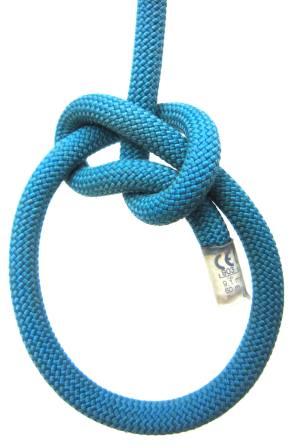
The attached photos show ‘standard’ (ie regular) Vs ‘anti’.

Anti conjured images in my mind of something being ‘opposite’ or ‘against’. If we consider the direction from which the returning eye leg enters the nipping loop, the use of ‘anti’ to describe an ‘opposite’ or ‘against’ direction would appear to be appropriate.

"anti-" already connotes too harsh and wrong notions. On balance, I favor its complete removal, lest it sully the already unclear waters with [b]seriously misguided[/b] notions.

Who is misguided here?

The terms ‘cyclone’ and ‘anti cyclone’ are routinely used in my part of the world - which refer to the relative direction of spin/rotation.
Anti is a prefix in common use in the English language.

There is also ‘arctic’ and ‘antarctic’.

And ‘Proton’ Vs ‘Anti Proton’

The direction from which the returning eye leg enters the nipping loop is key to what type of structure you will end up with (in a Bowline).

Dictionary meaning of ‘anti’ :

prefix

  1. against; opposing: anticlerical; antisocial.
  2. opposite to: anticlimax; antimere.
  3. rival; false: antipope.
  4. counteracting, inhibiting, or neutralizing: antifreeze; antihistamine.
  5. designating the antiparticle of the particle specified: antineutron.
    [from Greek anti]

I used the descriptor ‘Anti Myrtle’ because it distinguished a Myrtle tied with the returning eye leg entering the nipping loop in the standard/normal direction versus entering from the opposite (anti) direction.
It also fit in with the general concept of Bowline Vs Anti Bowline in terms of which direction the returning eye leg enters the nipping loop.
I wanted to be consistent - and the direction of the returning eye leg appeared to be key to this consistency.

/////////////

I would say that your continued use of the term ‘turNip’ and/or ‘nipping turn’ is an abuse.
I thought the notional view of a turn Vs a loop had been settled?

Should we describe a ‘round-turn-and-2-half-hitches’ as ‘a round loop-and-2-half-hitches’?

When is a turn a turn and when is a loop a loop?

At some point, we have to stop and agree on terminology - and this is something I have pointed out several times over the past few years. It appears that elements within the IGKT still cannot agree on a standardized knotting terminology.

I would also comment that your 11th hour change of mind with the use of the term ‘anti’ is a bit late in the day. Why wait until now (at the very last minute) to waive the red flag?


Bowline_Anti_Kalmyk_Rear.JPG

And, in short, they are good to show how my thinking
has lately changed :: that now I am favoring looking at
the nipped part’s angle rather than direction through
the central nipping loop. !? --as a reasonable (?)
distinction (rather than merely possible one) for bowlines.
That in the one (first-shown) case this angle (readily) makes
the nipping loop orient towards non-helix, crossing-part pressure,
in contrast to the (2nd shown, “anti-”) other which invites
helical separation of the loop --though knots of this kind
should be (insofar as they want to be bowlines) dressed
and set so as to resist such opening of the loop.

And my verbally sketched hilarious & bowlines paint
the point well, both having such an angled nipped part,
yet delivering that part from opposite directions --really
op. dir. and not just op. sides!

"anti-" already connotes too harsh and wrong notions. On balance, I favor its complete removal, lest it sully the already unclear waters with [b]seriously misguided[/b] notions.

Who is misguided here?

The terms ‘cyclone’ and ‘anti cyclone’ are routinely used in my part of the world - which refer to the relative direction of spin/rotation.
Anti is a prefix in common use in the English language.


Now you’re quoting my utterances back to me! Yes,
this was just the use that brought out my introduction
of the term. Re “abuse”, IMO it is your taking it purely
qua “against” for anything, rather than my intended
pure “opp. side from #1010” focused denotation!
(E.g., suppose that the myrtle had been itself of
the “anti-b.” side, like the Eskimo bwl. : yes, by your
thinking the actual M. would then be “anti-M” but
that focuses on the very “original” knot itself irrespective
of how it is oriented; whereas I, who see bowlines as
all with a central nipping loop [<–see, I’m redressing
my past sins!], cite it as a violation of the point, which
is “anti-b.” is a genus indicator irrespective of there
even being any “non-anti” corresponding knot : the “anti”
refers to a particular side of working-end entry, period.

I would say that your continued use of the term 'turNip' and/or 'nipping turn' is an [i]abuse[/i]. I thought the notional view of a turn Vs a loop had been settled?

Should we describe a ‘round-turn-and-2-half-hitches’ as ‘a round loop-and-2-half-hitches’?


TOUCHE’! Ouch, I’ve been doing this for quite some time.
I’ll like to blame another for getting “nipping turn” out into
parlance for my cutesie “turNip” word-fusion,
but, yes, originally and rightly/aptly it is a “nipping loop” about
which we should talk --that, fitting the defined “loop” of many
books (neverminding the overloading of “loop” to be either
an eyeknot or a bight (I can’t even bring myself to say “the
rug is made of many bights…”!).

Although if you consult ABoK #32 & 40 you will find
good challenge to the above, and also the defined (in
the glossary) “turn” which denotes a full circle/360degrees.
.:. Knotting nomenclature is a challenge both in cleaning
up and in setting (a) straight (course) !!

When is a turn a turn and when is a loop a loop?

At some point, we have to stop and agree on terminology - and this is something I have pointed out several times over the past few years. It appears that elements within the IGKT still cannot agree on a standardized knotting terminology.


It’s a tough task not even well started, IMO. Although
we’ve pointed out some of the troubles, to a small (reading)
audience. IMO, for specific technical discussions, it will
be necessary simply to try to avoid problematic terms
and to otherwise specifically define one’s own terms, how
one is using/meaning terms. (I don’t hold hope that common
parlance will have the precision that possibly we might define
for technical talk.)

I would also comment that your 11th hour change of mind with the use of the term 'anti' is a bit late in the day. Why wait until now (at the very last minute) to waive the red flag?
I raised as described --recent turn (loopy?) of mind on the consideration of [i]hilarious bowline & ...[/i], of *angle* vs. *direction* --though there are fuzzy in-betweens or rather neutral (perpendicular to axis of tension) directions of the nipped parts. And then a stepping back to ask of the point/purpose of making some such distinction --gotta be a better reason than merely "because we can" & "it makes a divide (in quantity per division) for easier reference". My initial thinking was the per-direction was a weak guide to resisting the opening helix; now, I'm thinking maybe it's *angle* rather than *which-side* as the better indicator, though noting that compromises and does-it-better/-worse can occur regardless (along with the in-between, perpendicular angles challenging the new classification). --and esp. in the knots that delay tucking through the nipping loop; when the working end goes elsewhere [i]and then...[/i] is tucked through. (Though having maybe 3, 4, or more classifications might be a good thing : some will favor ignoring the further-from-1010 cases as being "bowlines", but they'll at least be attached at arm's length with a known relation --whatever one calls them, then.)

–dl*

Given my more recent thoughts/realizations about the lack of a sure, practical-in-knot-behavior distinction based on the tucking, it might all be "back to the drawing board".

This is worth some greater context, too :: the much-revised
paper IMO is straddling two noble aims, and I think compromises
its potential on one direction --of being a presentation of many
heretofore not well known bowlines that are worthy of
consideration/knowing;
and making some profound statement about bowlines,
of their essence, workings, and what-have-you. It is this
latter venture that is problematic and rich with challenges
and points of view, and going much into such discussion
will likely be offputting to those who simply want some fresh
insight into possible useful knots; they might turn away.
(The audience for this latter venture is relatively small;
that for the former might be more agreeable to fee-based
access, provided they get a clean(er) here’s-the-goods/knots
presentation!?
:wink:

And, wow, would I realllllly like to see ONLY the “right” view
of bowlines, and NOT the “conventional” one!! The whole
point of advocating for this view was to redress confusions
attributed (conjecture, but …) to the conventional view.
But for the most part, for an effective part, conventional view
rules the day --as though the new doc. is to be read adjacent
to some old one.

–dl*

that now I am favoring looking at the nipped part's angle rather than direction through the central nipping loop. !? --as a reasonable (?) distinction (rather than merely possible one) for *bowlines*.

Yes indeed…this is something that Xarax hinted at several times to me over the course over many emails (over several months) - including emphasizing the direction each leg of the collar takes in relation to the nipping loop. Although I found it difficult to photograph and adequately describe the concept in words. The logical solution (for me) was to look at the direction from which the returning eye leg enters the nipping loop. Furthermore, when attempting to tie a Bowline by following the ‘anti’ direction - the returning eye leg can not collar the SPart - it doesn’t work - you can only collar the ongoing eye leg (or alternatively create a Myrtle).

At some point though - a decision had to be taken - and the ‘anti’ concept had tipped the balance for me; despite having some reservations.

I personally want to see the matter settled once and for all…But, whatever decision is taken in the future - it MUST be capable of being consistently applied and also withstand peer review/scrutiny.

yes, by your thinking the actual M. would then be "anti-M"

Indeed - I had to find a way to distinguish one type of Myrtle from the other… and I was using the ‘anti’ term specifically in relation to Bowlines - and not trying to apply the concept to a broader set of knots. At the moment, the ‘anti’ direction seems to hold up - I haven’t been able to detect any glaring flaws with the general concept of direction that the returning eye leg takes through the nipping loop.

It is not too late in the day to add another page showing the pitch angle / canter of the nipping loop relative to the returning eye leg as an alternative theory.

and making some profound statement about *bowlines*, of their essence, workings, and what-have-you. It is this latter venture that is problematic and rich with challenges and points of view, and going much into such discussion will likely be offputting to those who simply want some fresh insight into possible useful knots; they might turn away.

Well you know Dan - much of what I wrote down in the paper needed to be documented - if not by me - then someone else surely would have done it at some stage? Part of my driving motivation was to gather up all the current best thinking and document it. With people such as yourself, Xarax, knotsaver, SS369, Derek and a host of others - why not pick everyones brains and develop a comprehensive paper on the subject?

For me, the issue now is whether I have made the right decision to lock the paper down and attach a $ value to it. I have had little by way of reward for my efforts (probably more grief than happiness truth be told) - and it did require a significant and sustained effort on my behalf.

But for the most part, for an effective part, conventional view rules the day --as though the new doc. is to be read adjacent to some old one.

I have come to believe that the ‘conventional view’ actually shows the collar and its 2 legs better than the detail view. I think both views/aspects of the Bowline structure have merit. It depends on what you want to show. If its the operation of the nipping loop - then the ‘detail view’ is best. However, if you want to emphasize the collar, the ‘conventional view’ works best (in my opinion). And this is not echoing anything from Xarax…he simply impressed upon me the important of the collar and its structure (ie its 2 legs) - and this made me realize that the ‘bight’ structure was really a composite of several individual elements. Once the idea of the 2 legs hit home…I just had to devise names that were reasonable for each leg. A few tries (and criticism from Xarax) eventually led me to speculate that ‘entry’ and ‘exit’ were reasonable terms.

Although if you consult ABoK #32 & 40 you will find good challenge to the above, and also the defined (in the glossary) "turn" which denotes a full circle/360degrees. .:. Knotting nomenclature is a challenge both in cleaning up and in setting (a) straight (course) !!

My view is that Ashley was not entirely clear on his distinctions between loops and turns. So I turned to Budworth to see if I could find something more concrete - and the solution appeared to be the ‘Round turn and 2 half hitches’. On the fact of it, Budworth seemed to be favoring a definition where the rope encircled some object such as a post, a rail, etc.
This is one of the reasons why I favor a stricter definition of a nipping loop in that it must be loaded at both ends - as it creates more well defined parameters. Xarax favored using terms such as; 180 U turn, 360 degree turn, 540 degree round turn to achieve greater precision (which I tend to agree with). One can look to the CMC ‘540’ rescue belay device as an example of mainstream use of the concept of 540 degrees round turn.

EDIT:
I am adding one extra page on the concept of TIB.
I think it was Xarax who posited that all Bowlines - with the tail exiting through the collar along a parallel pathway with the SPart - ought to be TIB. Is this general hypothesis correct? For example, I note that the standard #1010 Bowline is not TIB. And yet, I can untie the #1010 Bowline with Yosemite finish by way of reverse engineering it without access to either end.
I can find no way to reverse engineer the standard #1010 Bowline without access to either end.

I want to be done with the Bowlines paper… I need to move on to another worthy project. And this would be ‘Rope Joining Knots for increasing the length of abseil ropes’.

Mark G

I think it was Xarax who [b]posited[/b] that all Bowlines - with the tail exiting through the collar along a parallel pathway with the SPart - [b]ought to be[/b] TIB. Is this general hypothesis correct? For example, I note that the standard #1010 Bowline is not TIB. And yet, I can untie the #1010 Bowline with Yosemite finish by way of reverse engineering it without access to either end.
One doesn't posit morals! It shouldn't be hard to disprove the X's "posited" wish --just do some more fancy weaving with the tail before making the prescribed final exit. You could even tie a knot in it --a non[i]TIB[/i] one!
I need to move on to another worthy project. And this would be 'Rope Joining Knots for increasing the length of abseil ropes'.
ARJs --abseil=ropes-joining knots, end-2-end knots.

Along these lines, I’ve been playing with making the
initial turns or loops to go in opposite vs. side-by-side
directions, hoping to get the knot to entail each end
making a “loop” and not “arc” into the nub --which
would likely improve strength (which isn’t part of the
main design goal, I know); but I’ve not been satisfied
with the results (they might look promising, but then
in different materials … not so much).

–dl*