Adding a new page to the Bowlines paper.
Topic is ‘TIB’ Bowlines.
Comments please…
Not sure who started the whole TIB investigation and then development???
Mark G
Adding a new page to the Bowlines paper.
Topic is ‘TIB’ Bowlines.
Comments please…
Not sure who started the whole TIB investigation and then development???
Mark G
Mark,
Scott’s simple lock Bowline isn’t TIB, but the tail exits through the collar along a parallel pathway with the SPart (doesn’t it?).
(A TIB variation of Scott’s Bowline is at
http://igkt.net/sm/index.php?topic=4517.msg30269#msg30269)
I’ve found this topic about Xarax’ position:
“Retuck the Tail end through the collar - you may end up with a TIB bowline.”
http://igkt.net/sm/index.php?topic=4695.msg30329#msg30329
Ciao,
s.
Thanks knotsaver.
I’m glad I was only asking the question about TIB and not making any absolute declarations of fact.
The issue for me now is what is the current best theory about what makes a particular Bowline TIB?
I suspect that in the case of Scott’s locked Bowline - the S bend weave that the tail takes in order to exit via the collar is the cause of failing to be TIB.
How many other Bowlines with the tail exiting via the collar alongside the SPart are not TIB?
Mark G
Bravo, this page on TIB bowlines is important, you also provided an excellent tying method.
The yellow dot marking the collar to be is a nice touch,but imho you should add a red one in the frame number 3 in order to show the tip of the eye to be.
imho you should add a red one in the frame number 3 in order to show the tip of the eye to be.
Thanks enhaut…implementing your suggestion now.
Also fixing a few grammar issues.
I am still trying to find a theorem for what makes a particular Bowline TIB.
In Scott’s locked Bowline, the tail follows an S bend before exiting through the collar and parallel to the SPart. This results in the structure being non-TIB. But is Scott’s Bowline the exception rather than the rule?
What was Xarax’s theorem?
I’ll have to email him…
Please try this:
tie a Standard Bowline (#1010) with a strangled double overhand knot (around the returning eye-leg, tail towards the tip of the eye (= around the ongoing eye-leg, tail towards the nub)) and then retuck the tail through the collar along the parallel pathway with the SPart…and try to “UnTIB” (untie without using the ends)
and as if by magic…

(Edit: BTW the TIB method to tie the knot is simple…)
But, if we tie an overhand (single, double…) around the returning eye-leg, with the tail towards the nub we can’t UnTIB! 
Mark,
you could mention the method (as in ABok #1080) to discover/invent TIB Bowline suggested by Dan_Lehman,
(see http://igkt.net/sm/index.php?topic=4695.msg30331#msg30331)
–
ciao,
s.
Here it is: a class of locked TIB Bowline:
(it’s a variation of Dan_Lehman’s suggestion):
ciao,
s.
I’m not sure if I like you anymore knotsaver… 
You are causing me to further extend the length of my Bowlines paper - and hence, further push back the completion date. :o
…
But, thank you very much for your input!
I always felt my paper needed to elaborate on TIB Bowlines and the whole concept of TIB in general.
My initial thoughts focused on just a one page summary…but, I see now that this is not possible.
I have to admit that I didn’t know about the TIB capable Bowline with strangled double overhand lock on returning eye leg. And your interesting TIB tying solution.
This is all extremely important in my view and I thank you.
I should also point out that it is really easy to ‘reverse engineer’ knotsaver’s above-mentioned locked Bowline - I am sticking with this term. I have personally found ‘reverse engineering’ a knot a useful tool to determine if the structure is TIB.
By the way, I have received an email reply from Xarax about his theorum on TIB Bowlines. Its all Greek to me…but, I am working through it all now…
EDIT: I wonder if I am ‘allowed’ to post Xarax’s comments re TIB Bowlines on this forum? I am unclear what the IGKT moderators rules are for me acting as a ‘proxy’ for Xarax?
Mark G
It wasn’t here, and it wasn’t via the Net, either :
connections were knotted together the ol’-fashioned
way, by snailmail and Knotting Matters (newsletter,
mailings of physical paper & ink), circa 1987.
Two of knotting’s keener innovators, viz. John Smith (UK)
and Pieter van de Griend (Nederland) brought out the
fact that a knot that the former had presented in KM#018
(Spring 1987) was in fact TIB --noted by his comment
(as sparked by private correspondence from PvdG) published
in the next issue (Summer 1987). That’s nigh 3 decades ago.
(And although I came around to the same discovery, on my
own, IIRC --even if this speaks poorly of my reading/research
skills (or sometimes even of my memory : inventing a knot
more than once!), I’m pretty sure that it was well later.)
The knot that was presented is the one I’ve been advocating
for to replace in prominence/usage the Yosemite bowline
–you have it now in the document, but still not with suitable
emphasis.
.:. It should be HERE, vice what your have as the 2nd, AND
as what gets the step-wise tying imagery. The idea is to promote
a better knot than the commonly promulgated YoBowl!
Re(-re)ading the old articles, I’m reminded of another point:
the nub matches that of angler’s/perfection loop (#1017)
but one’s ends are the other’s eye legs (!). (And I’ve not been
clever enough to figure out if one is TIB must the other be?!)
I've found this topic about Xarax' position: "Retuck the Tail end through the collar - you may end up with a TIB bowline."Yes, that is a good point --the tuck amounts to a sort of *retreat* which might beget [i]TIB[/i] status. BUT it does not ensure it, and the document should not imply that it is an open question, when it is easily proved false!
the tuck amounts to a sort of *retreat* which might beget TIB status. BUT it does not ensure it, and the document should not imply that it is an open question, when it is easily proved false!
Actually, my question was:
For those Bowlines which are proven to be TIB - do they all have the tail exiting through the collar and then along a parallel pathway with the Spart?
In other words, is it possible for a Bowline to be TIB - with the tail not exiting via the collar?
This is what I am trying to confirm or disprove!
Mark G
I’m sorry Mark ;), but you asked for comments … I think it’s because of the time zone
(you are welcome).
Neither did I!
Please try tying the double overhand lock on the ongoing eye-leg, I will post some pictures as soon as I can.
I’ve tied a TIB Bowline with a girt hitch collar (a ‘complex’ collar, is it a Bowline?) and with the tail exiting through the collar, is it a known knot? I think it’s interesting… I will post a picture.
ciao,
s.
What about ABoK #1074?
How do we consider it? (Ashley named it Bowline with a bight).
(BTW, the eye of the Bowline could enter the bight and we could tighten the bight)
ciao,
s.
This is simply shown to be false. Browse [u]ABoK and you’ll
see some, if not making your own, per recipe of the question.
We can “improve” (?!) the method using a generic TIB Hitch (for the nipping loop [and for the collar])
the knot I’ve tied is a single eye version of a knot suggested by Tex at
http://igkt.net/sm/index.php?topic=5385.msg36531#msg36531
About the TIB Bowline with the tail exiting/not exiting via the collar, I think the simplest (and maybe the best) are those with the tail exiting via the collar, to obtain the others (with tail not exiting via the collar) we have to use a slipped loop/bight with the tail somewhere.
ciao,
s.
A good point, and there are four cases:
The butterfly knot is generally regarded to meet #4’s demands,
and the directional fig.8 #3’s,
with the bowline on a bight #2’s
and my “hilarious bowline” just #1’s.
Thank you, Dan_Lehman!
I’m sorry but I’ve not found the hilarious bowline…
Could you show it, please?
thanks.
Ciao,
s.
I will tell it (again), for now.
rope runs from right-to-left (SPart right, to-become-eye left),
making the nipping loop with a clockwise turn,
crossing point at bottom (6:00),
on-going eye leg crossing OVER SPart;
at suitable length for eye, make the U-turn ANTI-clockwise
so to bring returning eye-leg back below & beside on-going
one, and crossing back over SPart;
at which point, turn this working end clockwise down
under the SPart (and now, roughly, pointing down from 6:00).
HERE, there is a choice :: to make hilarious bowline
or a similar one (described after…).
FOR H.B., take the working end around (continue
clockwise) OVER the adjacent eye legs;
and now, form a bight and tuck this in through the nipping
loop, from back to front (i.e., towards view) --so, crossing
9:00-ish side of loop UNDER and bring bight out from that.
The substance of the bight --the material bulk and resistance
to being bent/folded-- is what is hoped to keep the nipping
loop loopish and not opening (too much) into a helix.
So, dress & set the knot accordingly, working to minimze
the collaring of the eye legs, hauling on the bight end to
get this snugged, which will tend to rotate the nipping loop
opposite the direction it will want to move when loaded,
which is towards opening into a helix --a little of which might
be fine for the situation (YMMV).
.:. This is a knot that looks fine for putting in an eye w/o ends,
and maybe instructive about knot strength in having the
SPart in a curvature of diminishing radius (something that might
obtain more in some materials than others).
That other-like-knot choice would have one form a bight
at the decision point (working end at the 6:00 area after
turning around the SPart), and tucking out through the
loop immediately, front to back (away from view).
AND THEN, though, one must draw the eye through the
tucked bight and snug the latter around it, which will give
more sure resistance of the SPart opening into a helix,
though it can do so, depending on materials and so on.
In the H.B., one might be able to untie it by simply pulling
on the tail and spilling the tucked bight --though it wasn’t
the point of the tucking, which was need (TIB) and bulk.
Generalizing the tying aspects/techniques/… presented
above can lead to many more such eye knots, and some
look great (there might be elements of immodesty showing …). 
Thanks (again) Dan!
If I’m right this should be the Hilarious Bowline (look at the pictures)
If the eye enters the bight and then we back-flip the bight, the obtained Bowline should meet #4’s demands (as the butterfly), am I right?
Ciao,
s.
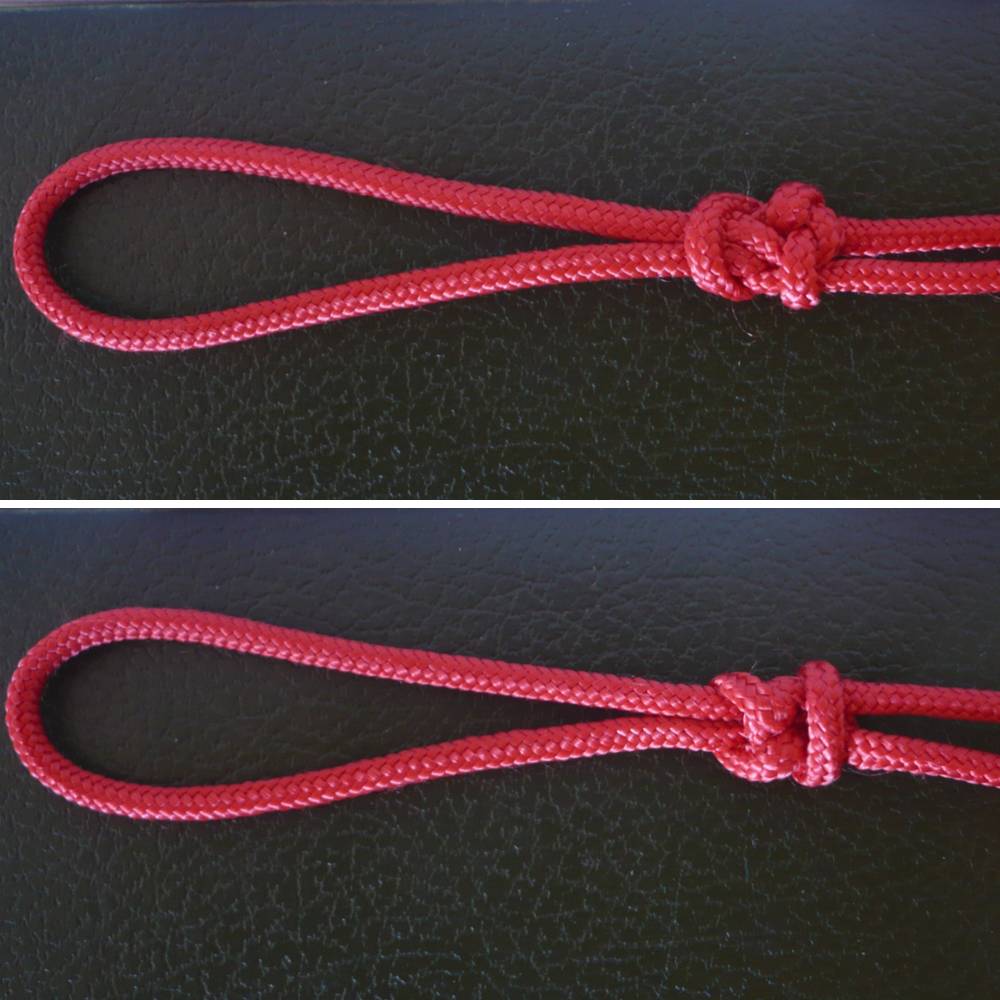
Yes, nearly :: in the original --which might have no
claim to preference; just noting the fact–, the tucked
bight didn’t have crossed legs, so the curving SPart
reached farthest and bit into the tail-leg of this bight.
NB: in the version as you set it, the SPart’s loop is well
oriented against being a helix --it has some movement
to give, and still be loop (so, you show the desired
setting). Loading surely will turn you loop more into
the plane with axis of tension, and then maybe beyond
that, towards the helix’d state.
As for your backflipped variation, I’m not following this
to get similar look :: yours shows still a collar around
the eye legs, but that is what was to be backflipped?!
(or I need to scrutinize the images better!)
Just advising that I have uploaded VER 2.6 of the Bowlines paper.
All password restrictions have been removed.
Hopefully the 2 new pages on TIB are acceptable content?
I have only provided an overview of TIB - it is not intended to be exhaustive…
Mark