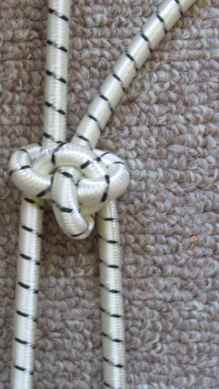
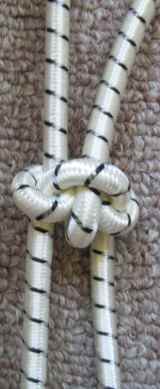
Oh, I assure you, I much wanted the EBDB to hold
that “Devil’s material” small, hard-stranded,
slick, polypropylene cord that was sent to me
(in anger & disgust!) : when it didn’t hold, on my
initial tying, I acknowledged only losing a battle
on account of lack of trying, and I re-tied, with
deliberately forceful setting --“THERE, take THAT,
ha!” And it took it for a while, but only a short
while, and then . . . those turns around turns
–3dia each way, so nice-- all expanded.
(I might have uttered some curse, at that point.)
The same material, tied with a “Janus” bowline,
only worked loose-ish --the turNip expanded but
the “janus’d” bights tried and failed to open much
like scissors (instead of rotating), and more of a
workable knot remained.
But “horses for courses”; rockclimbing rope is not
so devilish --less slick, less springy, more compressible.
But one needs to set the EBDB’s turns around
turns tight. Those of the SPart will be heavily loaded
on a fall; but those that bind them (when slack),
of the tail, will be no tighter than manual setting,
and hence the key to untying.
A future situation, where we would have a few circumstantial, differently designed and performed, and subjectively evaluated "tests", can be worse from the present situation, where we have no tests at all !It should not be bad but helpful, to some degree, if the testing is well described --which it seldom if ever is, alas. (E.g., was Roo's rope --Bluewater II-- new(ish)? (All I have of that brand is ancient and pretty darn intractable; but I have some newer PMI "E-Z Flex" (which is well contrasted with their regular which might be aptly named "No-Flex"! ;D ) )
1. What was "[i]vigorously shaken[/i]" ? The Standing End only, or the whole eye-knot, the eye included ? 2. Which was the angle between the eyelegs during the shaking ? 3. Was the eye free to move/rotate around the wrapped object, or not ? 4. Was the eyeknot pre-tensioned at the start of the shaking, and, if yes, to what degree ? [i]Any[/i] shaking, however vigorous and prolonged, will not be able to loosen a very tight knot, of course - so we should not only certify that the compared eye-knots were tightened to the "[i]same degree[/i]", but we should also decide/define this degree. 5. An important element that should be always decided/defined, too, is the length of the Tail. I have seen that, during "shaking", the motion of the Tail influences the behaviour of the whole nub : a longer Tail, which is shaken along the rest of the knot, can help the nub remain more compact, for a longer time.Also, we should describe the “shaking”, with more precise terms. For example, we can specify the exact location of the point of the line, and the path and frequency of its repetitive movement, which induce this “shaking”. I have seen that a “shaking” of the eye-knot by the Standing End, which involves short instances of pulling of this End, has a very different effect on the loosening of the nub, as it was anticipated.
Yes, if one grasps the eye and shakes,
there should be some compressive effects
that wouldn’t come to the nub if the eye
were freely rotating around something.
But, in large measure, the tests are not needed
to exact some degree of security, but more
of a pass/fail check. Even in the quite-different
material of that “devil’s material”, seeing the EBDB
loosen did give some useful information, a caution
to tying and so on. (Maybe to use some further
extension, such as a 2nd collar & tuck.)

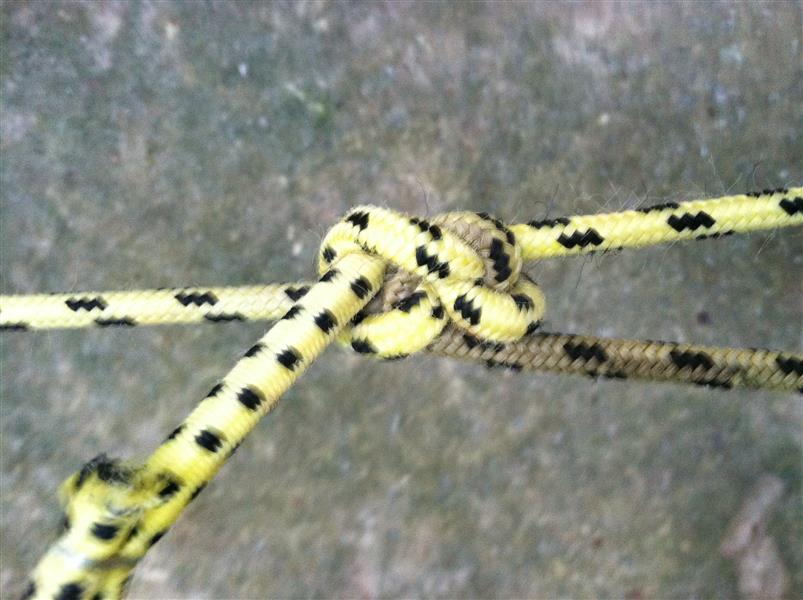
 which will simply determine which variation is a practical knot for me. However, I have developed some theoretical analysis of different knots over the years which I want to summarize in a bowline variation.