Why are you hyperventilating over something I didn’t address? Did I say that the loop had to be something that required steps before passing the rope through an object? NO!
Can you stay on topic, please?
Why are you hyperventilating over something I didn’t address? Did I say that the loop had to be something that required steps before passing the rope through an object? NO!
Can you stay on topic, please?
“Required Steps”, means no-thing - and it can used to imply, on purpose or not, erroneously nevertheless, that forming one or more nipping turns is, in fact, also a “Step”, just as tying an overhand knot, or a fig.8 eye-knot ! We should always beware of the various tricks one would try to fabricate / trump up, in order to underestimate the PET characteristic of the bowlines, and with it, the bowlines themselves.
"Before tying" should always be accompanied with “after untying” - because no knot required to be tied on the Standing part before the tying of the eye, also means no knot required to be untied after the untying of the eye. The later is what makes the bowline such a valuable mooring knot - because a “relic” knot, still tied on a line after the eye has been untied, is a dangerous thing. It can be caught up somewhere, and cause severe problems.
Having said that, I agree that you have not said something about a non-PET loop - yet !  Because by judging from hundreds upon hundreds of posts where you did, I reckon that, sooner or later you will do - and I have to be cautious about it ! Sooner or later, you will refer to the fake, so-called “Zeppelin loop”, which does not work as a rope-made hinge, as the genuine Zeppelin knot, the Zeppelin bend. Of course, you had never, and, most probably, you will never refer to loops that ARE working like the Zeppelin bend ( and ARE PET as well ) (1), because then you will have to admit that the so-called “Zeppelin loop” is an imposter in the family of genuine Zeppelin-like knots !
The sad thing is that you are always too quick to refer to your site, or to the lamentable one-liner Wikipedia article about the fake Zeppelin - which, in its turn, expectedly or not, refers to only ONE site - guess which ! (2)) You had not made any comment about anything written in the “Analysis…” paper, you had not submitted any opinion about any of the many knots shown there - but you are worried that Gommers lost his “original objective” (sic), which you suppose that you know better than him !
Dozens of knots shown there, but you had not been able to find ONE good word about any of them?So many notions, definitions and explanations about the bowline family - but you have not been able to discover even ONE thing that is true, and on what you agree ! Of course, this should have been expected, because you do not behave now in any original way ! You did the same in the three hundreds of posts in the “Bowlines” thread - and I bet you will keep doing the same long after I will die, voluntarily drinking poison !
I wasn’t comparing the “square fisherman” to the reef knot. I was comparing the “square fisherman” to a regular double fisherman’s knot.
OOps, yes, --my misreading. :-\
As I said, though, if one uses the thief knot vice square
in this compound structure, with appropriate setting,
then the slippage in the center knot will give some bit
of stopper-effect on the strangle knots to help keep them
tied --to some degree redressing the vulnerability you cite,
yet without the considerable tightening effect seen in
the grapevine bend.
last update for a while…
VER 2.1c
Change-log:
revised the Foreword - added new paragraph stating that the ‘Analysis of Bowlines’ paper has grown to be much more than just a simple search for a replacement for #1047
as per X1’s suggestion, all figure numbers have been completely revised (now listed as 1a & 1b; then 2a & 2b, 3a & 3b, and so on…)
added further commentary/revision to the Carrick loop (which has a nipping turn as a key bowline component)
made a fundamental change to the notion of ‘front view’ versus ‘rear view’ - hopefully this will please a few knotting masters Instead of stating that there is a ‘front’ and a ‘rear’, I have opted to use the terms ‘detail view’ and ‘regular view’. The ‘detail view’ emphasizes the nipping turn. The ‘regular view’ shows the side most people are accustomed to seeing.
as per X1’s suggestion, I have made an attempt to align all the ‘call-out’ boxes so its a little easier on the eye when reading.
Mark
Hello Mark,
Here are images of the Tresse Bowline which you requested. If you prefer a white background, I can do that. If you require full size images, that can be arranged.
I’m sending tech info via PM.
alpineer
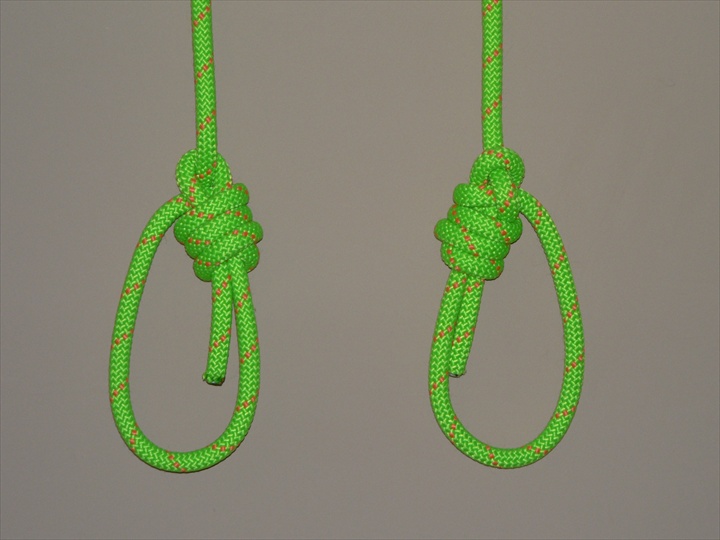
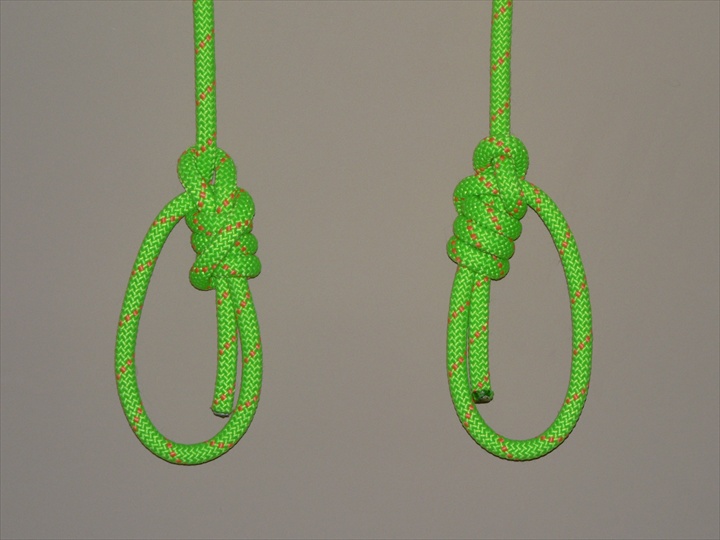
And the Tresse Bowline on a Bight.
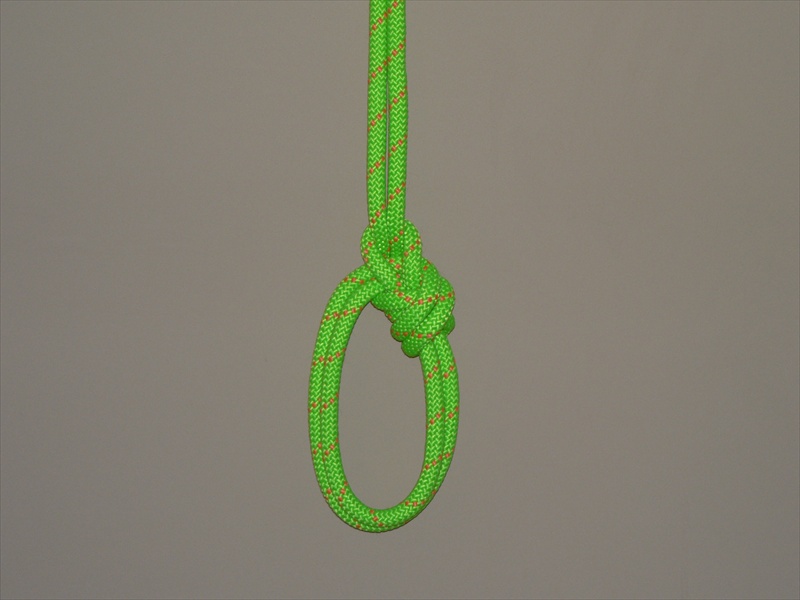
Hello Mark, Thank you for your work in industry and in the Guild. Thanks for the opportunity to contribute. I would like to limit my remarks on the Analysis of Bowlines to the section on the Carrick Loop, ABoK #1033. I question the suggestion that the Carrick Loop, ABoK #1033, is based on the Carrick Bend, ABoK #1439. The Carrick Loop, when loosely tied, can be pushed by the fingers into the outline of a carrick just as any partial carrick may take up the carrick resemblance. This carrick in the Carrick Loop lacks the complete interweaving of the Carrick Mat or the Carrick Bend. There are a number of such partial carrick knots. The Reef Knot, the Thief Knot, the Granny Knot, the Sheet Bend, and the Bowline are a few notable examples. Especially for the demanding purposes in your view, a more clear basis could be reserved. As much as ABoK #1439 represents a specific carrick, a true carrick, then it can be seen as the basis of the Knife Lanyard Knot, ABoK #787, and the Chinese Button Knot, ABoK #599. A fixed loop with a complete, oblique carrick could also be similarly judged.
Agreed : this should be called the “carrick bowline”,
leaving the name unfortunately chosen by Ashley
for a certain other eyeknot.
It has been a long time since the last update! Any news on this paper?
Also, I don’t understand why Mark doesn’t recommend the EBDB Bowline in this paper! I think EBDB is a very recommendable knot since:
Dan Lehman, any suggestion on comparing these two knots for climbing tie-in?
Whoa, that’s one “B” Byond balance
(redundancy). ;D
* It has the two nipping turns which is historically known to make the knot much stronger ...Testing is, for what it's worth (not so much), not quite this clear --and to a much less than "much" degree. The real appeal is its better security vs. loosening (which itself might be of a degree too small for full comfort --hence my extension).
It is much easier and faster to tie compared to the EBSB+Y (hard to pass the tail in both collar and binding loop in practice!But you must understand that Mark is deeply in luv with the "Y" bit --I think he probably [i]Ys[/i] his shoelaces! ;D
Dan Lehman, any suggestion on comparing these two knots for climbing tie-in?I'd go with the [i]EBDB[/i] (albeit partly from pride, not the best guide). But I've seen that eyeknot loosen, in some things, and more recently taken an interest in the more complex, repetitive knots such as the [i]mirrored bowline[/i] --which can be quite loose in setting but I think will just not loosen further very easily. Also, the essentially double-eye knots --where there is a 2nd passing of rope through the harness-- provide some good assurance against (at least) [u]unnoticed[/u] untying, as there'd be a long tail flopping about.
Might be good to have more- & less-rope-efficient
tie-in methods just to put the knotting at two
different places along the rope. Otherwise, there
might be a desire for a knot that works better in
the stiff, inflexible rope one can sometimes encounter
–and where tightening the EBDB isn’t so easy.
BTW, here’s one of my latest ideas:
take the tail of a fig.8 eyeknot --that knot
sometimes required by climbing gyms to be used–
and put in a bowline guard knot to it,
reeving the latter’s tail through the former
and back through the central nip of the Bwl
(for that 3dia bulk). I think that the fig.8 will be
less prone to jam, thus (esp. w/the tail reeving),
and the bowline can evaporate so far as safety
is concerned, leaving the 8 standing guard as req’d.
BTW, here's one of my latest ideas: take the tail of a fig.8 eyeknot --that knot sometimes required by climbing gyms to be used-- and put in a bowline *guard* knot to it, reeving the latter's tail through the former and back through the central nip of the Bwl (for that 3dia bulk).I would like to see this in a picture if it's possible. ths
We really need to get away from appearance-based evaluations. I just did a security test with the belly of an “End Bound Double Bowline” linked to a Water Bowline in some bluewater II rope. It didn’t take much shaking for the bound end to spring out and become a regular, mediocre, old double bowline which then proceeded to become entirely untied.
The simpler, more compact Water Bowline stayed in form for the duration of the test.
I was at the National Waterways Museum today and not being busy I did some rough and ready testing of the slack security of a few bowlines. The rope was 10.5mm ‘semi-static’ climbing rope which is stiff and not something I would normally use. In each case I tried a vigorous shaking of the knot for 30 seconds and the results were:
Ordinary bowline (#1010) - fell apart before the 30 seconds were up.
Water bowline, girth hitch bowline, double bowline, end bound double bowline, Lees locked bowline : all of these loosened considerably though in each case when force was applied (only a pull using hand and foot) they all gripped and none collapsed. However I would be reluctant to trust any of them in this rope unless under constant strain.
Scott’s lock : this was a surprise in that it was tightened to the same degree as the others but showed no sign at all of loosening even after a second bout of shaking.
This was an idle moment test born out curiousity rather than serious study so please treat the results with scepticism as I know you all will - and bear in mind that all I was testing was slack security not holding power under load. Nonetheless Scott’s lock is something I will look at using to see how it performs in everyday situations with ‘ordinary’ rope and cordage (I don’t do climbing).
Barry
I believe we should establish a few guidelines for such tests, otherwise we would not be able to compare and evaluate any results we may acquire from them. Anybody would be able to “shake” an eyeknot differently, and “see” different things - because, as we all know, most knot tyers wish so badly to “see” only what they had already convinced themselves they “know” … A future situation, where we would have a few circumstantial, differently designed and performed, and subjectively evaluated “tests”, can be worse from the present situation, where we have no tests at all !
Also, we should describe the “shaking”, with more precise terms. For example, we can specify the exact location of the point of the line, and the path and frequency of its repetitive movement, which induce this “shaking”. I have seen that a “shaking” of the eye-knot by the Standing End, which involves short instances of pulling of this End, has a very different effect on the loosening of the nub, as it was anticipated.
Having said that, I wish to make clear that I am delighted those “tests” involved some newer eyeknots, as the Scott s and the Lee s locked bowline ( re-tucked Yosemite bowline ). Although my “tests” on the same knots had not the same results :), I am delighted when people decide to tie and try knots they were not aware of until recently. The history of knot tying had not started, and we should always remember that it had not ended, with the ABoK !
I do like the slack shaking security of this variant, but I have had instances where the knot form capsized under heavy load, and have discussed the issue with Scott on this forum:
https://igkt.net/sm/index.php?topic=5995.msg40270#msg40270
It should be noted that many loops are more or less secure depending on the direction the loop is hanging (e.g. if the belly of the loop is above or below the knot body).
I do like the slack shaking security of this variant, but I have had instances where the knot form capsized under heavy load, and have discussed the issue with Scott on this forum.
Yes, we did discuss this variant, your claims, and to date I have not been able to duplicate your findings without leaving the knot poorly dressed and loose. As such it is no different than any other poorly tightened/dressed eye knot. A competent knot tyer/user knows to set their knots well.
I have recently pulled a tractor out of a ditch using two of these, one on each end and suspect that I was dangerously close to an unsafe working load (sometimes you use things you have the best you can.). I am not recommending this to anyone. But, the loops did the task and untied without the use of tools. No capsizing, no difficulty untying.
It should be noted that many loops are more or less secure depending on the direction the loop is hanging (e.g. if the belly of the loop is above or below the knot body).
Want to qualify or expand on the quoted statement a little more?
SS
The most convenient way to observe the nature of the Scott’s Lock Bowline capsizing event is to tie the knot in bungee or shock cord. Elasticity seems to play a role.
Where that appearance suffices, it’s fine;
I take it that the reference is to the 3 diameters
stuffed through the central nipping loop (and
suggested to be indicative of better strength).
I just did a security test with the belly of an "End Bound Double Bowline" linked to a [url=http://notableknotindex.webs.com/waterbowline.html]Water Bowline[/url] in some Bluewater II rope. [b]It didn't take much shaking[/b] for the bound end to spring out and become a regular, mediocre, old [url=http://notableknotindex.webs.com/doublebowline.html]double bowline[/url] which then proceeded to become entirely untied.Of course, the obvious takeaway from this report is that you made a good effort to put the former knot at its loosest, or are entirely incompetent at tying (dressing & [u]setting[/u]) it!
But if we are using rope that is relatively stiff
and resistant to bending (and worse, springy),
it is critical for the EBDB to be set tightly and
that might be difficult; if loosened, its turns
around other turns can all just expand --which
in contrast the bights (by which I mean
U-shaped not O-shaped) want to open like
scissors and that can be easily impeded,
with good effect for arresting further loosening.
It’s possible, but there are many ways,
but I’m unsettled on what’s preferable
–doing what I’ll describe again, and which
should need no graphic, seems overly bulky
(and needing some good guidance on how
much working end to have, in anticipation
of what one will need to do with it!).
Tie a bowline with amply large eye,
in which to then tie a fig.8 eyeknot
(with/in the former’s eye), set close to
the bowline. Now, tuck the bowline’s
tail through the fig.8 --try different ways.
Now, the above tying method was given just
for simple illustration --to get one to the result–;
for tying-in, one cannot practically tie in-the-bight
but must reeve the tail of the fig.8. Doing this,
though, with ample tail, enables one to then
put in a bowline to guard the fig.8
(since the former is “PET”=post-eye-tiable).
What I’m likely to prefer is some (novel) “quick8”
first-formed eyeknot, which (naturally, being “quick”)
is more easily done, and then casting the guard knot
and then re-tucking the tail. All of which is to result
with a bunch of knotting that, even loose-ish, should
prevent the tail from working out of.