There are thousands of “Eskimo” “Janus” bowlines ( like the one shown in the previous post ) - and it should be expected that some of them will be TIB (1). However, this particular one is not acceptable, because, during the tying and dressing stages at least, and regarding the Standing Part after the eye, the tip of the first bight can slide in between the adjacent segment of the on-going eyeleg and the tip of the last bight, pass from the other side of it, and then the knot degenerates into something else ( into a more complex ABoK#1051, with an additional collar on the on-going eyeleg ).
Moreover, with such complex knots, where the Working End makes so many U-turns, there is no reason why we will not have wider, rounder nipping loops ( encircling three rope diameters ) - as the nipping loops of most eyeknots tied by Alan Lee.
In other words, dress the knot properly, or it might degenerate into something else. One wonders how many others knots would become “not acceptable” if we didn’t dress them right? Maybe a Plait Loop might turn into a Farmer’s Loop if we didn’t dress it right and therefore become “not acceptable”? Maybe I should have used the words “not acceptable” when I actually did trial the Pretzel Loop and it collapsed by folding in half? That knot needed to be dressed a lot differently to avoid capsize, to the extent it really was a different knot.
And of those “thousands of “Eskimo” “Janus” bowlines”, how many are: PET, TIB, EEL, easy to tie, easy to untie, non-jamming and have been trialled (at least a little)? I will not accept the “not acceptable” tag based solely on apparently flimsy thinking.
Unlike some who just theorize about knots, I actually go to the trouble of trialling a knot I put forward (admittedly, not a great amount in this case). This knot (if dressed properly) does not turn into something else easily from my experience. Instead, it does dress nicely and it does load nicely in the trials I have conducted.
I am quite willing to hear from someone who actually does some other trials with this bowline and finds that the knot does not meet expectations. However, a theoretical “not acceptable” from someone who admits they are not interested in doing trials means nothing to me in this case.
Cheers,
mobius
Thanks for that comment, I will keep doing what I feel is the best way to learn about knots 
I should had not made any comments regarding the flimsy, indeed, knot shown in Reply#159, but I just wished to notice how easily this knot degenerates into some other knot ( and which other knot ) - and how the Working End of bowline-like loops can be wandering around its nub, without doing what it should do : 1 : “feed” the nipping loop, so it will become wider and rounder, by passing through it at least 3 times. 2 : stabilize the nipping loop, so it will not run the danger to “open up” and degenerate into an open helix. 3 : become attached to the knot tied on the Standing Part, in a stable and secure way. Those tasks should be accomplished with the minimum possible amount of material, with as few turns and twists as possible - otherwise a significant portion of the tensile forces induced into the nub will be “wasted” aimlessly = consumed in generating friction ( and wear/heat ) in areas where it is not required. For a good practical knot, nec quam plus minimum.
It is a common symptom of inexperienced knot tyers, to tie unstable, or overcomplicated, amorphous ( and so ugly ) knots. They tend to believe that they should not “theorize” about knots, but they should jump into “practice” as soon as possible - and that, by entangling ropes into some “new”, to them, knots just a couple of times ( sometimes before they had even learned how to tie them properly - which, for me, requires to tie a knot at least a dozen times…), on the first material and load happens to fall into their hand, they accomplish something great. I do not underestimate the joy of turning a flexible straight line into a whatever rigid globular knot - but I also do not underestimate the power of abstraction, the value of frugality regarding the required amount of material, and the virtue of deprecation of most of the knotted tangles. Knot-tying is not much more difficult than simple arithmetic, but, just as arithmetic, it does have rules - and some twists of its own.
8.192, to be precise !
And I am taking into account only those “Eskimo” bowlines where the nipping turn AND the collar turn encircle 3 rope diameters !
If we relax this condition, and we allow narrow turns and collars ( so, sharper curves ), the number jumps out of the window.
What we really need in not any TIB one of them, but one that can also be tied in-the-bight easily, following an easy to memorize and to remember method. Also, one on which the segments follow some pattern - because such knots can be easily inspected after they are dressed : a mistaken tying or dressing would turn the “ordered”, “regular” arrangement of the segments into an amorphous conglomeration, and so it could be spotted at once.
Hi all,
Evidently the memory made me a joke, because trying to retrieve online excerpts from the CAI manuals regarding the re-traced/re-threaded Bowline,I found nothing in the descriptions of this knot that mentions the fact that is no longer used or no longer recommended to use it.All this in fact concerns the description of the SIMPLE Bowline(nodo Bulino semplice) ::).(But in the CAI schools is widely taught the fig. 8 loop indeed).
Bye!
P.S. alpineer,thank you for the new videos about the methods for the Butterfly loop! ( http://igkt.net/sm/index.php?topic=5210.msg34070#msg34070 )
Thanks Luca. You can view more ABK methods by clicking my youtube username or this link… https://www.youtube.com/channel/UCnFcaU1Qbkw_fZA8_yxkspw
Hi All,
Xarax, Thanks for help, here are the result of my load test.
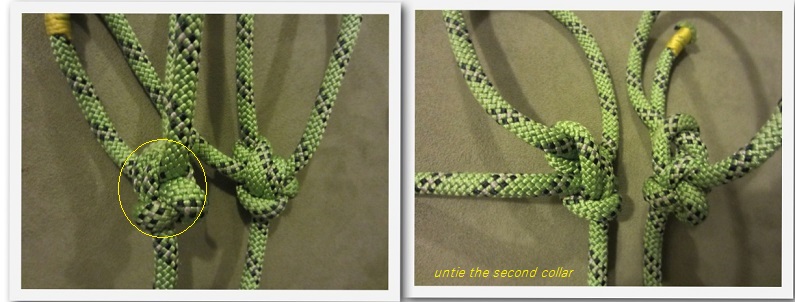
First, breaking test with 1/4 rope, I fond is easy to untie from the second collar.
                second heavy load test with 8mm blue water rope, see third photo right side picture, It is easy to rotate the second collar loose, once it loose, 2 diameter of rope can fill in the hole of the collar. Now we come back and see the left side picture the Eskimo nipping loop already on the bottom of it stock(no sure I use the right words) from now on even more weight you add on it, the tail side eye leg will not able to move anymore to tighten the eight knot inside, even you break the rope, I assume the second collar will remain easy to untie.
               I hate writing, properly it take you ten minute to write all these, with my poor English it take me more then two hours to write poor me, you are welcome to correct my English. You can make me a better man tomorrow. I hope you understand these broken English.
               謝謝 alan lee
But then they hardly know all the knots of the knotting
universe that have been revealed by X. et alia in these
threads, and elsewhere.
There is a more sensible way to "re-thread’ a bowline
–since you will NOT be needing “EEL”, don’t make the
knot so, with a pointless finish, just because you think you
have to follow the same darn diagram that has become so
stale in decades of echoing! Rather, the re-threading can
be done in a much better way, getting much nicer-looking
curves (to what end this matters is of debate), and still TIB
and more secure.
And novel, which counts for something maybe, maybe not. 
And a better, much better, “fig.8 bunny ears”, as well as
–contrary to D.Merchant’s assertion-- a quite decent “fig.9
bunny ears” as well, of like construction.
–dl*
Hi All,
Just said hi to Dan up strait.
     More test here With Lee s Eskimo 8 bowline(A). it jam at 2000lbs.

     謝謝 alan lee
Hi Alan,
This is really good - but may I please enquire about the following questions:
-
Is the threshold of jamming at 2000 lbs force? Or is it somewhere between 1500 and 2000 lbs? Are you able to pinpoint the tension force which triggers jamming?
-
What was the rate of applied tension force to your knots? That is, how fast did you increase the load?
first test with 1/2 inch solid braid nylon rope, I have a small comer lock pull as hard as I can, I don't have scale no idea what is the exact weight, but I can show you the picture while the knot still on tension. so far I have been tested quiet a bit of knots ( if I have to guess I have to said at least 1200 lbs,) [b]after the loading, it is very easy to untie[/b], and hold quiet a solid form.Second test with 8mm blue water rope, do the same thing pull it as hard as I can, the result are the same. It look good to me. Third test with 1/4 nylon solid braid nylon rope, with my multiple force device loaded it with 650 lbs. [b]With the small size rope it does create little problem to untie it[/b], how hard to untie it, let put it this way, I am 5 feet 5 inches tall, weight 138 lbs., active and have a strong hand, [b]I use my finger nail to push it back and fore with my best effort and get it untie in 45 second.[/b] This loop have to untie it from the top collar(second collar).</blockquote>Could you please confirm the type of rope you used in your test? I am a little unsure!
Note: Not trying to be difficult - I am just seeking to compile accurate data
Thanks,
Mark G
@Alan Lee
So, which one of the three Lee s Eskimo 8 bowlines do you prefer ? Which is more easy to untie after really heavy loading ?
The one shown at :
http://igkt.net/sm/index.php?topic=4480.msg35904#msg35904
Or any one othe two shown at :
http://igkt.net/sm/index.php?topic=4480.msg35910#msg35910
Thanks for the vids.
You’re welcome McKnottee.
Hi All,
Xarax, I like the one with three rope diameter nipping loop , it is the most secure one, amongst all the knots I have,
the Eskimo nipping loop was lock in by the figure 8 knot, the tail was embrace by the nipping loop and the tail
side eye leg. the nipping loop lock the figure 8 knot and the figure 8 knot lock on it own.
Just so many combination locking effect.
This four here are more easy to untie, Lee s Link bowline, LeeZep bowline (Inspaired by Xarax),Lee s φ crossing
knot bowline, Lee s Eskimo 8 bowline).
謝謝 alan lee
Thank you, Alan.
Perhaps you should test it on Dyneema ?
I remember using the name ‘Retraced Figure 8’ earlier on and being told that the name ‘Figure 8 Loop’ was the only name needed for #1047. As I was new to this knot at the time, this had the consequence that I thought climbers were not ‘retracing it’ and were therefore regularly tying this knot in the bight and using it as a clip-in. That is not so, apparently.
An unfortunate effect of this simple misconception was that I went to a lot of trouble to find a bowline that would tie very easily in the bight, as easy as a Figure 8 Loop. It now seems that if a bowline is tiable in the bight (TIB) then this is an almost irrelevant consideration when the bowline’s application is as a tie-in for a climber’s harness (no carabiner). A climber wants a simple way to tie a knot in an ‘endless rail’ method. A ‘TIB’ method will hardly matter I think.
Cheers,
mobius
Hi mobius.
Your conclusion, in part, is correct in regards to a climber’s tie in loop. Not all climbers tie in this way, harnesses being different, etc. And then there can be the use of a tied with a bight loop for anchoring purposes, equipment hauling, etc.
Outdoors enthusiasts, workmen, rescue techs and others can have a use for other -than- working end tying methods.
And then there is the pure pursuit of knot tying exploration that some find alluring.
I am sorry that the “unfortunate effect” you’ve encountered may have bothered you, but I am very glad that you’ve been “bothered”. 
Thank you for your contributions!
SS
Having to thread the end of the rope though or around an object comes up often, beyond climbing applications, too. Since a lot of on-the-bight loops don’t have a good, simple end-tying method, it’s natural to look to other types of knots. The removal of this on-the-bight constraint allows for freedom to find knots with better security, jam resistance, simplicity, and other high-importance, non-acronymized ( ;D) practical properties.
A lot ? ? I do not know ANY-one… and nobody does ! What really happens is that, some times, the in-the-bight tying method of some TIB knots is better = simpler, easier to learn and remember, and quicker, than the in-the-end tying method - but that does not mean that " they don’t have a good, simple end-tying method " ! When this happens, it can only be another reason to PREFER this knot, not to dismiss it, and search for a knot that is not TIB ! This is an amusing “reasoning” : Because there is not a simpler and quicker method to tie a certain knot in-the-end than to tie it in-the-bight, " it is natural to look to other types of knots ", that can not be tied in-the-bight at all ! ( So the method to tie them in-the-end is, by definition, simpler and quicker than the method to tie them in-the-bight - simply because the later does not even exist !
The TIB condition is NOT a “constrain”, it is a bonus regarding versatility. And the bright “idea” implied on this sentence, that TIB-ness is not a “practical property” :), or it is not of any “high importance” ( perhaps because it is “acronymized” ! ), is pure nonsense ( if, of course, it is not promoted for some “practical” reason - to show how jam-resistant and simple/easy-to-tie is the so-called “Zeppelin loop”, for example :))
Nothing regarding security, jam resistance, simplicity or any other property of lower or higher importance should be sacrificed, of course, in order to choose a TIB from a non-TIB knot ! ! However, people who have not understood the easy methods we have to tie TIB knots, and so find it difficult to figure out such knots, or to tie knots that can be tied following such a method, try to diminish the importance of TIB-ness : the well known story of sour grapes, again… The simple fact is that, ceteris paribus, a TIB knot is, by definition, preferable to a non-TIB one, because, simply, TIB-ness can not be a negative value ! It can not cancel what a knot already has, so, if/when it has all what a not-TIB knot has, to also be TIB is a bonus, and an ADDED, positive value regarding versatility, which should not be underestimated.