What would be your choice for a quick and secure way to hitch on to a smooth pole or pipe? I am looking for a hitch for pulling 20’ sticks of copper pipe or galvanized pipe up on roofs. Right now I am considering using a short loop of small diameter rope or maybe even webbing, and just make a Klemheist and hook my haul rope into it.
Hi Mike,
I think you’ve hit on the right idea. Most of the easy prusik hitches will work. It is whatever you can tie the quickest since it is work you’re going to be doing. Cinch it up tight!
I would choose some soft-ish, adequate small cord for this. 3/16 -1/4 inch
Just make sure the ground-man is up to speed (assuming you’re on the roof).
And not underneath!
SS
I’d probably go with a Well Pipe or a Klemheist. They’re both simple, effective, and difficult to tie wrongly.
I don’t think this is the right application for a lengthwise pull hitch, if that is what you are talking about. Lengthwise pull hitches should only be used on objects where slippage will not be catastrophic. That is not the case here. If something isn’t applied right, you could drop a pipe and have it crash through a window or worse. You need something more foolproof.
I assume your buildings are fairly tall if you can’t merely hand off 20 foot pipe lengths.
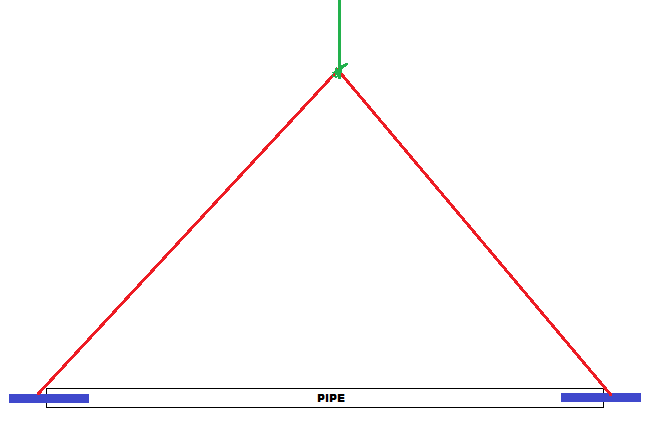
A quick, safe method would be to insert rods into the ends of the pipe. They don’t have to be tight fitting. At the center of each rod, drill a hole to help to attach the rope ends. See the attached image. The rods are shown in blue.
After you have it made, there are no knots for the help to mess up. Just insert the rods, hoist, and remove the rods. You could even hoist a bundle of pipe at once, if the bundle is secure enough. A stepped rod or some hose for protecting the rope from the pipe edges would be a nice addition.
The best hitch for a smooth pole is the one shown at :
http://igkt.net/sm/index.php?topic=2075.msg16893#msg16893
Of course, it is not the quickest ! What you can use is an auxiliary piece of string, a little longer than the pipes, that can be hooked into the two oposite openings, and be raised by its middle - so the two hooks will not run the danger of slipping off.
Roo’s suggestion may be altered, if the pipes would bend if hoisted horizontally supported by the ends. Then you may instead use one such rod, and half-hitch the rope to the other end of the pipe to hoist it vertically. Instead of half-hitching, you could have a butterfly loop at the right distance, to push the pipe end through before inserting the rod. That might be a bit more convenient, maybe quicker and would need less skill.
You don’t say what diameter the pipe is - if it’s 3/4 inch or more then I would use a 20ft+ piece of cord with a loop at each end (only one end if the same cord is used for hauling). Use a small but heavy weight to drop the cord end with a loop through the pipe and slip a toggle through the bottom loop having attached the top loop to your haul rope (unless it is your haul rope). Quick and easy and relatively safe, the weight of the pipe will keep the toggle in place.
Barry
Then you should tie two loose mid-line loops on your auxiliary rope with the two hooks on its ends, so the pipe would not be raised and supported by its middle, but the two middles of its two middles.
P.S. The solution of (1) that will be posted in the first picture of on Reply#12 :), but with hooks at the ends of the rope, is exactly what I describe here.
Being in the construction trades myself, I would go with either the Pipe Hitch or the Icicle Hitch. Once masterd, both are relatively simple and quick to tie. The options presented to lift the pipes parallel with the ground seem overkill and certainly would kill the clock when you need to get a move on.
The inventor of the Icicle Hitch famously tied himself to a tapered fid and demonstrated it’s holding power when it didn’t drop him but held him perfectly in place!!
Horizontal pull is out of the question as is putting anything inside the pipe. The copper pipe I use is dehydrated and sealed on both ends until ready to be installed. Anything inside could possibly contaminate the intended use.
Last night I made a fixed loop of paracord and tied a Klemheist around a sample piece. It did seem to hold very well. I pulled on it with all of my strength and it didn’t slip any.
The gripping hitch around poles, presented at:
http://igkt.net/sm/index.php?topic=2075.msg16893#msg16893
is superior, by far, to the Pipe hitch, the Icicle hitch or the Kleimheist hitch (to name but a few…)
I have tested all the known hitches-around-poles, and then some, and I know. Of course, I guess that there will be another half century or so, before we. the concervative knot tyers, will re-discover this fact…but this is how fast things move in our forgotten field.
You can use capped sleeves (made from larger pipe) in place of the rods. I would use a pre-made pipe sling. Simple insertion and no friction dependant hitches to tie at the time of hoisting will be safer and much, much faster. You don’t have to worry if something slick gets smeared or splattered on the pipe or your rope, either.
Attached are two more options. You can size your sling as needed to carry multiple pipes at once, if desired.
For midline loops shown: http://notableknotindex.webs.com/butterflyloop.html
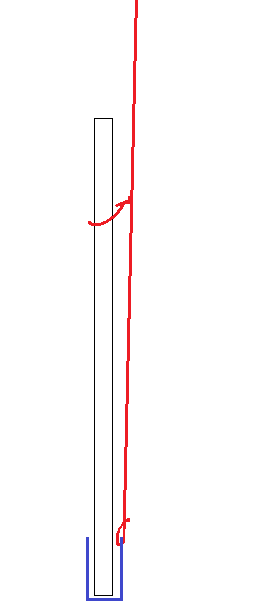
No, not at all. I doubt that there will be ANY gripping hitch around a smooth pole that would be “a quick tie”. They should be based on tying multiple coils, and then taking the slack out of those multiple coils… so any secure, safe gripping hitch around coils would take some time to set, dress and tighten. The Klemheist hitch, suggested by the author of this thread, is not a quick tie either.
Hi Mike,
pulling on it with all your might means that it will hold - if the normal load is going to provide that much loading. I would, to make sure first, hitch it looser and and tug simulating what you might expect the pipe to “see” as it is being hauled to the roof.
I am personally in favor of the 3 coil prusik and would probably opt for two small slings of suitable cord where the tyer has one ready on the next pipe while the other is being hauled up. Then you could use a larger haul line if you care to.
Or if the haul line is the cord to use only, tie a loop knot of your choice in its end, then tie the prusik around-the-thumbs method, install on the pipe and lift away.
I’ve used this for hauling gas (black) pipe to a third floor to be cut and installed. It was a workout for sure! Works for lumber too.
SS
I thought about the 3 wrap Prisik, but I have not tried it yet. I may give it a shot and see how it compares to the klenheist
What is different in the hitch I had presented - and which will become quite evident after half a century I believe,  - is that the two ends of the coiled structure are tightened together even before the “lower” of them is tensioned by the externally applied load. So any slack is diminished, the coils are kept as tightly wrapped around the pole as possible, even before we hang something from the 'lower" end…
If we find another, stronger, better way to tighten and hold the two ends of the coil tube together, that would be an improvement, indeed, over the '“beefed up Glipnir hitch”. The only simple way I have found, is to 'beef up" the Gleipnir coil itself, i.e. to use a double inverted Gleipnir coil instead of the single one. This way the Gleipnir tube is longer, and the twisted pair of tails inside it is nipped more effectively.
Of course, you can very well pre-tighten the coils by your hand force, without using a knot to do this, and then try to somehow fix the ends together, at the very end of this tightening procedure. However, the tension you have applied by your hands will not be accumulated withing the coils, unless you already have a knot at the two ends, that will prevent any tension applied to be released. And this accumulated tension will thus be maintained, EVEN IF the load at the one end is not yet applied, or it is applied and then released many times.
One could help in a constructive way here, trying to find out a more secure, stronger, better way we can tighten the two ends of the coil tube together - and keep them tightened even when there is no force applied to the “lower” one… I am sure there would be other, perhaps better and/or simpler ways… but I myself have not figured out anything yet.
See the ABoK#1740, and a simple modification of it, for another solution :
http://igkt.net/sm/index.php?topic=3016.msg17923#msg17923
The one end/leg of the Pipe hitch (ABoK#504) remains straight, and the other is wrapped twice around it, and so the two half-hitches end knot made by them can not be a tight knot, and can not secure the straight end/leg without any additional pull. The closing of the Pipe hitch is, in fact, not even the one tenth as tight as the Gleipnir coil tube.
P.S. The attached picture from the ABoK has the “lower” and the 'higher" ends inverted, because it shows a pipe hung by the standing end of the Pipe hitch tied on it, and not vice versa. The closing knot that connects the two ends of the coil structure is usually placed on the 'lower" end of the coiled friction hitches - if the hitch is loaded by the hung weight of another body, and the axis of the pole is placed verticaly.
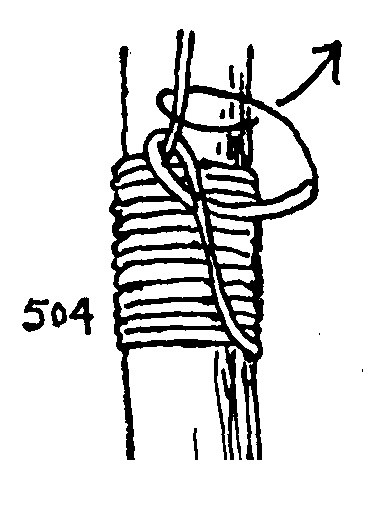
I have actually used the “beefed up Gleipnir hitch” for several different applications. I can say from personal experience that my descriptions of it is accurate - I have tested it repeatedly, and found it much tighter and superior than the Pipe hitch.
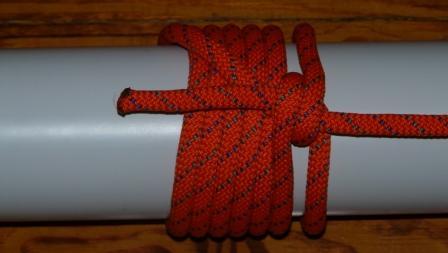
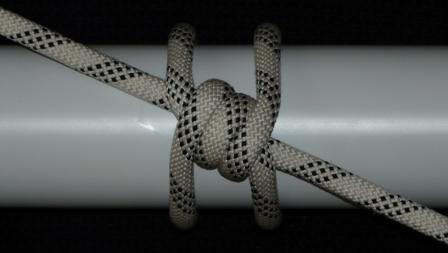
The Round Turn and Two half hitches used as the closing knot at the Pipe hitch, is not a tight knot around the standing part, if the standing end is not kept under continuous loading. Instead, a loose standing end will slip through the two half hitches, and will feed the coils, sooner or later. So the tension that is accumulated inside the coil tube will be released - unless the load on the standing end is constantly applied.