The Kleimheist is a good option, but if you want more security for a little bit more complexity, there is a similar alternative.
The Beefed up KC Hitch invented by DerekSmith:
http://igkt.net/sm/index.php?topic=551
The Kleimheist is a good option, but if you want more security for a little bit more complexity, there is a similar alternative.
The Beefed up KC Hitch invented by DerekSmith:
http://igkt.net/sm/index.php?topic=551
Something that may have not yet been noticed enough, is that a good gripping hitch around poles should connect the two ends of the coil tube, with a closing knot that would be capable of keeping those two ends tightly entangled - even if there is no load at the standing end. This way the tension forces that are accumulated inside the coils during the initial dressing and tightening procedure can not “escape”, and the coils of the coil tube remain perpendicular to the axis of the pole, and firmly wrapped around it even before the loading - and they grip the pole even more effectively afterwards, when the standing end is loaded even more.
(The hitch presented by Derek Smith is a good hitch when tied around a tensioned line, but not so effective a hitch when tied around a slippery pole. )
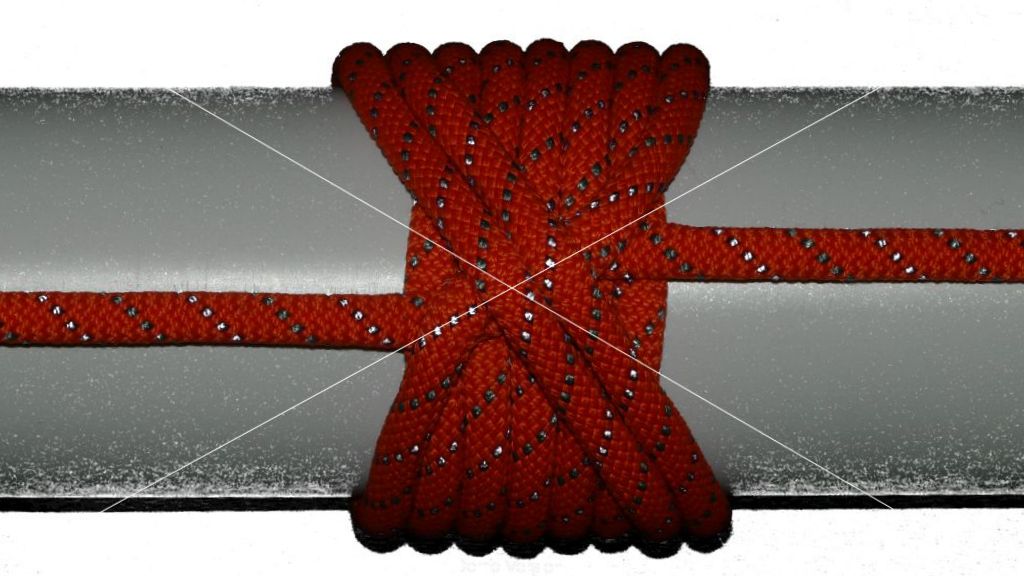
To people that still find difficult to remember how to tie the best gripping hitch around poles (known to me…), mentioned at Reply#4, I propose the use of a multi-coiled double Constrictor. (See the attached picture). It is almost as good in accumulating and keeping the tensile forces inside the coil tube, and has the advantage of being based upon a well-known-to- everybody hitch. ( For two other, more symmetric forms of the Double Constrictor, see ABoK#1253 and (1)).
Please note : it is ‘klemheist’ --only one “i” (“klemme” meaning “clamp”?).
“I have tested all the known …” !! That assertion alone is
hard to fathom, as to what all is known. But where are these
test results for public consideration? The icicle hitch is said
to grip even a tapered spike; that hitch you show as “superior”
doesn’t look good enough to hold on slick pole.
“I guess that there will be another half century …”
because you have not shown your test results (and those
have not been checked by others’ testing, to confirm or
contradict). I believe that Derek tested his hitch to a
smooth pole, with a hydraulic jack?
I wait to publish them after yours… 
As I have said, I prefer OPT… My tests are not at the quality level I would like them to be, so I keep them to myself, for the time being. (However, I always hope people will not treat me as a liar when I report something - or stop treating me as a liar, as they used to do… I guess I am an optimistic (?))
“Is said…” By whom ? Where are his “tests results for public considerataion” ? Did this “who-ever” tested also the hitches I have proposed, and have compared them to the hitches he knew? ( provided he now knows the hitches I have proposed..)
“Look” ? Do you judge knots by “looking” at them ? Then, I have the right to question your sight, as you question my word…And to use the exclamation marks the way you did…
It can hold on any pole - including yours - because it can be pre-tightened as much as we can tighten it even before it is loaded - as I have explained many times to “whoever” wishes to listen… And I wait your comparative tests on “knotted materials” tied with those knots. Until then, I suggest you “look” more carefully ! So,yes, it is "superior to the Icicle hitch, BY FAR, as you will be surprised to discover before the end of this half century…
I do not put a question mark, when I say that Derek Smith has NOT tested the hitch I have proposed, and has not compared it to any other hitches…using a hydraulic or not jack - just as you, I believe (?) :).,
( It is very easy to attempt to try to diminish the work of others by such “criticism”. I wait, and hope, for something more constructive by you. )
I was ready to say just the same thing knot4u just said, but he typed it faster than me…
When we compare gripping hitches ( around poles and/or tensioned lines), we suppose that our different alternatives will use the same number of coils…otherwise our comparison has no meaning. If you wrap a pole or a tensioned line with a rope 100 or 1000 times, it will hold anything !
The real issue is how we can improve a certain coil tube, with a given number of coils, so it will hold better than another, that has the same number of coils. I have seen that we can accomplish that by pre-tensioning the coils, and by using a closing knot that will not allow the ends to slip through it - so that the pre-tensioned coils will remain in this state even when the standing part is not loaded yet. When the standing part will be loaded, this pre-tensioned ( should we say : pre-stressed , like the pre-stressed concrete ?) coil structure will grip the tube even better, and much better compared to another similar, but not pre-tensioned hitch.
To achieve this purpose I have used a single or double “inverted” Gleipnir coil, and made the two ends pass through it, be twisted and entangled in its interior, be nipped by the surrounding coils, and so resist to any release of the tension forces that have been accumulated in the coil structure during the pre-tightening procedure. The multi-coils Double Constrictor proposed at Reply#21 would probably do almo st the same thing, and has the advantage of being a well-known knot to most knot tyers.
I do not doubt that somebody will figure out another, probably simpler, and/or stronger way to accomplish the same means…After the little quarrel we had with knot4u the other day :), I thought that it would be nice if we somehow could use a (self-locking) trucker s hitch or versatacke knot, so we gain from the mechanical advantage offered there…This way we could pull the two ends towards each other more effectively, so our pre-tensioning would be stronger. However, I was not able to find a clever way to do this, in the limited space we have between the “higher” and the “lower” of , say, the 4 to 8 coils - and in this inconvenient specific place - because the closing knot is forced to be in contact with the convex surface of the pole…
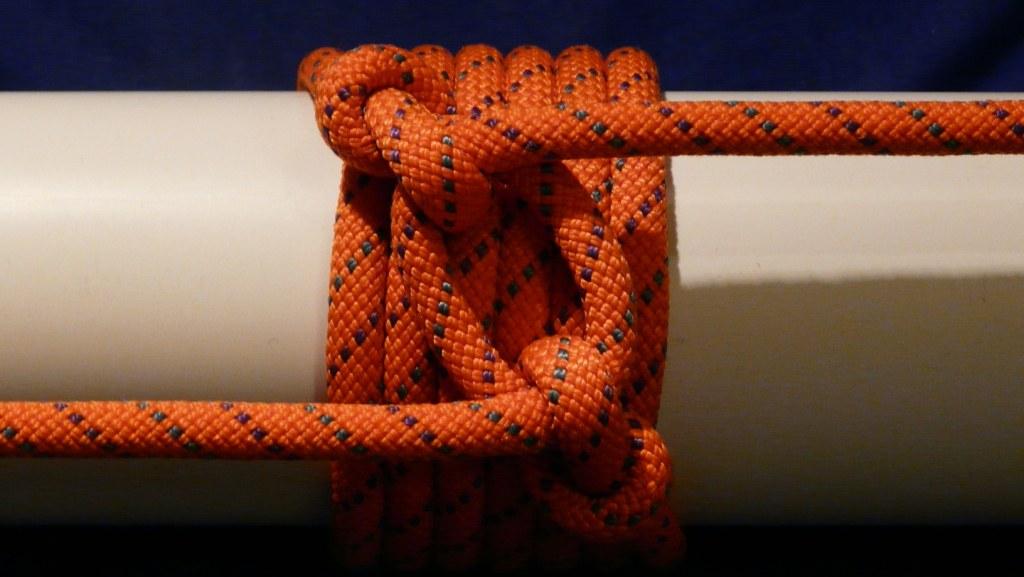
A way to improve the pre-tensioning of the coil “tube” just a little bid, is to place the inverted (single or double) Gleipnir hitch at the middle of our hitch. Doing this, when we pull the one end of the “tube”, we have to tighten the one half only of the number of the coils ( - only the three of them, if we have 6 coils in total, as shown in the attached pictures - ), and when we pull the other end we have, again, to tighten only the other half. The friction forces between the rope and the surface of the pole we have to overcome to tighten each end are, in this way, cut in half, so we are able to convert our pull to internal tension alongside the coiled structure more effectively. If the surface of the pole is slippery enough, and if we can pull each of those two ends forcefully enough, we may thus achieve a more satisfactory pre-tensioning state of the coils around the pole.
( I have to repeat that a coiled gripping hitch can be really improved a lot, if we will manage to figure out a clever way to use the mechanical advantage offered by a (self-locking) tucker s hitch or versatackle knot ( or by any other similar rope mechanism, (1) ) for or purpose : to pull the two ends of the rope that is wrapped around the pole with a greater force, so that the coils will be pre-tensioned, and grip the surface of the pole at an exactly right angle, and tighter, even before the final loading of the hitch. I have not yet found the solution of this very concrete problem, although Ihave tred for quite some time now…It could well be just under my nose,and I am unable to see it.)
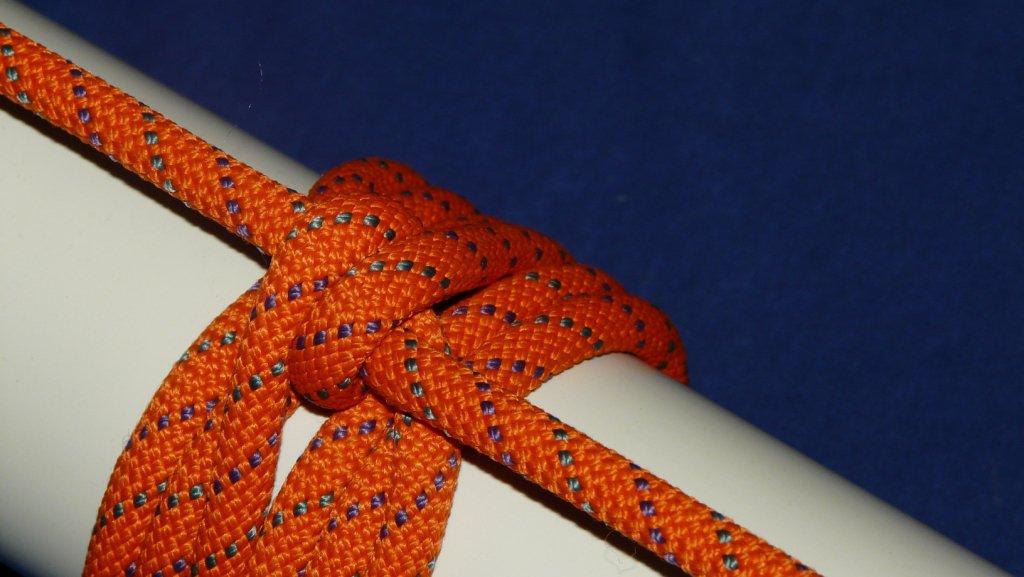
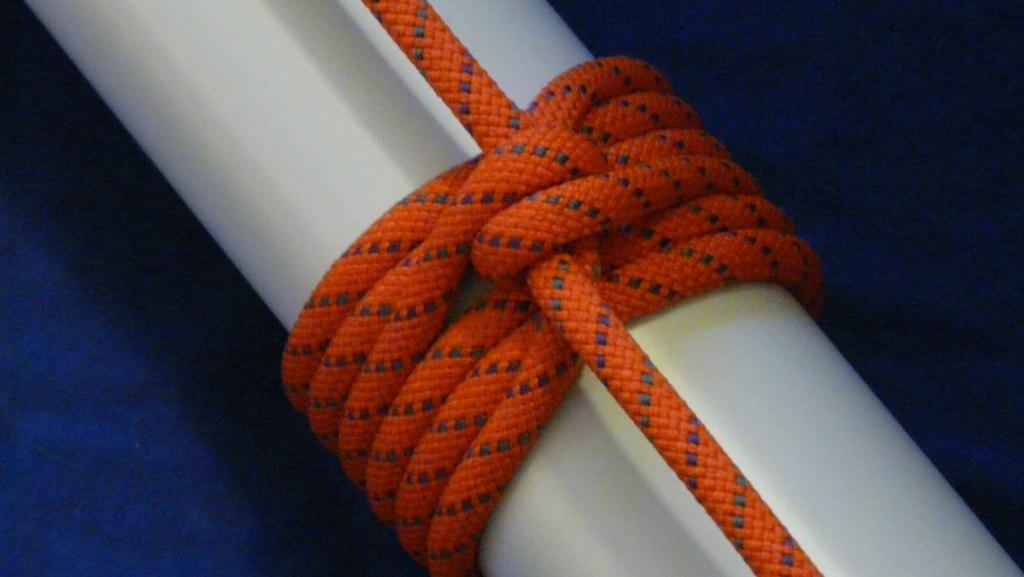
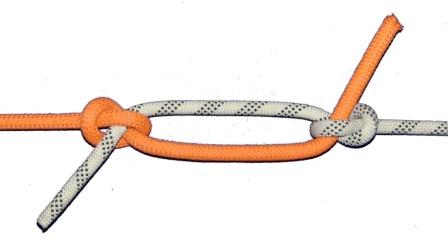
A not-so-clever - but also not-so-dumb, I hope - solution to this problem - of how to use a mechanical advantage in order to pull the two ends of the coil tube towards each other - is the one shown at the attached pictures. I use the simplest binder that offers a 2:1 mechanical advantage I am aware of, based upon two overhand knots tied on the two ends - the tail of each one going through the bight of the other.
( At those pictures, I show the hitch in the stage just after the pull of the two ends, and the tightening of the coil structure around the pole. After this stage, we can always pass the one of the two free ends through the central “ring”, so it will be re-oriented towards the same end of the pole as the other one.)
The pre-tightening of the coils has also another beneficial effect, that I have not yet mentioned in this discussion. Not only it enhances the friction forces - because the rope is pressed much harder on the surface of the pole - but also flattens more the round cross section of the rope alongside its helical contact area with the pole. So, it is really no wonder that such a friction htch would be able to hold as effectively as it does - and much more effectively than the friction hitches that do not benefit from such a mechanism.
xarax, do you find any of these hitches comparable to Klemheist and Prusik in quikness to tie?
Mike didn’t mention simplicity and quikness/easiness to untie, but I would assume that’s something he wants in a work situation.
As I have said, any friction hitch based upon not-crossed multiple coils is, in fact, not a “quick” knot to tie… It needs careful setting and dressing, otherwise it will not function properly, because the coils will cross each other, etc.
The hitch based upon the 'simple-hitch-a-la-Gleipnir" is almost as quick as most climbing friction hitches to set, but, as it needs tightening to gain its full advantage, to complete its tying takes a little bid longer. That is the price you have to pay, to get a pre-tensioned, tightly wrapped multi-coils structure around a slippery pole. Taking into account the cost/benefit ratio, I think it is worth the added trouble. Also, the multi-coiled Double Constrictor is a relatively quick knot to tie, and it might take a shorter time for people that know/understand this knot to tie it, even than the time required to tie some climbing hitches.
The other hitches, that would require a tensioning of both ends of the coil tube through the use of a rope mechanism offering a mechanical advantage, require much more time. They are supposed to be useful only when the situation is very demanding - and we wish to make some show-off, and not just wrap the pole with our rope 10 or 20 times !
A specific problem is able to put our knot-tyers mind in motion, and the results of this motion might be proven to be useful in other problems, in the future. That is what has happened to me time and again, and when a new problem arrives, general solutions of other problems might serve as starting points to fill the dots, and arrive at a new solution, for the new problem. The Knot Land is not a place where some strange species of knots live, independently the one of the other. It is a complex “knotting environment”, a sort of a mega-organism where the individual knots are but cells or organs, and where each animal is related to any other…and in order to understand this environment, we have to pay attention even to the most bizarre, lonely beasts…
We are not just knot-users here, I guess. we do not need to learn only the smallest number of the most simple knots, do our job, and ignore everything else… I want to learn every possible simple knot that exists, and I want to learn them not as a collector, but as a person that wishes to understand the subject he finds interesting…And to understand knots, we have to explore all the interesting knots , not only the knots that answer a few needs, and need only a very short time or understanding to tie!
I am applying grease and butter and oil on the poles, and see how the hitches I tie behave on those things… Do you think that I am so fool to believe that I might need to adress the problem of tying a friction hitch around a stinky slimy pole in my (short) remaining life ? I am just curious, and I would be glad if I die after I have met the most effective gripping hitch, even if I will most probably never use it, neither in this life, nor in the other one …
Tying knots when I’m a bit stressed, tired, tying it in around an awkward object, in rainy and cold weather, are situations when I do actually find a lot of knots very difficult to tie. They seemed easy and simple at home, but when I’m out there I get easily frustrated when I’m stressed out and in a hurry. The once so easy, simple and quik knots seems complex, messy and slow.
Gleipnir is one of those knots, and that’s why I often tie a simple Constrictor even when the Gleipnir would have been a better option. The inverted Gleipnir is even worse. The Gripping Sailor Hitch is perhaps the most effective hitch for a smooth pole I know of, but it’s difficult and confusing to tie in situations as described above.
I’m sure the Versatackle-Pole-Hitch would have been great for a permanent application, but tie, pull, untie x 20… One minute extra is 20 minutes, 3 extra minutes is an hour and time is money (that’s how your boss and customer sees it). Was the extra security really needed?
Those pre-made, friction-independent pipe slings are looking better all the time.
For those of you who want to use friction systems, I looked up what you need to make it legal per ASME standards.
For this regime, the horizontal clamping force on the pipe would have to be reliably applied at .65*(Pipe Weight)/(lowest expected coefficient of friction).
So, what is the coefficient of friction? Wet nylon block on steel is 0.15. Oily metals tend to be in the neighborhood of .03-.10. I’m not sure what mud splashed metal would be.
I have tried this hitch, of course, and I have found it one of the LESS effective, ! Even the hitches in the ABoK are better…You should study the gripping hitches a little more. It is a very interesting subject, and I believe that the gripping hitches around poles or tensioned ropes are the most demanding knots - so they are the most interesting !
If you use knots to make a living, yes. I do not sell or buy anything that has to do with knots, and I do not even use knots in my everyday life. Knotting is a hobby, a game, a puzzle, it has no “meaning” or “financial interest”, for Knot Land s god sake ! So is golf…What is the meaning of trying to put a small white ball into a hole in the ground, hitting it with a stick ? Why you do not send a servant, a robot, or a trained dog to do this for you ?
Gleipnir is one of the most simple knots we know, even simpler than the bowline ( of which it might well have been an predecessor…). The Gleipnir nipping loop is exactly the same thing as the bowline nipping loop - and I do not believe that you would ever characterize the bowline as a time-consuming, complex knot !
The only, minor, difference is that, in the Gleipnir, we do the most simple, easy thing we can think of, we pass both the tails through it, in an effort to secure them. In the bowline, we became a little wiser…and used only the one end, and a new, more clever invention, the collar. On the contrary, the Costrictor is a complex knot indeed, much more sophisticated in its mechanisms than the Gleipnir !
Now the inverted “Gleipnir”, the “simple hitch a la Gleipnir”, is nothing but the same bowline nipping loop, placed in a way that the two limbs of it, when they are being pulled, they can pull/squeeze the loop itself, as a whole, on the surface of the pole…I do not understand why you find this most simple, easy thing difficult to tie, or time-consuming…I guess that it has something to do with the not so satisfactory understanding you have about the Gleipnir and its relation with the bowline nipping loop - and I believe you can very easily overcome this by examining and studying the knot just a little more. I think that if you re-name the Gleipnir as “both ends through the bowline s nipping loop”, you will be able to tie it in a shorter time, with ease.
I had it outperform The Prusik, Klemheist, Double Pile Hitch and Rolling Hitch. The KC Hitch was good, but in my brief testing the Gripping Sailor Hitch was slightly better. The KC Hitch and Gripping Sailor Hitch needs a bit more space to “spread” out, before they really hugs the pole.
Perhaps you compared it to other hitches than those, when you came to the conclusion that it was less effective?
[quote="Hrungnir post:30, topic:4320"] and time is money (that's how your boss and customer sees it). [/quote] If you use knots to make a living, yes. I do not sell or buy anything that has to do with knots, and I do not even use knots in my everyday life. Knotting is a hobby, a game, a puzzle, it has no "meaning" or "financial interest", for Knot Land s god sake ! So is golf...What is the meaning of trying to put a small white ball into a hole in the ground, hitting it with a stick ? Why you do not send a servant, a robot, or a trained dog to do this for you ? :)I do actually use knots to solve some problems at work, at home, in the garden, when working out, when I'm hiking in the mountains, solving problems related to my car or when trying to help family and friends. The rope and knots is just a tool, helping me to solve bigger problems. When working on a project (unpaid or paid), you wanna focus on your tasks and being effective. It doesn't matter whether the poles were brought by a volvo or a mercedes.
I understand that the structure of the Gleipnir is simple and that its structure is related to the Bowline. I also understand that the Inverted Gleipnir is just an upside-down Gleipnir.
However. Tying methods and structures are two different things. I’m able to tie the Bowline with one hand in two motions. I’ve seen people tie the Bowline with no active hands at all. Just swinging the working end. Is this possible to do with the Gleipnir? ???
To tie a Gleipnir I put the rope two times around the object. I have to let go of one of the working ends while grabbing the middle of rope and twist it (be careful to twist in the right direction) to make a loop. When I’m not holding the other working end, it might slip off the object and out of position. Next I put the working end I’m holding through the loop. Then I let go of this working end, grabs the other working end and puts it through the loop. Here the working part I’m not holding might slip off (especially if the object is small, short or narrow), which certainly would make things difficult and annoying. Then I let go of the loop and pull both working ends to tighten.
(I do not know what is the “double Pile hitch” (?)…)
I have compared it with the Blake, and the Ashley s hitches - among them the ABoK#1740 and the little modification of it I had made… And, of course, I always compare apples to apples, that is, friction hitches with the same number of coils.
I never use knots at home, I am retired so I do not work, I do not have a garden ( I live in an apartment where people are complaining about noises when I try to test knots… :)). I am not going up on the mountains but only out at the sea, I do not have a car because I live in the city center, my family and friends HATE me when I speak to them about knots, as I always do !
The knots themselves are my problem, I do not use them to solve “bigger problems”, because I think that the problems of the knots are big enough for a hobby - and the big problems of life can not be solved by the use of knots, unfortunately ! ( In fact, they can not be solved, period.) My focus is on learning all the interesting simple knots, and how they are related to / transformed into each other.
So, we are as different as we could be ! However, I am sure we love knots just as much as anybody else in this forum, and it is this love of knots that brought us here…
I have not said that… There is no “up” and “down” on this hitch, and by just placing something “upside-down” you do not change it ! I have said that ;
Of course, you are right about the Gleipnir being harder to tie than a bowline…That might be the reason people have discovered the bowline, and forgot the Gleipnir ! I was talking about the concept of the Gleipnir, that is more fundamental than the bowline ( and it has no need for the collar). So, conceptually, the Gleipnir is a more fundamental, simpler knot than the bowline, even if it is harder to tie ( for two handed / five digits on each hand creatures ! I do not know what octopuses would have said, if they have discovered the language… :)) I mean, the fact that a knot is simpler than another, does not make it easier to tie…
You may prefer “OPT” ("other people’s testing), but your
claim here was different --and needed to be, given it all.
So trying to wave off any serious question is just cowardly,
or what else should we call it? You, who “know” how “far
superior” something is, yet, cannot say how this rare wisdom
is to be understood?
–in terms of the test method : what materials where used
(hitching & object; cordage type & size(s)); how the various
knots’ results were graded/ordered.
One can envision a test device in which the two ends of
specimen cordage are knotted in competitive hitches on
either side of some capstan-like cylinder for simultaneously
pulling each end towards it, wrapping up the line. Then,
at least in some H1-vs-H2 ordering one might see one
knot yield while the other holds.
[quote="Dan_Lehman post:23, topic:4320"] The [i]icicle hitch[/i] is said to grip even a tapered spike; [/quote] "Is said..." :) By whom ? Where are his "tests results for public considerataion" ? Did this "who-ever" tested also the hitches I have proposed, and have compared them to the hitches he knew? ( provided he now knows the hitches I have proposed..)
The demonstration of this was before a meeting of the IGKT;
it’s reported in an old issue of Knotting Matters. And that
is a point of reference for what the knot --some particular
entanglement of cordage to some spike-- can do: it stands
as a challenge for other hitches to equal or not --just this,
and not some sort of more transferable currency of hitch
performance, although it seems a considerable feat.
[quote="Dan_Lehman post:23, topic:4320"] that hitch you show as "superior" doesn't look good enough to hold on slick pole. [/quote] "Look" ? :) Do you judge knots by "looking" at them ? :) ...
Yes, just as you do in looking at your gentle curves
in those hoped-to-be-so-strong end-2-end knots you’ve
put up --a naive look, devoid of any intelligent testing
to support it (and I know, for I’ve followed that path,
but have some testing & practical hints of its speciousness).
So, I look at your hitches and try to see how force will
flow into them, on what it will bear, how it might tighten
further, and so on --a looking that bereft of better understanding
is itself only an inchoate basis for judgement, but one that
should be made (i.e., one should make oneself forecast,
to test one’s beliefs), in a sort of trial-&-error building.
It can hold on any pole because it can be pre-tightened as much as we can tighten it even before it is loaded -
Everything can be --that is
a mere tautology. But as for seriously tightening some
knot, that will depend upon materials: manual force will
be insignificant for much rope tightening --quite in contrast
to that in angling knotting, where setting knots to some
50% of expected break strength is sometimes expected
for getting proper results!
... And I wait your comparative tests on "knotted materials" tied with those knots. Until then, I suggest you "look" more carefully ! So,yes, it is "superior to the Icicle hitch, BY FAR, as you will be surprised to discover before the end of this half century...
Such childish replies serve you poorly.
As noted, I look at that (however tightened) wrapping of
cordage you advance and surmise that on loading it will
move on a tapered device and NOT have the mechanism
to increase tightening & thus grip on the reduced-radius
material and so will slip even more, to failure. Whereas
those knots that feed force into the bottom of a coil can
have some chance of rapidly constricting around such
a tapered object sufficiently to hold. (Though I remain
leery of putting much faith in them; still, one person
was brave enough to suspend himself by a now famous
hitch. (In true knotting fashion, some arborist site cites
this performance in promoting its use of the hitch, without
considering that the arborist use is to load both ends,
unlike the single-S.Part loading that gripped the spike!))
[quote="Dan_Lehman post:23, topic:4320"] I believe that Derek tested his hitch to a smooth pole, with a hydraulic jack? [/quote] I do not put a question mark, when I say that Derek Smith has NOT tested the hitch I have proposed, and has not compared it to any other hitches...using a hydraulic or not jack - just as you, I believe (?) :).,
No, but what you say raises a question mark in readers,
for there’s nothing there, but assertion. Derek tested …
in that manner, with that result. Now, he didn’t test
your knot; but how DID you --in what way, with what
materials and what force. For if all you did was dangle
your empty chair from a water pipe and rouse your
neighbors, we’ll have a good idea of figuring which of
the these briefly tested knots has had the real challenge.
Modesty, wisdom… among other things…Iff you do not dare to publish anything out of “cowardly”, you should not suppose others have the same motives !
Anyway, I hope I will publish my results as soon as I can… and, of course sooner than 35 years … I will not live so long !
I want to test each knot at least 20-21 times, to its ultimate strength/ breaking point, so that 1 test would represent a 5% difference, and the sample would be reliably large enough. Now, my universal test machine needs about a 2 m length of rope each time, and we have hundreds of bends and bowline-like loops. It will need some time, and some money, to accomplish this task.
Each person has some talents and some shortcomings. I am not born to be an experimentalist, but I am forced to do this dirty job, too, because some people are too lazy, or shy, or what-else, to do or publish their notes, their results…or believe they will better do it in the after life.
I have used 9-12.5 mm nylon-based kermantle climbing ropes till now, but I believe that we should do our tests in a more common and “generic” type of material - so I have decided to go on with 1/2’ solid braided nylon - and cheap ! - rope. Any other suggestion is welcomed, of course. The diameter of the object/pole - as well as the sheaves the rope would be wrapped around on the machine - would be 8 and (hopefully) also 16 times the rope diameter, i.e. 4 and 8 inches.
I wanted to get rid of the usual problem all the universal testing machines have, that is how to connect the specimen to the two anchor points. I have decided a simpler procedure : I tie the two ends of a 2 m. rope segment with the bend I want to test, and then push two sheaves, around which this loops is wrapped, apart from each other, by the use of hydraulic cylinder(s). It is easy to mark the maximum pressure of the cylinders until the rupture, and then to compare the results. Of course, one can also do the same test with two knots tied on the same two-segment loop, in a tug-of-war type of test…but I am afraid that the vibrations on the rope during the collapse of the one, will somehow affect the other.
[qush thote]
For the pre-tensioned griping hitches I am talking about ( even without using a 2;1 mechanical advantage to pull the ends of the coil tube more forcefully ) , this is a piece of cake- and you should have understood it by now !
Well, I am hoping that I will be proved to be right some day- by intelligent testing, when you will decide to execute and publish them ! For the time being, I am not so “intelligent” - and I am not sure I would be able to become more “intelligent” any time soon… ! And if you have “looked” at the “simple hitch a la Gleipnir” - or even the one where the pre-tensioning of the ends is conserved in/by the Double Constrictor- and you have decided it/they will not hold as tight as the Icicle hitch, then you have a very minor, simple problem that can be solved immediately… Buy another pair of glasses !
I have shown that any gripping hitch where the two ends are firmly entangled together, via a Gleipnir closing knot or any other similar tight mechanism, just because this closing knot can preserve any pre-tensioning of the ends, is superior, by far, than the well-known hitches which do not benefit from that effect. It is an altogether new class of gripping hitches around poles - but i know there will another half century needed for the conservative community of knot tyers to ACCEPT this…and, fortunately, I will not be living by then !
Noope ! That is what a naive “look”, or though, might suggest, but it is wrong nevertheless. The result of even a manual pull - even without using a mechanical advantage - are impressing ! My theory is that this has to do with :
Of course, you are not going to test this by yourself, will you ? It is EASIER to “look” than act - as we all come to know some day ! And saves you from the “coward” obligation to tell to somebody else - else than yourself - :
“You are right, I was wrong.”
Well, I did the exactly same thing with myself, the “simple-hitch- la-Gleipnir”, and 8 coils, tied around a 3 " pole… Am I brave enough ? Nooo, because I was hung at a 3" height above the ground, the f…coward ! …
The very tight friction hitches around a pole - capable of being pre-tensioned to a smaller or larger degree - that I have described, are not very “quick to tie”- but, mainly, once they are set and tightened around the pole, they are not easily and quickly released. I was looking for a gripping hitch that would be very tight, yet it would also be able to get loose in a moment , a “quick to release” hitch - and so be free to slip out of the pole, or let the pole free to slip through it. I think that I have found such a hitch, and I present it here, for further evaluation. I briefly mention the two main advantages of it :