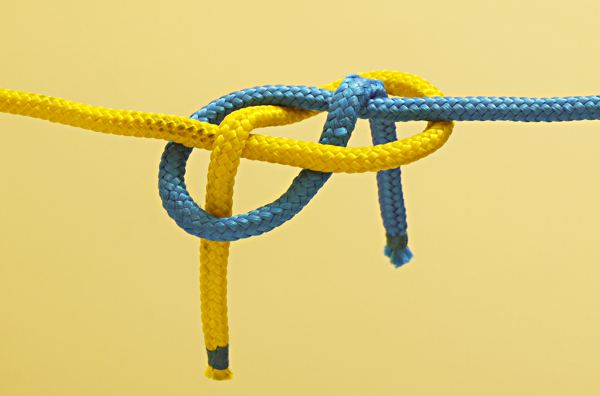
As the Carrick Bend and its common misinterpretation once again came up in the thread about useful knots, I go back to it once more to clarify how to tie and how to draw it up.
There are a few erronous statements in knot books about the Carrick Bend, most notably the one by Brion Toss in his book “The Rigger’s Apprentice” ISBN: 0070650756 (The Complete Rigger, Wire and Rope ISBN: 0-540-07314-8). Such errors, in my opinion, do incredible damage to the knotting community.
In the recent thread on useful knots, once over it was stated that the knot is a clumsy affair, and also statements about it being prone to error occured.
The knot, contrary to popular belief, is one of the easiest to tie. When the technique is learned, it is virtually impossible to mistie, and it is neither clumsy, nor can it jam. I have an easily followed method described on my webpage: http://web.comhem.se/~u77479609/Carrick%20Bend.html. By that method, it is easily tied, even with gloves and in complete darkness, and there is very little risk of mistying it. When I tie it in that way, it consistently forms the right pattern and draws up correctly without any hassle. There is also a video on the webpage that shows the sequence.
Ashley says about the knot:
/.../ The Carrick Bend, when under stress, pulls up into easy loops, which may be readily opened with a few light taps /.../ (ABoK #1439)Toss:
/.../ [i]Drawn up [/i][b](B)[/b][i], the Carrick Bend is secure but bulky, with a poor lead, and not easily untied. [/i]/.../ (The Complete Rigger, Fig 77 p 51)
Toss illustrates his notion with a sketch showing something that does not even remotely look like a Carrick Bend (image below, copyright Brion Toss. The image is presented as a quotation according to Swedish Law of authorship (1960:729) #22 and #23,1 amended Law (1993:1007) ).
How did this happen?
Evidently, Toss first pulled on the ends, till the knot was drawn up in an inverted fashion. Then he capsized the inverted knot by applying load, which rendered it severely misformed. When I search different books, the only notion I find about the way of drawing it up is the one in Ashley’s book, where it seems not sufficiently pointed out, that the very method of drawing up the knot is by applying load on the junction. The ends shall not be drawn tight, they must be left loose.
Just as Ashley states, the knot draws up into easy loops when load is applied, and from that state, it cannot capsize. The second image below shows a properly dressed Carrick Bend.
I have been reluctant to point out the error, for several reasons, but I think that at least within the IGKT, it must be rectified. Errors in knotting books can do tremendous damage.
(Post edit: Copyright to the sketch, first image below, belongs to Robert Shetterly.)