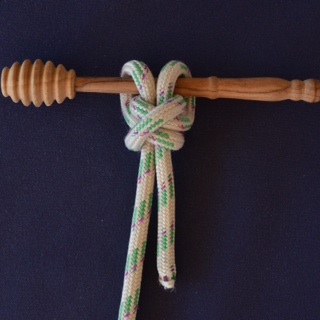
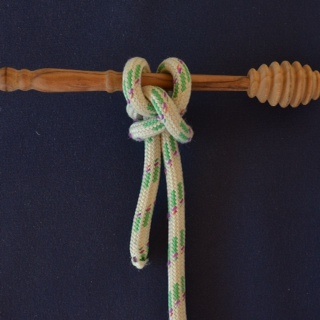
I was browsing through Grogs Animated Knots recently and I found two new additions: the EStar Hitch and the EStar Stopper. They were designed to be useful for tying in unsheathed Dyneema, a line so slippery that sailors currently struggle with how to tie secure knots in it.
For those of you who haven’t seen this knot before, if tied correctly the EStar Hitch is the most secure “easy” way known at the moment to tie a hitch using Dyneema (eg Amsteel Blue). From memory Evans Starzinger (the inventor of the knot) reported in January that it did not slip, but broke at 54% of line strength. It is a very useful knot to know if you are using Dyneema on board a boat and need to attach it reasonably securely to something in a hurry.
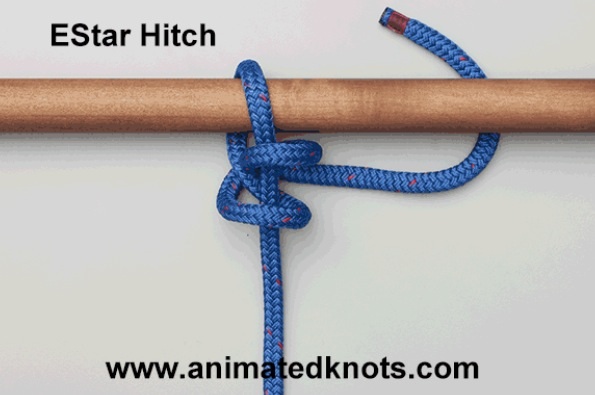
The animated version for the EStar Hitch shows the initial clove hitch reversed in an odd way. I’ve never seen a Buntline started like this and the quick animation confused me to no end at first.
In the animation of the stopper, it is shown going the traditional way.
I have contacted the inventor of the knot (Evans Starzinger), but I have had no reply.
I have also posted the query on Cruisers Forum, but as this is a new knot, people are unfamiliar with it and hesitant to say anything, other than one member stating he had never seen a hitch started like this.
This is the frozen image from the animation at the step before a Buntline is extended to form the EStar. This is not like any Buntline I have seen. I think Grogs have made a serious error. I doubt this hitch would hold securely the way Grogs have shown it.
Am I correct in thinking. Grogs have made an error? Any feedback would be wonderful.
Hi Seaworthy
I have tried these two hitches as shown on the site (buntline and Estar), they are as you mentioned different in the making.
May the author had some reason too put them in the same family :-\
Hi enhaut
Thanks for looking at it. Yes, they are different aren’t they!
I am not aware of the inventor having tied two versions. And the version Grog has shown looks weaker to me. Any comment on what you think the strength would be like of the one Grog has shown? My gut feeling is that it is worse.
My opinion is that Grog, for as shown on its website,ties(for me the picture attached above illustrates a Buntline hitch tied correctly),sets up and loads the knot just as it does EStar:
The purpose of EStar, in my opinion, is not so much to make a strong knot, but to make a knot that will not slip in any way before the rope reaches the breaking load imposed on it by that knot, using this particular material that is dyneema.
For a discussion on other ways to “mount” this construction around the hitched object,and/or the ways to load it:
The knots you see in various sites are often the result of successful public relations and persistent advertising… :). Also, the “spectacular”, animated way they are presented nowadays, to attract the customers/consumers of the commercials, is no testimony about their real value.
I, too, had asked the author of this hitch to clarify the apparent ambiguity, but I had not received any reply yet. So, anybody is free to chose his own version - and then tell me if it differs from the hitch explained and shown at : http://igkt.net/sm/index.php?topic=4748.0
Iff the “EStar” hitch is the one shown at the .pdf file Luca refers to, then it has no relation whatsoever with the knot presented at the post he refers to ! The one knot ( the “EStar hitch”) is tied with the “bridge” of the Clove hitch in contact with the hitched object, while the other ( the “Bull Clove hitch” ) is tied “upside down” ( or “inside out” ) ! The fact that the two knots are topologically identical ( if we ignore the hitched object, and do not consider it as part of the knot - which is a debatable issue…), does not, of course, mean that they are the same knot ! I had explained this simple fact at : http://igkt.net/sm/index.php?topic=4748.msg31703#msg31703
so I will not do it again…The shown at the .pdf file knot is the same with the knot shown by SS369 at : http://igkt.net/sm/index.php?topic=4748.msg30678#msg30678
and described as :
“If you tie it in the bight and reverse the loops, it makes for an interesting hitch as well.”
Interesting it may be, but such a tight hitch as the Bull Clove hitch, it is certainly not ! The squeezed in between the nub of the knot and the surface of the object Clove hitch of this “EStar hitch” can not clinch around the penetrating lines as tightly as the “free” Clove hitch of the Bull Clove hitch.
xarax, your Bull Hitch is identical to how I imagine the EStar hitch should be tied.
Is the 18th of January the first time you posted about it? I can check when I first saw it discussed by Evan Starzinger.
Here is the front of how I imagine the EStar Hitch should look:
I agree ! It should had been tied this way - but had it ? A knot tied in one way is not the same as a knot tied in another ! Geometry tells if two knots are the same knot, not topology. We have many cases where topologically identical knots are completely different - see, for example, the case of the “bistable knots” (1). The simple-hitch-a-la-Gleipnir, tied the “other” way, is a completely “other” knot, a different knot ! Notice that the corresponding “bridge” of the nipping turn is “free” there, too - if you “reverse” the wraps of the hitch, and tie it so that the “bridge” is in between the nub and the surface of the pole, i.e., if you tie it “upside down” ( or “inside out” ), you do not have such a tight hitch any more.
P.S. To better appreciate the great difference, tie both hitches around a thicker pole. The fact that “EStar hitch” is always shown tied around a carabiner or a ring, explains why many people - and, perhaps, the author of thisEstar hitch, too - had not realized how different those two knots are… Another reason may be the fact that, thisEStar hitch was conceived as a doubled ( = two wraps ) Buntline hitch - while the Bull Clove hitch was conceived, right from the start, as an improved, tighter Bull hitch, where the already double nipping “neck” is replaced by an even tighter ( almost jamming ! ) Clove hitch “neck”.
“For a discussion on other ways to “mount” this(mere/bare) construction around the hitched object, and/or the ways to load it,in order to obtain at least four different knots:”
Four ? I can see only two - where are the rest ?
Unless you mean that the each hitch can be loaded from the one or the other free end - but then, as the “same” hitch can also be loaded by both ( as a Cow hitch ), there are six…
I have now looked at the link Luca gave in post #4 (my internet is poor on board and I skimmed over it while I posted photos) and I now realise my question has been answered. The EStar Hitch was designed to be tied as Grog has shown it. An error was not made (except by me in thinking Grog was wrong LOL). The photos I presented of what I thought should be the EStar Hitch, were actually the Bull Clove Hitch.
I just could not understand why the EStar Hitch was chosen to be tied this way when It looked like it should be stronger tied with the pass being over, not under the standing end (ie like the Bull Clove Hitch). This impression was not helped by the fact that the EStar Stopper was tied in the manner of the Bull Clove, not the EStar Hitch.
You seem to leave the matter pending in the thread of the Modified Bull hitch, not showing what is the standing part in the photos that you have attached…(On second thought the question for me remains pending even as far as the non-modified Bull hitch …)
In he Bull Clove hitch, I have not seen any difference in the ability of the Clove hitch to grip, immobilize and “lock” the penetrating continuation of the Standing End and/or the Tail End, whichever these may be. Although the loading is different if/when the Standing and the Tail ends are swapped ( and so the geometry of the structure is stabilized differently), in this particular case the difference is so minute, that we should not speak about two different knots, I believe. However, if we turn the “mere/bare construction”, as you describe it, inside out, like a glove, and then pass the pole through the two wraps the “other” way, the geometry becomes VERY different - and that is why I insist that the two hitches, the (one ?) EStar hitch, and the Bull Clove hitch, are entirely different knots. It would be great if the inventor of THE supposedly ONE EStar hitch ( iff there was one, only, such knot, tied by him…), would clarify this matter for us… My impression is that he had paid no attention to the difference, because, when tied on Dyneema, around carabiners or rings, the difference is not easily noticeable.
I had not tied any knot on a Dyneema rope (yet…) !
For what it is worth, my photo in Reply #6 shows which end I think is the standing one for the stronger of the two options.
I think altering which is the standing end alters the dynamics of this knot. It is no longer the same knot, and in a slippery material like Dyneema the differences may be more obvious.
Xarax, if you are laying claim to both, I would name each one differently :).
In theory, you are right - but here we are talking about practical knots ! In my ropes / poles, I have not been able to pinpoint any visible differences, even after really hard loading.
Perhaps - or they may be smoothed out even more ! :-\ :-\ :-
Tie and try them !
That is almost sure - but I was not talking about those “two knots” in my previous posts ! I was talking about the Bull Clove hitch, loaded the one or the other way / free end. However, we should also be sure first about what, exactly, EStar hitch s creator himself had in mind, which was the knot he thinks it is the one that should bear this name, before we jump into those conclusions.
Xarax, I am a novice here, but with a very keen interest in knots. I love tying them and I am intrigued by what makes them work (enjoy looking at the components). I have no knot tying books on board and up until yesterday no copy of Ashleys. All my new knot knowledge in the last 7 years has just come from the internet.
I live on board a yacht. I do use knots for a practical reason daily. So practical differences are what are important in my day to day life, not the theoretical ones.
I have been thinking about all this and I have a few questions.
I arrived at your knot just by tying what Evans described. This is NOT, however how he tied it in his pdf, nor how it is presented in Grogs.
That is why I thought Grogs was wrong - it did not match his description. In fact, Evans tied it ‘wrongly’ I think.
I could see instantly when I first saw the knot in Grogs that if the knot was tied around a bollard (a big diameter pole) it was likely to be much weaker than the another way (what I now find is your Bull Clove hitch - in Cruisers Forum I laughingly called it the SWL-EStar).
What happens in this situation with laying claim to the knot? Evans has described your knot, but he has tied something different. The method of arriving at a knot I think is irrelevant if the final result is the same knot. This is not the case here though. The Bull Clove is definitely not the same knot as the EStar.
Yes, I realise you were saying that :). See my comment below. By ‘two options’ I mean the two options of what to make the tail in the Bull Clove Hitch:
 - and then tell me if it differs from the hitch explained and shown at :