Hi all,
I have to say right now: I’m a Poldo tackle fan!
I’m so fascinated by the self-locking feature!
I often use it as a cunningham and sometimes as a vang and it works fine, every time I need to
strain a rope I use it. I use it also as a key ring. But one of my “favorite things” is fiddling
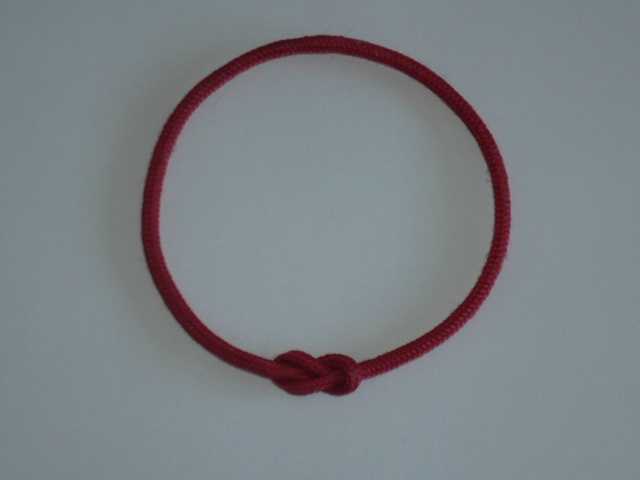
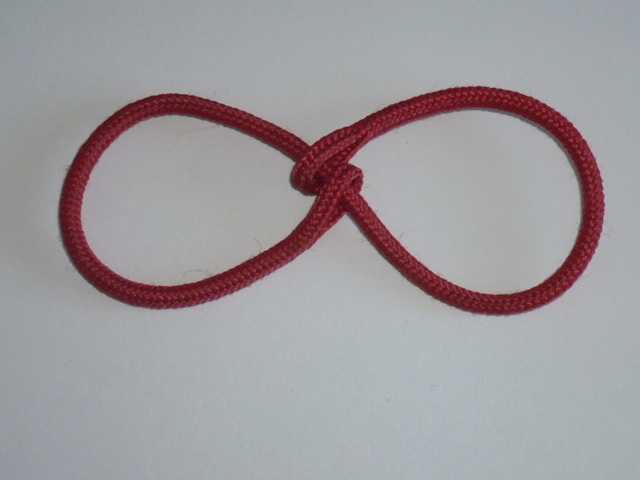
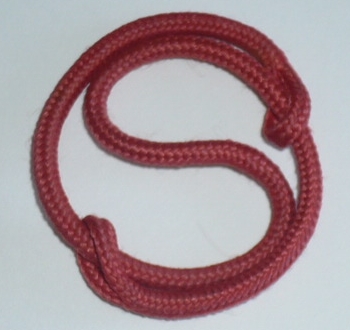
with a piece of string and these are some of the figures obtained by fiddling with a
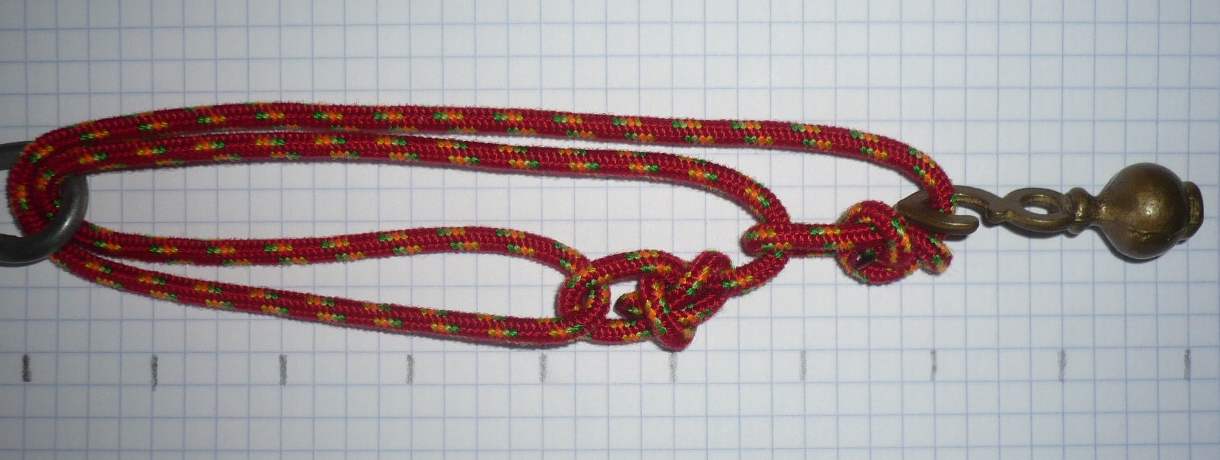
mini-Poldo tackle (with 2 eye splices):
Thanks a lot, xarax!
You are an encyclopedia!
I often wonder how a knot was tied the first time. In this case I wonder if someone was
fiddling with a piece of string and he tied an english, better, a double english knot (ABOK #1415) (or another bend for instance the 2 eyes as in the bracelet above) and then he/she pulled the 2 double overhand knots off in opposite direction and then discovered the tackle.
Yes, maybe you are right,
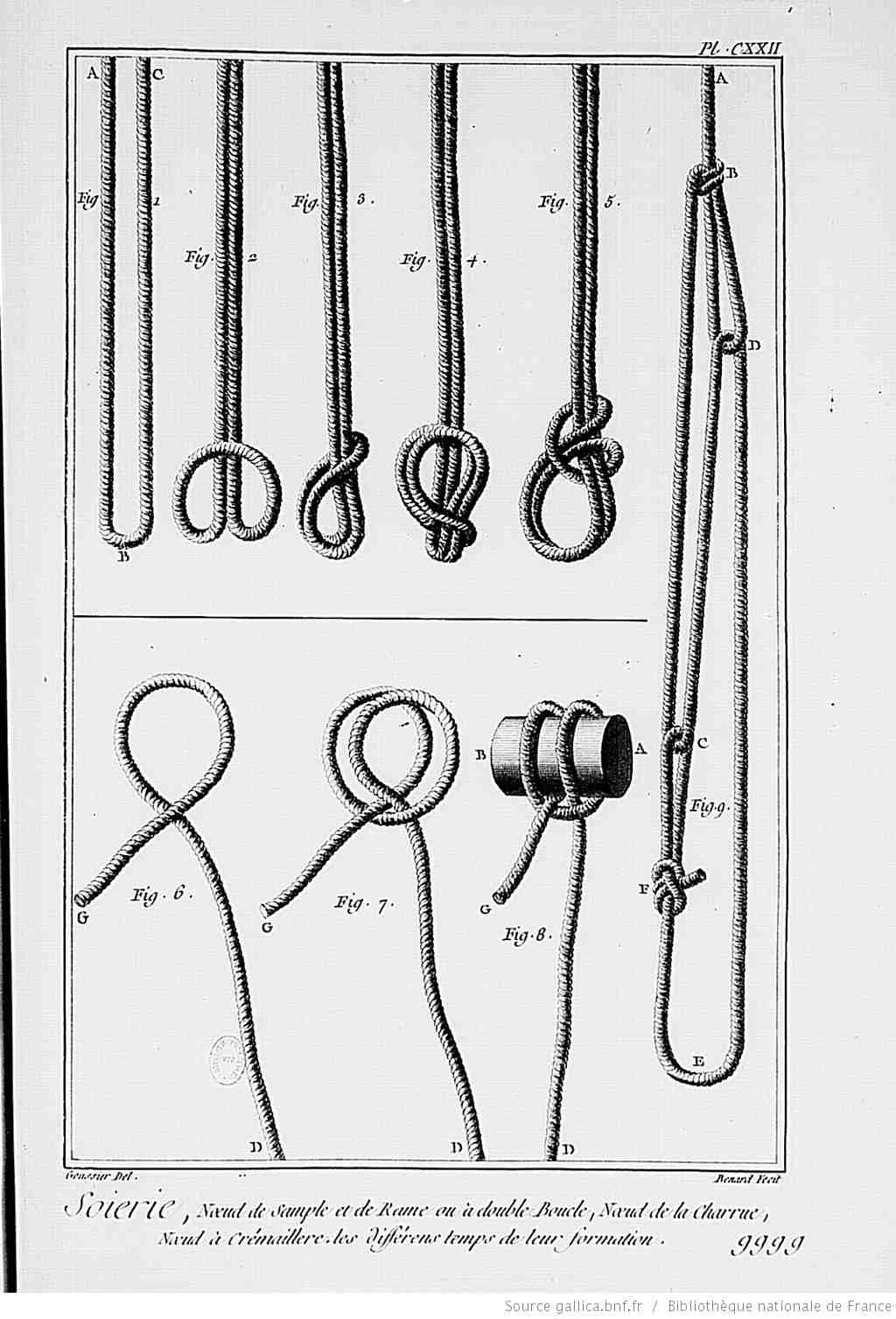
but the pulley systems are usually open (with a free end), whilst the poldo tackle (" noeud a cremmailler ") is closed, so I guessed that.
We do not know how the pulley systems were during Hero s times ! ( or during Renaissance, before 1751… )
" The Mechanica in 3 books survives only in Arabic, in a translation made by Qosta ibn Luka in the 9th century. In the 17th century Grolius brought back a 16th century manuscript of it from the Orient, thereby making it accessible. The first full edition and a French translation of this was by the baron Carra de Vaux in 1893. It covers weight-moving machines." http://remacle.org/bloodwolf/erudits/heron/table.htm https://books.google.gr/books/about/Mechanica_et_Catoptrica.html?id=_RfHGwAACAAJ&hl=en
Don’t know when pulleys were invented, but I surmise that this mechanism, like the Truckers hitch has been around for as long rope has been used.
Archimedes (4th century) has been attributed to using a compound pulley type system for crane work in ancient Greece.http://classroom.synonym.com/ancient-greek-invention-pulley-9468.html
And I remember reading that the Chinese used pulleys some time long before that.
The main thing that I like about the Poldo tackle is the locking or resisting giving slack once it is tensioned.
I learnt the Poldo tackle from the book: “I nodi che servono”, M. Bigon, G. Regazzoni, Oscar Mondadori 1979 (soon after, a little different edition was published as “The morrow guide to knots”). There it is written:
“Il paranco qui illustrato e’ chiamato “di Poldo” in onore di Poldo Izzo, istruttore di vela a Caprera, che normalmente lo utilizza sulla sua barca.”
“The tackle here shown is named in honour of Poldo Izzo, sailing instructor in Caprera, who usually uses it on his boat”
Except that what actual construction of rope & pullies
does it mimic?! I.p., tell me theideal MA (mechanical
advantage) of any of these Poldo Tackles (the old thing,
or the one brought forwards by the Italian book, and
then promulgated by many authors w/o hint of much
understanding!).
I think we should compare Poldo tackle at least to ABOK #3211, but I guess that Poldo tackle is better than #3211. However, even if Poldo tackle were worse than ABOK #3208, we should consider the self-blocking feature after we have strained the rope and the easiness of unblocking it!
The latter has a clearly indicated loading (one pulls up on
the end, and tension is born by three vertical lines in the
system, hence the 3:1 IMA).
Now, both the Italian’s “Poldo tackle” and the old book’s
pictured structure had no indicated working, as they are closed
systems. Even at that (closed, i.e.), please explain the tensions
on their parts!
?!
We don’t need to compare but to explain the Poldo
Tackle systems shown in this thread. One can start by
explaining how they are supposed to (be) work(ed),
and go on to analyze their supposed mechanical advantage!
(IIRC, the Italian authors admonish their readers to “not
underestimate” the mechanical advantage; apparently,
though, they can not (plain ol’) estimate it --and yet
they esteem it! Some copycat books are similar,
extolling it as a marvelous contraption, but, oh, btw,
what is it for?!)
<[b]I’m sorry, I made a mistake in this post:
I’m correcting the original post using red color!
errata corrige:
4L , 2L
F = 1/4 W , F = 1/2 W
and so IMA is 4:1 , and so IMA is 2:1
we have F_righthand + F_lefthand= 1/4W , we have F_righthand + F_lefthand= 1/2W
and so F_righthand = F_lefthand = 1/8W , and so F_righthand = F_lefthand = 1/4W
please see Reply #19[/b]
Hi Dan,
you are right, here I am.
The principle of conservation of energy helps us to solve the (ideal) problem (i.e. only conservative forces act).
(for reference see Feynman Lectures on Physics Vol.1,ch.4)
The general principle is:
= x
The formula for gravitational potential energy is:
<grav. pot. energy> = x
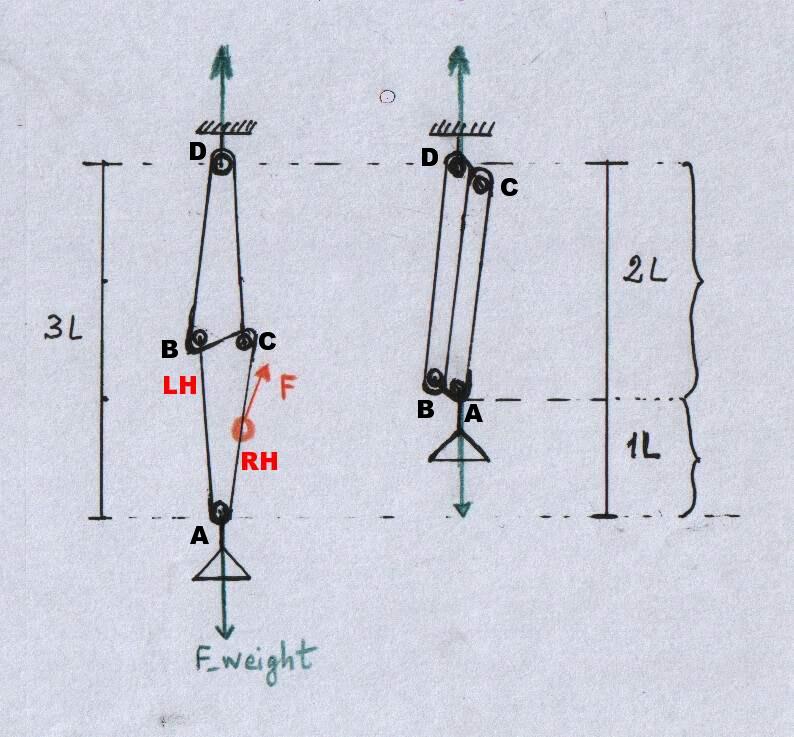
Let’s consider a rope 6L in length and a load of weight W:
at its maximum extension Poldo tackle is 3L in length, (we can suppose <grav. pot. energy> = 0, i.e. = 0)
at its minimum extension, Poldo tackle is 2L in length, (<grav. pot. energy> = W x 1L)
(see figure Poldo_max-min_ext.jpg)
We have gained a change of energy (from 0 to WxL) as “our” force (let’s call it F) has been acting on the Poldo tackle, but we have pulled the rope for a displacement of 4L in length (our force F has done a work of Fx4L) whilst we have lifted the load only by 1L in length (the force of gravity has done a work of Wx1L (remember W is the force of gravity acting on the load)).
Now, F x 4L has to be equal to W x 1L (for the principle of conservation of energy)
and then
F = 1/4 W
and so IMA is 4:1
Note: if we use both hands (simultaneously and with the same force acting on points RH and LH in the figure (right hand upwards, left hand downwards))
we have F_righthand + F_lefthand= 1/4 W
and so F_righthand = F_lefthand = 1/8 W
Curiosity: look at figure Poldo_Super.jpg for a super-min-extension of Poldo tackle!
s.
You do not need the Feyman Lectures on Physics to measure, and to count, do you ?
I other words, if the ends of the two straights segments, at the maximum extension, are, say, 3L apart, at the minimum extension, when those two segments will become three, they will be at 2L apart - simply because the total length l=6L of the rope has not changed , so 2 x 3L= 3 x 2L = 6L ! ( as I, too, remember, since I my elementary school service )
However, you have only proved that the gain on the sum of the work done by utilizing the mechanical advantage is 33.3% ( NOT 50% ! You start from the state of the maximum extension, where the distance between the anchors is 3L, you pull, you consume work, and you end with the state of minimum extension, where the distance becomes 2L, so you go from 3L to 2L ( a 33.3% reduction), not from 2L to 3L ( a 50% reduction) ! )
You have not proved that the consumption of the work will be linear, throughout the transformation - that the mechanical advantage will remain constant from the start to the finish of the pulling ( although I think that, given the linearity of the arrangement of the segments before and after any tensioning, at any two distances between the anchor points, this would be easy. If the segments are not parallel to each other - which happens when we have four anchor points, not two - and the angles between them are not 0 degrees, the mechanical advantage varies. )
P.S. The Super Poldo is nice ! However, to be able to utilize its full potential, the bowline should be able to pass through the ring - so you better use a wider one !
Xarax, I cited (for reference) Feynman lectures for the principle of conservation of energy!
of course, by construction!
The load was lifted from 0 to 1L of height, but I (or someone else) pulled the rope 2L in length (the rope in the middle of the Poldo tackle at maximum extension is zero but at minimum is 2L)
yes, sure, but we can consider infinitesimal displacement of the rope and we obtain that pulling 2 infinitesimal piece of rope is equivalent to lifting the load 1 infinitesimal piece of height, (then we can consider the integral of the force), so the mechanical advantage is 2:1
or we can use eye splices!
but friction exists!
ciao,
s.
You should conserve your energy, too !
I mean, we should better try to understand and explain things as simply as possible ( especially the simple things, as this ), because I have seen that this MA thing has a bad reputation among knot tyers, as being something magical and incomprehensible. I believe you could had simplified your exposition a lot.
Right. You could had started from this ! Specify that, what you do, is to pull the two ends of this segment, the two eyes of the two loops, apart from each other, in order to extend its length, and that you will calculate the mechanical advantage regarding THIS action. The way you had described it was ambiguous ; you had not said explicitly which segment(s) of the rope you pull, from which point(s), towards which direction(s), to shorten the tackle ! You extend the middle segment by 2L, and doing this, you shorten the tackle ( and you lift the hanged load ) by 1L. ( Tex would had told you that tight from the start… ) EDIT : Notice that I am talking about pulling the ends of the middle segment here, that is, pulling the eyes of the loops, NOT the line itself, from some point P. By pulling the line, from some point P, you do achieve a 4:1 mechanical advantage, indeed, because when you drag P, you drag the eye of the corresponding loop half as much, so the 2:1 mechanical advantage is duplicated.
HOWEVER, read my next post, and have a look at the attached picture there : you should take into account friction, which is required to stabilize the mechanism and establish an initial equilibrium - or, in the “ideal” case where there is no friction, the action of an incarnated ghost-spring, or the action of two more not-annihilated hands !
THAT is what I was talking about ! Speaking like this, I believe that you lose most knot tyers, who will think that this is rocket science ! I tell you this, because I am an expert in loosing readers Simplicity is not as simple as we believe… It is veeery difficult, at least for me, to explain something as simply as possible ( but not more… ).
oooops…
I’m sorry, I made a mistake!
but, as a Poldo tackle fan, I’m really happy, 'cause the IMA is 4:1 !!!
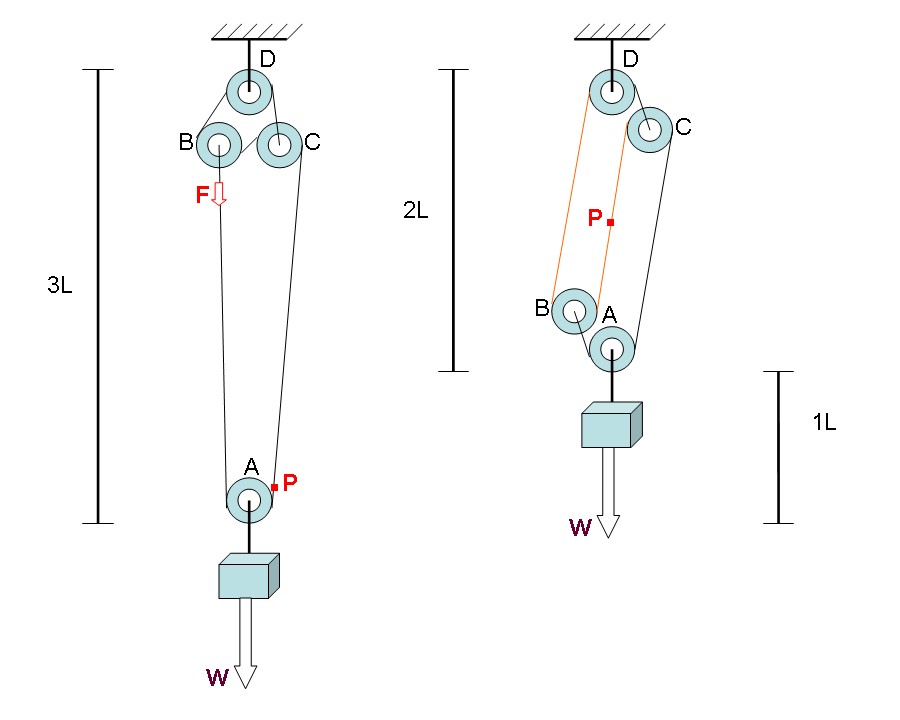
(see attached figure Poldo_max.min_ext.jpg)
When our force F (the red arrow in the figure) acts on the Poldo tackle, we pull the rope for a displacement of 4L in length (the 2 orange lines of the second diagram in the figure). The red point P moves from the A pulley (in the first diagram) to the middle of the central rope (in the second diagram), so we pull the rope 4L in length!!! (please try to pull the central rope of the Poldo tackle and you see how much rope you pull).
So we have gained a change of energy (from 0 to WxL) and our force F has done a work of Fx4L whilst we have lifted the load only by 1L in length.
Now, F x 4L = W x 1L (for the principle of conservation of energy)
and then
F = 1/4 W
and so IMA is 4:1
…
I was not able to sleep…
s.
This analysis isn’t what I wanted, and I think it must
be bogus, but I’ll not wage that battle now.
But I can only think that neither of you two posting here
has actually tried to USE this supposed “4:1” structure,
e.g. to raise (even) 25#!? For I have, and with some
re-direction pulleys to convert hanging (barbell) weights
into upwards pulls at some specified points, IIRC, it took
more weight devoted to this raising than the weight raised!
Now, what I was looking for you to do was to analyze
either of these Poldo (-like) tackles at the static state
where they are at least mid-way in contraction (and show
the zig-zag structure; not fully extended, anyway)
and try to determine what the tension(s) on the parts
must be!!
Curiosity: look at figure Poldo_Super.jpg for
a super-min-extension of Poldo tackle! :)
s.
//
The [i]Super Poldo[/i] is nice !
However, to be able to utilize its full potential, the [i]bowline[/i]
should be able to pass through the ring ... !
I’ll show you what I mean with regard to this “Super Poldo”,
referring to your image (which has it oriented left-to-right,
pulling leftside towards right anchor hook).
Since we’re going for IMA we must assume frictionless
sheaves. (What I was aiming at in begging X. to name the
supposed using-pulleys (which are fairly efficient vs. friction)
device that these mimicked : there isn’t one!)
At the load sheave (left side, 2 parts running away above
and below) one should see force split evenly over the four
parts --2 above in opposition to the 2 below.
But the uppermost >>1<< runs through the anchor sheave
to turn to a sheave-end which supports 2 parts coming to it
(from either side, i.e.); and one of those parts itself splits its
load into the 2nd internal sheave. So, at the anchor sheave,
you have this ONE part opposed to the other three (ultimately),
and 25% vs 75% does not a stationary system make !!
.:. In short, given freedom from friction, these devices will
simply elongate under load --there is no locking.
There are some other behavioral characteristics one can discover
when playing around with them and actual forces, such as which
parts actually move --and which ones you might have thought
should move, don’t! (E.g, try lifting your regular Poldo with just
the one hand --either one, but esp. the left one, I think–, where you
are supposed to get some (“1/8th”?) MA. Good luck with that.
My playing with it now is with 1/4" laid coextruded PP/PE and standard
carabiners (polished aluminum). The story promulgated in knots books
is for --believe it at your peril-- rope-through-rope sheaves (!).
I used the hard-plastic-slick cut-off necks of 2-litre drink bottles qua
sheaves and some fairly hard-slick laid PP cord to manifest a structure
that did (slowly) expand when weighted, as theory foretold.
Btw, a 4:1 IMA would imply that you moved 4 units of rope
to raise the load 1 unit; but Poldo shows moving 1.5:1.