First of all, thanks for taking the time to read my topic.
I am a complete newbie in the art of knots, my knotting knowledge is limited to tying my shoe laces … This i why i came here, i need help with a project i?m working on.
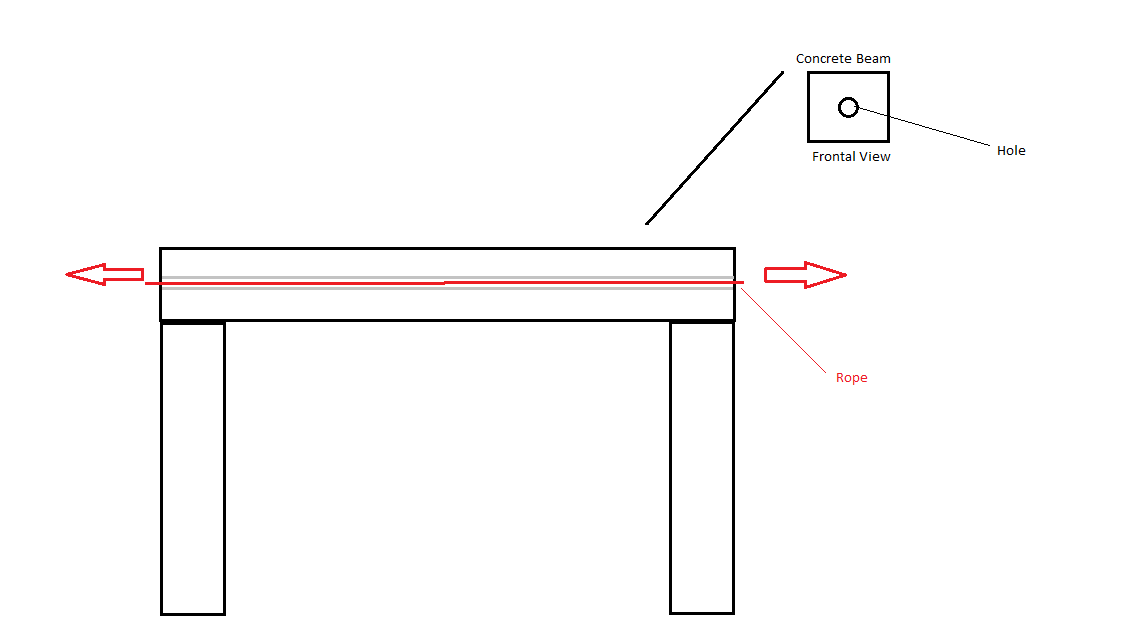
I need two knots, here is a drawing (expertly made in Paint) to explain my need:
The poles that are going to be tied are much thinner than what i drew, maybe about 5/16" give or take. And the rope width will vary between 1/16" and 1/2".
The rope will be a Dyneema rope (i don’t know if this will influence the knot much, but still, better mention this).
Fixed End: This is auto explanatory.
Tensioning End: This end will be used to tension the rope between the poles. I need a knot that can only be tensioned and stay at that tension for a long time, maybe forever if possible.
Both knots need to be able to handle a huge amount of tension.
If it shall withstand lots of tension, maybe the versatackle at both ends might be an answer, but it is a tricky problem, as HMPE rope is not prone to stay knotted when tension is applied. There has been discussions on the board about loop knots that hold in HMPE, and I think thorough testing should be done before walking on a tightrope of the material. Sometimes I think the H is for Houdini and the E Escape, fill in for the letters between.
When approaching about half of the rope’s breaking strength, most knots slip.
Spliced eyes might be needed to do the job, and spliced eyes with versatackle for tensioning might be the answer.
I think before a real meaningful answer can be given you should provide us with more information. What is the purpose of this construct? Will the rope just be a guide line? Will it have something else attached to it? Will this be a permanent thing?
How many poles in all?
Your poles are not all that substantial and your rope/cord is very substantial. I would think that any tension between the poles will bow them toward each other and you will be adjusting the tension till they touch!
I would not go so far as to say, as you have, that the fixed end is auto explanatory. You show an eye knot, but this can slide up or down and might need to be a tight hitch instead. Or the rod(s) may need a through hole(s).
Ditto/+1 to SS369’s concerns.
And --goodness!!!-- what an odd set-up,
such as it’s been so far presented : HMPE
super-static/-strong cord varying in size
from 1/16" to 1/2" :: that’s about 30times
breaking strength (interpolating the missing
1/16" value from the table of strengths given
here : Phillystran, engineered ropes for demanding applications
(I tried to figure a rough factor from doubling diameter :
about 2.8 or so.)
There is a way, using the simple crossing knot, to pull effective tension between the two poles/spars. Don’t have the time to do a video or sequential diagrams but essentially it involves forming a crossing knot, pulling excess slack out of the the line between the two poles by pulling the tailing/working end toward the “fixed end” pole then pulling back away from it, inverting the crossing knot over the top of the “tensioning end” knot’s pole. This effectively cinches taut the “standing” line between the two poles/spars. Can then wrap around the tensioning end pole crossing knot, locking it in place by crossing over the crossing knot, pinning it in place, and using half hitches to secure. Wish I had more time to show but some of the knot wizards on the forum will probably understand, can clarify and improve upon… or, as is the custom, challenge the solution. Sometimes we complicate our solutions.
To clarify : the line runs around 2nd pole,
turns around itself,
goes *back* around pole,
pulling excess slack out of the the line between the two poles
by pulling the tailing/working end towards the "fixed end" pole
[u]then pulling back away from it[/u],
inverting the crossing knot over the top of the "tensioning end" knot's pole.
to be hauled upon (towards 1st pole)?
I’m lost, now, with “then pulling back away from it”
[= 1st pole]?! For one thing, that seems like a LOT
of pulling back --i.e, maybe I’m e.g. a half-metre from
the 2nd pole in tensioning it by pulling towards 1st,
and now to “pull back” I must cover all that ground
(with slack!) and then again (the extent of material
in my grasp) before I gain tension in the opposite
direction. !?? --something’s not right, here.
Also, I find that in the first pulling, if it takes enough
material --there’s an issue re initial tension–, the crossing knot will be capsized --a familiar sort
of thing, e.g., with rockclimbers belaying : they are
pulling IN for a following (“2nd”) climber but if
she falls, she pulls OUT and flips the mezzo barcaiolo
(Munter hitch).
This effectively cinches taut the "standing" line between the two poles/spars.
Hmmm, weil, something I tried did work, around
my finger; but a smooth pole I think will see the
structure rotate, if one releases the tail.
.:. I think another stab at words is needed,
but we should be closer, now. Thanks,
Yes, there is, but we have to use TWO crossing knots, the one next to the other. See (1), and the attached picture.
I have not found any other way - and I bet there isn’t any !
Well, it doesn’t look like Awtchi is coming back to answer the questions in a hurry, so in the meantime, how about we consider how we would do it if we were doing it for ourselves.
Lets presume that those anchor poles are fixed to some rigid enough frame so that they can take the load that the Dyneema is capable of sustaining - then how would you fix the rope and how would you tension it?
To start the solutions rolling, I will offer an anchor for the LHS pole.
First I would tie (yes, you guessed, a KC hitch) as the base of my anchor. I would then lead the Dyneema into a multi turn around the pole. The number of turns will depend upon the coefficient of friction between the Dyneema and the pole material but must be able to shed virtually the whole load into the pole at full rated Dyneema load.
The advantage of using multiple round turns is that a) the rope does not loose any strength in the fixing and b) sufficient turns can be utilised to guarantee that the Dyneema cannot pull out of the anchor knot.
Now I have to tension the rope and anchor it on the RHS pole.
To tension the rope, I cannot expect any knot to function both as an anchor and as a tensioning device, so I would split the job into two.
Tensioning. I would start by tying four VT friction hitches onto the end near the RHS anchor pole and connect each via pulley to a pulley anchor to create enough MA to allow the rope to be tensioned to the required force. I would use a fifth VT as a ‘third hand’ to retain and sustain the tension while I then anchored the end of the tensioned rope.
Naturally, the first part of my anchor is going to be the same number of round turns I used to shed the load into the LHS post. But now I need a tensioning hitch to supply the small load necessary to lock the capstan turns in place and allow them to generate the full loaded tension when the pulleys are slacked off.
Yes, disappointing that we’ve not read back from awtchi. Maybe he’ll check in and contribute.
Since the poles won’t come close to handling the tension we can induce using Dyneema, at any diameter indicated, I’ll just throw in what I would do in any case.
Since we need an anchor knot that will have a right angle pull and needs to grip the pole so it doesn’t slide up or down potentially, I would most likely use something that wraps the pole a couple of turns.
Maybe a Ground Line hitch (ABoK# 1680) and take it one step further with this slippery material and add a stopper knot.
Though a two round turn with half hitches knot and a stopper would probably suffice.
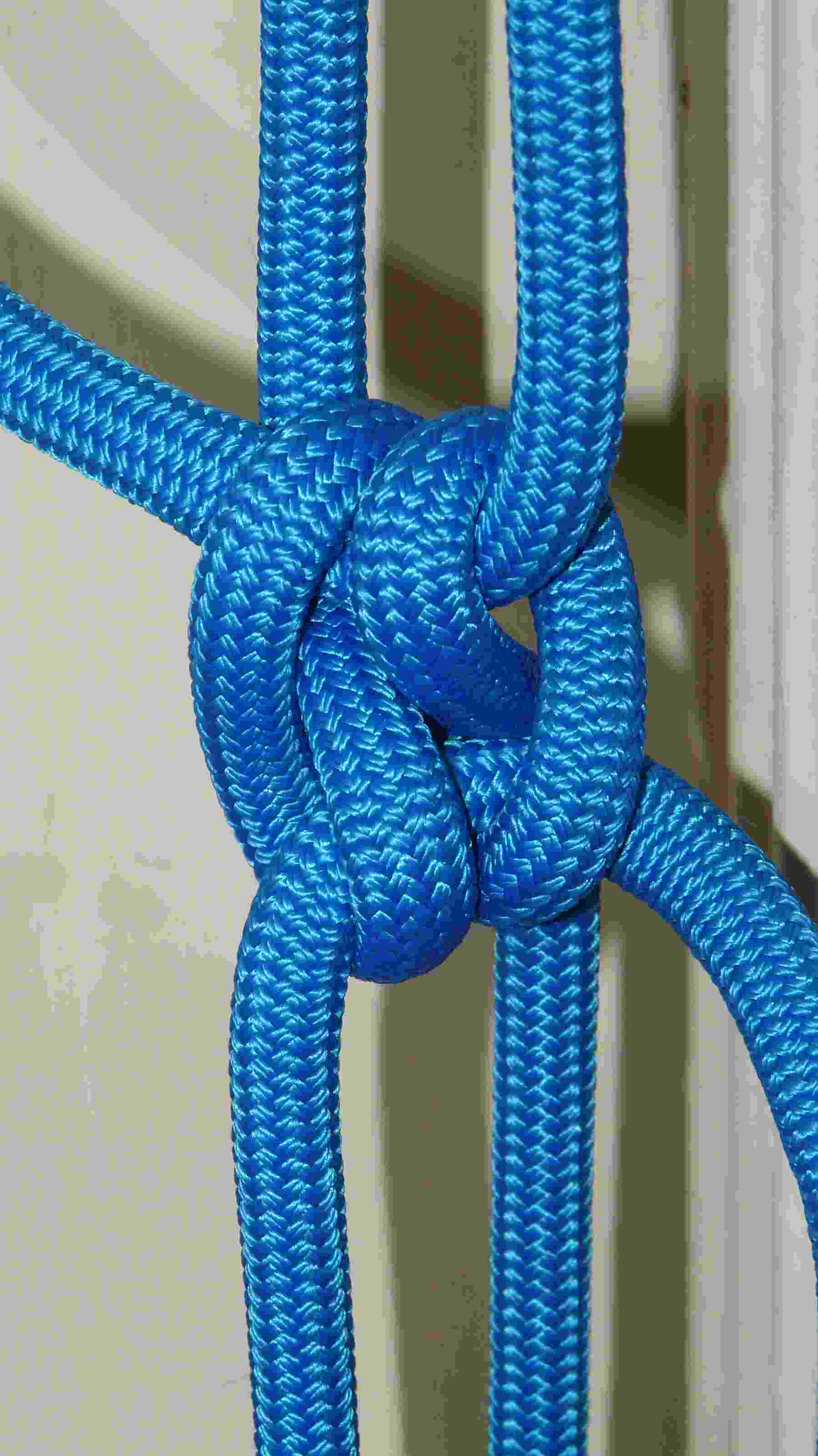
For the next pole, assuming there will not be anymore, I would consider using the double slipped prusik as presented here> http://igkt.net/sm/index.php?topic=4813.0. With the tail pulled through the last slip bight or with the lock suggested in that thread.
With the project in hand I might try other things too. (Of course.)
By hand of course.
Pull the cord/rope between the poles and at the same time take the slack with the other hand after the round turns and working part pass over. Like a Munter hitch and belaying, then complete the knot when the tension is adjusted.
With 5/16" poles I don’t feel any force multipliers (versatackle, etc.) are needed.
Yes, I am still addressing the original post conditions, just in case.
Sorry guys, i got caught up with college and work stuff, so i didn’t have the time to visit this thread.
Thank you so much for all the answers (i still didn’t read them, i wanted to thank you all first).
To answer one of the first questions, here is another drawing about what i intend to use this rope for (attached).
Before explaining where i’m going to use the rope, i will tell you something about me. I am a Civil Engineering student and in my college, in order to graduate, you must submit a thesis. Mine will be about using ropes instead of steel wire in small prestressed concrete structures using
Now to the image. As you can see there is a concrete beam with a hole in the center. I will use the rope to apply a normal tension, compressing the concrete beam.
When i drew the first image, the poles i used were referring to the how i was going to tie the rope on each end. I was going to use a very short steel rod and loop the rope around it (I dont know how to draw this in paint).
This latest diagram and explanation puts rather a different complexion on the problem. To restate what you want : the rope will run through a concrete beam down the horizontal axis. It will be attached to steel rods at each end of the beam to apply tension to the concrete. One end of the rope is therefore to be permanently attached but the other end needs to be attached in such a way that tension can be applied. Where this differs markedly from the original proposal is the rope will be concealed by the concrete.
The answer would seem to be to attach the rope to both steel rods and then apply tension by forcing one (or both) rods away from the concrete beam using perhaps a hollow bolt with the rope running through the centre. The bolt fits partly inside and partly outside of the beam held in place by a nut and washer which when tightened acts to push on the steel bar to which the rope is attached creating tension.
The only other possibility I can see is to use the non-anchored rod as a windlass to apply tension but the inaccessibility of the rope in the concrete beam would make it difficult if not impossible to tie off the wound rope and stop it unravelling.
I will use the rope to apply a normal tension, compressing the concrete beam.
I have worked concrete many years and I don’t think I have ever compressed it with anything. Let alone a rope.
So I must be missing something.
What is the purpose of trying to compress the concrete beam? If it has rebar (reinforcing steel) in it you won’t compress that either. And if you were to manage some how to compress this structure, what will keep it from bowing unduly?
Would you be talking about the form work to cast this beam in?
I’ve seen pre-formed concrete slabs where they stretch steel cables or rebar, pour the concrete, let it cure and then let the steel retract back and compress the concrete. The idea is to keep the concrete from seeing tension (say from bending) since concrete is much better at handling compression than tension.
Yes, with preformed sections of overpasses for roads, but they don’t use ropes and knots. They use multiple steel cables inside a conduit that get tensioned using a huge amount of hydraulic pulling. The cables are then wedged to keep the tension and the conduit is mortared completely.
I don’t believe it is actual compression of the concrete as it is additional tension to resist deflection after cure.
Rebar may stretch, but I doubt very much it has any elasticity. Many of the bridges and parking structures use #11 which is of 1.25" diameter. I’d say that is high tensile strength, so it would resist stretching, especially with all the cross hatches formed in its surface to engage the concrete and unify it.
How much “retraction” the steel cables have after encased in cured concrete stretches my imagination.
Post cure tensioning with cables, sure and then fill the conduit.

 as presented here>