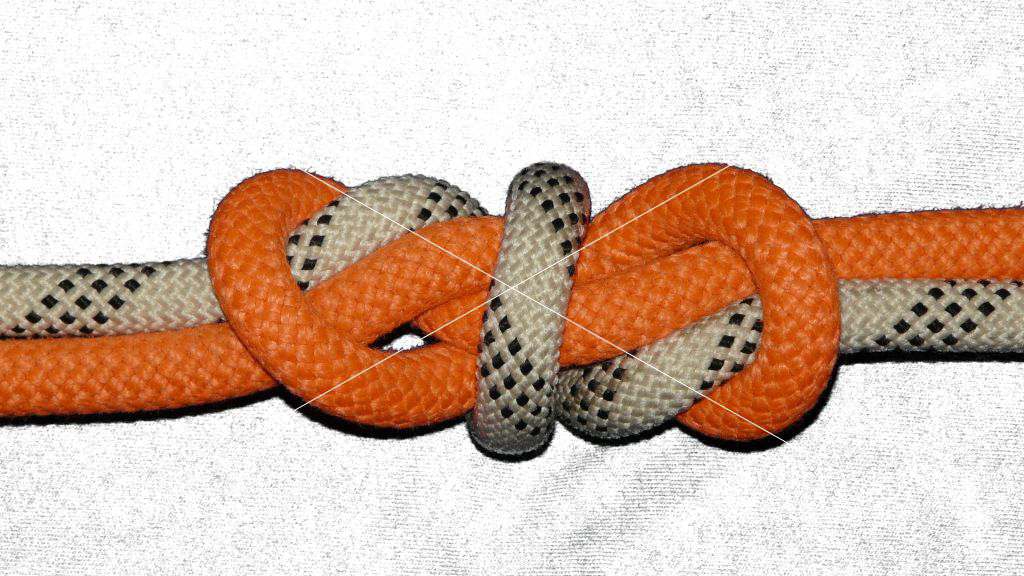
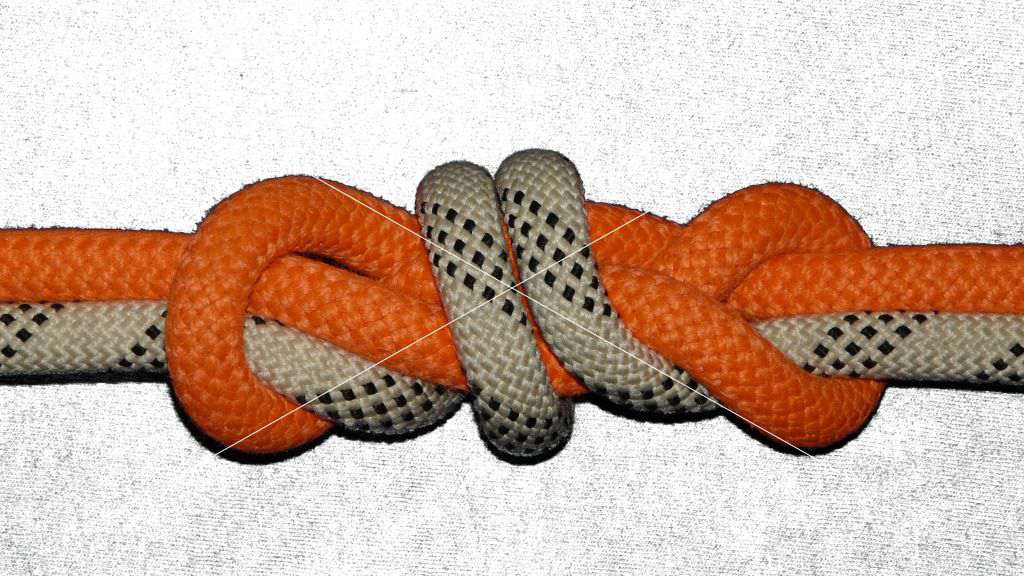
Two interlinked overhand knots midline bend
There are two variations of this knot, just as in the cases of the Pretzel and the Strangle midline bends. Shown here are the top view of the first, and the bottom view of the second.
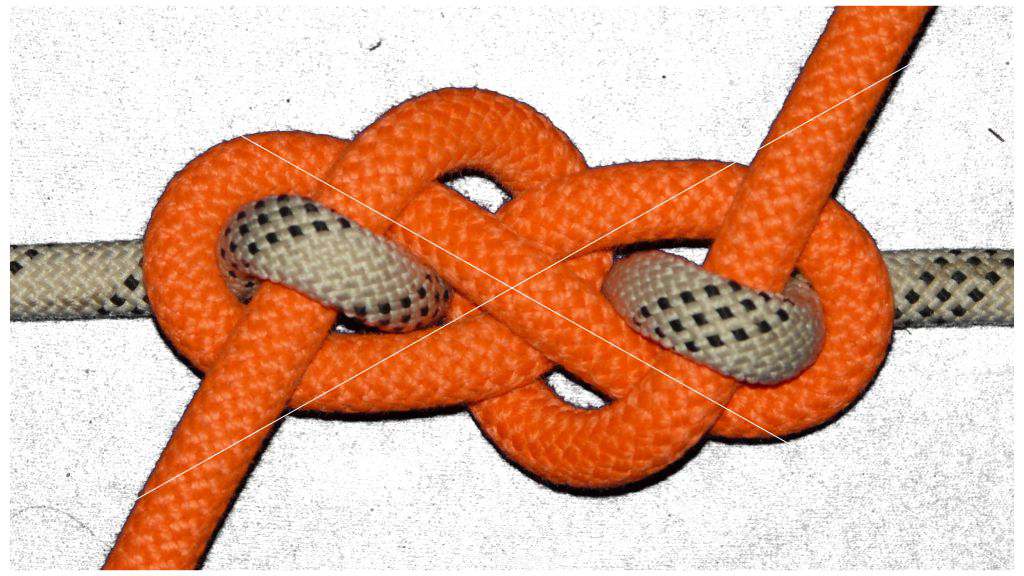
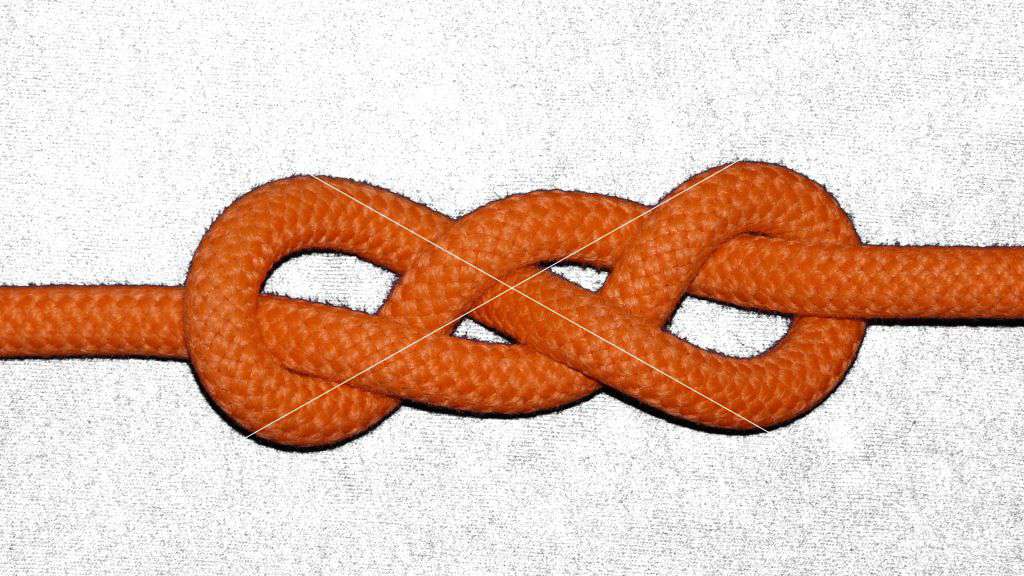
Two interlinked overhand knots midline bend
There are two variations of this knot, just as in the cases of the Pretzel and the Strangle midline bends. Shown here are the top view of the first, and the bottom view of the second.
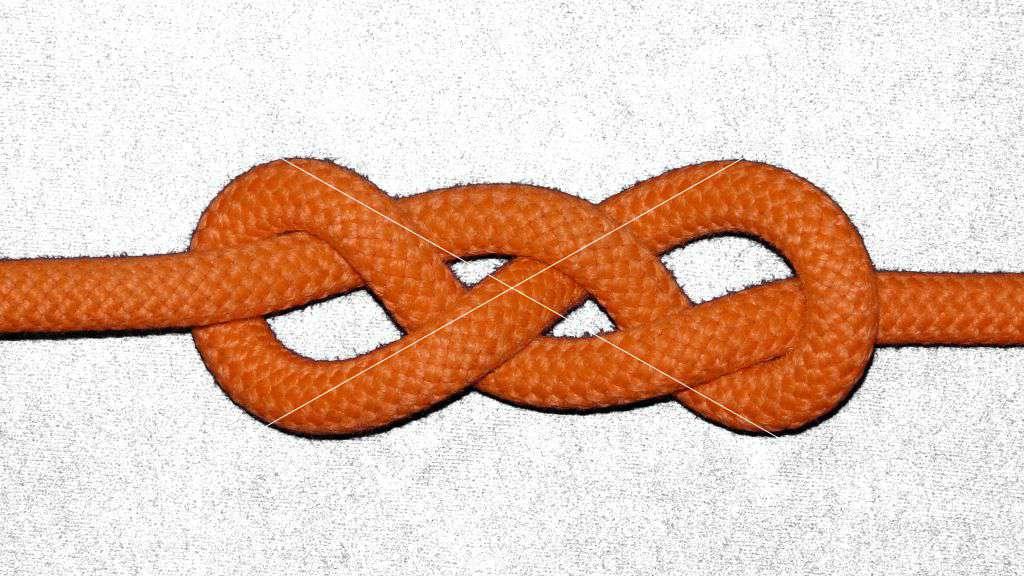
Two overhand knots midline bend
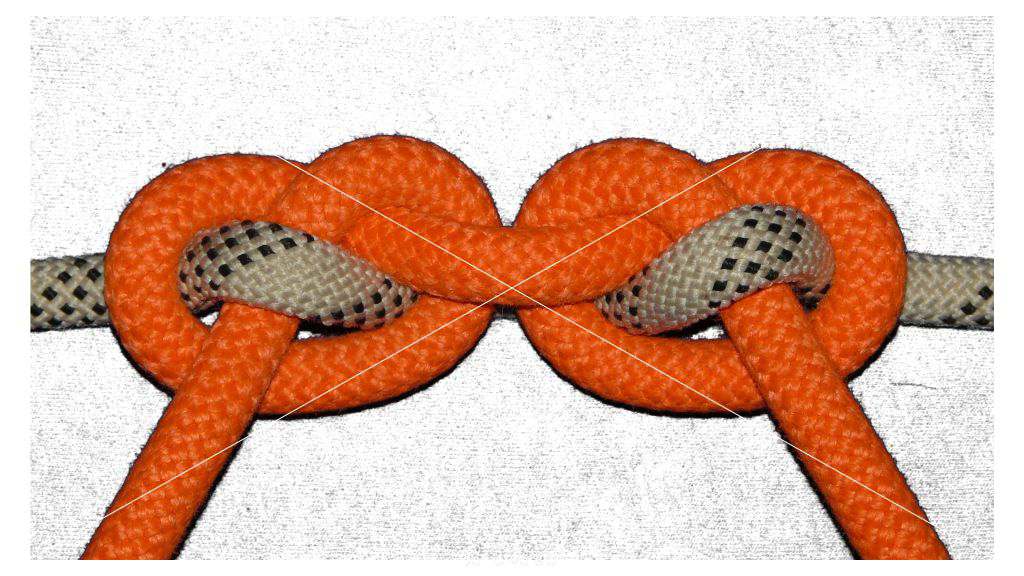
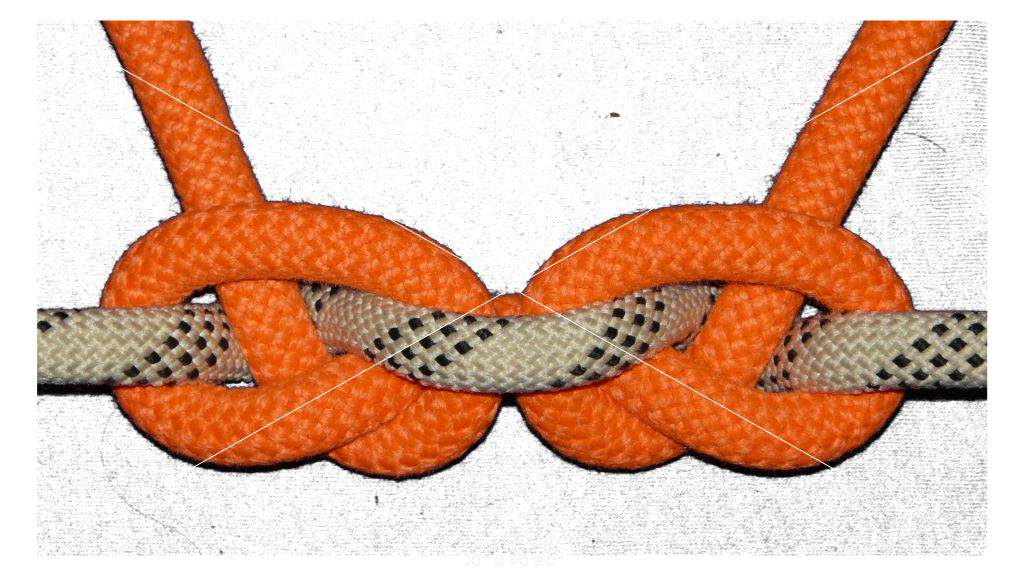
OK, but pics may violate rules of original post. It looks like there’s access to both ends of orange rope. Your own OP makes those solutions more difficult to tie, and way less memorable. The OP is provided here for preservation before Xarax strikes again to change it:
Oftentimes the attached line is short, and there is access to both ends. However, anything that can be tied when we have access to both ends, can also be tied if we have access to only one, is nt it that so ? …  The tying method might become more complex, because we lose the symmetry of the tying operation, but the symmetry of the knot structure remains the same…and the mental picture of it is very easy to memorize.
As I have said many times, I have seen that one needs to tie a new knot at least a dozen times, in order to get the feeling of it, and start to be confident about his opinion. A knot that looks very difficult at the start, may be proved very easy - and vice versa. I believe that the five knots that I have presented in the previous posts are very easy to remember, but I speak for myself - and different people have different ways to memorize things, especially 3D shapes. The adjustable loop based on the Constrictor was more difficult, so I tried to figure out an additional mnemonic rule that would facilitate its tying ( see Reply#30). I do not believe that something similar is really needed here, because the two steps shown at the pictures do not need any verbal instructions.
I do not reply to such …
Screw that. I’m not letting you weasel your way out of this one. We have access to one end. That’s the rule for this entire thread. If we have access to both ends on one rope, I would have come up with some better solutions.
Given the rules of the OP, the knots in Posts #60-62 are simply not going to be remembered after a few days (or hours) of not tying it. This problem is rare (at least for me). Also, that solution is not the preferred solution. So, I am highly unlikely (i.e., will never) practice it.
The solutions at Replies #21, #25, #26, #27, #29, #42, #57-62, as well as dfred s nice solution, are all symmetric solutions that can be tied either with the one end of the attached line ( or the eye leg of the bight of a loop), or with both ends of the attached line.
A general problem should be addressed and, if possible, solved, regardless of the number of times we have met it…because its solution could lead to the solution of other, more special and less “rare” problems. I repeat what i have written at Reply#56.
P.S I know that few people tie the knots I present, so it is no wonder than even fewer, if any, read what I write about them ! Of course, elegant knots, just like elegant mathematical theorems, do not need writers to defend them, nor readers to read them…They are true, and they exist, independently of the every-day “user”.
Hi xarax,
some people do tie these offerings and evaluate them.
Another symmetrical offering is the prusik knot. It holds position in either direction very well with just four coils. (Not necessarily in all size ropes though.) Nothing new, but it is along the lines. 
I do wonder what effect tensioning the white “pass through” main line will have on the couple you’ve just offered (#52-62)?
SS
I try many of your knots, Xarax. In fact, I’ve played around with the knot in the OP a lot. I think that solution is pretty good: simple, memorable because of its similarity to Bowline. All I need to do is remember the Bowline well, and I can figure it out.
As for the solutions that are not memorable, I suppose they could still be considered “practical”, but realistically I’m never going to use them. Every knot I’ve tied in real life for a real application is from memory. That’s just my perspective on it, something to keep in mind. Others may be different, or they may be exactly like me. It doesn’t really matter. I’m the one tying my knots.
By the way, Xarax, for the Strangle solutions in Replies #60-62, there appears there may be a way to make those knots memorable. For example, can the orange rope show the Strangle in its normal form, with the white rope passing through in a memorable way?
But then you violate the rules of the original post because you need access to more than one end. (Strangle can’t be tied on the bight). I’m not opposed to changing the rules of the original post, or starting a new thread.
I have not compared those knots with the climbing hitches. As I understand, climbing hitches hold well on a certain point of the main line only when -and because - they are loaded, and they are easily transported upwards or downwards when they are not. The bends/stopper/hitches - whatever we may call them - presented previously in this thread, as well as the last ones, tend to stay in place even after the ends of the attached line are not loaded any more. However, the main difference is elsewhere…The knots presented in this thread do not work on a straight, tensioned line, because they are based upon a more or less curved segment of it, to anchor the attached line. At those last knots, this curvature is imposed by the tightening of the attached line, i.e, we start placing the shape “8” knot of attached line on/around the straight main line, then we pull its two ends, and this operation deforms the main line as much as needed, to multiply the friction forces between the two lines. My purpose was this ; Find a knot tied with/on the attached line, that, when the main line is forced to curve inside it, the curvature is : 1 : Enough to offer the proper anchor so the attached line will not slip, and 2 : The curvature of the main line will not be straightened again, if, after the pull of the two ends of the attached line, the main line is tensioned much more forcefully than the attached line ( at about double the load, as it happens with the standing end of a loop, in comparison with the two legs of the loop).
I was amazed to see that the knots presented were successful in both of those tasks. I have not compared them in any detailed way, but it is clear that, although we start from about the same shape “8” knot on the attached line, we end with quite different knots, that should differ on their slippage characteristics. Great news ! Because we want to chose the best of them, and this difference of the end knot makes this much easier. My problem with knots that are e very similar, is that I can not chose which one is really better - and I am forced to keep all of them in the limited space of my brain…
So, I believe that those knots, based upon a more or less deformed main line, are very different animals than climbing friction hitches. And they have the advantage I have repeated many times, that climbing hitches do not : they can serve as knots for adjustable of fixed loops. I have stated that this iwas my main interest in the first place, to find a better mousetrap, sorry, bowline !
THAT is the crux of the matter ! I have seen that, after the attached line is tensioned and have succeeded to impose a curvature on the main line - be it an open helical segment or two ‘bumps’, a wave-like shape - those deformations of the main line tend to be permanent and stable. The existence of the attached line, even if it is not loaded, is enough to keep those necessary curves on the main line at their final state after the operation, i.e. that the deformation of the main line is, more or less, irreversible ! I say "more or less’, because those knots are different, and in some of them this irreversibility is more assured than in others - and also because some straightening is expected. I have loaded the main line at double the load than at each of the two ends of the attached line, like it happens in a loop, and I have been satisfied with the results. I would love to perform the same tests with more slippery ropes, like the spectra/Dyneema non-coated ones, and see what happens there. volunteers are always wanted, and much welcomed !
Till now, my dear knot4u, till now… Wait a few more years, and then you tell it to me again…
That is correct, of course. A practical knot that we can not tie from memory, is not a practical knot for us - by definition !
However, you should first tie the knots some times, test them, and if you find them satisfactory, tie them again and again ! Only at the very ,end of this process, you can say that it is difficult for you to memorize a knot, and dismiss it. You have not run the full course of this process yet, have you ?
Of course, all those knots can be shown while they are being tied by a different series of pictures and steps. I have only tried to present them in one post, in a unified way - as it is evident from the first step in all of them. I have started from the different variations of a shape “8” - looking knot, on top of the straight main line. But you can tie the same knots differently - and you can memorize them differently. I find very difficult to predict which is the easier way to memorize a knot-tying sequence, because people differ a lot on that matter…What I have presented, is only the way I use to keep all those different knots in the same place in my brain - so I would be able to address them easily, in the future.
Please, do not pay any attention to the specific names I have used… Many knot tiers will not recognize a Constrictor or a Strangle knot in those mid line bends, and/or will deny the relation. I use those names because they reveal the sequence of thoughts that drove me at them : We use the simplest knot on the main line, and we start from the most complex knot on the attached line. Then, we try to use a simpler knot for the attached line, too. So, we go from the Constrictor to the Strangler. It is the logic of the research that is labeled here, more than the actual end product, the specific knot.
Hi xarax, I intend to differ here.
Some climbing hitches are problematic in that they are hard to release (after load has been released) and this is what drives climbers (and others) to pursue exploring different methods.
A “standard” prusik stays where put very well because it cinches tight and deforms the rope and generally stays that way till advanced. If that rope - main line is soft then there will be a pronounced “dent” and warpage, if hard then the result will be a deforming (bending) of it at the loaded knot. The caveat of sorts here is that some of these “climbing hitches” don’t work well in sizes that match the parent line. Or in , very very large ropes.
Maybe I have a problem with this all because in my mind I have the definition of a bend that says “Bend = joinery using the ends of the ropes)” To me a mid-span bend, as in the OP, is a hitch on a main line.
There are six classes of two-line bends: in the case when we have to join two lines, and only the one end of only the one line is accessible, we need a "mid-span" or "mid-line" bend. (The bend should be able to withstand a pull coming out of any end(s) and any direction(s).)
As you know, I do try to tie these tangles with the most difficult ropes I have, including the Titan cord that generally fails most knots because of its properties. I also use static and dynamic ropes of varying “hand” (suppleness or lack of) and diameters. It is with this approach that I see, sometimes, the good and bad and can give voice to drawbacks or praise.
I am certainly not trying to hinder exploration, just sharing what I find.
I suspect that some of the knots will be just too hard to tie if the mail line has tension, such as from tree to tree, and therefore not be able to warp. And so I think that we may be really including hitches as bends here.
If the scenario is that there is no existing tension to counteract during the tying, then the possibilities go up, way up. For example: Make a round turn in the main line, then tie a constrictor (or variation) around the crossing point of the round turn.
SS
Some of the knots presented in this thread can clearly serve as bends of the main line and the attached line. Some are more like a kind of hitch of the attached line on the main line, and some are something in between !
In my mind, I have the following categories ;
They are not designed to work in this situation…This is a job for the 1. and 2. categories mentioned above. Do not confuse those things…
Yes, this is the scenario, and yes, I have done this ! I believe that the knots presented are the more simple, stable and secure of the MANY I have tried…Dfred s knot is also an elegant, simple, fine knot, that had not crossed my mind !
The possibilities go up, but so goes the complexity and the bulkiness of the knots…Try to figure out some other solution that stays withing the limits of a practical knot ( and try to avoid complex solutions, as the safe but bulky solution of knot4u, for example). I do not doubt that you may well figure out something that had escaped my attention. That was the meaning of the thread, and of any thread…To introduce a problem, and persuade some other members to spend some time with it, and come up with different and possibly better solutions.
We should make the distincion between a local deformation, a deformation of the surface of the rope, and a deformation of the geometry / of the path of the rope.
In the first case, we have those “dents”, a wave-like deformation of the surface of the rope, that affects its circular cross section, and in the second we have those helical segments, or those “bumps”, a wave-like deformation of the linear extension of the rope, that affects its longitudinal profile.
In the 1st and 2nd categories of hitches around ropes that I have mentioned above, we have the first case, while at the hitches studied in the 3rd category and in this thread, we have the second case. I do not doubt that there are hitches that lie in between those two cases, as when a climbing hitch is tied tightly around a not-so tensioned main line, or a adjustable loop or noose is tied tightly around a very taut main line…but, grosso modo, I think that we can, and we should, make this distinction .
I supposed that was a mistaken remark by knot4u, said under the heat of a debate :), but, as yet another member made the same mistake, I have to mention what I thought was obvious : at the 6 knots shown at Replies#57- #62 the white line is representing the main line, and the orange/red line the attached line. The problem was/is to connect a second, secondary line on a certain point of a main line. The Constrictor, at the Adjustable Loop of Reply#27 and Reply#30, the shape "8’ nipping structure of the 2coils-2collar loop at Reply#42, and the Pretzel, Strangle and two-interlinked-overhand knots at Replies#57-61, are tied with the attached line ( using one or both ends of it).
That’s not what I meant. Go back and read my post. I was suggesting presenting pics/diagrams in a way that makes the knot memorable. As the pics are presented now (white rope stationary, orange rope doing all the work), the knots are not memorable. My suggestion was to forget the rule in the original post, show the Strangle Knot in its more recognizable form, and then show the white rope passing through the orange rope in a memorable way.
It may not be possible to show pics that are memorable, but for future reference I don’t mind if you free yourself from the rule in the OP.
Ok, sorry, I see what you mean. As I have said, this was only a first presentation, and its purpose was to show the different knots that come out of the same shape “8” nipping structure, following the same steps. The “tails” of this shape “8” base form can be crossed or not, the diagonal that goes from the first bight to the second can be over or under them, and the re-tucking can be made at the near or the far bight - but the general image is the same. However, the final products/knots of this process are quite different, and they are expected to address the problem differently - i.e. more or less successfully. That was the logic of the way those 6 knots were presented. Iff, and I stress this iff, we judge that any of them is really a viable solution, and a more interesting one than the others, then we can try to present its tying method in a more memorable way.
Here, I follow the thread from Reply#42-#43. The knot presented there as a midline bend, can also serve as a adjustable end-of-line loop. The same can be said for two variations of it that are presented here.
If we want to keep the bights of the collars tightly wrapped around the penetrating ends of the main line, we must somehow entangle the ends of the attached line, at their path through the coil tube. Doing this, the bights are nipping the main line hard, they can not move apart from each other, and the main line s helical structure remains intact, however tensioned it might be.
Of course, to entangle the ends of the attached line, we have to manipulate them carefully inside the coil tube of the main line, and this makes the tying of the mid line bends, or the loops, that are presented here more “difficult”, than when the ends were just parallel to each other, as they were at Reply#42. However, if, while we are tying those mid line bends or loops, we keep the - most simple - knots tied with the attached line in our memory as simple mental pictures, we will not make any mistake.
I have to mention one more characteristic of those knots, that might have escaped the attention of the future reader. The helical coils, the coil tube, is winded around a core of three rope diameters, which is good because the core remains stable ( each rope line is adjacent to the other two) and the diameter is sufficiently large. We wish the curves of the main line of the mid line bend ( or the standing part of the loop ) to be as wide as possible, because this line bears the heavier loads, and it is this segment of the knot that should be watched more carefully, if we wish to somehow improve its strength.
See the attached pictures for two variations of the 2 coils-2 collars midline bend, or end-of-line loop, with a more tightly entangled core. At the first, the helical coil of the main line travels around a fig. 9 stopper knot, and at the second around a double overhand stopper knot. I also post pictures of the internal cores, tied with the attached line, at the same scale, so the future reader would not need to see through the ropes with his X rays vision…
Of course, we can also use other stoppers as cores tied with the attached line, around which we will wind the helical coils of the main line. Here I have presented only two of them, but the principle reamains the same : Tie a knot where the attached line will form two tightly connected bights, and the main line will penetrate those bights, while it is wrapped around the whole knot at the same time, forming a single- or multi- collar helical structure, a coil tube.