You've done some nice work here 'Dennis_Pence'.
The so-called 'Half hitch Noose' (per original Wright and Magowan 1928 paper) is less than optimal when through-loaded. In contrast, the 'Butterfly' is optimal in a through-loading profile. The 'Butterfly' is now widely employed in life critical roping systems by rope access technicians, vertical rescue teams, climbers, canyoners, etc. This is because it is secure and stable in through-loading and eye loading profiles (in multiple directions).
With the more complex variant Butterfly knot structures, you'll find that people (in general) have a strong preference to use their hand as a scaffold framework around which to form the knot.
The tying methods you depict will likely remain in the realm of knotting enthusiasts. That's not in any way to diminish or discredit your work! The diagrams and concepts you depict are very good and quite an achievement - thank you! Us 'knotting enthusiasts' like to understand knots including how they work and their underlying structure (we like to look under the bonnet). Most people who drive cars don't care or aren't motivated to understand how an engine and drive train works. They generally dislike looking 'under-the-bonnet' - and leave that part to professional mechanics. Same goes with PC computers - most people don't care about motherboards, hard disk drives, memory sticks, fans, etc. They just want to hit the power button and turn it on...
Although in the context of this IGKT website - the majority of contributors are devoted knotting enthusiasts - and are motivated to look under the bonnet (hood). Our audience is knotting enthusiasts.
I'm exploring some of these concepts in my soon to be published paper on the 'Butterfly' knot.
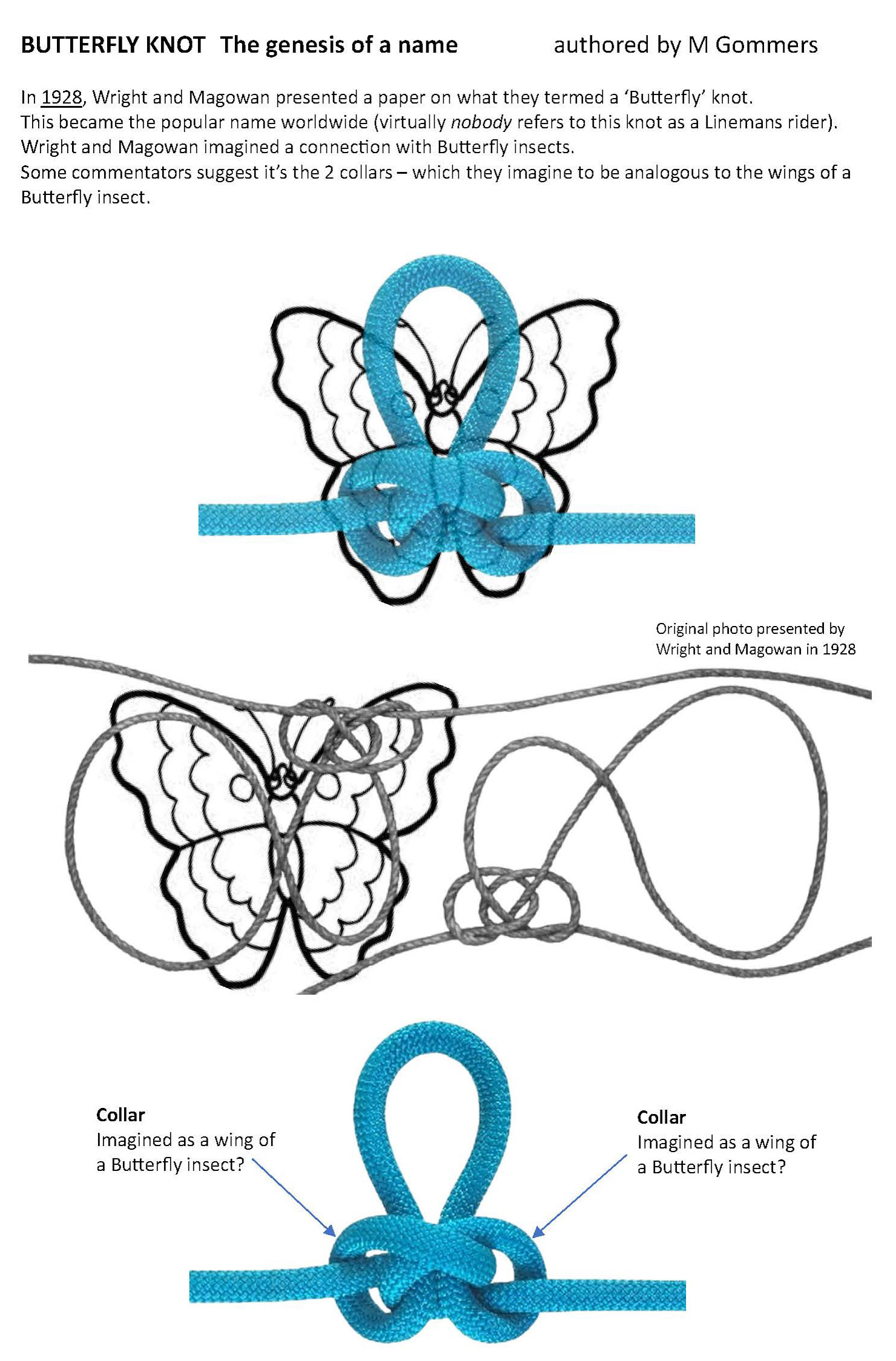
By the way 'Dennis' - I'd be keen to get your opinion on the genesis of the name 'Butterfly'. That is, why did Wright and Magowan imagine an association with the Butterfly insect? Please refer to attached image and comment if you feel like it...