I am new here so allow me the indulgence of being the ultimate noob.
A few years ago I invented what I think may be a new knot. While it may be technically possible to patent a knot, monetizing it would appear problematic.
I would however like to get “credit” as it were for it’s invention/development/discovery or whatever. Assuming of course that it is original.
OK. Now feel free to laugh or poke fun. My hide is fairly thick.
Benefits of credit? Realistically nothing. Trying to figure out the best way to describe.
I realize that claims of an original are numerous, I think I may have stumbled on one.
I have not been able to find its like in ABOK or anywhere else. Yet it is so simple it looks like it can’t possibly work, which is why I think it had not been discovered previously.
On the other hand I may be completely wrong.
There was a thread here about someone setting up a group to evaluate the claims of “NEW KNOT” Anything ever come of that?
No worries. You’ve come to a good place, I think. Could you send a jpeg of the knot flattened out so as to view all the “overs and unders”(i.e. crossings)?
Half’n’half can help: words’n’images (referred to). "Form the left side as for Ashely’s #nnnn,
and then bring the 2nd end in at … ", and we should be able to figure it out, especially if
it’s simple. Which is not to say there might not be a false start with a question for some
ambiguity, but, hey, bits are cheap. And maybe I will post some Is-This-It? photo to
reply to.
There was a thread here about someone setting up a group to evaluate the claims of "NEW KNOT" Anything ever come of that?
You are here, with a gathered audience. What might come afterwards,
we cannot know.
The “Floating Constrictor Knot”, although it could also be called “Concave Constrictor Knot”. But if you want to throw “Dahm” in the front I won’t complain.
Please don’t laugh too hard if this is really Boy Scouts 101. And apologies for poor nomenclature and descriptive skills.
History
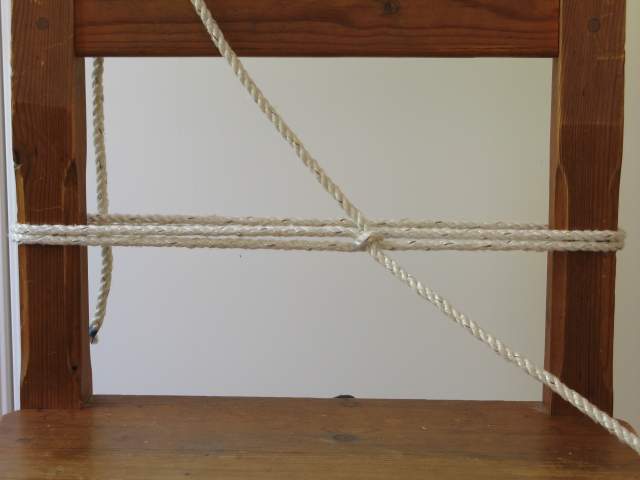
The basic problem I faced was tying together (and compressing) bundles of sticks and branches for trash pickup. Constrictor knots require that the knot lay across a convex surface which was generally not available with a bunch of sticks and branches. The traditional constrictor knots have the bite pass over the knot and press down like another person’s finger when tying a package. I had no extra finger, and nothing to press against. I needed a knot that would do it all for me. The solution I found combines the double wrap 4 to 1 mechanical advantage of the traditional constrictor knots with the single loop free floating holding power of the Sheepshank.
How to Form Knot
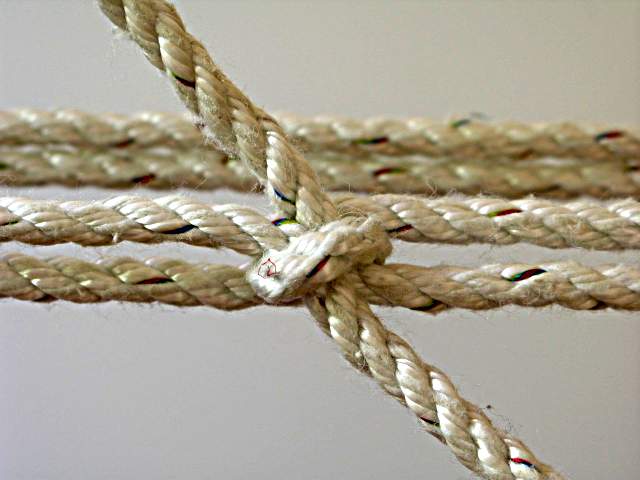
Here goes my attempt at a description. Take the rope twice around object to be tied. In the middle of the bite pinch rope and twist 270 degrees forming a loop perpendicular to the rope, with its opening parallel to the rope. (This loop is comparable to the loops in a Sheepshank.) Pass both bitter ends through the loop going in opposite directions. Hold bitter ends in both hands and pull tightly. When pulling the bitter ends apart, the two sections of rope which circumscribe the object will close on object. On releasing tension from the two bitter ends the knot or twisted loop will squeeze the bitter ends tightly and hold fast. I know this sounds too simple to work. But it does.
Modifications
Finishing - It is most secure under constant pressure but can be finished off with half hitches or square knot.
Multiples - In more slippery material instead of a single loop make several in series. Multiple twists on a single loop weakens the grip of the knot. The loops series do not have to be twisted in the same direction sense they are independent. I often grab the bite in both hands and twist in opposite directions.
Making Slippery - By doubling the bitter ends back on themselves prior to passing through, you can make the knot slippery, but this does not hold as securely because the tension and friction of the knot is no longer working on just the bitter ends but also the pass back.
Usage
This knot can be used across a flat surface or in the open air such as when two pipes are separated and the knot is in the middle. It can be used for lifting or for pulling two things together. I have used this knot for fence pulling, carrying furniture on the top of the car, packages, carpets, etc.
Tightening
It can be pulled tightly by a single person pulling the bitter ends in opposite directions, or by two people, or by using the stick under the feet technique (watch the chin if the rope breaks, Mag Lights hurt), or by hand with quick jerks, or my favorite is to wrap the bitter ends around separate weights or sticks and pull apart with strong sudden jerks. If the rope is strong enough to handle the last one, the result is a very tight constriction.
Type of Rope
It can be tied in any rope twine or string I have found. By increasing it to multiples loops in series, it can even work on glide dental floss. I think for glide dental floss I used 5 or 6 loops in series. The only problem I have found can be with some very rough cordage like manilla, or when the object being tied is sticky and does not let the rope slide easily across its surface.
Precursors
Although it is not how I discovered it, this knot is really an adaptation on the principle that underlies the Sheepshank. But may be stronger than the Sheepshank because rather than having three sections of rope going through the twisted loop you only have two. It appears to me that the sheep shank is a relatively unexplored area of knotting.
Mechanical Advantage
I calculate the mechanical advantage at 4 to 1, (or maybe it’s 2 to 1 not good at geometry). For every 4 foot of rope that you pull through the knot, the constriction decreases by 1 feet. You can make the knot extremely tight. When tying lumber to the car on Home Depot runs the rope will generally dig into the wood if I am not careful. Very little of the mechanical advantage is lost due to friction from the knot.
Breaking Strength
Contrary to knots in general I think in some sense due to the 4 to 1 mechanical advantage this knot is stronger than the rope itself. If the bitter ends are pulled past breaking point, then one of the bitter ends tends to break outside the knot and the knot remains secure.
To Untie
Attacking the knot directly is useless. Grab the section of rope (pre-bitter end) before it passes through loop and pull apart.
When made in slippery material in a series like picture 2 above, it is important that during tightening that the loops do not bunch together or else they will interfere with each other and the strength of the knot will be reduced considerably.
I think it’s possible that you really found a new one. I haven’t seen anything like it before, and due to its simplicity, it’s unlikely that it is widely known, considering the bulk of publications on knots. Moreover, the knot also fulfills a real purpose. The drawback, compared to other methods for tying down a load maybe is the multiple passes, but for tying a bundle it’s nifty. The more standard method of course is a fig 8 in one end and the other end rove through it. When tying down a load, a trucker’s hitch is often the preferred method.
The knot has advantages over the fig 8 in end method, as contrary to the second, both ends may be pulled and the center of the rope remains fixed. Thus friction over the bundle will not introduce slack when drawing it tight.
On the basis of “first sighting”, I won’t hesitate branding it The Dahm Floating Constrictor.
Truckers hitch offers a 2 to one mechanical advantage, it needs to be tied at the top, and I think needs to be tied off while maintaining tension (but I may be wrong). Also because it has 360 degree turns under pressure there may be a greater chance of the rope cutting itself.
The passing twice around can be a hassle, but it does give you that 4 to 1 advantage. Also it doesn’t need to be tied off.
Oh and thanks for the vote of confidence in it being original. I feel nervous like a father when his daughter goes to prom.
Oh, I only mentioned the trucker’s hitch, as it is a rather “standard” method for tying down a load; something that probably will remain unchanged even if better methods would be invented. The advantage of the trucker’s is 3 to 1, although friction takes away lots of that advantage, and yes, it must be tied off under tension, but it is not difficult to do. My main objection against the trucker’s hitch is that the overhand loop knot that is mostly used may jam, so it is not always easily undone. But it’s a side-track from the issue of your knot, and it does not constitute any objection.
Of course it is also a matter of what you have at hand. In twine or lesser cordage, the trucker’s hitch might not be applicable due to the drawbacks you mentioned, but the floating constrictor will work fine. One possible objection, when made with rope, is that you might not have one of the ends easily available. That however is a minor issue, as it works fine if you just pass a bight and leave the rest of the rope coil tied to the bundle or secure it otherwise in any convenient way.
Sorry. I didn’t mean to sound defensive. Although I am admittedly a little excited (or anxious) about how this will be received.
It does require a lot of material. I have not tried tying when one end is not available. I’ll have to think about that one.
The Dahm Floating Constrictor Knot, I do like the ring of that. Though I probably shouldn’t get too used to it. Someone will be along anytime to say, “Oh that knot is a standard in the Swiss Imperial Royal Navy.”
“bitter end” : please, let’s leave this where it was found, at the bitts,
and not for some absolute “end”; “end” suffices w/o qualification.
“bite” => “bight”
In short, yes, I’ve played around with this damn floating constrictor,
which to my mind came as a better Clove Hitch – but then those
knots are just a tuck apart, aren’t they.
I wonder in what you’ve tied this, for in some hardware-store common
solid-braid nylon (3/16" or about) around a 1" diameter PVC pipe,
the locking grip just isn’t there – it’s easy to push apart the turns
opposite the knotted section and see it loosen. This nipping loop
in the structure is tensioned only after a full turn around the object,
so that’s a strike against its efficacy at providing sure nip. The turn
could be a double turn, which I think will be better than the more
complicated additional two single loops of your variation.
As for mechanical advantage, in many common materials you’ll find that
the usual Trucker’s Hitch is around 1.5:1, way shy of the theoretical 3:1,
and friction as well as material resistance to bending eats up a great deal
of such supposed advantages in related structures; there is a thread about
that on this forum, in which I experimented with some various ropes and
barbell (dead) weights. I really recommend that others employ such testing
to better appreciate the hype that books sell.
On the plus side, though, is that the same friction works mightily to arrest
whatever gain you get, to ease the tying off. In the case of the Versatackle,
e.g., you get a pretty solid lock.
I like to think of such structures as “Paul Bunyan knots” : i.e., ones in which
even mechanical disadvantage is overcome by simply being able to deliver
much more force than is needed in the finished binding, and where the
automatic locking is a key aspect. – where one can surge force
(vs. a steady application), and have that surge’s effect held.
... because it (viz., Trucker's H.) has 360deg turns under tension ...
Huh? I don't see this; the Trucker's H. has 180deg, "u-"turns, no roundturns.
As for the usual Overhand knot jamming, that can be alleviated by careful
orientation of the Overhand, or using a variation of Bowline (and getting
thereby double eyes through which to reeve the end, maybe lessening
abrasive wear on the rope).
As for
and due to its simplicity, it’s unlikely that it is widely known,
considering the bulk of publications on knots
I have my doubts: maybe there are some small-press, esoteric publications
scratching reality and novelty, but most of what’s come to my eyes has
been terribly redundant. “Hansel&Gretel” e.g. have many Plates of
Sheepshanks, e.g. – which won’t be found in the Wild . Yet
that nifty Reverse Groundline Hitch so common in commercial-fishing
knotting, does not show up in the books I’ve seen (other than by a
roundabout, not quite to-the-point, way, as some Miller’s knot or
spar hitch).
Perhaps a good thread to start is one entitled “Binders”,
where the different tasks such a general title covers can be explored
along with various solutions. And we can see another new knot.
Um. I’m a little confused. I freely admitted that I did not have a firm command of some of the specific language used in knotting. I did my best to explain what I had done as I was encouraged to do. If I was able to communicate it to you then I suspect that I succeeded at least in that.
I think that functionally the floating constrictor and the clove hitch very differently in the mechanism that hold them in place. The cove requires a convex surface to press against. This does not. That is often a useful feature. The Clove only has the gripping section pressing against one side while the floating has it wrapopoed around and pressing the two ends together, which are moving in opposite directions thus increasing the grip. There are of course similarities. For example both pass around the object twice. And both can be tied in rope, cord, twine, etc.
But you know I just realized that the only thing that seperates a Sheepshank from a folded piece of rope is a couple of tucks as you say.
I believe I did mention that it holds better under tension. Similar to a Sheepshank whisch requires tension to maintain grip. I also mentioned that it could be finished with half hitches or a square knot to secure it. I don’t think that a single small pipe is really the best application of this knot. However I did try it on a 1.5 inch PVC and a 3 inch PVC piupe. On the 3 inch it did hold better.
You are correct. If you will notice in my original description I wrote how this is how you untie it.
I am sorry but in this you are completely wrong. Increasing the number of turns in the nip loop will dissipate the tension and results in very poor grip. Multiple loops increase the grip as a linear function. Two will have twice the grip of one. Three will have three times, etc. But the multiple loops will also begin to increase the resistance to pulling tighter. As I said with 5 loops it was possible to tie in Glide dental floss.
Where to start? It would not surprise me if the Truckers Hitch measures out at 1.5 to one Mechanical Advantage, because theoretically it actually only starts out at 2 to one not the often quoted 3 to one. This is just basic pulley physics. Just look at this diagram from the Wiki pulley entry for an explanation. http://upload.wikimedia.org/wikipedia/commons/8/86/Pulley1a.svg
Try your testing experiment with weights and the ropes passing over lubricated pulleys. rather than each other. I think you will find the results are very close to the true 2 to 1 mechanical advantage. Using ropes instead of pulies adds friction not mechanical advantage. Look there are only 2 ropes supporting the load they can’t each be bearing only 33.3% of the load because that would only add up to 66.7% of the load. And there is no explanation offered for what is holding up the other 33.3%. Anti-gravity is not generated by knots. The third section of the rope is NOT bearing the load directly. It is redirecting the force downward. The best way to calculate theoretical mechanical advantage is to look at how much movement is applied vs how much is generated.
Try this:
Tie a truckers hitch.
Tension the system.
Pull the LOOSE END (whatever you want to call it Mr Lehman)
Measure how much you move the loose end versus how much the load moves.
Realize that for every 2 feet of rope you pull, the load moves 1 foot.
Realize that this is what is called a 2 to 1 mechanical advantage.
Regardless of whether the Trucker’s hitch has a theoretical 2 to 1 advantage or a 3 to 1 advantage does not address in any way this knot. Crack open a high school physics book. It should be in one of the early chapters.
Seeing as how I am right about the mechanical advantage of the Truckers Hitch, could you please give me the benefit of the doubt and take a look at this knot with an open mind? (By the way I am not the first to point this out to you. see: http://igkt.net/sm/index.php?topic=1416.0, for a recent Noob who tried to discuss this that you shot down.)
I do not think a Clove Hitch tied on 1 inch pvc would hold that well either. But at any rate the effect of the “Paul Bunyon” as you call it is to create tension which as I said is required. And this was not the sort of application I was suggesting for this anyway. However I did find that it held a bit better on 3 inch PVC. Probably as a result of having a longer piece of rope in which to create tension. The theoretical mechanical advantage of the Floating Constrictor is the same as the mechanical advantage of the Clove Hitch it is 4:1. Again nothing magic. Just Physics. If you draw THE LOOSE ENDS in by 4 feet the load will move 1 foot. Friction is of course the enemy of mechanical advantage and even on well lubricated block and tackle there is a loss of efficiency but the advantage remains the same, pull 2 move 1 in 2:1, and pull 4 move 1 in 4:1, . Remember that it works both ways if you ease tension on line the load pull 1 foot for every 2 feet of line that is drawn in.
And I will note that generally 4:1 is better than 2:1.
You are correct I should have typed 180. My mistake. But never the less the issue remains the rope is still in the position to cut itself. This is going to significantly reduce the breaking strength.
In the first place that was not my quote. However I have not found this knot in any of the sources I have looked at. Given your experience which is obviously vastly superior to mine, I suspect you haven’t either, or you would have mentioned it.
I don’t know about whether there are other new knots, perhaps you can find one yourself.
WELL, “completely” entails the bit about the reach of tensioned ends to the
nipping loop, about which I’m quite right; adding loops in your way will by
force migrate then around the object and so closer to the ends. But my point
is that whereas in e.g. the Constrictor the tensioning of ends pulls directly into
the Overhand crossing (but has the long reach around to tighten the overwrap),
here, in order to tighten the nipping loop force must flow around the object
which is no small order for some sorts of things.
As for the double loop vs. single (my way), I find the opposite – same materials
as before; at least if I have a structure in which the two turns are rather spaced
in their circumnavigation of the object (in my case, roughly 1.5" opp. dble.loop).
Here, the tensioning was more nearly parallel with object.
In some earlier playing, I found that the workings of the dbl. loop were adding
nips that frustrated tensioning it. argh.
[quote="Dan_Lehman post:12, topic:3399"]
As for mechanical advantage, in many common materials you'll find that the usual Trucker's Hitch is around 1.5:1, way shy of the theoretical 3:1, and friction as well as material resistance to bending eats up a great deal of such supposed advantages in related structures; there is a thread about that on this forum, in which I experimented with some various ropes and
barbell (dead) weights. I really recommend that others employ such testing
to better appreciate the hype that books sell.
[/quote]
Where to start? It would not surprise me if the Truckers Hitch measures out at 1.5 to one Mechanical Advantage,
because theoretically it actually only starts out at 2 to one not the often quoted 3 to one. This is just basic pulley physics.
Just look at this diagram from the Wiki pulley entry for an explanation. [see above]
Here's where to start: with a proper notion of the structure at issue. A Trucker's
Hitch is a mechanism to tension a line tossed (paradigmaticly) over the truck's load
from an anchor side to a hitching side (to coin some terms); there, after working
some impromptu sheave mid-line of the rope (maybe a slip-knot), a turn is made
on one hopes a relatively smooth hook or through a ring --low friction, ideally--
and then taken up through the impromptu sheave, and hauled [i]downwards[/i] -- NB.
Now, by your bassackwards reference, you would have the low bed of the truck
moving up to the impromptu eye :o ; in fact, it is this eye that moves downwards
towards the hook/ring anchorage. That, as you can see, means that there are
3 parts bearing load (haul end (still not bitter), reeved up to eye part, and first
part brought from eye to hook/ring), to the one S.Part carrying force away: 3:1.
Or, put another way, to close the gap by pulling the rope eye down to the ring
would move this eye X distance and you’d have hauled out 3X rope to do so.
Try your testing experiment with weights and the ropes passing over lubricated pulleys.
For me, at issue is [i]actual[/i] (vs. hyped, and theoretical) advantage.
Seeing as how I am right about the mechanical advantage of the Truckers Hitch,
could you please give me the benefit of the doubt and take a look at this knot with an open mind?
(By the way I am not the first to point this out to you. see: http://igkt.net/sm/index.php?topic=1416.0,
for a recent Noob who tried to discuss this that you shot down.)
My mind is plenty open; I doubt you followed my link there, but only echoed your
mistaken notion of the hitch. I've explained it above; Inkanyezi has done so here,
and perhaps some others will chime in, if you want the *democratic* approach.
But the issue should be clear from above. It's a matter of what moves; [i]that[/i] you
must understand before throwing physics books about, or they'll miss.
If you draw THE LOOSE ENDS in by 4 feet the load will move 1 foot.
This points to an aspect of such binders that goes against their use for tying
up the odds'n'ends of, e.g., gardening for trash: that you loose a lot of cord
(one end or the other). As opposed to some binding such as hauling line
through a Rolling hitch, where the hitch's end is short as can be, and when
tightened the other end can be cut off close to the knot and all remaining
line returned for further use.
And I will note that generally 4:1 is better than 2:1.
You might test this theory in practical circumstances. There can be quite
a diminishing return (of gained tension/force) with each frictional sheave,
and balanced against the complexity of tying and consumption of material,
"better" might go to the structure w/less TMA. YMMV.
... But never the less the issue remains the rope is still in the position to cut itself.
This is going to significantly reduce the breaking strength.
Do you know what will be cut? -- quite to my surprise, it will/could be the
[i]moving[/i] rope ! (not the bight one would think it was going to saw through)
At least that's what happened when I tried it in cotton string (supposedly an old
way to cut such stuff). AND in one case where a rockclimber did "StairSteps"
with old climbing rope through a nylon tubular sling -- imagine! (Sling was
not in good shape, but the *winner*.)
In the first place that was not my quote. However I have not found this knot in any of the sources I have looked at.
Given your experience which is obviously vastly superior to mine, I suspect you haven't either, or you would have mentioned it.
As I said, books copy prior books and stick to a pretty narrow repertoire of "knots".
Now, in Hansel&Gretel land, there's no telling what might turn up (!); but, so far,
I've only found this floating binder in my own hands; and it's nice to see others
looking around with new ideas, too.
I don't know about whether there are other new knots, perhaps you can find one yourself.
You have spent most of your time discussing the Truckers Hitch, and applying my Floating Constrictor knot in a situation I had not even described as an application. This would be like saying a cat is no good because it doesn’t bark. I am willing to discuss the mechanical advantage of the Truckers Hitch in the thread http://igkt.net/sm/index.php?topic=1416.0 I will not address it here further.
Also I assume that you were able to understand the words I used even if they offended your sensibilities. But whether or not I use the words that are standard in knotting, or whether I used them exactly correctly has no baring on whether this knot is original nor on whether it is useful for the purposes intended.
If you are need a constrictor knot for a 1 inch piece of PVC, then use a clove hitch. If you are trying to strap a load to a truck with strong anchor points then by all means use a Truckers Hitch. If you did not catch the name I suggested it was “FLOATING CONSTRICTOR” of “CONCAVE CONSTRICTOR”.
Neither the Clove nor the Truckers will serve in the situation the Floating Constrictor was designed to solve. A single rigid pipe is a problem that this knot was not designed to solve. I doubt the clove hitch would perform well in 3/8 on a piece of 1" PVC either, but that is irrelevant.
I clearly said that this knot requires tension in order to hold well. The Sheepshank require tension as well. Not surprising, sense they share a similar mechanism. But by all means tell me how the Sheepshank is no good either because it doesn’t hold a a 1 inch piece of PVC.
Is it a perfect solution for all problems? No. I never said it was.
Is there an issue with friction? Yes. Again I had said so. But the friction problem generally relates more to the friction of sliding over and across whatever is being tied, more than passing through the loop.
Adding multiple twists to a single loop is simply worthless. I have been using this knot for years. It quite simply weakens the grip.
The multiple loops were for slippery material. Nylon braid is simply not an issue generally, and in the applications I am suggesting there is NO wrap around concave object like a pipe. That is not what it was for. Please see OP, or heck even just the names I suggested. Across an open space, multiple loops form a straight line, but should remain separate and not allow to bunch up together as this weakens the grip.
You ridicule the application of high force. This is done to primarily add tension not to overcome friction, certainly not the friction of the loop itself. ABOK talks about tightening a constrictor by pulling with a stick under the feet and the other in the hands. When using this knot to bundle moving boxes using Tiger twine with the knot across the flat side of the box it can be drawn so tight that it will thrum.
If you don’t like this knot fine. For the applicastions I specified it is extremely functional, and there is no other knot I know of that serves in the same capacity.
Nor have I been able to locate any documentation of its prior usage. Yet I clearly stated that this did not prove that it was original. And I came here asking about whether anyone else might have seen it documented previously or whether they though it might be original not whether you thought it would work on a piece of PVC pipe.
I don’t think it’s fruitful to quibble over trivial matters as mechanical advantage and waste of material in this thread. There’s always another opinion, and I put forth the trucker’s only to point out that for some applications, the new knot might not be the preferred one, due to tradition or due to the relative simplicity of the latter.
My usual method of tightening a constrictor is to pull with two marlingspikes either if they are very close to each other, with both hands, or, when impractical to pull with both hands, hammering the marlingspikes apart with quick jerks. That method works also with this knot. When tightening a constrictor very hard, until the twine breaks, it will often break outside the knot. When tying around a hard object that is not compressed, it is the elasticity of the tying material that maintains tension; there’s no difference if we compare with the floating version. Therefore it is more likely to hold well if it is formed around a large bundle, as the amount of rope governs its elongation by elasticity.
The most important factor that I see for any knot is its usefulness. When a knot is complicated or difficult to make, usefulness may be hampered by its complexity, particularly if it is not often used, so it will also be difficult to remember. This knot is easily remembered, and I can see real world usage for it. From this first sighting, it is added to the rather few knots that I see as really useful, as it indeed solves a problem of binding over anything that would not hold a constrictor, clove hitch or other binding knot that relies on the convex shape of the bound object. Wherever a constrictor might be considered, but there is a gap where you want the nip, it is useful. I haven’t tried it for connecting two objects at right angles yet, but I can see that there is a possibility that it might be superior to the constrictor for a cross.
And the open question of course is whether this actually is the first sighting or not.
Goodness, you began by saying you had a thick skin, but it seems like
it’s something else that’s “thick”! I addressed the points of your query,
in all cases, plainly enough.
First up, I’m unaware of this structure having been published. (But it’s a big
and old world, and maybe somewhere … – just as somewhere, many places,
others are unaware of what we are doing here, and previously, in private.) I have played with this knot and the like, a little, in recent years.
Here’s another twist on the structure, tying in the bight (which, yes, will
not suit many tasks): form a Clove Hitch but spread flat and such
that the crossing part is generally perpendicular to the ends; take one
side/loop and rotate it around 360deg back into position – thereby
putting in this “floating” nipping loop in the crossing part, and sort
of crossing the ends 'a la Constrictor. This structure inverts the central
loop (it points down into bound area rather than up away from it).
It’s a quick method of making a similar binding structure for cases in
which the binding material can be put around some (likely known)
collection of objects – set of stakes or paddles, e.g..
But to your motivation …
I.p., I am well aware of the binding task you have in mind – to wit: “The basic problem I faced was tying together (and compressing) bundles
of sticks and branches for trash pickup.”
To which my suggestion above is that a knotted structure that requires
both ends to be drawn out (and esp. at 4:1 compression) will be material
inefficient. Did you miss this?
As for the Trucker’s Hitch (which you persist in not understanding), that actually is quite adaptable to just the circumstance you face:
at one end, make a small eye (Overhand will do, or some other Oh-based one)
lay cord where debris is to be collected & bound; place stuff over cord
bring other end up, and whatever midline eye (even Slip-Knot) in it
and reeve Versatackle-like from eye to eye – it might self-lock thus
This method & structure can be tweaked to be TIB (tied in the bight) by
using a Slip-knot bight to span sheaves, the OH base being then the sheave
itself (vs. its bight, as w/Trucker’s H.), and by tying the eyeknot of the
first step last (this being the ONE end available, the rest of the material
–binding twine, say-- yet in a spool/ball/whathaveyou). Tie to the slip-eye
AND end part, and the back’n’forth now goes one reeving further than with
the Truckers, which gets you a potential in-the-sheave nip good at least
for holding long enough to tie off a freshly cut 2nd end.
Also I assume that you were able to understand the words I used even if they offended your sensibilities.
My understanding is evident, not any offence. (In fact, the bit about "bitter"
is more aimed towards other(s).)
Neither the Clove nor the Truckers will serve in the situation the Floating Constrictor was designed to solve.
Actually, they can. I explained the adaptation of the latter, above.
As for the Clove, one can draw it up and while holding the tension put in
an Overhand of the ends such that they can be tightened down to lock
'a la Reef knot against the crossing part of the Clove. Which structure
was shown mistakenly by Verrill in 1917(?) as his interpretation of Bowling's
or one of Bowling's echoers' verbal description of the Constrictor! Try it.
But it, too, leaves one drawing out both ends, with one to chop or toss
along with the trash, if working with some ball of twine (although for light
stuff one could [i]walk[/i] the knotted part around until one end was short).
-- in some cases, anyway (though not so completely generally, binding across
pure space), such as a cluster of 3/4" ropes with cord (just tried).
But by all means tell me how the Sheepshank is no good either because it doesn't hold a a 1 inch piece of PVC.
Now you're tossing out non sequiturs. Slow down!
Pipe or no pipe, that was a check of the nipping loop's grip,
and as I stated, I found it wanting. Will you fare better with less
object surface? -- yes, likely so, but the PVC is slick and should see force
making it to the nipping loop; I didn't see enough to give me great
confidence in the structure, that's all I said.
As for the Sheepshank, I continue to puzzle over its supposed duties;
many books now present it even admitting it has no use. (Some years
back there was a debate over that here which went sour, missing some
obvious points.)
You ridicule the application of high force.
No, not at all; rather, I point to it as a necessary aspect to overcome
friction, that's all -- friction of the material against the object, and of
the material against itself, which will ultimately enable the self-locking.
Oh dear, you have gone and riled the guard dog !! Please step away and stop annoying him, the barking only upsets the neighbours. Next time you come, please make sure to bring a tasty treat and he might just grow to like you. He really is a sweetie, but does love to eat the Newbies.
Now to your knot ---- WOW WOW and treble WOW
No I have not seen it before, but Dan is our expert on this, and I think you have your answer, he doesn’t seem to have come across it before either.
The name – sorry, way off the mark – there is nothing Constrictoresque about this baby at all, more a ‘floating monoshank’, seriously though, a name is important and will influence how well it catches on. Without doubt, I will use it and will teach it, but it needs a catchy name - ‘Grabber’ or ‘Load Lock’ - but it’s your knot so you choose, just please don’t associate it with the Constrictor with which its only similarity is the two load wraps.
You clearly have been working with this beauty for some time and understand it well, even down to what loops work and which ones don’t (by the way, it is really really easy to tie ‘in line’, I will explain if you are interested). I started playing about with it in completely the wrong way, by tying it ‘on’ something, constricteresque style, and of course it didn’t work and was a very poor fastening. Then by accident, I held the two loops on my fingers with ‘The Beast’ suspended in free air and Bingo - it worked. It has a strange action and it took me a while to understand exactly how (why) it works, and I have to say this mechanism is novel. I haven’t seen this mode of functionality before. Most knots rely on compression within the knot to generate the lock, but this beastie relies on elasticity of either the load or the binding to create the lock. Pull up on the ‘ends’ (you have got us all twitchy now as to just what to call them !!) and the structure rotates and unlocks, allowing cord to flow through the eye. Then when tension on the ends is released, the elasticity in the lines or the load rotates the ‘eye’ and it locks - the greater the load, the greater the lock - Pull, unlock tighten, release, lock.
This is an absolute gem. Ultra simple to tie - two wraps, twist, feed through the ends and tighten, or make inline and pass over the load. Easy to remember. Easy to untie, and so far, I can’t find any way for it to spill or degenerate into something dysfunctional.
This really should be published in KM, and for my money you should be in line for some form of recognition from the Guild for bringing this little beauty to light. I am interested in how you ‘found’ / ‘created’ it. Would you be interested in sharing the details with us? Are you a member of the IGKT and would you be interested in creating an article for KM? But first of all - what about a proper name for it please.