I kind of like ShepherdShank or RoundShank as a name for this binding knot.
alpineer
I kind of like ShepherdShank or RoundShank as a name for this binding knot.
alpineer
Or,
If found you have reasonable claim as your original intellectual property, and would have your name included in the knot’s name, then DahmShank.
Gleipnir,
I’m not sure how to go about evaluating what you have. So I’ll just ask a question about your “open air” binder:
When or why would I use the mechanism you show instead of a Versatackle, for example?
Why sully the structure with a name reminiscent of something generally regarded
as useless – viz., the Sheepshank?
“OneGoodTurn” or --as it’s a nipping turn-- “TurNip” come to my mind.
A problem though is that names seemingly descriptive can soon be fount to
be as apt for some other, similar structure. E.g., I’ve used the roundturn for
a tensioner envisioned for use in lobster pots, to hold the entry-cone netting
(or opener ring in such netting) tautly in place; either term could apply to
that, as well (though not so well in the “ONE…”, as there is more than the
turn to it).
I still find the dble-turn version secure if not more so, btw – just tried in
3/4" soft-laid PP around the back of a desk chair. And it still takes some
good hauling to deliver tension/force to the nipping loop(s), so using this
around hard edges (lumber) will be difficult or take some working. I should
think that Inkanyezi would have tickled this problem with the size of his
cordage around the chair, though perhaps the hard smoothness of that
facilitated force transfer.
Roo asks “When would I use … vs Versatackle?”
I think that Inkanyezi’s application shows one case: the TurNip is simpler,
and the tensioning is evenly distributed to each end. But, yes, other
mechanisms can work.
(In the V. one will have tension on the haul end plus tension on the
immediate continuation of that putting that combined tension into
the side going away (if pulling leftwards to tighten, the right side will
feel the rough double the hauling force, during tightening (when
the free haul-end bears tension). – bit of an imbalance.)
So I sometimes find my other hand grabbing the other half of the Versatacle. It usually suffices, especially as the load increases and friction starts putting the brakes on things.
If one wanted, two on-the-bight loops could be used so that a free end of rope is available on both the right and left side to balance the Versatackle.
I tensioned from both sides, with levarage with the marlingspikes. I didn’t appreciate that there was much friction from the turns over the back of the chair, but there was some slippage when the knot set itself. Maybe two turns might help that. I made the knot in the bight and passed it over the back of the chair. I strapped the chair in two more places, but I couldn’t pass it over there, so I used Spanish windlasses. However, it seems as this knot works quite as well, and it might perhaps be combined with a Spanish windlass on the parts that go behind the chair if more tension is needed.
I think a clever invention regarding the way of tying might be next to come, preferrably with double turns. I give my kudos to the discoverer of this knot.
Gleipnir might perhaps be a good name for the knot, although it would be nice to attribute it to the name of the discoverer/inventor. The Vikings had names for everything, and in the tale about Fenrir, Gleipnir is the fetter with which they bound the wolf so that he could not escape.
Out of curiosity, I tried it with double turns and a Spanish windlass on the two parts behind, and I tensioned it as much as I dared; tensioning more might break something. When I hammer somewhat on it it gives out a high pitched “ping”. The cord makes a slight impression into the wood. There is absolutely no slip.
Which is as G. claimed; now, he also claimed that if those TWO turns were
a single double turn (interesting wording, that, eh!), it would lack grip.
This is contrary my experience.
I tried with two turns, but then the double turn is like drawing the ends through a pipe, it won’t twist back under tension, as the double turns provide leverage, and friction in the remaining elbow will decrease the nip of the turns. It becomes more difficult to set, and the nip seems poorer. I was able to set the knot, but it is more difficult. I’d say that doubling the turn does not improve the knot. However two or more spaced turns increase grip, although they also increase resistance to tensioning.
I tried this last night as a bit of a last resort. I have 8 roughly one foot long pieces of ex-curtain pole each one is round cross section and about an inch diameter. The pole was waxed before I cut it up (and I haven’t got round to degreasing it) so holding this heavy lump together to carry it has proved frustrating; a constrictor won’t grip properly and alternatives are difficult on this slippery (and heavy) bundle. So I tried this knot using a trainer shoe lace which has some elasticity (and happened to be handy!) and a piece of 2mm cord again with stretch. To start off I used a bit of old string and a reef knot just to hold the bundle roughly together and then applied 2 fastenings with a single nipping loop each. It is holding really well - so much so it is difficult to slide one rod from the bundle (before they all fell on the floor as soon as I picked it up). Its uses may be limited but I think this knot has a niche market where it scores highly.
Barry
PS you may wonder why on earth I want to carry round 8 lumps of wood…!
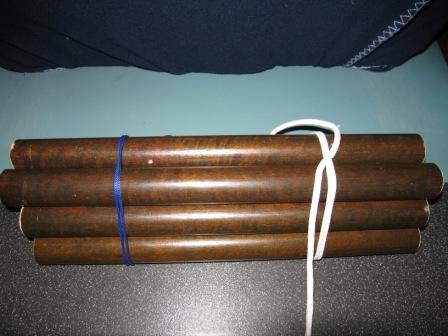
Yesterday, I did a quick and dirty test around a bathroom scale (non-convex surface, but not open air). I only had a few minutes, so the results are equally quick and dirty. The rope wasn’t particularly slick.
The mechanism in question had roughly half the tension of a Verstackle. Both methods retained roughly half of their peak pulling tension.
Then, on to my favorite method of bundling sticks: Running loop around bundle (or a hitch on an anchor point), and roll up the bundle as you compress the load and pull the line, allowing friction to hold previous wraps’ tension. It spreads the compression out over the whole bundle, but uses more line (which isn’t a big concern with twine). Then I finish with a utilitarian hitch (half-hitch based), since it’s just sticks. With not too many wraps, this method also achieved more tension than the mechanism in question.
This isn’t a condemnation. Just an observation. If I was not interested in a lot of tension, but in simplicity, I might use a Trucker’s (single loop) setup instead of the mechanism in question.
It may be worthwhile for the original poster to do some open air tests with a hanging scale.
Barry,
your example should be put under my separate and more general thread on
binding structures; and that initial structure could serve you. BUT,
your case of multiple cylindrical objects makes a good contrast to my
photographed binding of square lumber: it would be frustrating to try
to implement my binder with a collection that was not sitting still,
in neat order; rather, Roo suggests a method to work with such dynamic
cases, among various. Conceivably, an overall method might even entail
an iteration between something done quickly just to roughly settle
the material, and then a better binding put on for the final securing.
Again, in your case, that formed-in-hand-in-the-bight sort of inversion
of Dahm’s structure could be fit around the quickly bound set of things,
once they indeed got so bound.
Interesting. I’d post a photo, but am not eager to click-&-download for
just that.
As what I just did, upon reading this report, it to run some 5/16" (hard
to figure hollow-braid size) fairly slick (but collected from the Wild)
PP hollow-braid (quite compressible cross section) through an oval
'biner (very smooth, round, 1cm dia) and a slightly fatter hook of
a 5:1 pulley, running the ends through a double turn of the continuous
side of the simple loop (two strands bearing load). I tightened it pretty
easily, and then stood on the pulley.
NOW, “5:1” is TMA, but as it’s a quite lousy (one bad sheave) pulley,
let’s chop actual MA by half: 5x180=900#/2 ~=> 400# say.
AND, after initial loading, I tightened the loop further (just hands),
and stood upon it again. There was little slippage (the sort of yield
that might better be seen as a setting-settling of material.
This hollowbraid flattens in the double loop, to a nipping width
of about 3/4"-2cm. Your 3-strand rope looks to be rather firm
and round (and grooved). => YMMV
!?
I think your knot is quite brilliant!! It is presently holding together my bundles of hedge clippings etc. awaiting the garbage truck.
There is only one name for it. Its a - GLEIPNIR -
Be careful. If the garbage guy grabs certain parts of the twine, it will cause the bundle to fall apart. Finishing with a tuck or two of the ends would help
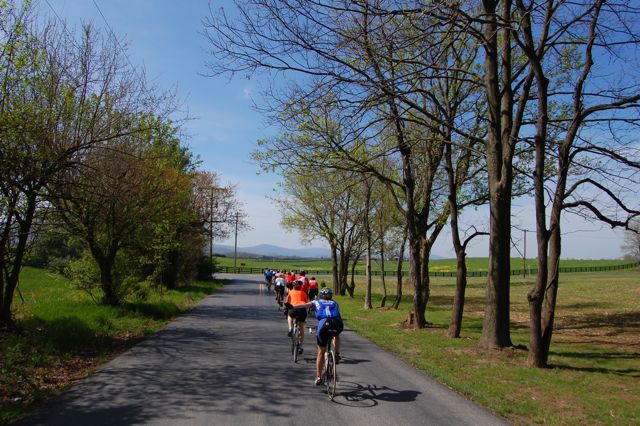
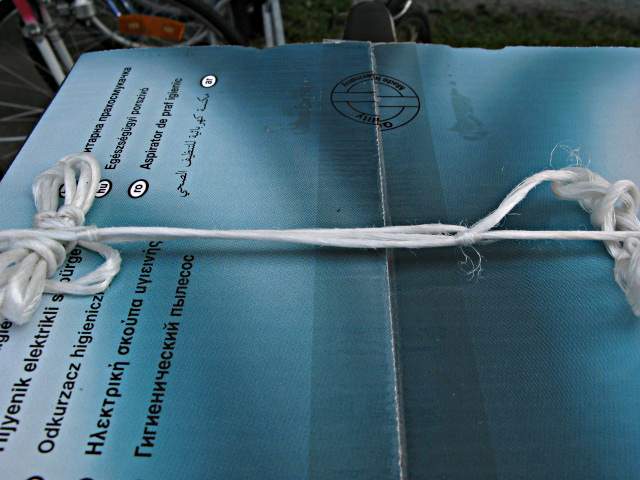
I was using it for the third time today for a real job. The Media Markt had remodeled the store and there were special reopening offers. I needed a new vacuum cleaner, and the actual store is about 25 miles away and I don’t have a car. So I went there on bicycle, bought the vacuum cleaner and tied it to the bike with two turns as it’s a very slippery PP cord. It held for 25 miles without the slightest slip, and part of the way is cobblestone. I really like this knot, it is really the answer to a few needs.
The pictures were taken after I got home.
:o
Maybe you can talk a friend, neighbor, or relative into giving you a lift sometime. 
Cycling is healthy. I had the possibility to use the underground, but I don’t mind going a few miles on bicycle. And it’s on the other side of the town, which is not car-friendly.
I.e., the ride was not too short to be worthwhile! ;D
Indeed!