Now and then, I peek through the Ashley Book or Knots, and just now I saw something familiar. Ashley might have been close to discovering the Gleipnir knot, although probably not fully appreciating the HH transforming into the TurNip. The contraption shown in ABoK #160 is closely related to the opened bowline in the third picture in post #64 in this thread.
While I’m at it, I couldn’t help thinking out a possible improvement to the scheme of captain Mullins. Considering the importance of the TurNip and the similarity with the holding power of the bowline, if instead of taking the rabbit turn, a bight is passed up the hole, then the bight may be toggled to the SP, and the resultant knot will be a sibling of the bowline, with the same features for easy adjusting and casting off as the ABoK #160.
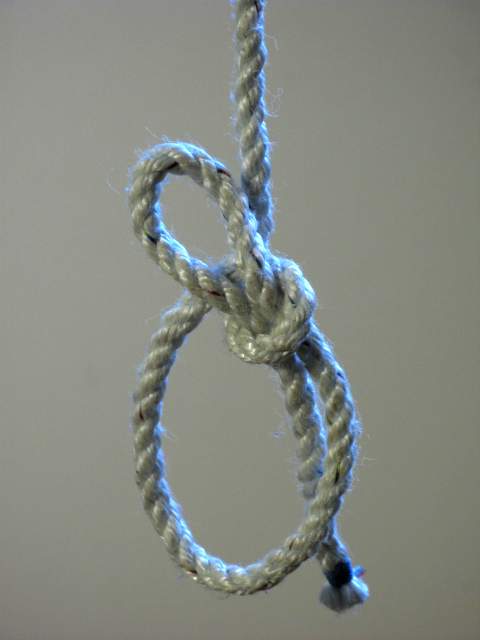
What I see in the Gleipnir as its essential charasteristic is the transition from a half hich into the round turn, which is stopped from further becoming undone by the very same force that holds it tight; the returning end, whether those are two loops around a bunch, or two splayed loops between two objects. The same principle is at work in ABoK #160, although it is not as secure, due to being loaded only from one side. In the Bowline (as well as its sibling shown above), the impediment from further untwisting is the bight that forms a collar around the standing part (or in the toggled variety, the toggle). Very little force is needed to hold the form, and the partially “capsized” bowline is in fact the form that a bowline will inevitably take under strain. We are only so used to see it in the uncapsized form, that we regard this form as the “true” form of the bowline and its final form an anomality. But we see the bowline in real life so often having this “capsized” form, that the question has been raised whether it is done on purpose. The answer is simple; it’s not done on purpose when making the knot. It is the inevitable result of using it.
In Ashley’s sketch of the half hitches in the standing part of #160, he has acknowledged the orientation of the half hitches. It is evident that he in part draws what he can see with his eyes. The actual setup is different from what we can expect of modern rope, which is probably not as stiff as those ropes that captain Mullins was using.
But the riddle that the Gleipnir has resolved is the one of the half hitch/TurNip transition. When a coil is hung with a half hitch around a bight at the top or around the coil itself, and in the sheepshank, as well as in the bowline, the half hitch will form the TurNip, and it can save a bit of headache for the boatsman that might think of a capsized bowline as something gone wrong. It’s not wrong at all, that’s exactly what a bowline looks like. The Gleipnir helped us to understand how tittle force is needed to hold the TurNip from collapsing. We may observe that principle at work in one of our most well-known knots as well.
And if only Ashley or Mullins had thought of treating the other end of the rope in the same way, they might have come across the evident, that only one HH is needed if both ends are passed through it. But they did not, probably because the Mullins variety served its purpose.
I’m stuck on how/whether/what … of this distinction between half-hitch & i turn[/i]
– as well on the whole mess of “(round) turn(s)”: 180, 360, 540 degrees … .
In e.g. what I call the “Reverse Groundline Hitch”, which is common in commercial
fishing knotting for intermittently locking a spiral wrapping of things together (e.g.,
some clump of netting at its edge, two sides of netting, netting to a headline, or
two lines), there is the ditinct locking-down-upon-itself aspect, able to be seen in
a single structure, one end nipped and untensioned beyond, the other being loaded;
in this Rev.GlH use, both ends are in some stable low tension, leading fore/aft to
other such structures. Whereas in the Bowline, the arguably like structure is loaded
significantly coming & going, and not really so much nipping itself (in contrast to
the Sheet Bend, NB!).
and the partially "capsized" bowline is in fact the form that a bowline will inevitably take under strain. We are only so used to see it in the uncapsized form, that we regard this form as the "true" form of the bowline and its final form an anomality. But we see the bowline in real life so often having this "capsized" form, that the question has been raised whether it is done on purpose. The answer is simple; it's not done on purpose when making the knot. It is the inevitable result of using it.
Here I disagree – at least at all points beyond “partially”. You previously presented
an image/photo of what you labeled “capsized”: that is markedly different from
my photos of (truly) capsized knots, where many folks won’t be able to identify
the knot (and it can be confirmed by them as “new”!) – where the HH=>turn=>
… spiral. And these I do NOT see as inevitable (testing of the knot will prove this),
but as results of having a relatively loose collar which enables that much distortion
of the knot’s nipping loop. One could see a problem of man working with big,
stiff, rope, unable to adequately set the knot and then the huge loads for which
such rope is intended working this capsizing; but in the cases I’ve seen, although
rope & loads might be large, the material actually is rather pliant, not all so elastic,
and I believe can be tied with a snugness denying the deformation seen.
(Look at many sailing/yachting images: there is often a HUGE amount of looseness
in the bowline’s collar!) Why, I can tie shock cord --super deformably elastic stuff–
and see it behave. (And, as I’ve mused before, the end-on-outside bowline better
resists the capsizing; at one point I thought that if indeed the “Dutch navy” had
this form in favor, it might be why – but I think all that Dutch business is myth.)
In Ashley's sketch of the half hitches in the standing part of #160, he has acknowledged the orientation of the half hitches. It is evident that he in part draws what he can see with his eyes. The actual setup is different from what we can expect of modern rope, which is probably not as stiff as those ropes that captain Mullins was using.
Indeed. And the load is relatively slight. One can think of various ways to have
met this rope problem ; I immediately wonder “Why not just a bowline?”
– or the toggled one you show, easily re-made w/new bight and toggle reinserted
for the move-release-backup-reattach sequence Ashley suggests.
Incidentally, I still find the Gleipnir to be way deficient in effecting lock: again,
that the bending of each loaded end’s transmission of force to the nipping loop
must go around 4 edges (of squared bundles) renders getting a decent nip in
this way fruitless. Dang, I’m about to load some books-bound thus with dead
weights to show it! Recall that in my prior musing with this structure some
years ago, I didn’t see adequate nip around smooth PVC pipe with flexible
soft (common) nylon solid braid cord (I saw it as a locking Clove hitch).
One way I’m seeking to redress this deliver-tension-to-TurNip problem is to
figure ways to set the wraps relatively snug AND THEN load ends to capsize
into the initially straight part the TurNip, which naturally tightens that part,
effects the lock, and can be further loaded a bit – though of course there
is little hope in many cases of getting that load around the 4 corners to
the TurNip (conceivably, those edges might not want much pressure).
I see that this deliver-force… problem is aggravated by binding to a
convex surface, as the ends will press inwards on the TurNip and add
a point of frictive resistance for force to overcome in tightening it.
The Gleipnir can be locked by Simple knot (as though closing a Reef knot),
or by making a Slip-knot in one end with the other nipped by it, snug to
the TurNip. In many cases, for any duration, I’d not trust the TurNip
to keep tension – bit by bit, there can be some pressure on the ends
to come out; there is no turn in them to resist. – varieties of circumstance.
–dl*
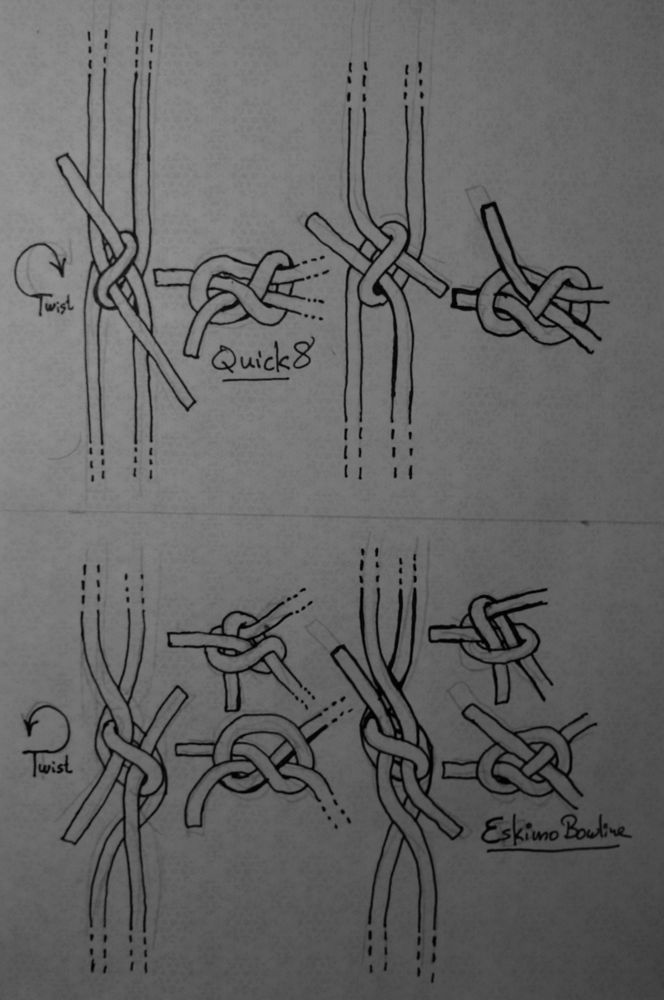
Okay, here are XaraX’d Gleipnirs in the four main versions.
“The” G. is upper-left; Xarax’s version is lower-right,
switching both the twist AND the end-tucks. The X-t(G.)
aka “Quick8” is a nice-seeming eye knot (adjustable until
loaded); it can be further secured (and maybe strengthened)
by tucking the end down between the eye legs right where
they enter the Fig.8.
The upper-right Gleipnir version is one that can be tied in
the bight (TIB) from a Clove hitch start, having the two
halves sort of step around each other. And the inverted
TurNip’d Clove version is this, too, viewed outwards from
the bound area; note that the XaraX transformation of this
is not the same, as the moved loop is going the other way.
Beyond what you see here come the same structures but with
doubled TurNips, inverted TurNips (these same images representing
the underside of the binding, i.e.), and who knows what
further. Maybe those are left as frustrations (er, “exercises”)
for the reader!
–dl*
Well here we are 6 months later and we still aren’t sure what to call this knot.
I understand the founding of the IGKT was inspired, at least partially, by the (as it turned out re-) discovery of the Hunter’s Bend. The Hunter’s Bend is a beautiful thing, but it doesn’t really do anything any better than half a dozen existing knots - the Zeppelin Bend probably being the closest. If one knot that is neither new nor unique can help found an international guild, then what should we expect from something as special as Mr Dahm’s creation?
Yet here we are with Mr Dahm’s more beautiful(?), more useful, and UNIQUE knot. And after a flurry of initial excitement (and some less enthusiastic responses) we have let it .. go to sleep.
If we still think this is as important and significant a knot as we (okay not me, I wasn’t around then) did 6 months ago, then what are we going to do about it? Could I request that someone with some authority contacts Gleipnir/Mr Dahm? It will need to be on his personal email address, a forum PM will be no good as he does not seem to frequent these pages any more.
Could we ask him what he wants to call his invention?
We have variations on:
“Floating Constrictor Knot”
“Concave Constrictor Knot”
Dahm Floating Constrictor
Gleipnir
Dahm knot
OneGoodTurn
TurNip
TurNip Twist
ShepherdShank
RoundShank
DahmShank
And just for the hell of it I’ll chuck in “Wolfshank” I think it would be more meaningful and more memorable to more people than “Gleipnir”. The IGKT is here to spread the word; it should resist the temptation to indulge itself in the telling of in-jokes. I concede, for the cognoscenti, Gleipnir is colourful.
I can’t resist posting this from the wiki article:
[i]Gleipnir
In Norse mythology, Gleipnir (Old Norse “open one”) is the binding that holds the mighty wolf Fenrir
Even though it is as thin as a silken ribbon, it is stronger than any iron chain. It was forged by the dwarves in their underground realm of Svart?lfaheim, and made of six ingredients:
* The sound of a cat's footfall
* The beard of a woman
* The roots of a mountain
* The sinews of a bear
* The breath of a fish
* The spittle of a bird[/i]
Marvellous!
And could we ask Mr Dahm to tell us a little bit about himself?
Such information, assuming he is happy to provide it, will be helpful to whoever first incorporates Mr Dahm’s knot into a book.
Gleipnir (Old Norse "open one") is the binding that holds the mighty wolf Fenrir Even though it is as thin as a silken ribbon, it is stronger than any iron chain.
Since it was brought to us, I have used it regularly and teach it whenever I have the opportunity. And when I do, I call it The Gleipnir ( I pronounce it glipe-ner ).
Although it is a strange name, now you have brought the Norse definition to us, I can see that it is the perfect name for a knot which so easily embodies the most simple principles of effective binding.
Your point Spitfire is well made that the Guild should not let this opportunity simply fade away - but there you have come full face onto the problem - just what is ‘The Guild’ ?
Is it you and I and the folks of this Forum? surely not ?
Is it all the members dotted around the world? Possibly, but how would they collectively ever ‘do’ anything?
In essence, when it comes down to matters like formally recognising an important ‘new’ knot, ‘The Guild’ is embodied in our Council.
Recently, Barry (Hon. Sec.) said to me that the Guild has the Council that it deserves - “as volunteers are like frost in warm sunshine - they disappear as you watch”. As a consequence, ‘The Guild’ is in essence no more than one or two seriously overworked individuals with virtually no support from the rest of us. Without support a little more substantial than the proverbial ‘frost in sunshine’, what should we expect other than Forum excitement followed by obscurity as the next interesting challenge floats onto the Forum ? ? ? We on the Forum, don’t actually ‘DO’ anything despite all our noise and input, and despite all of the substance here on the Forum, behind us there is very little ‘substance’ in the real world (not wishing to demean any of the work our Council puts in).
If we want more to happen, then we here on the Forum need to be offering real physical support to our Council to get things happening.
A few months ago, I put in a proposal to the Council that they award a new knot certificate for the ‘Hurley Hitch’. Lindsey has asked that I write an article for KM and I offered to produce a Certificate to award to the Hurley brothers and to their Scout troupe. This still leaves Barry with the task of signing and presenting the certificate, but it has taken as much of the work off him as possible.
Personally, I believe that we should make as big an issue about the Gleipnir as possible - but for that to happen WE must be prepared to do the physical legwork to make it happen. Barry et. al. can formalise it for us, but they cannot supply the time and effort to make it happen.
Who on here wants to make it happen? How can you make it happen without waiting for ‘the Council’ to do it for you ? What help can you offer to Barry to recognise what many of us think is a great knot ?
Or would we rather watch the ‘frost in the sunshine’?
Derek
It is a lovely story isn’t it?
We could, if we chose, exploit the story in a carefully-written press release. We could obtain a lot of free publicity for the IGKT and for knotting generally by making use of it. Newspapers are always looking for little stories to fill their pages. This new knot would be perfect - it’s simple, novel, and if we made use of the word Gleipnir it has a nice little story behind it too. All we need is for Mr Dahm to be handsome, and his photo and the knot’s would be in every other Sunday paper worldwide. Are you handsome Mr Dahm?
I have four concerns about Gleipnir though.
1. The word Gleipnir will not be memorable outside the confines of the IGKT. And we really, really should think beyond our immediate membership if we are to fulfill our mission as spreaders of knotting knowledge.
2. And would the knot really be of any use tying up a giant wolf?! I know this sounds silly, but if the knot isn’t suited for such a purpose, we have to ask whether we should be using the name Gleipnir. Okay, okay, I’m splitting hairs.
3. As for pronunciation, Derek says Glipe-ner, Inkanyezi says
Glape-neer
Though Inkanyezi then muddies the waters with
And I suspect most people familiar with neither German nor Norwegian might say Gleep-neer
So, Gleipnir has a great story behind it, but do we really want to launch a new knot with a name we know in advance will be pronounced so many different ways? We really should think about things like this. Conversely, maybe a point of the differing pronunciations could be made in the press release - you say tomato ?
4. Similarly, every time the word Gleipnir is spoken to a non-Norse audience, it will need to be spelled. This is a weakness. AEBE, we would do better to chose a word that has only to be spoken for the listener to know how it is spelled.
Despite all the above, I still like Gleipnir, if only for the story!
Before we rush to crown Gleipnir though, let’s look again at the alternatives
Dan’s OneGoodTurn and TurNip are both simple, great fun, and pack in a lot of how-to-tie-the-knot meaning - which helps the name and hence the knot to be memorable.
My variant, TurNip Twist has a nice bit of alliteration, and reminds the user that they will need to put a twist in the rope.
Alpineer’s ShepherdShank also has alliteration, and is close to SheepShank, which will make it easier to remember, the knots being similar. Sort of. We might need to -ahem- invent a story about shepherds using the knot to carry bundles of firewood. Anyone know a tame shepherd..?
Alpineer’s RoundShank is less strong, I feel
NB Alpineer later decides he’s not so keen on ShepherdShank !
An alternative to ShepherdShank would be Wolfshank
Derek’s Grabber or Load-Lock are short and punchy names. But is there a risk that they are too generic?
Floating Constrictor describes what the knot does. That could be the day-to-day name, the “official” name could be the Dahm Floating Constrictor - though I note that very few knots are named after their inventor, even those whose inventor is known. Ashley might be an exception.
I understand to an extent, Derek when you say
The knot might not resemble, say, a Boa Constrictor, or a “single” Constrictor, or a Double Constrictor. But Constrictor surely describes function rather than form? I recognise that a constrictor normally needs something solid for the knot to sit against, such a thing is not present with the Gleipnir~. But don’t we get round that by prefixing Constrictor with Floating?
I have tried to present as many pros and cons of the various names as I can, in order that Mr Dahm has a good overview of the implications of his various possible choices. Of course, there’s nothing to prevent him coming up with something entirely different from any of the above.
I offer to liaise with Mr Dahm (in a week or so, to give people time to see this and comment if they wish). Assuming everyone’s happy, I offer to work with Mr Dahm (and maybe you Derek? and maybe Inkanyezi and others who have been so positive?) to draft some form of Press Release to go to the council for approval before whacking it out to the biggest newspaper list we can find.
This knot has been kicking around for long enough now. Let’s move things along. Unless anyone objects, I will email Mr Dahm in, say, a week’s time with a link (not that he will need it) to this thread. Then, hopefully, he can give the definite name, and we can move towards getting it out into the world.
So, speak now or forever hold your peace !
Over to you Mr Dahm?
I really don’t get this. The tensioning mechanism in question does a substandard job of applying tension. And in its original form, is quite rope-length inefficient in applying that substandard tension. And it has to have open air to do what little it does. And it falls apart if the rope load is distributed funny unless it is backed up.
I am left to think that you’d be willing to drain your bank account to put up billboards advertising a mechanism just for its relative simplicity.
Okay, that’s one bit of feed-back. Thank you Roo. Let’s have some more from other people.
Oh, one thing Roo, I’m not suggesting the IGKT spend any money on billboards. Sending an email to a list of newspaper editors costs nothing but time. And i don’t mind giving my time on this.
The thread has considerable information it it, already.
On the name, I think of it as "the Gleipnir ", happily. I don’t mind
that pronunciations will differ; they do on most things (a local radio traffic
announcer or a cycling friend of mine say “bay-ack” for “back” or “cray-ash”
for “crash” and so on; or the peculiarities of those New Englanders or NYCity;
and sugary Southern states sweet “thank-eee-yew” still tickles my memory
heard in a fast-food joint between manager & waitress (each to other)
somewhere in Carolina?). It is certainly a unique/distinctive name to my
American ear. --and it carries less of a personal sense then would “Dahlm
Twist” or some such.
(My once-suggested “turNip” I favor being the name of the turn so
used to make a nip, seen in many manifestations, no particular “knot”.)
On the working & supposed MA: I think that there is none – rather, as
I stated, it’s a “Paul Bunyan (giant) knot”, requiring over-exertions for
what is ultimately delivered, but working to lock & hold the gain. But
you will have differing effect in different circumstances. Just consider
that all that frictional gripping that must be done to lock the tensioned
ends pulled through it must be resisting their tensioning pulls as well
(with some caveat about differences in frictional effect on moving
parts, which I won’t pretend to understand (one can quote CLDay’s
famous remark about friction)). But I have found much LESS favor
in the structure than has Inkanyezi, surprisingly. Just yesterday, out
“in the wild” and using a 3mm kernmantle old bit to bind a newly
harvested coil of rope to another one already dangling from my
belt, I thought to try the Gleipnir : it was impossble to get
much tightening to the turNip; it worked okay, but far from the
glowing reports Inkanyezi brings. So, YMMV.
(One could try to test this with weights & pulleys (for redirection).
And, given your insistence on not trusting things voiced in the
thread on a knot mystery, I’d think that before you devoted an
iota of PR to this novelty you would insist on giving it a full testing
yourself, to better understand it. Please take a shot at this, using
both slick (metal) objects and then something less so – bit tough
to think of working out how to assess binding tension around a box,
though (essentially, around 4 cardboard corners).)
This thread contains a couple of similar structures that employ
a turNip and which might better tighten, in some instances.
I’m playing around with one now where the turNip feeds its
end through a bight to pull back through the turNip, and so
in limited spacing (typically) to have that apparent 2:1 pull
on a bight, the anchoring end of which (the pulling line, i.e.)
is the turNip and so worked tighter. This structure should do
well on convex surfaces, with lessened space to delivering
tension to the turNip.
–dl*
I’m not trying to re-open the discussion about the knot. I’m trying to summarise where we are right now, and achieve consensus on how we / the IGKT should move forward with this knot after 4 months of doing nothing. I am asking for people to come together on this.
Fine, that’s one more vote for Gleipnir. I still feel Mr Dahm should have the final say, but given that he chose Gleipnir as his name here, I wouldn’t be at all surprised if he concurred. But that’s for him to say.
[color=blue]We are being sidetracked here, but for anyone interested, Name this mystery knot:
I responded
Meanwhile though, no-one is suggesting the Gleipnir/~ is ever used in a life-critical situation. The Gleipnir is a simple knot for bundling firewood etc. Not for climbing the North Face of the Eiger. As Mr Dahm made clear in his posts when he described the knot as a “floating constructor”: The basic problem I faced was tying together (and compressing) bundles of sticks and branches for trash pickup.
This is the sort of test to which a hitch or conventional constrictor could rightly be put. But Mr Dahm never presented his knot as a hitch or conventional constrictor. As he made clear in his posts when he described the knot as a “floating constructor”: The basic problem I faced was tying together (and compressing) bundles of sticks and branches for trash pickup.
It is good to have a voice of caution, especially when discussing something as potentially life-critical as knotting. But when that voice of caution is negative about everything and anything, people eventually stop listening.
Roo probably made a valid point though:
Dan/ Going back to your testing suggestion: I had already tested the Gleipnir. If I hadn’t, I wouldn’t be posting all this. I tested it weeks ago when I first read about it. But I did not test it on a piece of solid pipe, constrictor-style. I understood that that was not what it was for. I tested it on a bundle of lengths of planking in my garage. It did well. I recognise I am not an expert, and have no authority to speak with authority(!), but when I tested the knot on the application it was designed for, it worked. I’ll freely concede my “test” doesn’t prove that the knot will always work on its application. But other types of test on applications for which the Gleipnir was never designed are irrelevant. And should not be allowed to cloud the issue.
No. The Gleipnir was not designed for tying around slick metal objects, nor was it designed for tying round boxes. It was designed for tying round bundles. As Mr Dahm made clear from the start. The basic problem I faced was tying together (and compressing) bundles of sticks and branches for trash pickup. (That’s the 3rd time I’ve quoted Mr Dahm, should be enough)
I find it difficult to understand, Dan, why you persist in trying to undermine the Gleipnir. And, for that matter, other innovations presented by people on this forum. No doubt you would also criticise a motorcycle for being a poor choice of family vehicle, or a helicopter for being relatively slow compared to an aeroplane. Edit: Mr Dahm got here before me:
Dan/ You also ripped apart Mr Dahm’s understanding of Mechanical Advantage. Even though he humbly admitted up front that he was no mathematician/engineer. But you didn’t explain to him how and why he was wrong: He arrived at his (incorrect) 4:1 ratio because he was erroneously thinking of the Gleipnir’s “TurNip”* as the top tackle of a pulley system, but with the bundle-of-sticks “load” replaced by a hypothetical load attached to a hypothetical twin-wheel block sitting at the bottom of two loops of rope. In doing so he mentally applied an invalid test to a knot which was never designed as a block-and-tackle. It was designed for bundling, and given that the rope wraps only twice around the bundle, the MA is actually only 2:1. But your pointing out his mistake on that matter should not be allowed to detract from the value of the Gleipnir when used for what it was created for - tying up bundles.
*I welcome and embrace, Dan, your offer of your word, “TurNip”, which you originally put forward as a candidate name for the Gleipnir, as the word we could use for the …err .. TurNip when it appears in the Gleipnir or indeed in any other knot.
Finally, Dan, I notice you seem to claim that you invented the Gleipnir knot some time ago.
Perhaps I should not be surprised. After all, when in my first post on this forum (not this thread) I presented a new method for tying a loop knot, your response was to state that it was “obvious”. I wonder how many other novel knots and novel methods are stored in your brain that you have not yet deigned to share with us. A cynic might suspect that you will not reveal these gems until someone else first announces them.
But I am allowing you, Dan, to sidetrack me into a discussion of things that are not the issue here.
The issue is, how are we going to take this i knot forward?[/i]
Hi Spitfire,
You asked where do we go from here? I think that next step should be for Gleipnir to submit his knot to the Knotting Matters Journal of the IGKT. Is he a member I wonder? If not, are you a member and, again, if not, will a member submit on his/your behalf? I think it has had more than a fair share of discussion and there seems to be no positive or negative concluding remark that has not been discounted or nay-sayed or accepted. Maybe it should just be submitted to the scrutiny of the IGKT members for their say-so and then see what happens - maybe it will be pronounced as a new knot and receive the publicity it deserves/warrants and maybe not. Won’t know until it is tried, will we? 8)
Lindsey Philpott
Editor, Knotting Matters
AKA squarerigger
I agree that the next (or maybe the next-but-one*) step should be for gleipnir to submit the knot to the IGKT
*First, though, we need to encourage him to do so. Which is why I offered to email him to encourage him to do just that - and to formally name the knot. I’m still happy to do that.
As far as I am aware, Gleipnir is not a member of the IGKT. I do not know the rules, but it would seem strange to me were the IGKT to refuse to consider a new knot simply because the person submitting it was not a member. I am not a member either, but if this really was an issue I am confident that someone who is a member here would raise the matter in whatever way the IGKT committee requires.
But first, we need to contact Gleipnir to encourage him to come forward after a too-long lapse.
I agree with your philosophy, Lindsay, we won’t know how this will pan out until and unless we try. I’m simply offering to do my bit to get things moving along.
I’m not sure if it’s been mentioned, but that knot seems to be tied incorrectly compared to what I think is intended. Specifically, the third half hitch appears to be tied wrongly.
I don’t think so. Gleipnir wanted to convey that the twists can be done any direction, and that in case of several twists, they should not touch each other, but lie somewhat apart. When you tie it in slippery twine, it might be necessary to make more than one twist (TurNip). So far, I never needed three.
Interesting, is that also the idea for Gleipnir with two turns in the middle? I have found that a Gleipnir with two turns that touch is fantastic security, nearly jamming.
@Spitfire Tripple,
Did Mr. Dahm ever reply?
Derek
Yes he did. PM sent.
Considering how strong the wolf were, it is doubtful that the wolf was hitched to an object. Gleipnir (the thread) was the only thing which could hold the wolf, and the object the wolf would have been hitched to, would have to be just as strong.
A drawing on wikipedia suggests binding the legs of the wolf in pairs together. I’m sure this could be the gleipnir knot 
http://upload.wikimedia.org/wikipedia/commons/7/75/John_Bauer-Tyr_and_Fenrir.jpg