i am not able to get the knot to grip very well in 550 cord. I did, however, find another way to tie it. It is simply a clove hitch with the sides reversed. Just make a standard clove hitch, and then bring one side around the other side.
I don’t find any problems in getting a grip with paracord. When tying in paracord, if the cord is just long enough, i.e. the object(s) sufficiently large, there will be no problem to get it to grip. Mind that 550 cord needs more than 500 pounds tension for 30% elongation; a thinner paracord might be a better choice for small objects. 550 cord might not have enough elasticity for tying around a small object that is not resilient enough. The nip relies heavily on resilience, as all parts must have equal tension for the knot to hold. Very elastic cord, as shock cord, can capsize if there is too much tension on the center part, and too little tension on the center part will allow slippage in any material.
Your way of tying is simple when the knot can be passed over a rather small object, like for closing a sack, but it is unfeasible for larger ogjects and situations where an end of the object is not accessible.
I’m getting used to this knot and its behaviour, and I have already used it in several real life situations. Like any knot, it has to be learned, so that you understand its virtues as well as its limitations.
Good Mike. NB, you could’ve found that method on p.2 of this thread
– to wit:
Here's another twist on the structure, tying in the bight (which, yes, will not suit many tasks): form a Clove Hitch but spread flat and such that the crossing part is generally perpendicular to the ends; take one side/loop and rotate it around 360deg back into position -- thereby putting in this "floating" nipping loop in the crossing part, and sort of crossing the ends 'a la Constrictor. This structure inverts the central loop (it points down into bound area rather than up away from it). It's a quick method of making a similar binding structure for cases in which the binding material can be put around some (likely known) collection of objects -- set of stakes or paddles, e.g..

:-[ I guess I need to slow down my speed reading. I missed that post.
The similarity with the sheepshank has been pointed out, but I find it a lot more interesting to see its relationship with the bowline.
The question has been raised whether “capsizing” the bowline is deliberate, and although I think it is not, the most common form in which we see the bownline is with the bight drawn out, half capsized, in a form rather different from the one that is tought, and very different from the sheet bend knot form.
When “capsized”, the round turn, or rather the elusive half hitch that nips the knot, is in line with the pulling force, exactly as in the Gleipnir binder. I demonstrate it here below with a bowline tied in 4 mm cord, where I have attached a monkeywrench with a carabiner, so that it is under load.
- The first picture is the “theoretical” bowline, before it has been capsized.
- The second picture is the practical bowline after capsizing.
- The third picture is the same bowline, where the end has been withdrawn from the nip. The monkeywrench still hangs in the carabiner. The knot still holds, in exactly the way that the Gleipnir knot holds.
- The last picture is a detail of a bowline captured in the wild.
I think this new knot casts new light on the bowline and why it is such a good knot, as well as pointing out why a half hitch can be used for hanging a coil or in the sheepshank. The sheepshank might be a useless knot, but there is something to learn from it, something that tells us more about how many common knots work. I’m thankful to Gleipnir for pointing it out.
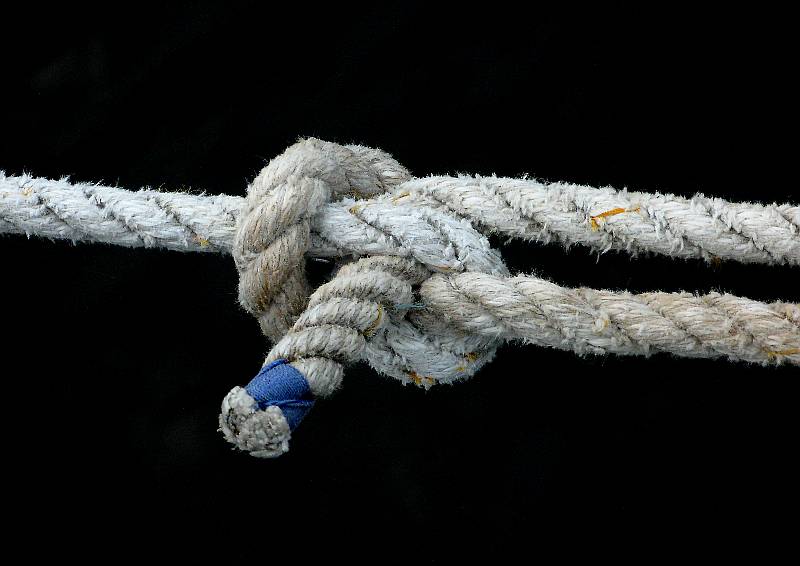
I’d say not “exactly”: for the TurNip of Gleipnir’s structure is held more in the
half-hitch orientation by virtue of each end’s un-ending side, which sustains
tension resisting the opening of the Half-hitch into Round Turn form. Without
such resistance, the TurNip is a fickle thing – YMMV with material, et cetera.
The Bowline with such a hard turn in it I’m guessing is one that gives a lower
reading then were the bending around the tail significant. But these details
remain to see deliberate testing.
–dl*
Of course it is fickle when the bight that hugs the SP is removed, security then is nigh to nil, no better than the balancing pole hitch, but I did try putting more load on it, and it still holds as long as both legs are loaded.
And in the Gleipnir, the end that comes from the opposite end helps to hold the HH from untwisting, as well as the bight hugging the SP does in the bowline. What I wanted to show is the relationship, and how maybe some new light is shed on the mechanism that makes the bowline work. Its ‘capsized’ form is the one most often seen when it has taken some strain after seeing some use. Its HH then is similar to the Gleipnir HH, with the force mainly in line with the turn.
Maybe this deviation from the original theme is more akin to knot theory than practical knots, but nevertheless, I put it in the Gleipnir thread for the similarity, which might help us understand how knots work.
How does one get to see your pictures??
You might have to enable scripts in your browser to see the pictures, but in most browsers you should see miniatures of the images in the post, and clicking on them should open a larger popup. Under the picture also is a text link with the image name, and it can be downloaded by right-clicking.
I got to employ both Gleipnir’s binding (with rather short run, to bind together
two shelving sides, for temporary support while installing X brace), and also
a variation of the one shown here, with the TurNip in an eye knot.
But unlike what I’d done previously with this eye knot where I used its
end running long out & back, the S.Part anchored separately, I used the
eye with TurNip in one end of a long loop/grommet with the opposite
side running through it en route to a remote anchorage, where the cord
turned and returned through the TurNip, then to become a hauling end
for that mythical Two-to-One (theoretcially more, 3:1, here?) mechanical
advantage, all the while being directly nipped and directly tensioning that
nip – that is the point! – worked great, while the Gleipnir binder
had the problems previously experienced, where the TurNip is too far
removed (by bends of material around corners, here) from the direct
input of force to quickly gain increased binding effect; it worked for
me, in quite frictive old marine kernmantle sheath (?! – an odd find),
but showed the difficulty in gaining nipping power.
–dl*
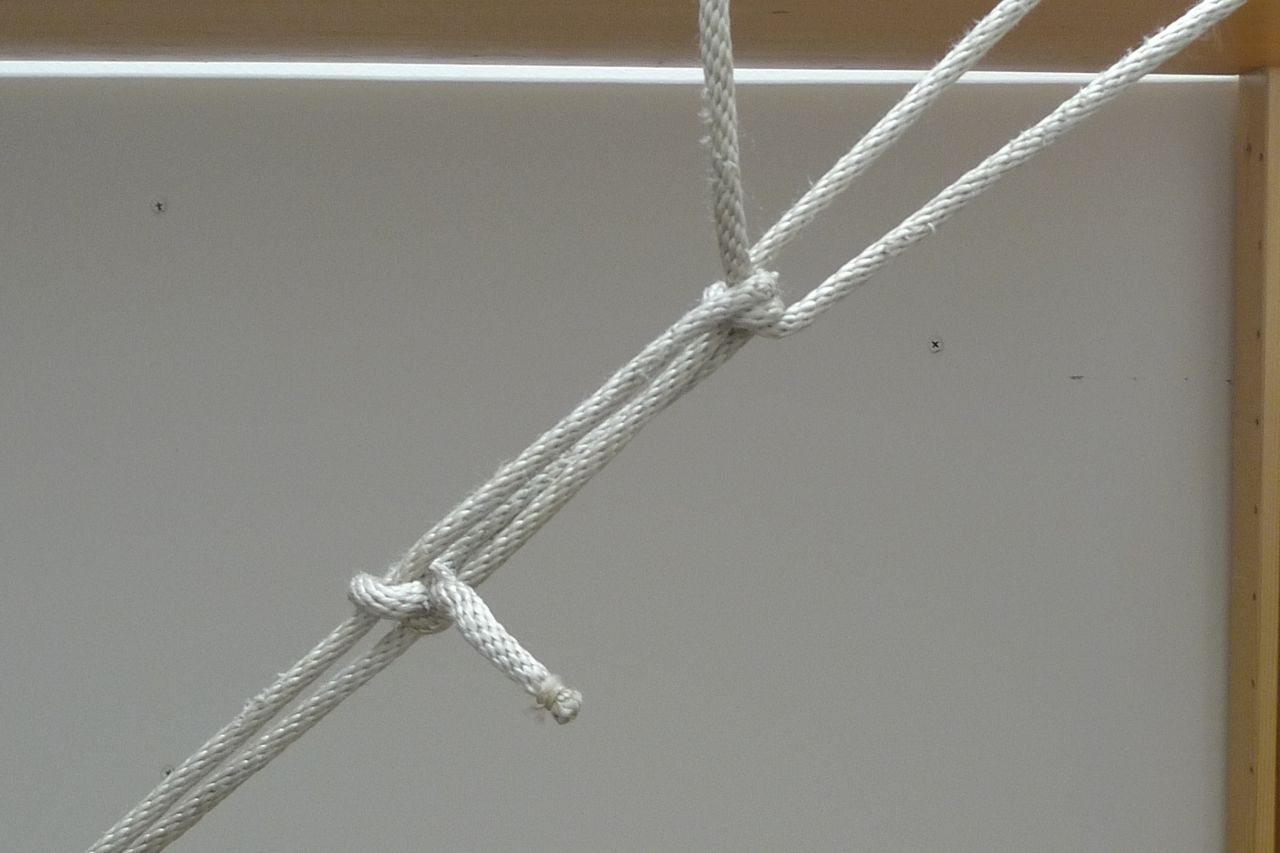
Attached is a photo of the TurNip-in-Eye structure that I used in tensioning
some shelving frames (to hold in place while a metal X brace was installed).
This structure will give stronger nip in cases where the material cannot flow
around the object and tighten the TurNip so well.
Image explanation: the 3/16" solid braid nylon(?) cord (soft, flexible) is
run through some half-inch thin polyester cable-hauling webbing secured
to the lower left side of the shelf, in a sling, and an end from this point
forms a Myrtle/Quick Bowline with a round turn (TurNip) around the other
side, which side reaches up to the shelf’s top-right post and comes around
that smooth surface back to enter the TurNip from the opposite side, end
pointing upwards here. Haul on the end to tighten the long loop formed
and the TurNip’s grip as well; the main pull is on the eye knot side.
–dl*
??? You’ll have to do better than this, for, no, just collapsing either loop
around the object (by which I mean remove the object, pull on one end
– what else is there … ?) gets one a nothing, or a form of “Fig.10”.
( which works better than the standard bowline when the loop is stretched wide
Hmmm, the bowline works rather well, wide; greatly wide is something that
one should prefer to avoid, but if the material’s got the strength, it can be
done.
The zipper was invented between 1905 and 1915, AFTER the special or the general theory of relativity!
Now there are two achievements of mankind to contemplate together!

If I’d do any guesswork on precedence, the mesh knot for netting probably would be preceding, as a historically more fundamental knot, than both the bowline and the sheet bend, which both might be derived from the mesh knot.
The fisherman’s net is essential for growth of the human society, and it has been invented in all continents, and they all use the same form of knot, which is the basic form with which we make the sheet bend and the bowline. The bowline afterwards, by collapsing, takes its form with the Gleipnir turn, which someone might think is not accidental, but done on purpose. The turn is not the same in the net or in the sheet bend. The reason is that the bowline is loaded on both legs of the loop.
So historically, afaik, there is no former appearance of the Gleipnir, although it is closely related to the bowline after it has ‘collapsed’, as well as the sheepshank. I think one reason why it is not common would be that anyone accidentally making one would be reluctant to trust such a fickle contraption. We like to add something for security, but the Gleipnir in its basic form will not be improved by an extra half hitch. It relies on tension, and the fact that all legs of the knot bear equal load. It works better if there is slip over the object around which we bind it, and it takes its form by a cooperation of the elasticity of the binding stuff and the bound objects, as well as the slip over what it binds. It should not, however, slip where it is nipped.
I think it is rather a very specialised knot; a knot that takes a specialist, one in the know. It has a distinct minimalistic beauty. It is hard to think of anything simpler that would do the job that it does. It isn’t just coincidence that its inventor thinks of it as a constrictor; what it shares with the constrictor is utter simplicity and the ability to hold the tension applied to it. I really love this knot and consider it one very basic knot that explains a lot about what knotting is about. I regard it as one of the most beautiful knots that can be found. And it sure does explain the riddle of the bowline; however, I don’t think it relates to the bowline in any other way, than explaining why a ‘collapsed’ bowline is still an excellent knot.
It’s not that it would precede the bowline, but when dissecting the collapsed bowline that has taken its final form, we find the Gleipnir turn, which makes it hold.
I managed to do the transformation, but it involves one extra step that’s missing in the instructions. The “first loop”, before collapsing, must also be taken around end B to form the Eskimo bowline. I think the operation is a bit far-fetched, and it does not show any real relationship between those knots.
Well, this has been an interesting post - I have learnt three things;
I have learnt (yet again) to trust my convictions - I have struggled for days to translate the Gleipnir to the Eskimo bwl., yet no matter what variant of interpretation of the instructions I took I only achieved a Reef, a fancy rethreaded Eskimo bwl. or a Non-Knot. Then thanks to Inkanyenzi, I dread that it is necessary to partially undo the knot by its ‘B’ end before the translation is possible. Undoing the ‘B’ end one step is not simply a matter of collapsing the first loop as claimed, so I feel Dan’s protestations and my own failure to be somewhat vindicated.
Second, I have learnt (yet again) that the value of a knot is hugely influenced by the means of creating it. If the method is clumsy and unmemorable, then the knot is virtually useless, while a less ideal knot that is easy to tie will posses greater utility. I have always felt that the Eskimo is essentially valueless for this reason.
But third, and by far the most important, I have discovered an easy way of tying a very useful knot. The knot - yes, it is the Eskimo bwl. The method - NO it is not the collapsed Gleipnir !!
Take the end of the rope and pass it around or through whatever you are going to make the loop to, and take the end back to the rope where you want to make the Eskimo. In the rope tie a simple slipped overhand and poke the end through the slipped loop. Pull the rope to collapse the slip and to pull the end into a bight, pulling it back into the OH. As the bight forms, the OH collapses to form the bwl. collar. It is a stunningly simple method of making the Eskimo bwl. exactly where you want it.
I think I would have to say that this method makes the Eskimo the easiest bwl. to tie.
As the slipped OH is possibly the simplest of knots to make (and therefore possibly amongst the oldest), I think it is reasonable to surmise that the Eskimo was likely to have been the very first bwl. to be discovered, and that the other variants of the basic structure, predominantly the Bowline and the Sheetbend, evolved from it - Not from the Gleipnir as xarax proposed.
I think this method of creating a loop even beats the Constrictor / Myrtle method for speed, and simplicity, and now I can tie the knot so easily, I can even see the utility of the loop legs leaving at 90 degrees instead of parallel. A part of my barn roof has just been blown off in a storm, and I had to lash a tarp over the damage. I fed a rope through two adjacent tarp eyes, brought the end back to where I would have made a myrtle, folded a slipped OH, popped in the end and pulled - the resultant Eskimo sat naturally with the two loop legs leaving at a wide angle to the tarp eyes, and the collar left the knot at right angles to the tie down point - the perfect knot for the job and tied so easily even with a high wind flogging the tarp and trying to pull the rope out of my hands.
Thank you xarax for stimulating the thought provoking challenge - I can see that if we can convince you to stay around, we can look forward to having a lot of fun with you.
Derek
Forming the Gleipnir in hand, when it shall be passed over an object, like when closing a sack, can be done very quickly by first forming two round turns, then slide the upper round turn to the side and place it below the other, forming a clove hitch, and subsequently repeating this with the turn that now has become the upper one, which will form the Gleipnir. The method is nifty, because there’s no reeving to be done, half hitces need not be formed, and there are two sequences that are just repeated; first one round turn, repeat, then slide apart to swap sides and repeat. Although limited in use, because it is done in hand, it is a quick and simple movement. Of course the method of grabbing the line with both hands a bit apart and twisting to form the half hitches, then passing one behind the other is the same thing.
My rather humble opinion is that these musings around bowlines are wandering far from the subject at hand, the Gleipnir knot.
I am rather convinced that we have seen a first sighting even though there might be some former evidence somewhere about such a knot, but so far, it has not surfaced.
The knot is ingenious, and it lends itself to alterations that adapt it to various tasks. It has real world usage, and for its utter simplicity, it really merits recognition. i haven’t however seen Gleipnir himself around for some time, I hope he might put it in KM and get his due credit for what that’s worth.
I am really glad to have been around when the matter arose, and the Gleipnir is indeed a very nice addition to the tools at hand.
So I really want to thank Gleipnir, aka mr Dahm for sharing this,
I agree with your comments - as I commented back in post #18. I also hope that Mr. Dahm presents an article on this knot to KM so that the wider IGKT membership gets the chance to learn about it. So far every comment seems to support its newness and its value.
These latter posts are now moving on to cover the lateral issues of the structure / nature etc of this knot. I hope that you can agree that they do not in any way damage or demean the comments that have gone before.
@ xarax
Yes I do hold you culpable for the misinformation that led Dan and myself astray. Your terms involved “snip… have to shrink the one loop around the other snip…” You made no mention of the ‘B’ end being included, nor any consideration for the fact that the ‘A’ and ‘B’ ends could have been of considerable length. Indeed, you have ignored the fact that in post #18 I mentioned that this knot could be tied inline, in which case it could not have been transitioned. Still, you did apologise for your lack of ability to communicate this procedure, so I have to accept the final limitation to be on the parts of the readers and not you and thankfully not Inkanyezi.
The well known method you refer to of using ABOK #529 is in fact using the slipped OH I was referring to. It is strange that this method, being as you claim a “well known fact in the boating world” that I have not been shown the method before, and I am surprised at this because it is such a slick little method of creating the bowlines - why didn’t anyone show me this way instead of the wrist twist or the rabbit tree methods ? ? ? ? Clearly I need to frequent the boating world a little more.
Derek
Really OT here, but I’d confirm that the slipknot method is not widely known. I have however worked out my own way of doing it, and I have tought it to firefighters among others. (Situation: you have a rope that you shall tie to your comrade’s belt, and you have gloves on, and it’s pitch dark and smoke-filled.) And yes, in a way, I’m into boating.
I have a video of it at http://www.youtube.com/watch?v=WTApTsLIe1g (in Swedish). The slipknot method is first shown at about 50 seconds into it, and the surprise moment is at the end from about 2 min 33 sec.
Just when I was going to leave this aggravation undisturbed, as XaraX continued
in denial and unrecognition, I found my/our own – all of us – oversights, and, so, … ::
Well, well, wellllll.
Now --eureka–, I see at last that (1) XaraX is right (if not precise) (!!!)
and (2) there are a host of subtleties on the XaraX transformation(s)!
Details I think best wait for time & CAMERA (of pen-on-paper illustrations) for
full follow-up. The factorial aspect is here: multiple ways to twist the turNip,
and various ways to cross the ends through it. I don’t know if some combinations
with different path (twist-A, cross-C = twist-B, cross-D) get equal results yet,
but I think not, trying to think knot (‘thinKnot’).
whew.
But The Gleipnir Binder cannot! (This reduces to the Overhand, btw.)
The XaraX transformation on it produces my Quick-8.
Yet some Gleipnir version can !
You can check the submitted photo to confirm the first fact;
you --XaraX-- then will know how that differs from your version:
in the twist: clockwise for G., anti-c. for G’<=XaraX=>Eskimo.
(Xarax’s G. reduces to something looking like a Fig.10 (Stevedore) in one
or its symmetric forms; and if the ends crossed just differently there, it IS
this Fig.10.)
So, by page 6-7 we have “Gleipnir” binder(S), “TurNip” structure, and now
“XaraX” transformations of Gleipnirs.
There are versions that can be formed w/o ends; there are a couple ways to get
similar structures, e.g., via transformations of the Clove Hitch (one described by
me and later by Mike; and that one at the mid-way point, with Clove halves just
slid atop/below each other, so turNip is in proper away-from-object orientation;
and I think both such transformations exist for the Constrictor); and there are
other Gleipnir versions that reduce to a knot – i.p., to an Overhand (and more?),
not to nothing.
XaraX transformations on these various knots can produce the Eskimo Bowline,
the Quick8, the half-nipped Q8, the Anglers Loop (!), and who knows what else.
(If you are not nuts when you start out playing with these --and trying to keep score–,
you soon enough will be!)
: :o :-[
It might do well to see about purging many of the exercises in futility just
preceding this eureka post, as those serve no good purpose.
... the higher elite of knots, equal in simplicity and beauty with the Zeppelin bend the double eight bend, and the bowline ( perhaps I should add the constrictor, but nothing else I guess).??? To explore this notion will go well Off-Topic, but I hardly see anything so special about these knots -- perhaps esp. Rosendahl's Zeppelin, which has a family of interlocked Overhands each worthy of any claim made for it, or nearly so, depending on knot (i.p., Ashley's Bends #1452 & 1425). And the Constrictor I think is hyped beyond merit. I've yet to see it out In The Wild, though I can accept that various crafts people employ it.
I also believe that I am one of the few persons [who] now ties his pants with the help of a Gleipnir,
May your necessities not be urgencies. 