Is there a knot to make a loop that can be loaded in all directions with tails that can be loaded in all directions?
What’s your application?
I think we’ve had some members experience flipping of the Butterfly Loop when the loop legs are pulled in different directions during special tests. Maybe they could chime in. I experienced such a capsizing with a quick and dirty bungee test just now.
per bushrag:
Is there a knot to make a loop that can be loaded in all directions with tails that can be loaded in all directions?The answer is yes. However... as was hinted at in a previous post, there might be certain performance characteristics which you deem to be crucial (of which we are unaware).
For example, consider these metrics:
jam resistance
stability
And possible applications:
life critical (eg climbing)
yachting
fishing
camping
#1053 Butterfly is vulnerable to jamming when eye loaded.
When through loaded from SPart to SPart, it is jam resistant.
If you don’t mind a composite knot, #1763 Prusik hitch actually provides an omni-directional attachment point (which can be adjusted up/down a line).
Another interesting composite I have been experimenting with is dual #1074 Bowlines (tied in opposition). Bring the 2 eyes together and you have an omni directional attachment point.
If you state that the knot is for life critical applications, it casts everything in a different light.
i think angle of pull on Butterfly and tension ratio change things some.
Best if eye is loaded less/if at all; and best if angle of pull is perpendicular.
this will pull more evenly to both sides of mainline than lengthwise pull
and maintain ‘dominance’ to both sides of eye from the mainline proper.
.
At lengthwise pull, pull on eye is to 1 unbalanced tension side of mainline axis
i think this imbalance gives distortion that dominoes to problems.
Prussik as mentioned also good as sited, can get some slip on lengthwise per loading and materials
unless sits on B’Fly as shelf, that is found to be a different matter.
.
i like knowing the pull direction on prussiks to set by pulling outwards 90degrees to tighten
then in anti-travel direction and groom, then fold down to user position.
Prussiks to me are dual legged, sharing load to 1 full load line of greater tension thus rigidity
lesser half tensioned/‘softer’ prussik legs should then be formed in smaller/tighter diameter
who’s rigidity would more match or exceed the double loaded (from prussik perspective) mainline .
Friction Hitches like Taut Line, Blake’s etc. that have single input leg of pull are more likely to work without being smaller than mainline.
prefer prussiks for this app if friction hitch used, and if can’t get smaller/tighter, B’Fly shelf makes more usable
.
Never done that bi-directional tho, but w/o making 2nd B’Fly shelf , should be able to reeve prussik leg thru eye as 2nd restrictor to prussik drift.
When I tie the #1053 Butterfly I use the three coils on my hand method.
I suggest trying four coils using the same method (or any method with the same result.), passing the coils over three times and then through them all.
Using climbing rated rope and cords I have not been able to jam the loop after loading in any direction.
I haven’t tried itty bitty strings of soft materials.
It seems that the additional turn within the nub adds sufficient bulk to offset jamming.
SS
It gets a bit bulky, but for omnidirectional loading I’ve had good luck with this one tied in a bight.
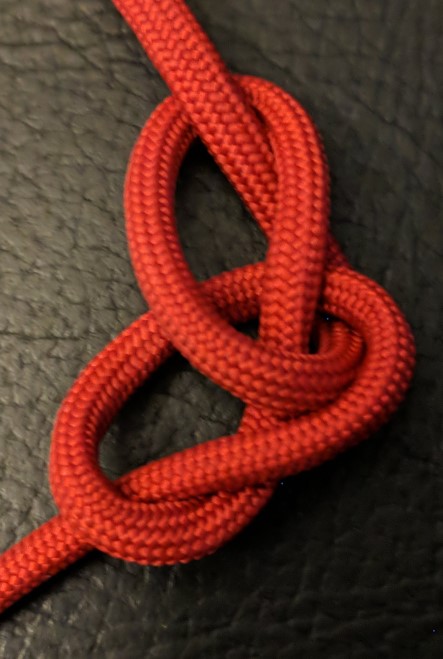
per jimmyh:
It gets a bit bulky, but for omnidirectional loading I've had good luck with this one tied in a bight.Hello jimmyh, strictly speaking - and going directly off the knot image you offered... this is not helpful to the original poster. The specific knot image you posted isn't TIB and it isn't in the form of an [i]eye knot[/i] (ie loop knot). Its actually a rotated variant of #551 from 'ABoK'.
It would helpful if you could post an actual ‘TIB’ eye knot based on your posted image.
Original Posters question:
Is there a knot to make a [b]loop [/b][i]that can be loaded in all directions[/i] with [i]tails that can be loaded in all directions[/i]?
i think it is ok if a thread is free ranging, not locked to focus of single question, as grab wider scope.
Especially if it then helps explain bigger picture, to perhaps allow to show original question’s placement in this bigger sea ;
to then give target some definition.
.
Then too, many times it is the thread’s journey, not destination target that get most out of.
Simply take a bight and tie the same knot. You will end up with every part of the knot doubled over and a loop on one end. Think figure eight stopper knot:figure 8 loop::this knot:______
per KC:
i think it is ok if a thread is free ranging, not locked to focus of single question???? I would suggest to you that the moderators may hold a different view. If someone asks a question - you should make a reasonable effort to answer the question (and I would have thought such a concept to be obvious).
Politicians are notorious for evading the crux of a question.
They are masters at answering a question with actually answering the question!
Be that as it may, it might be acceptable to explore and add some related concepts and insight - BUT, you should first make a reasonable effort to answer the question.
per jimmyh:
Simply take a bight and tie the same knot.Yes - but... your posted photo is not so (and thats my point). In any case, when it is through loaded (axially from SPart to SPart) - that knot core and [i]eye [/i]are offset (ie offset from the axis of tension). In experimenting with this structure in offset loading profile, it appears to resist capsizing (which is good). When eye loaded, it is also stable and secure. As for resistance to jamming, I cant comment because I didn't investigate it. In terms of the amount of rope consumed to create the knot, it is not insignificant (which is not so good). Complexity of tying is more so than in comparison to #1053 Butterfly.
I think Groundline’s earlier suggestion of #1053 Butterfly neatly and succinctly answers the original posters question.
I apologize, it is up to the moderators to say; fair point.
Yes - but... your posted photo is not so (and thats my point).
Right… Which is why I specified that it must be tied with a bight instead of as pictured. I’m not sure why you’re speaking as if I don’t know what I posted?
It’s just easier to see what’s going on when there are less strands everywhere.
I think Groundline's earlier suggestion of #1053 Butterfly neatly and succinctly answers the original posters question.
Except that the butterfly loop jams when eye loaded, as a wise poster noted upthread 
SS369’s solution to that is neat, and perhaps one of the better solutions. I haven’t seen it before and will have to play with it.
Complexity of tying is more so than in comparison to #1053 Butterfly.
I find it actually quite simple to tie. Fold your rope in half and tie a slip knot with the doubled over rope, then pass the end through the loop formed. If you want to get the symmetric and pretty version, you have to make sure do a half twist before passing through the loop, but it doesn’t really seem to matter all that much.
jimmyh:
Here is your original post in relation to OP’s question:
It gets a bit bulky, but for omnidirectional loading I've had good luck with this one [b]tied in a bight[/b].
In reply to your new propositions…
Tied-in-the-bight has a different meaning to tied with a bight.
Refer to #1074 Bowline with a bight for background info.
Another good example is a bend (ie end-to-end joining knot).
It is possible to tie most bends ‘with a bight’.
Just to be clear, that’s not the same as stating that the bend is ‘TIB’.
TIB in its purest definition simply refers to condition where the knot can be tied without access to either end.
Yes - the knot as you propose is ‘TIB’ - by that definition.
And, it can also be tied with a bight! (which is also good!).
However, when through loaded from SPart to SPart the knot core and eye are offset.
Whilst an offset knot by itself isn’t a show stopper, it does require further investigation to assess the ability of the knot to remain stable and secure in the offset loading profile.
Your comment re jamming of #1053 Butterfly is misplaced.
Yes - #1053 jams when eye loaded BUT - only when the load goes beyond a certain threshold.
Mere body weight is not sufficient to induce jamming. Were you aware of this fact?
The original poster did not state precisely how much load his knot would need to withstand.
If its body weight only (and indeed up to around 2kN), Butterfly works fine (when eye loaded).
It's just easier to see what's going on when there are less strands everywhere.The idea behind posting your initial image would have been excellent had it been also accompanied with the 'TIB' version! Also, not all readers/visitors to IGKT are fully savvy with all the concepts - so it makes sense to provide them with all the information they need to understand (not isolated pieces).
By the way, have you also experimented with #551 tied with a bight? It would be based on #1425A (Riggers bend).
Also, your presentation and #551 (tied with a bight) have not been fully investigated to determine jamming threshold.
Tied-in-the-bight has a different meaning to tied with a bight. Refer to #1074 Bowline with a bight for background info. [...] Just to be clear, that's not the same as stating that the bend is 'TIB'.
I’m familiar with the difference between a “bowline with a bight” and a “bowline on a bight”, as well as the acronym “TIB” for “tieable in the bight”. Yes, I suppose “with” would have been the better choice of word here, but I figured that the meaning would be clear given that the knot pictured is clearly neither TIB nor an eye knot, and that the method of tying can’t be relevant unless you’re actually forming a different structure.
Out of curiosity, was this a genuine misunderstanding, or a roundabout way of reminding me of the proper nomenclature?
Your comment re jamming of #1053 Butterfly is misplaced. Yes - #1053 jams when eye loaded BUT - only when the load goes beyond a certain threshold. Mere body weight is not sufficient to induce jamming. Were you aware of this fact?The original poster did not state precisely how much load his knot would need to withstand.
Sorta seems that last line there sorta invalidates your point here, don’t you think? If OP had specified conditions under which the butterfly loop doesn’t jam then the jamming wouldn’t be relevant. Since it wasn’t specified, it sorta seems like the topic remains omnidirectional-loaded loops in general, where jamming of 1053 is a relevant drawback.
Certainly you seemed to think so upthread.
If its body weight only (and indeed up to around 2kN), Butterfly works fine (when eye loaded).
Depends on what you’re tying it with. Try loading paracord that way with body weight and then untying it. No knot jams if you load it lightly enough in thick enough line.
Doesn’t make 1053 a good knot for general purpose omnidirectional loading. I learned that one the hard way.
By the way, have you also experimented with #551 tied with a bight? It would be based on #1425A (Riggers bend).
I don’t believe I have. This is actually really interesting, since “connecting the tails of a bend and tying with a bight in order to form an eye knot” is the exact process I was trying to achieve when I found this knot, only I don’t think I ever found this particular (and quite aesthetically pleasing) knot partially because I wasn’t actually familiar with the riggers bend. I was aware of it, but never looked at it in any detail because of it’s reported tendency to jam, and it seems like the zepplin bend is a strictly superior knot. The thing that makes it interesting though, is that the same thing that kept me from learning more about the riggers bend is the same thing that steered me away from discovering “#551 tied with a bight”.
As a general rule, overhands with something passing through them are more more prone to jamming when both the incoming and outgoing lines are on the same side of the thing passing through the center. As far as I can tell, there are two reasons for this. One is that the line has to bend around a larger angle before getting to the part where it binds and the capstan equation says that more angle means less tension, and less tension means less jamming. The other is that there is a bit of a “collar” formed, and there’s always that space under there that doesn’t get cinched down with tension. This allows loosening in the same way one would loosen a bowline.
For example, in the butterfly loop there are two interlocking overhands. There’s one of each type, and the one that jams more is the one that doesn’t have the incoming and outgoing lines separated. In comparison, Ashley’s bend two of the less jam prone type, and in my experience doesn’t jam so much when you pull on the tails (e.g. when making a loop in the same fashion one makes a “zeppelin loop” from a zepplin bend (hope I’m not opening a can of worms here)). Too bad there’s no TIB Ashley’s bend equivalent of the butterfly loop.
Since #551 has both knots of the more jam prone variety, and riggers bend is known to jam, I would bet fairly confidently that it would retain that greater propensity to jam than the knot I presented above.
Also, your presentation and #551 (tied with a bight) have not been fully investigated to determine jamming threshold.
You mean “by you”? Or are you claiming to know that no one else has ever investigated it either? The latter seems like quite a bold claim 
Hmmm jimmyh, lets see…where were we?
Out of curiosity, was this a genuine misunderstanding, or a roundabout way of reminding me of the proper nomenclature?Neither.
Sorta seems that last line there sorta invalidates your point here, don't you think?No.
Certainly you seemed to think so upthread.No - I didn't.
Depends on what you're tying it with. Try loading [b]paracord [/b]that way with body weight and then untying it. No knot jams if you load it lightly enough in thick enough line.I didn't realise that we were focusing on cords such as paracord (or any other myriad of non human rated rope). But thank you for pointing out that #1053 Butterfly eye knot is potentially difficult to untie after subjected to body weight. In human rated EN1891 and EN892 ropes (including Sterling HTP), I have found the complete opposite. Maybe you might need to specify each and every type of rope?
is the same thing that steered me away from discovering "#551 tied with a bight".Or indeed [b]#582[/b] might be the topological basis for tying it 'with a bight' - and this indeed might bare fruit for further explorations.
Doesn't make 1053 a good knot for general purpose omnidirectional loading. I learned that one the hard way.Strange - I have found the opposite. #1053 is a very good omni-directional knot provided any eye loading doesn't [i]exceed [/i]around 2kN-2.5kN threshold (in EN human rated ropes). Paracord performs differently (obviously).
in the butterfly loop there are two [b]interlocking [/b]overhands. There's one of [b]each type[/b], and the one that jams more [b]is the one that doesn't have the incoming and outgoing lines separated[/b].Interlocking (no). Interlinked? Yes. By each 'type' are you referring to chirality (ie handedness)? With jamming mechanism for #1053 - I think you are specifically referring to eye loading profile (not bi-axial loading profile). Load could be directed one direction of the other - depending on orientation. The exact mechanism that induces jamming when eye loaded is not fully understood - but relates to how load is injected from both eye legs into the knot core. When the eye is loaded, it aligns itself automatically with [a] SPart. That SPart is the 'normal' or counter-balancing force against the loaded eye. [i]One [/i]of the eye legs forms a simple overhand knot around the SPart - and it is here that the mechanism for jamming likely propagates. I am currently writing a new paper on the Butterfly knot - which will compliment my other 2 papers (Zeppelin bend and Riggers bend) - making it a trio of related papers.
You mean "by you"? Or are you claiming to know that no one else has ever investigated it either? The latter seems like quite a [b]bold claim[/b] :pThis is a strange and curious remark. This is quite bold of you to engage with me in such a manner. I looked for a research papers and/or jam threshold testing of #551 tied with a bight - but, could find none (for human rated EN ropes). Your presentation is axially rotated variant of #551 and I couldn't find any papers on that subject matter either. I am considering investigating [b]#582[/b] (tied with a bight) - to probe its jamming threshold (in EN human rated ropes).
EDIT NOTE: Some ideas added for the original poster.
The twisted Butterfly is something I have had in the pipeline for over a decade…I’m almost done wrapping up a series of tests to probe its jamming threshold (in EN human rated ropes).
The #582 derived eye knot (based on the Zeppelin bend) is also something I had investigated several years ago. I think it might make an appearance in the next update of my paper on the Zeppelin bend. I haven’t investigated jam resistance in #582 (tied with a bight).

Out of curiosity, was this a genuine misunderstanding, or a roundabout way of reminding me of the proper nomenclature?Neither.
You knew what I meant AND you weren’t trying to tell me what the accepted way of saying it is? I don’t suppose you’d help me understand where you’re coming from here?
Certainly you seemed to think so upthread.No - I didn't.
You brought up the butterfly loops propensity to jam when you thought it was irrelevant? Again, I’d love to understand where you’re coming from, but I can’t make sense of these seemingly contradictory statements.
I didn't realise that we were focusing on cords such as paracord (or any other myriad of non human rated rope). But thank you for pointing out that #1053 Butterfly eye knot is potentially difficult to untie after subjected to body weight.
We’re not. Neither are we focusing on body weight and less or human rated ropes, in particular. Both paracord and greater than 2.5kN are relevant to the full set of uses of omnidirectional eye knots, though of course they do not encompass the full set, and rarely encompass each other at all.
It’s as if you said “Yes, mammals go in the water BUT - only for a quick drink. Mammals do not live in the water. Were you aware of this fact?”, I said “Depends on the mammal. Look at whales, for instance”, and you responded “I didn’t realize we were focusing on whales”. We’re not focusing on whales, we’re focusing on the entire set of mammals, to which whales (and seals, and yes, Rhinos/etc) belong.
is the same thing that steered me away from discovering "#551 tied with a bight". Or indeed #582 might be the topological basis for tying it 'with a bight' - and this indeed might bare fruit for further explorations.
Yes, you can tie the analogous knot for 582 as well, and that’s where I started. Unfortunately, I don’t remember why I ended up not preferring that one.
Also, since you seem to be picky about proper word usage: https://www.grammar-monster.com/easily_confused/bare_bear.htm 
Doesn't make 1053 a good knot for general purpose omnidirectional loading. I learned that one the hard way.Strange - I have found the opposite. #1053 is a very good omni-directional knot provided any eye loading doesn't exceed around 2kN-2.5kN threshold (in EN human rated ropes).
It’s good for a lot of things, yes. And if your specific use case involves less than 2.5kn on EN human rated ropes, I’m sure you’re fine.
In general, neither of those are guaranteed. I’m sure if I only needed to stress my rope to body weight it would have been fine even though it didn’t have any special ratings. Sometimes things call for more force than that.
By each 'type' are you referring to chirality (ie handedness)?
No. A loose overhand looks like a pretzel, and there are three openings. If you pass a line through the center one, the resulting knot is more prone to jamming than if you pass it through either of the other two. The zepplin bend has both overhands passing through the gap closest to the standing part, Ashley’s bend has both passing through the gap closest to the tail. The butterfly bend has one through the center gap as well as one that passes through nearer to the tail. It is that center one that causes most of the trouble. If you eye load it so that the “Ashley type” overhand is closer to the standing part which is taking the tension it is less prone to jam than if you eye load it in the other direction. Even still, when it does jam it is mostly the “non-Ashley type” that is causing the jamming.
You mean "by you"? Or are you claiming to know that no one else has ever investigated it either? The latter seems like quite a bold claim :pThis is a strange and curious remark.
It’s really straight forward. You know what you have investigated, but you don’t have any way of knowing that it hasn’t been investigated by anyone else except insofar as that no one has told you about it. It’s quite bold to assume that if anyone has ever done such an investigation, you would know.
This is quite bold of you to engage with me in such a manner.
What, exactly, is “this manner” to you?
To me, it looks like I offered up a valid solution in a perfectly understandable way, and you have been bending over backwards to be hostile to me ever since. I’m not sure what I did to offend you since you’ve come off to me as hostile right out the gate, but my impression is that the combination of not appearing shaken by your criticism and the willingness to draw attention to what appear to me to be glaring contradictions in your posts hasn’t helped.
I’m sure you wouldn’t want people to cower in response to you, nor to pretend to agree with what strikes them as wrong so as to avoid challenging your beliefs, and so I’m sure things look different from your perspective. At the same time, I’m not aware of anything else in the way I’m engaging with you that could provoke such a reaction. Can you explain to me what I’m doing wrong so that I can stay on your good side? I’d rather we be friends and get along.
With respect to it being a “bold” way to engage with you, I don’t think it’s as bold as you think. I’m engaging with you fully and completely, but neither aggressively nor disrespectfully. With all due respect, I don’t see any reason to be intimidated by you. Am I missing something that would change my mind? Is there a reason we can’t be light hearted and playful here?
Your presentation is axially rotated variant of #551 and I couldn't find any papers on that subject matter either. I am considering investigating #582 (tied with a bight) - to probe its jamming threshold (in EN human rated ropes).
I still think you’re on the wrong track with comparing it to #551, and I don’t see how you think it an axially rotated variant of #551. To me, it looks more like an axially rotated #1452, which is what I was searching for when I found this one. It is mechanically more similar to #1452 as well, and that’s why it shares the non-jamming properties.
I think this narrative is drifting to something of a personal nature.
I am not sure how long this thread will remain open for business?
Be that as it may, I’ll provide some quick replies…
per jimmyh:
I don't suppose you'd help me understand where you're coming from here?No - sorry.
Again, I'd love to understand where you're coming from, but I can't make sense of these seemingly contradictory statements.The notional concept of contradiction lies only in your own narrative - not mine. I'm forming a view that you wont be able to get past this seeming contradiction.
We're not. Neither are we focusing on body weight and less or human rated ropes, in particular.I didn't know that there was a "we" in this narrative? I thought you raised the issue of paracord to support a proposition for jamming? I know that I didn't introduce paracord into my narrative. #1053 Butterfly is vulnerable to jamming when eye loaded - [u]but [/u]this of course is entirely dependent on the [i]magnitude [/i]of loading and the [i]type [/i]of rope material. I do mostly speak in terms of human rated ropes - because there is a specific standard to which they are manufactured - as opposed to non human rated materials - where this is far less rigor. And it follows that testing and commentary based on the use of rope material that conforms to a world standard is more likely to be repeatable by others. Also, the Butterfly is a knot that is used in life critical applications - and human rated ropes are therefore very relevant. Quite frankly, I don't waist my time testing or investigating knot performance in non human rated ropes . Others are entitled to their own personal views...
Also, since you seem to be picky about proper word usage:You could correctly state that I am 'picky' about [i]concepts [/i]- [i]not [/i]grammar or spelling.
It is that center one that causes most of the trouble.? You might want to look more closely at jamming mechanisms in Riggers bend versus Riggers X bend - and compare to Zeppelin (which pivots about a central toggle axis - sort of like a hinge mechanism as Xarax prefers.).
The butterfly bend has one through the center gap as well as one that passes through nearer to the tail. It is that center one that causes most of the trouble. If you eye load it so that the "Ashley type" overhand is closer to the standing part which is taking the tension it is less prone to jam than if you eye load it in the other direction. Even still, when it does jam it is mostly the "non-Ashley type" that is causing the jamming.An interesting proposition that I find myself in disagreement with. You should start an entirely new thread topic to explore jamming in knots. This is straying way off topic. There is a lot more going on with knots (as machines) than you describe in your narrative.
It's really straight forward.? It would seem that your narrative isn't as straight forward as it appears on the surface. Your continued preference to assert boldness is misplaced. I am happy for you to continue to believe in boldness.
...and you have been bending over backwards to be hostile to me ever since.? And here the real underlying motivation behind your posts has been revealed. You have formed a view about "hostility" that is [i]manifestly wrong[/i]. The notional view of "hostility" exists only in your mind - and does not exist in my mind.
I'm sure you wouldn't *want* people to cower in response to you, nor to pretend to agree with what strikes them as wrong so as to avoid challenging your beliefs...And here we are again getting down to what is driving you. I am happy for you to believe that this is some form of contest as to who has the greater knowledge. I certainly don't hold or harbor any of these views. I see this all the time in technical forums - where contests of who has superior command of knowledge are commonplace. Its often the principal driver for these back and forth posts between 2 individuals. Language is a factor - and its accurate interpretation - where face-to-face interaction is missing.
With all due respect, I don't see any reason to be intimidated by you. Am I missing something that would change my mind? Is there a reason we can't be light hearted and playful here?? Again - these views you have formed are manifestly wrong. I have no malice or no ill will - I merely type the facts as I see it. You may interpret my version of 'fact' as a form of personal attack (which it isn't). I would suggest to you that you actually want to engage in a contest of knowledge - one where you believe that you must not back down from? Maybe you see me as an adversary?
I still think you're on the wrong track with comparing it to #551, and I don't see how you think it an axially rotated variant of #551.You are perfectly entitled to form your own views. There is no law or rule that would prevent you from forming an entirely different view to mine.
Perfectly understandable en vacuo, even,
and certainly in the context of the OP ! :
The form is roughly that of what Harry Asher
named “shakehands” and can be found in [u]ABoK
in #1048 IIRC?
FYI, a 2-eye version can be formed, where each
eye is in the place of a shakehands tail. (And similar
things can come from other of the interlocked-overhands
end-2-end joins such as #1408 & zeppelin.)
–dl*
I’m forming a view that you wont be able to get past this seeming contradiction.
If you don’t even attempt to explain, then yeah, probably. I’m pretty stuck at explaining that one myself.
I don’t think it has to be that way though. My ears are open, I promise. Or we could just drop it, if you don’t feel like explaining yourself.
I do mostly speak in terms of human rated ropes - because there is a specific standard to which they are manufactured - as opposed to non human rated materials - where this is far less rigor.
So you trade applicability for rigor. Makes sense for some things, like scientific study. Less for others, like actual application to the full scope of knot use.
You could correctly state that I am ‘picky’ about concepts - not grammar or spelling.
Well, I think the concepts that the words “waist” and “waste” point to are as different as the concepts of “tying without using the end of the rope” compared to “tying with a bight of rope as if it were a single strand”.
If there were a confusion around actual concepts, this response would make sense. But that would take something like “since I don’t have access to the end of the rope, I need to make a knot by making a bight and tying something with that as if it were one strand”, since there would be a genuine conflation between concepts and introducing the distinction would allow things like the butterfly loop to be seen and used. As it stands, you claim to not be confused about which concept I was referring to, but objected to my use of the word “in” instead of “with”.
But it doesn’t matter. It was mostly a playful tease, and we can drop this one too.
You might want to look more closely at jamming mechanisms in Riggers bend versus Riggers X bend - and compare to Zeppelin (which pivots about a central toggle axis - sort of like a hinge mechanism as Xarax prefers.).
An interesting proposition that I find myself in disagreement with.
You should start an entirely new thread topic to explore jamming in knots. This is straying way off topic.
There is a lot more going on with knots (as machines) than you describe in your narrative.
I’m not sure what you’re getting at here. Obviously the abstraction I offered doesn’t explain all knot behavior, and abstractions in general tend to be leaky. Still, it actually works in the example you offered. Put more bulk in the right part of the knot and you get less jamming, as predicted. Only one of the two proposed mechanisms holds here, but that’s fine.
Are you willing to say a bit more about why you disagree, exactly, and how you see it?
It would seem that your narrative isn’t as straight forward as it appears on the surface.
Still seems pretty straight forward to me. It’s bold to make non-existence claims without evidence. Shrug.
And here the real underlying motivation behind your posts has been revealed.
No, not motivation. I’m not hurt by it, nor do I share the feeling of hostility. I do perceive it pretty clearly though, and I’m guessing that everyone else does too. I can even explain it, if you’d like, but I’d rather to talk about knots and that’s why I’ve only been responding to the other stuff to the extent necessary to keep the conversation working.
For example, I didn’t bring up your apparent hostility until you commented that it was “bold of me to engage with you in this way”. If that’s not coming out and explicitly making the conversation about the offense you’re taking, then I’m not sure what it is. If you want to insist without explanation that it’s not that, I’m happy to pretend that it didn’t happen and stick to knots.
I see this all the time in technical forums - where contests of who has superior command of knowledge are commonplace. Its often the principal driver for these back and forth posts between 2 individuals. Language is a factor - and its accurate interpretation - where face-to-face interaction is missing.
Do you have any insight on how best to deal with these types of situations? I’ll share what I’ve noticed, and you can let me know whether this squares with your experience, or if you’ve noticed something different.
In any conflict there are always at least two active participants enabling it. There isn’t always more than one “aggressor”, but there’s always another party unwilling to cede the (perhaps implicit, and perhaps objectively unreasonable) demands and allow friction. Like childhood disputes over whose turn it is with the toy, everyone tends to think the other side is the unreasonable one, and there’s often a ton of projection, so you get silly things like “Why are you making a big deal out of this? Just drop it [and give me what I want]” (the silliness being that they could just as easily drop it themselves, if they weren’t at least as unwilling to do what they think is wrong). The only way I ever see these things resolved is when both participants (either through self awareness or through character attributes or whatever) refrain from presupposing their correctness and engage with a willingness to change their own minds.
I see it manifest in a couple different ways though. Sometimes you see people who are fairly dismissive towards each other who are nonetheless so confident that they are right that they’re willing to get into the nitty gritty and show that they aren’t wrong. When this happens, it tends to lead to great discussions and even great relationships, but it’s harder to pull off because it requires the security to refrain from posturing/withdrawing/mentally contorting when challenged and a willingness to let “superior command of knowledge” land where it lands even when it isn’t necessarily comfortable.
The other more common way I see these things work out is for people to just care less about being seen as “the expert” and being more interested in learning from other people, regardless of whether that other person is an “expert” or sees themselves that way. Postel’s law is a good one.
I’m sure you have plenty of insight into knots that I don’t have, and I’d be happy to learn from you. I’m not going to pretend to be convinced when I’m not, but I’m completely happy to learn when I’ve been wrong even if it’s something that I’ve been confident about. I hope that’s enough, but if there’s anything else you can think of just lemme know.
I would suggest to you that you actually want to engage in a contest of knowledge - one where you believe that you must not back down from? Maybe you see me as an adversary?
Honestly no, I think you’re assuming too much here. I’d much rather have constructive sharing of knowledge. In order to do that though, we have to be able to point out each others errors when they’re made or else how do you even converse? If that reads as an adversarial challenge to you and/or you’re not open to being wrong, I’m really not sure what to do about that. “That’s a bold statement” doesn’t imply an adversarial mindset, and it didn’t come from one. It’s actually a fairly respectful and open minded way of pointing out what your claim actually implies.
When I asked what you’d like me to do, I wasn’t being rhetorical. Do you want me to jump straight to “agree to disagree” and not even try to resolve disagreements? Is there some way I can engage with you so that we can talk through disagreements about knots without you perceiving me as being “too bold” or “trying to compete for superior command of knowledge”? I’m willing to consider it, whatever it is.
You are perfectly entitled to form your own views.
I think that goes without saying. Everyone is entitled to their own views, even if they’re a bit uninformed and wrong sometimes. The point of sharing views is so that people can get together and voluntarily make them a little less so.
I’ve shared a heuristic I use which is quite successful in predicting the propensity of overhand based knots to jam, and which led to the design of the non-jamming omnidirectional knot above. If you have anything object level to say about that heuristic, other better heuristics, the knot I presented, or other omnidirectional loops, I’d love to hear it.
I hope you don’t decide to pull away from the object level discussion.