Hey, I smell 2 years and 900 posts later a la rockclimbing.com. 
alpineer
Hey, I smell 2 years and 900 posts later a la rockclimbing.com.
alpineer
When people talk of adding circles, they would properly say add “turns”. Lazy speech doesn’t negate what a round turn is.
I’ll ask you, too: How many degrees are there in a turn? Knot4u isn’t sure.
It comes down to this: The Ashley Book of Knots and other ropework references define a round turn differently than you and knot4u. Now, do I believe the the ropework references, or do I believe two self-admitted knot neophytes?
http://igkt.net/sm/index.php?topic=1960.msg13655#msg13655
http://igkt.net/sm/index.php?topic=2093.msg15002#msg15002
The problem with your interpretation here is that Ashley is talking in about the tangling of anchor lines due to drift of the vessel. The context of terminology is different. If you look a few inches down the page, you’ll see the turn and round turn structures that are being discussed here regarding wraps around a spar.
The turn makes a complete trip around the spar, as is consistent with the dictionary definition given earlier. I think you don’t like the way Ashley has drawn his diagram. If you think the description is ambiguous, you are free to use the dictionary definition of a turn being 360 degrees.
I agree that the Two Round Turn structure is 900 degrees. See:
http://igkt.net/sm/index.php?topic=2797.msg16509#msg16509
Nothing happened to it. A round turn is not two round turns, nor is two round turns double the degrees of a round turn. Please explain your confusion.
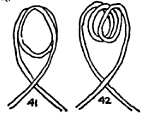
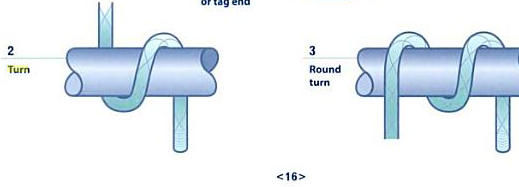
Round Turn Structure (#41) and Two Round Turns Structure (#42) from the Ashley Book of Knots and (second image) Turn and Round Turn from the Complete Book of Sailing Knots by Geoffrey Budworth and (third image) definitions from the Army Field Manual FM 5-125, US Army:
And even THAT is yet “TBContinued” !! :
(If only we can tie this into the EDK & equalizing anchors somehow …)
Touche’ !!
(and it’s getting all the more RC.com-like with someone’s finger stuck
on the Quote button (lest these gems of iteration be lost) !)
With the powers vested in me at birth, I disavow myself … . :
[b]You're talking about adding 2 x 360 degrees of turn, not 2 x 540 degrees. [/b] [b]Here's another experienced knot tier (Inkanyezi) who speaks like that: [/b] http://igkt.net/sm/index.php?topic=1379.msg9736#msg9736He’s talking about adding 360 degrees of turn, not 540 degrees.
Touche’! --good find.
But, I can assure you that my thinking is contrary to your
interpretation, or your break-down of items. On Ink, well, that
indeed fits precisely your sense.
But he is but one guy whom I’ll jokingly dismiss as non-English-native
(nevermind he handles it better than most…), and … his book is yet
to arrive.
Point: you have still the entire archive* of angling-knots literature using
“turns” synonymous with “wraps” and nary a peep of “round turn” to
try to explain away or run contrary to!
(*my conjecture w/o knowledge of the contrary).
And there is some bit of imprecise skipping of fine points of counting
in all of this : i.e., that, unlike your urging, folks who would speak of
making “two turns”, say, would mean “round turn” as 540deg in effect,
and not (same verbal equivalence, yes) 360 as some strict rule might
say; and, in fact, the result after joining the tail to the SPart will of course
pull things beyond the strictly interpreted 180deg, which would leave them
parallel and separated by a distance equal to the diameter of the object
around which the line is (round)turning. Go past this to “3 turns” and
you won’t have even any apparent equivalence --they will mean an added
360 per their “turn”, even though they’ll acknowledge 180 (which one
might see more nearly 270) for the first.
.:. No one says “make 3 turns” to mean what Ashley defines/illustrates
as a round turn --but in your hard interpretation that 3x180 is just so.
And “Round Turn & 2 HH” isn’t going to become “Turn + Round Turn & …”,
but I take your reasoning about the implicit “turn”; however, if one were to
build upon such reasoning, problems would arise (e.g., “round turn and turn
around SPart” : are you then possibly building a Cow or version of Rolling h.?
–the latter requiring your implicit “turn”, the former being more strict).
You logic & math aren’t bad,
just the wrong tools (if used alone, untempered) for
addressing this language.
And I don’t see some (re-)definition of such common simple
terms as solving confusion very well, in contrast to the less
elegant use of some hard digits to quantify meaning.
“several turns” is going to be understood, naturally, as you
would want “several round turns” to be --it would be spitting
into the wind to try to make it otherwise (though success in
the immediate region of few-turns hitches might invite some
hope).
Who said a turn is half of a round turn?
You really need to ask that?Why is asking the number of degrees in a turn an invalid question?
Go ahead and ignore what we're saying and "believe"(!) the irrefutable, glowing bible of knots.One source might be refutable, but the evidence is all piling up on the side of a turn being 360 and a round turn being 540. It's nothing personal. It's just a matter of language usage.
I'm fine with us not agreeing. I couldn't care less. But don't ****ing insult me.Where was the insult? I quoted your own words with no malicious intent.
Being a neophyte in no way reflects negatively on your character. I think highly of your character.
I do believe that some benevolent neglect of this thread is a good idea. It’s not worth inflaming feelings in any of my friends here (you and knot4u included).
The Captain is always right, and on my boat a ‘Turn’ on that bollard is 360 with you hanging on the end to surge the boat to a stop. Two ‘Turns’ is twice that to increase the braking power. Three ‘Turns’ gets you a dressing down for overstressing the rope, the bollard and the boat. A Round Turn means you take the rope all the way round the bollard (360) and bring it back round to itself (180) preparatory to tie off (540). So N Round Turns is just N Turns plus 180 to get the working part back to the standing part.
If half the effort expended here went into something useful like the Improved ABOK Index it would be finished by now and out there for all to use so we can find all the ‘Turns’ he ever mentioned.
So in the end call it what you like but make sure your crew know what it is on your boat.
Happy knotting
PwH
Thank you for this description PwH.
On semantics, replacing the term Two Roundturns with the term Double Roundturn might help remove some of the offense suffered by some/one.
alpineer
You’re welcome Alpineer. The sticking point seems to be the combination of the turn (360) and the half turn (180). The first RT has both (540) but second and subsequent ones have only an additional 360 each.
It’s the extra 180 that converts any sized stack of Turns (where the two ends leave the stack in opposite directions on the same side) into the same number of RT’s ( where the two ends leave the stack on opposite sides in the same direction ). So an extra 180 converts N Turns to N RTs, and conversely makes N RTs into N+1 Turns.
The phrase ‘Two Round Turns’ still works for me as it just means 2 x 360+180 to bring the rope back ‘round’ to itself.
Hope that hasn’t just confused us all again!
Cheers, PwH
Alternatively a Round Turn could just be a grossly overfed seabird?
So, further to the above, 180 gives us a half turn or loop( as in ‘loop knot’ eg bowline).
270 is a 3/4 turn.
360 gives us a ‘Turn’ or ‘Full Turn’.
360+180 = 540 bringing the rope back around to itself to give us a single ‘Round Turn’ or possibly an ‘Around Turn’.
540+180=720 giving us two full turns
720+180 gives us …
Etc etc
Make sense?
Cheers , PwH
A full turn is 360? . (Period)
It’s disappointing that 75% of the people so far voted 540 degrees. The correct answer is 360 degrees. Here’s why:
When somebody says “add another Round Turn”, they’re talking about adding another 360 degrees, NOT 540 degrees. Think about it. Do you still not get it? Here’s another example…
If the person says “add 3 more Round Turns” and then you add 3 x 540 degrees, then that person has a right to yell at you for being an idiot. If instead you add 3 x 360 degrees (aka, 3 loops), then you will be doing the correct thing. Got it now? Good, now let’s move on to yet another example…
Consider the well known Round Turn Plus Two Half Hitches. In that knot, the “Round Turn” technically includes an implied 180 degrees Turn plus a 360 degrees Round Turn, but who wants to say all that? The first 180 degrees Turn is implied in that, just like it is in just about every hitch. Think about the Slipped Buntline. It has an implied 180 degrees of turn around the object. Do you still not get it? OK, let’s try something else…
Someone may have said above that 180 degrees is a straight rope. That’s incorrect. Come on. Think about it. If 180 degrees is a straight rope (it’s not), then what is 90 degrees? Don’t hurt your brain by thinking too deeply about this. A straight rope has 0 degrees of turn. A rope that has 90 degrees of turn has an end pointing at a right angle relative to the original direction. A rope that has 180 degrees of turn has an end pointing in the opposite direction of the original direction. A rope that has 360 degrees of turn has an end pointing again to the original direction.
How about let’s not reinvent math. I’m not sure what your answer is, but please answer this with a number: If someone says “add 3 Round Turns”, how many degrees of turn are you going to add? I’ll be adding 3 x 360 degrees of turn.
Simply saying “turn” doesn’t clearly indicate the degrees.
A turn that is only 270 degrees is still a “turn”. That is consistent with at least some of the 122 definitions from Dictionary.com.
A turn that is 360 degrees is a “Round Turn”, and a “Round Turn” is a turn that is 360 degrees. That is consistent with the meaning of Round Turn when a knot tier says “add a Round Turn”. I won’t look down on you if you change your vote. ;D
I disagree. That extra 180 degrees is separate from the meaning of Round Turn. The extra 180 degrees is implied in just about every hitch. For example, the Slipped Buntline already has an implied 180 degrees of turn around an object. Likewise, a “Round Turn And Two Half Hitches” has an implied 180 degrees of turn before making making the Round Turn which is 360 by itself. Again, if someone says “add 3 Round Turns”, there is no new definition needed. It’s the same exact definition: add 3 x 360 degrees of turn to equal 3 Round Turns.