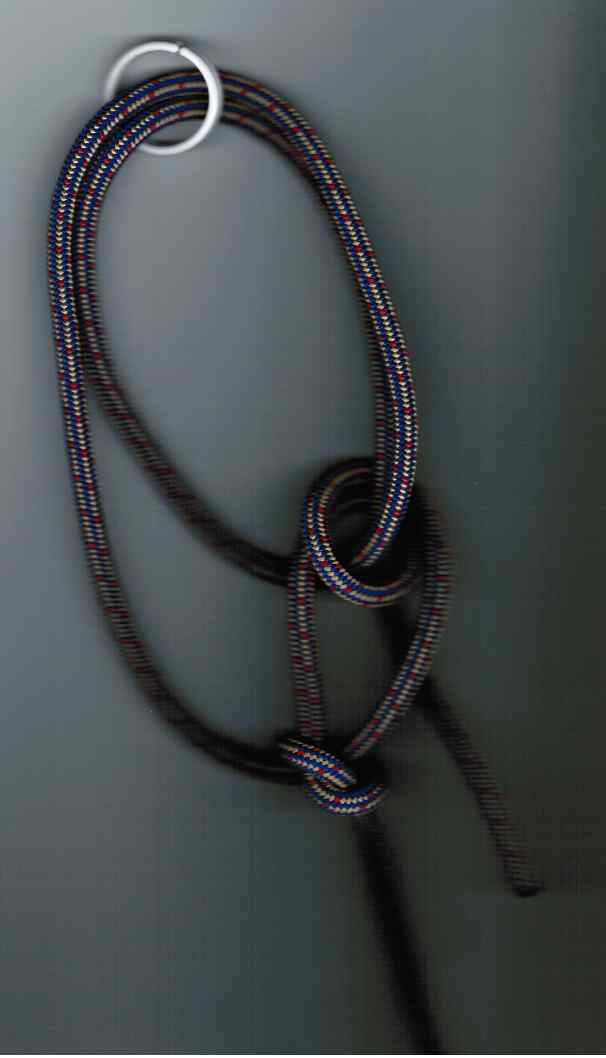
Possible new knot - Buffalo Hitch
Dear members of this forum, I’m submitting this hitch for your appreciation/ scrutiny. I do believe it’s original but understand it may already have been developed by someone else elsewhere at the same time or before I did. Although, I have done extensive web search for a while and through ABOK, could not find it. I included the words “new knot” at the title of the thread to facilitate future searches, but I’m aware it may not be actually new.
This is a hitch I developed to allow a single line rappel from a rappel ring or other type of anchor, reliable enough to stay put during a rappel descent (minimal slippage expected with alternating loading/unloading of standing part) and loose enough to be undone by just shaking the rope from below, allowing the rope to be retrieved without the use of extra gear. A single line rappel can be the only alternative for rappelling down a route and methods exist with the use of additional gear, the pull cord technique being the most used by the climbing community, but lives have been claimed by that technique when the stopper knot passed through the ring after being loaded with full body weight during the rappel.
It’s the same idea from ABOK#399, which I had a hard time getting undone.
Pictures attached (from scanner, hopefully the quality is good enough). Unloaded knot in the pictures, for clarity.
Directions:
With a climbing rope, start the knot some 3 meters from the end of the rope.
Make a running knot with the running end contiguous to the working end of the rope. The loop formed should be some 30-40 cm long.
Pass the working end through the rappel ring.
Form a coil (which may also be referred to as round turn or turNip as in previous discussions here) at the end of the running knot’s loop.
Pass the working end through the coil. The distance between the rappel ring and the coil should be at least double the length of the running knot’s loop.
Pass the working end through the rappel ring again.
Pass the working end through the coil again.
Leave the working end approximately the same length as the running knot’s loop, and no less than 20 cm.
The direction the two sections of rope go through the coil does not really make significant difference in the final result. But in the way shown in the picture it will dress nicely and be easier to be checked.
Hold the working end when loading the knot by putting your weight on the standing part, to which the rappel device will be attached (and the climber). Observe the coil constricting the two sections of rope within it. It does not matter if the coil stays as a coil or if it slides to the side becoming a twisted loop instead, it will function just as the same. Constriction achieved, the knot is ready to withstand the normal expected stresses inherent to a rappel descent (tugs, lateral oscillations, etc) and there will be minimal slippage with each occasional unloading followed by loading of the standing part, that is compensated by the 20 or so cm left as working end.
It does look scary but it is sound.
I appreciate your feedback.
Thanks.
Andre.