There are so many slight variations in how to tie a Butterfly Loop. If one works for you, stick with it. I have just found that beginners have trouble with methods that involve “reaching under” to pull something out. One of the instructions for the Butterfly Loop that seems most guilty of this is that of Des Pawson in The Handbook of Knots, 1998. Here are two websites that do the hand wrap the way that I like to do it. {Probably we get so many methods because it is not that easy for a beginner the learn this knot.}
Both of these sites also show how to use the same hand wrap method to tie the Butterfly Bend (and they both show other methods). Thus I have been playing with how to modify the hand wrap method shown at these sites for the RT Butterfly Bend. If you are joining two ropes of slightly different sizes, you would naturally want to put the extra Round Turn on the part with the smaller rope. Here is what I have so far.
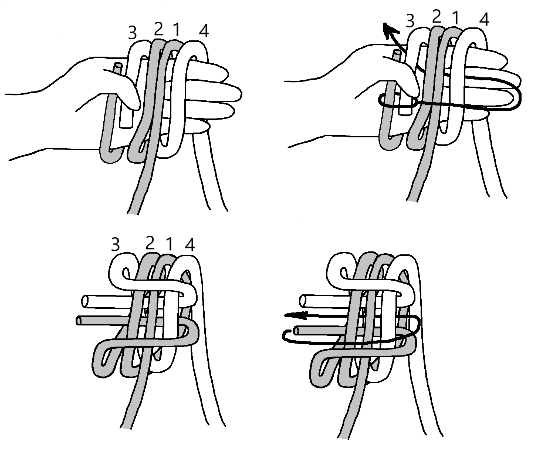
Start by wrapping around your wrist two and a half times with the smaller cord (shaded below), and put the end under your thumb. Then put the end of the larger cord under your thumb as well and wrap one and a half times over your hand now. That makes four wraps all together, and I have numbered them in the first diagram below, beginning with 1 nearest my wrist and 4 near the end of my fingers. Move 1 over both 2 and 3. Then move 2 over 3. Thus the order ends up 3-2-1-4 and all of the wraps are now on your hand. Finally, you pull the two ends under your thumb out a little and insert them both between the wraps at your fingers. This would complete a RT Butterfly Bend (see the next to last diagram).
If there is a dramatic difference in the size of the two cords, you might want to consider a double wrap of the smaller cord (indicated by the last diagram). When I make a Zeppelin Bend with cords of different sizes, I often use a round turn and two wraps with the smaller cord. I find it helps the smaller chord to “take up similar space” as the larger chord in the knot. You actually can find such a “round turn and two wraps” in Ashley where he uses it in an Alternate Anchor Bend (ABoK #1843).
Test #1
Configuration: Dual leg, mirrored (load split 50/50 to each knot) - U profile
Rope type: EN1891? (11mm?)
Peak load: 602.5 kg #1053 Butterfly on one side / RT Butterfly on other side
Test #2
Configuration: Linear
Rope type: EN1891? (11mm?)
Peak load: 355.5 kg #1053 Butterfly on one end termination / RT Butterfly on opposite end termination
Results / conclusion:
No jamming - both knots were able to untied by hand (without the use of tools).
Note: If tools are required, this changes the definition of ‘jamming’.
That is, a knot that is maximally jammed (in my view) means that the knot cannot be untied - even with the use of tools.
…
Suggestions for follow up test:
Do not mix the 2 knots in the same test. Only test one type of knot in a load test.
The test created a pulling force in one direction, then stopped - and then continued pulling in the opposite direction. Is it possible to inject force only from one side (not both sides)?
Avoid dual leg - U - test configuration because load is split 50/50 to each side (meaning you have to apply much higher loading to account for the 50% load split). Try to perform test in linear configuration.
Can you try to reach 400 kg force (in linear configuration)? I am speculating that the jamming threshold may be around 400kg (approx 4.0 kN)…
You mention ‘weak’ side… this implies there is a ‘strong’ side. I would surmise the concept of ‘weak’ versus ‘strong’ side may not be entirely correct.
Rather, you could suggest that one side may be more jam resistant than the other.
If you wanted to prove out this theory - you would need to run a series of tests to rupture (to MBS yield point). Probably 5 tests for each eye loading direction.
Need to define the eye loading direction… I think it makes sense to say eye loading in Z direction versus S direction.
Very interesting tests. It reminded me of the tests many years ago by David Delaney where he found that the Rigger?s Bend (or Hunter?s Bend) and Ashley?s Bend tended to jam, while the Carrick Bend, the Butterfly Bend, and the Zeppelin Bend did not. But he also found that a half twist of the free ends as they came out of Ashley’s Bend tended to make it less prone to jamming. {His old website was http://davidmdelaney.com/jam-testing/jam-testing-several-bends.htm, but I believe he died and the site is gone.}
I mention this because as I practiced tying the RT Butterfly, I found that it often happened that as I pulled the loop through the more extended knot, I got a half twist. This can happen in a Butterfly as well. After you tighten either a RT Butterfly or a Butterfly, it can be very difficult to see if such a half twist has happened deep inside. (Thus in tests such as yours, we cannot see easily if this has happened, although it did not seem to be twisted when you opened the knots.) In their 1928 articles, Wright and Magowan insisted that the Butterfly needed this half twist. This was one way that their knot differed from all of the previous descriptions of a Lineman’s Rider. I have never seen any source since that included this half twist, and the new diagrams seem to avoid it. My question is: Does this half twist help or hinder either a RT Butterfly or a Butterfly? It probably does not matter much, just as Richard Mumford (referenced above) showed that it does not matter how you dress the Butterfly (crossing in front or crossing in back). But you could argue theoretically that the half twist inside results in a less severe angle on part of the rope as it passes through the knot, and this is usually better for the strength of the knot. It would be nice to have some testing as to whether it mattered, either for strength or jamming.
BUT… Can we apply the scientific community expectations on an enthusiast/hobbyist tester?
Enthusiast/hobbyist testers do not get funded (they are self funded) and they do testing in their spare time.
They also tend to work in isolation - more often than not, their work is not peer reviewed.
Their test rigs are largely improvised - and the way they perform their tests may not be accurate.
When you cite people such as David Delaney etc, how much reliability can we assign to their test results?
This is NOT intended to be an insult - I am simply presenting the facts as I see it.
Go to this website to download a range of technical papers on Riggers bend, Zeppelin bend and other stuff…
Link: http://www.paci.com.au/knots.php
…
Commentary:
With Alan Lee’s RT testing, I am encouraged by the fact that he is not doing the usual mind numbing “pull-it-till-it-breaks” type of test.
He is testing the jamming threshold of the knot specimens (when eye loaded).
I theorize that the jamming threshold of #1053 Butterfly - when eye loaded - is around 4.0kN (in EN1891 and EN892 ropes).
However, we need to carefully define what we mean by jamming!
For example, if tools are required to loosen a knot, how does that affect the definition?
That is; a knot that can be untied by hand (no tools) is a different prospect compared to a knot that can only be untied with the aid of tools. Xarax has his own views on the definition of jamming.
He introduced the term ‘maximally jammed’ - which I think means a situation where not even tools will loosen the knot!
Note that we also need to define the direction of load.
eg.. in the case of #1053 Butterfly, load can be:
BTL (bi-axially through loaded)
Eye loaded (and the eye can be loaded in 2 axial directions - ie Z direction and S direction).
1. Do not mix the 2 knots in the same test. Only test one type of knot in a load test.
2. The test created a pulling force in one direction, then stopped - and then continued pulling in the opposite direction. Is it possible to inject force only from one side (not both sides)?
Don't make any sense to me.
Avoid dual leg - U - test configuration because load is split 50/50 to each side (meaning you have to apply much higher loading to account for the 50% load split). Try to perform test in linear configuration.
My rig can handle it, two knots side by side, easy to see how the two knots react.
4. Can you try to reach 400 kg force (in linear configuration)? I am speculating that the jamming threshold may be around 400kg (approx 4.0 kN).
Will do it.
You mention 'weak' side... this implies there is a 'strong' side. I would surmise the concept of 'weak' versus 'strong' side may not be entirely correct.
Rather, you could suggest that one side may be more jam resistant than the other.
If you wanted to prove out this theory - you would need to run a series of tests to rupture (to MBS yield point). Probably 5 tests for each eye loading direction.
I will do it.
Need to define the eye loading direction... I think it makes sense to say eye loading in Z direction versus S direction.
Again make no sense to me, Don't change the outcome, even if it have the difference, the 0.01 % or may be 0,03 %, who know ?.
So nothing to worry about.
Please refer to the attached image.
A #1053 Butterfly fundamentally consists of 2 interlinked overhand knots.
One overhand knot has ‘S’ chirality.
The other has ‘Z’ chirality.
When loading the eye of a Butterfly knot, you need to declare the direction.
Eye loading will be either in the ‘S’ direction or the ‘Z’ direction.
…
With regard to your test configuration, you are in fact testing 2 different knots at the same time!
On one end is the #1053 Butterfly, and the opposite end is the RT Butterfly.
I am requesting that you do not do this!
I am requesting that you only test one type of knot at a time (not mixing 2 different knots in one test).
Beyond this is DRESSING :: Wright & Magowan’s dressed form
has what Xarax would call “crossed legs” I think, so that one overhand is of the “pretzel” form and the other sort of a
minimal timber hitch form. The pretzel has its “spine”
intact, the other half’s spine is split by opposing SPart.
Agent_Smith shows what is the most commonly presented
dressing, which I call “tails (eye legs) abutting”. Tying the
knot with that traditional “twirly flop” method tends to torque
the rope into the dressing recommended by W&Maggowan.
`Dan,
Can you please post some pictures how it looks like, I always post good clear and loose tie knot pictures,
make it so easy to follow and understand the knots. What is so hard to post some picture knots?
Many members had complained before, fair enough just ask for some pictures, I am 71 years old man still has
a lot to explore, no sure if I have enough time left for me to finish what I want to do.
   If you don't like to post Pictures Knots, Please do not reply to any of my posts anymore.
   Just don't want to spend my valuable times on this issue. 謝謝 alanleeknots.
There are 3 possible orientations of the eye of a #1053 Butterfly.
Dan is referring to the historical document published by Wright and Magowan (England 1928).
You can download that historic artifice from the PACI website here: http://www.paci.com.au/knots.php
In that historic article, they showed the Butterfly with twisted/crossed eye legs.
The legs can in fact be twisted in either the ‘S’ direction or the ‘Z’ direction.
See image below (I extracted the photo from their historical document and cleaned it up to make it easier to view).
Dan possibly believes that the geometry of the eye legs may affect:
MBS yield
Jamming threshold.
Nobody has definitely tested this.
To the best of my knowledge, there is no existing test report that definitively answers the questions about the geometry of the eye - and what affect it has on both MBS yield and jamming.
Therefore, it is open for a bold and cunning tester to step up to the podium and run some tests to answer these questions.
The question is, who will be that bold and cunning tester?
There are some further ways to adjust the dressing of a Butterfly. In the first photo shown below, the first two knots are a Butterfly, but only the first shows the “crossing”. In the second photo, the back sides are shown for the same first two knots. Here in the second photo you can see the “crossing” in the middle knot. For comparison, the third knot in both photos is what Wright and Magowan called a Half-Hitch Noose (many call it a False Butterfly, but I prefer a more positive name, Twin Half Hitches Loop). Notice that the third knot has no crossing on either side.
Thus if you only see one side, it can be hard to determine if it is a Butterfly or not. I was not able to “adjust” the crossing in the RT Butterfly that began this forum thread to get two different views. The extra round turn seems to make the movement of this “crossing” hard to do.
Quote
Need to define the eye loading direction… I think it makes sense to say eye loading in Z direction versus S direction.
Again make no sense to me, Don’t change the outcome, even if it have the difference, the 0.01 % or may be 0,03 %, who know ?.
So nothing to worry about.
          Sorry, my misunderstand, I though you were talking the knot below.
         Second picture shows two knots were in the same direction, but with difference knot,
        謝謝 alanleeknots.
With regard to your test configuration, you are in fact testing 2 different knots at the same time!
On one end is the #1053 Butterfly, and the opposite end is the RT Butterfly.
This is the best way to test and compare two different knots with the same force and same rope.
I am requesting that you do not do this!
I am requesting that you only test one type of knot at a time (not mixing 2 different knots in one test).
No I don't want to follow you keep going into wrong path.
Does that make sense?
Again you are totally wrong, make no sense at all. 謝謝 alanleeknots.
If you are going to the trouble of investing your own personal time and energy with testing, it does make sense to try to follow the scientific method.
Testing 2 RT Butterfly knots (one at each end termination) allows you to compare and check the response of both identical knots to load.
Combining 2 different knots in one test introduces too many variables.
…
Of course, it is a free world. You can do whatever you want
A couple of comments about reply #29 above. I may be wrong, but it seems that the first knot in the diagram labeled Butterfly Eye Legs Dressing-State has a loop in the Z direction and the last knot has a loop in the S direction. (I am comparing the loops to the figures in your Bowline Analysis, p. 11, where the chirality is defined.)
I would also point out that a Butterfly knot itself has a chirality. In my reply # 16 above, both of the hand wrap methods that I show use a wrapping around the hand in the S direction. Thus they both give a Butterfly that I would call in the S direction. Using a twist-and-flop-down method (say ABoK #1053 or the figure from Bushby), if the initial twist is in the S direction (as both Ashely and Bushby do), then you also get a Butterfly in the same S direction. Both of the methods of Wright and Magowan (one in each paper) seem to also be in the S direction. If you wrap or twist in the Z direction, you will get a Butterfly in the Z direction. The difference shows up in the final knot as to the direction of the “crossing part.”
Wright and Magowan then give a half twist of the eye legs in the Z direction in both of their papers. I have also found (as Dan suggested) that my hand wrap method tends to want twist and go in the Z direction as well. Maybe it helps balance things or untwist some of what you did in the tying. Thus I would express a slight preference for the twist of the eye legs to be in the opposite orientation as the Butterfly knot itself.
A #1053 Butterfly fundamentally consists of 2 interlinked overhand knots of opposite chirality.
This is a fundamental rule that cannot be broken.
So a Butterfly will always be:
S/Z orientation (when viewed from the overlapping side - with eye pointing up)
Z/S orientation (when viewed from the parallel side - with eye pointing up).
You can alter which segment is ‘riding’ and which segment is ‘underpinned’.
However, this will not alter the chirality of each fundamental overhand knot (ie, it does not disturb the S/Z orientation when viewed from the overlapping side).
And I find this geometric rule very interesting. That is, when viewing a #1053 Butterfly from the overlapping side (with the eye pointing up), its always S/Z… and never the other way around. Its an unbreakable rule.
Lets examine your questions:
A couple of comments about reply #29 above. I may be wrong, but it seems that the [b]first knot [/b]in the diagram labeled Butterfly Eye Legs Dressing-State has a loop in the [b]Z direction[/b] and the [b]last knot [/b]has a loop in the [b]S direction[/b]. (I am comparing the loops to the figures in your Bowline Analysis, p. 11, where the chirality is defined.
Correct. Caused by cut and paste error and mixing them up. Image is now fixed.
I would also point out that a Butterfly knot itself has a chirality. In my reply # 16 above, both of the hand wrap methods that I show use a wrapping around the hand in the S direction. Thus they both give a Butterfly that I would call in the S direction. Using a twist-and-flop-down method (say ABoK #1053 or the figure from Bushby), if the initial twist is in the S direction (as both Ashely and Bushby do), then you also get a Butterfly in the same S direction. Both of the methods of Wright and Magowan (one in each paper) seem to also be in the S direction. If you wrap or twist in the Z direction, you will get a Butterfly in the Z direction. The difference shows up in the final knot as to the direction of the "crossing part."
Refer to my attached image (below). #1053 Butterfly always consists of 2 interlinked overhand knots of opposite chirality. This geometric rule cannot be broken.
When viewing a Butterfly from the overlapping side, it will always be S/Z (with eye pointing up).
When viewing a Butterfly from the parallel side, it will always be Z/S (with eye pointing up).
I agree that fundamentally the Butterfly consists of an S and Z overhand knots. But there can be a difference in how they overlap. I just found that if I start with S direction hand wrapping (or an S direction twist in #1053), then I ended up with the Z collar (or what Wright and Magowan called the “wing of the butterfly”) being the riding part, using your notation. If I do the hand wrapping in the Z direction (or a Z direction twist in #1053), then the S collar will be the riding part. Thus another way to say my slight preference (if there is to be a twist of the eye legs) is for the twist to match which collar is riding.
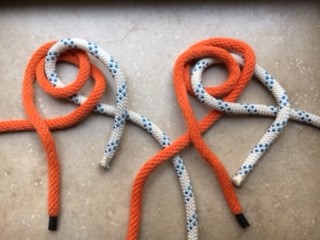
I have been experimenting with the RT Butterfly Bend using rope of slightly different diameters and stiffness. I find that I get a strong preference for one orientation of the “crossing” as opposed to the other. Always I add the round turn to the smaller rope (orange in the photos). In every photo, the knot on the left (preferred) is what I would get with the hand wrapping in the S direction and the knot on the right (less desirable) is what I would get with the hand wrapping in the Z direction. The first photo shows the expanded view of two knots so you can see how the round turn (Z direction, orange) interlaces with the other single loop (S direction, white). In both knots, I did a single wrap of the white (larger) rope and a double wrap of the orange (smaller) rope.
The resulting knot on the left is just “flatter” and seems more balanced. The knot on the right sticks out in the back much more.
There is not so much of a difference between the two orientations of this bend if the two ropes are made of exactly the same material and diameters.
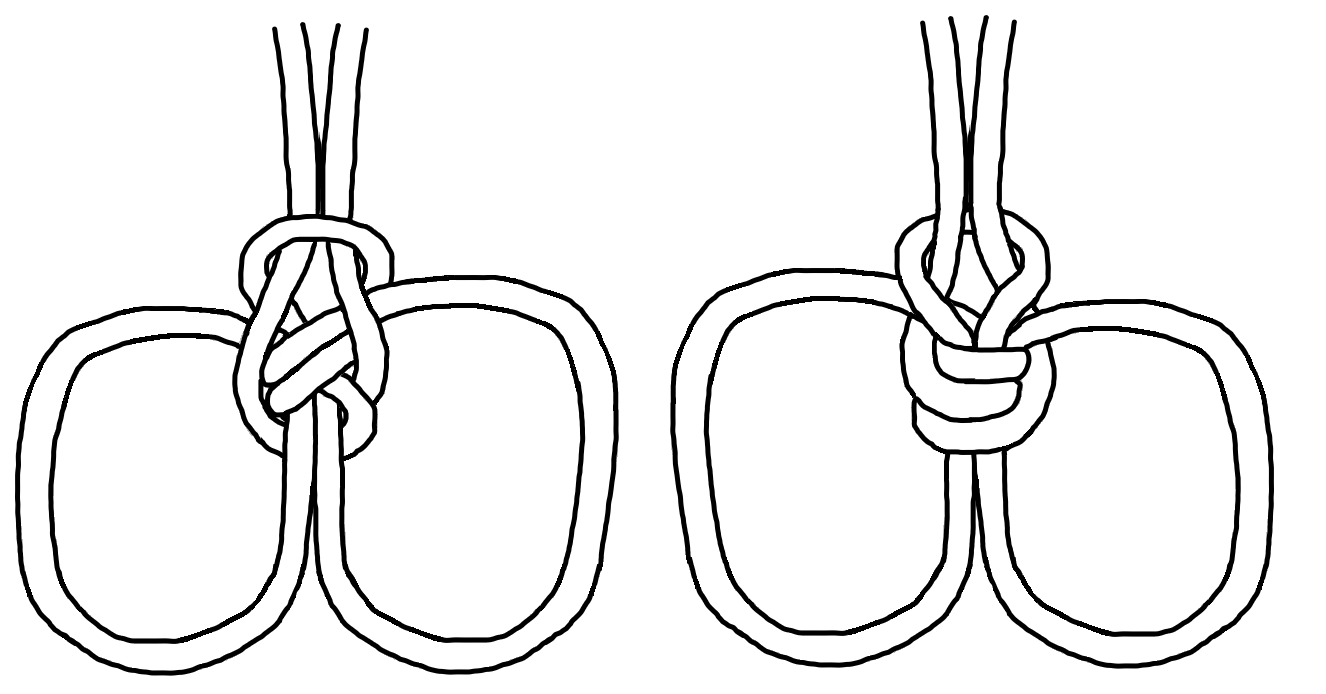
I have also found that you can perform the transformation that Ashley suggests in #1100 for a Butterfly to get two loops with the RT Butterfly instead. It is unfortunate that in the description of #1100 Ashley misnames the knot you begin with (Single Bight Loop Knot), but gives the correct number (#1053) for a Lineman’s Loop. In Phil Smith’s Knots for Mountaineering (available at PACI), this transformation is called 19. Twin Loops from a Butterfly. Brian Toss gives a more detailed drawing in his Knots for Boaters, where he calls it a Double Lineman’s Loop.
Surely #1100 (and the creation below) have to be considered in the “bowline family” because the final knot has a collar and each eye has a nipping loop (in the creation below one is a round turn nipping loop). In the transformation, the eye of the Butterfly becomes the collar of the ending knot, and the two collars (or wings) of the Butterfly become the two splayed eyes in the ending knot.
Not only can you do this transformation for the RT Butterfly in this forum, but you can also do it for most of the creations in Alan Lee’s forum giving other Lineman’s Loop variations. https://igkt.net/sm/index.php?topic=6976.0
Ashley also has a transformation very similar to #1100 where he turns a Fisherman’s Loop into two loops at #1084.