But if one uses the traditional, “twirly flop” tying
method (of making the two twists, and then bringing
the eye around and up through their center),
one can twist one side --it’ll be obvious which,
as doing the other won’t work–
so to have same-rotation of SParts; this extra
twist will convert that side to a [i]fig.8[i].
i make no claim but fumbling around endlessly with at least 3arc/RT forms as a superior theory usually in all working class knots except to purposefully pass of force to next position, or short on line etc. This certainly included friendly Butterfly; but in end collected/claimed nothing except an easy enough form for others on same journey to try etc. i thought might be for super slick line etc. But my 3arc rule still stood in proper SPart to SPart loaded form, just as turns on hand 3arcs.
.
i do prefer crossed legs to eye as more Whatknot-esq (#1406), and softer arc lending to eye especially in stiffer line as the line Naturally lends easier to.
.
i thought i had pix, drawings perhaps even Flash animation of B’Fly RT, as Bend, multi-loop but fairly could not find when got around to searching; fairly enough. i was going to draw out the finger trap to whip thread eye thru i do and don’t see referenced a lot; but found this instead from later pictures(older where mucho worser) forgot had done on dial-up for a Yahoo groups site (big at time when there was an ISA BBS , that would now be called a forum) :
https://upload.wikimedia.org/wikipedia/commons/3/38/Butterfly-in-hand.jpg
Shows start as Crossed Turn instead of Round Turn in hand, hop closest Turn to trap between fingers and snap/whip/shake/pull thru even pull rest of framework over eye . Similar shake/pull etc. also favor for inversion Bowline method to DBY w/same problem of threading loop thru 2 turns.
.
Always liked the Tree Pro Red w/gold tracer against the simple blue towel after many trials.
Contrast to rope and skin w/o harshness of white background; and blurs easily back variant textures blur imperfections.
I felt compelled to discover how to convert the “twirly flop” tying method for the Butterfly (such as in [ABoK #1053]) to do the RT Butterfly in this thread. About half the people who use a Twist and Flop Method for a Butterfly, flop down in back (particularly when they are tying up in the air). The other half flop down in front (which is easier to do on a table). What is shown below definitely needs to be done on a table. If I needed to tie the RT Butterfly up in the air (say outside), I would definitely prefer a Hand Wrap method instead.
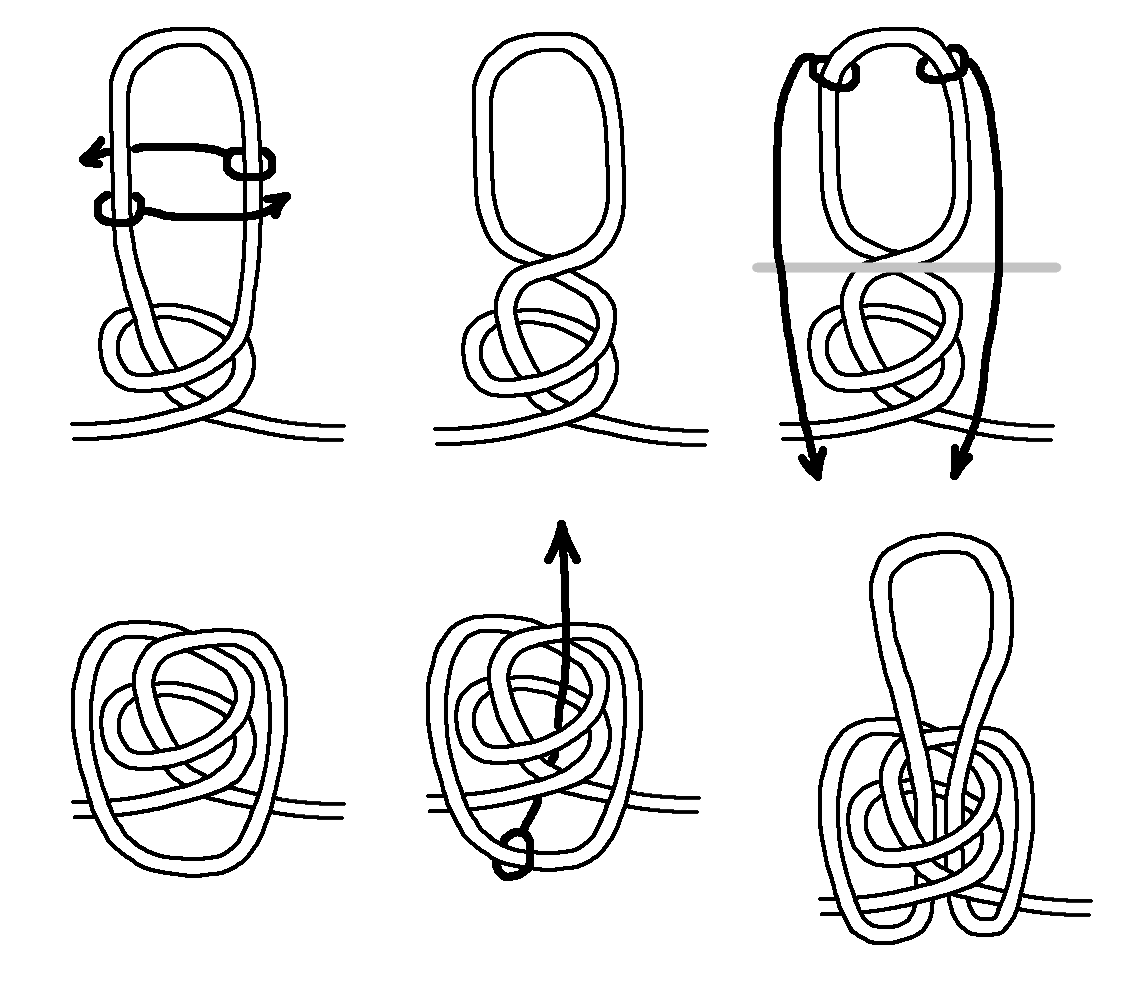
Dan,
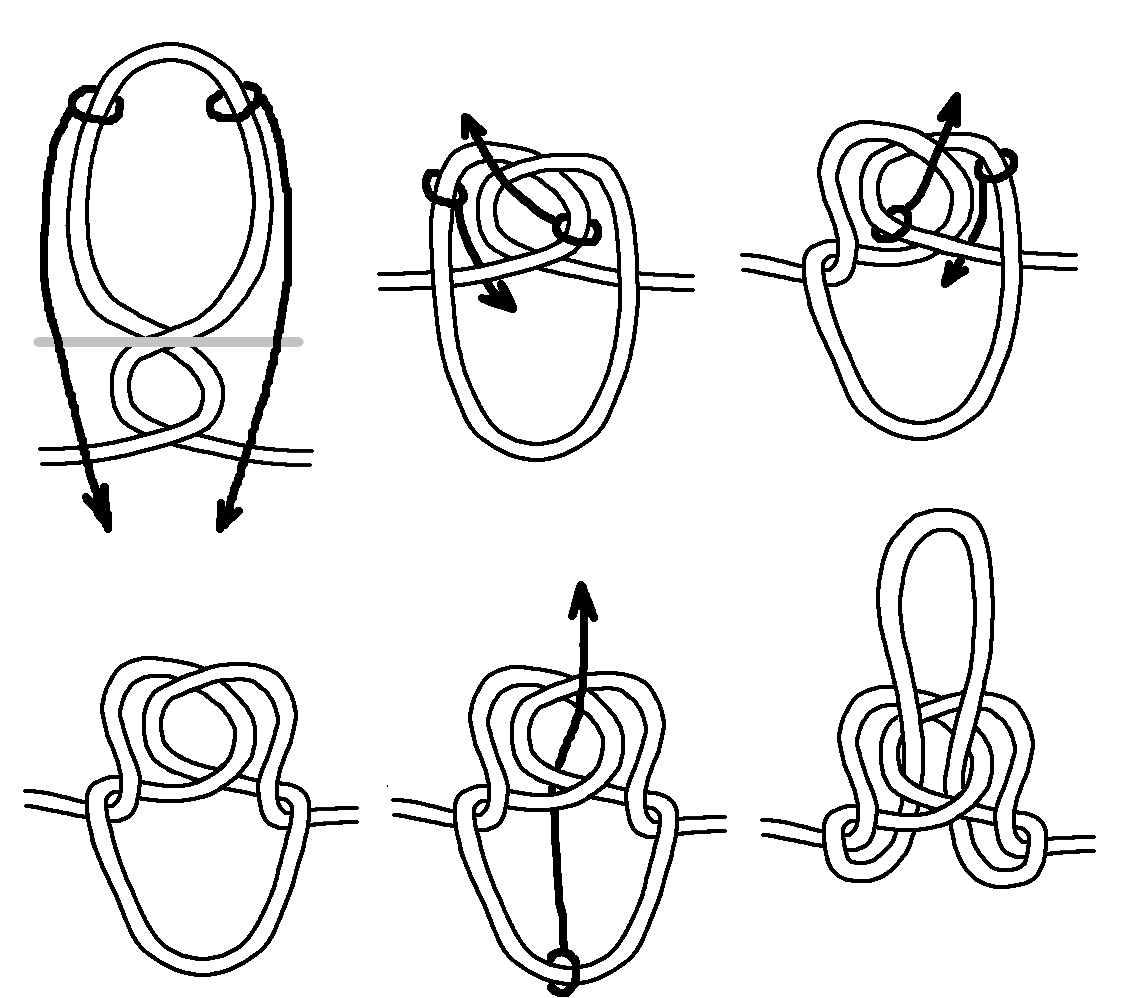
I think that I finally understand your suggestion in Reply 40 for a Figure Eight instead of a Round Turn to modify a Butterfly. I believe I have done it on the left side (I believe the Z side) in the first diagram below.
There is no reason why you cannot do this extra flip on both sides, getting what you might call a Figure Eight Butterfly. This is indicated in the second diagram below. Here I have flipped the two interlacing loops, one at a time, but you could also just flip them both at once.
Either one of these can still undergo the transformation described in [ABoK#1100] to form Twin Loops. It is just a little more difficult to pull the collars out to form the two eyes.
Mark will complain that the collars don’t have as many rope diameters inside, but a Figure Eight usually does not jam as much as an Overhand Knot.
Dennis,
We’re drifting off topic now…
But, the #1053 Butterfly variation you posted above was already presented by myself at this thread:
Link: https://igkt.net/sm/index.php?topic=6709.15 (at reply #15).
And I wouldn’t be surprised if others have also tied it but never bothered to report it.
Edit Note: That particular thread topic was quite bizarre … one which I’d rather forget that ever existed!
It is an interesting variant but I’m not sure if it is more jam resistant in an eye loading profile - or if it offers any advantages over the regular #1053 Butterfly.
When I use the term ‘eye loading’ - I am specifically referring to the eye being loaded in axial alignment with an SPart.
In such a case, there are in fact 2 different axial alignments - one being in the ‘S’ direction and the other being in the opposite ‘Z’ direction.
It must also be pointed out that the eye can also be loaded in a direction that is not in axial alignment with an SPart - in which case we might apply the descriptor "tri-axial’ loading. The Butterfly is routinely used in rope access anchor systems - where the knot is subject to a tri-axial loading profile.
Xarax had contacted me about this BTL (bi-axially through loadable) eye knot.
He thinks it might jam under heavy loading.
I think Xarax defined ‘heavy loading’ as greater than or equal to 50% of the MBS yield point of the knot.
He might be right…but obviously someone needs to load test it to find out how jam resistant it is…
…
I’m still thinking that the RT Butterfly has merit - and the 3 rope diameters that the eye legs arc around will boost the jamming threshold in an eye loading profile. Although there ‘might’ be slight differences in the ‘S’ direction compared to the ‘Z’ direction.
I also think the RT Butterfly will be jam resistant in a BTL loading profile (bi-axial through loading).
I think someone needs to carefully test eye loading in axial alignment with an SPart - testing both the ‘S’ direction and the ‘Z’ direction.
When designing such a test, care must be taken to only test one (1) variable at a time. This means tying identical knots at each end (not mixing 2 different knots in a single test).
Mark,
Here are a few more videos, I think is good enough to say RT Butterfly don’t gain an overall net benefit.
#1053 Butterfly is a very famous knot, all these years, I hear from YouTube and others said is easy to
untie and jam resistant, (I didn’t pay too much attention, and also language barrier) I thought it was
easy to untie with all profile loading, I was so wrong until I do the test on RT Butterfly and compare
#1053 Butterfly. and then I found out #1053 Butterfly weak side jamming threshold is so bad.
Please see picture below.
That is why I only test and target on the weak side, any #1053 Butterfly variation has to surpass
[url=http://“#1053 Butterfly weak side”]“#1053 Butterfly weak side”[/url] first ,then I can process to test the next loading profile,
if simple process to the next profile, just wasting my valuable time. 謝謝 alanleeknots
Test 3 https://www.youtube.com/watch?v=hWltfcXOV9s
Test 4 https://www.youtube.com/watch?v=BNjriTLPNZI
Test 5 https://www.youtube.com/watch?v=_WKe5zJ8oxE&t=342s
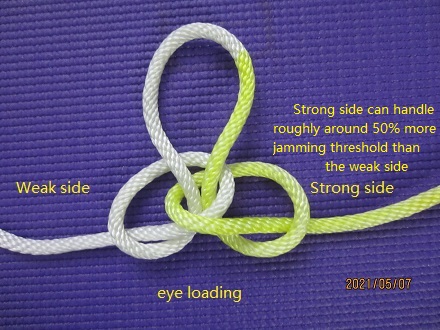
This embedded URLink doesn’t work, for me:
“#1053 Butterfly weak side” <<<<

The Wright-&-Magowan recommended dressing
would give your pictured knot a twist of the eye
so that the white leg crossed OVER the yellow,
which might change behavior.
(My way to remember this orientation is that the
“pretzel” formed OH doesn’t have its “spine” broken,
only the other half’s OH.)
–dl*
But that misses the point of doing the ONE side (only)
–to have complementary rotation of the SParts, not
one going one & the other the other way 'round!
.:. To be more like #1408/-52/Thrun’s knot (zep.).
