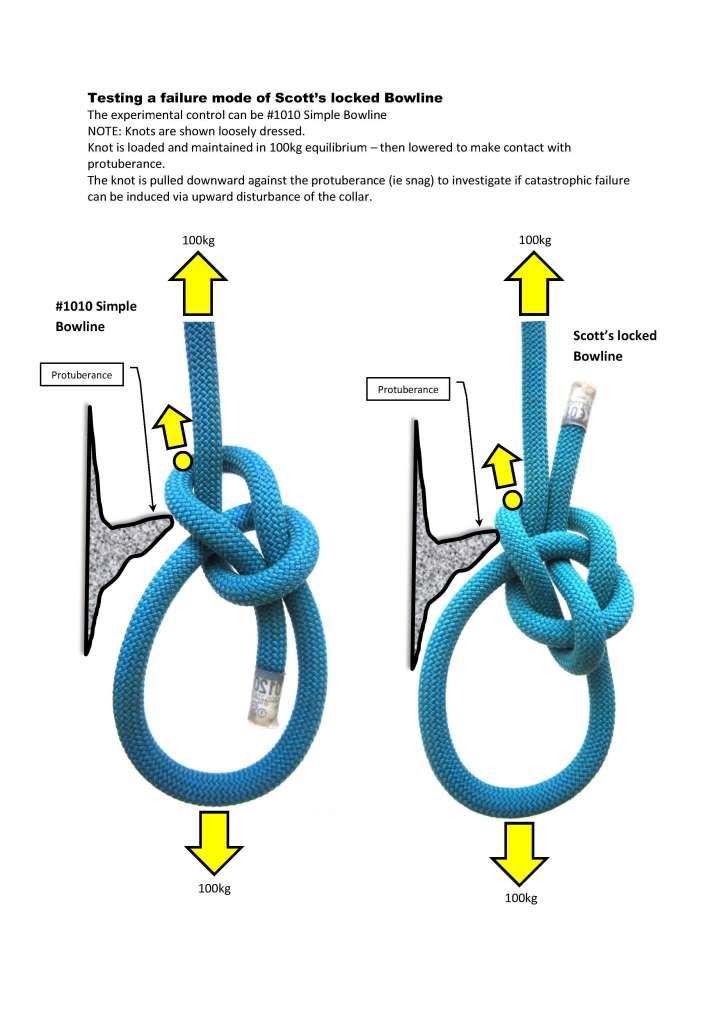
I started this new topic in response to a post by KnotLikely.
Reference link: https://igkt.net/sm/index.php?topic=6689.msg44495#msg44495
Alleged failure mode:
Scott's Lock just scared the crap out of me. I was playing around with [b]snags [/b]on the wall and I caught the collar (try sticking your thumb through the returning leg side). My knot was suddenly 3 feet away from me and out of reach, with a hoop of eye legs big enough to crawl through. If my (imaginary, thanks covid) belayer had slack in the line, this would take it all in to expand the tie-in loop. This seems to be an issue with all single nipping loop bowlines that I have tested.
and this:
I [b]snagged the collar[/b] and fell. The knot did not fall apart, but the standing end pulled through like it was made of ice. The knot was slightly looser than when initially set.
and this:
The extra friction introduced by the lock is not much in even slightly slicker rope. Even in ideal conditions, [b]I was unable to recreate this issue[/b] with my red (fuzzy) rope. But it certainly Did happen.
and…
I'm surprised that this comes as a surprise to you. ... The extra friction introduced by the lock is not much in even slightly slicker rope. Even in ideal conditions, [b]I was unable to recreate this issue[/b] with my red (fuzzy) rope. But it certainly Did happen.
In reply to refute to this alleged failure mode.
- Scotts locked Bowline is an inherently secure Bowline.
- It is intended to be tied in EN892 climbing rope
- As with all tie-in knots to a harness, it must be tied diligently and accurately - in a tight and compact dressing state.
- The size of the ‘eye’ of the Bowline must be small - not larger than 100mm diameter.
The alleged failure mode is entirely dependent on “snagging the collar”.
KnotLikely asserts that he was able to “snag the collar” - which sets in motion a cascading series of events.
My contention is the ‘test’ conducted by KnotLikely is flawed.
In order to “snag the collar” - a very specific set of circumstances must be achieved.
As a thought experiment - even if such a test was carefully designed and could successfully “snag the collar” - this by itself does not mean catastrophic core failure leading to ejection from the climbing harness.
Any test which could ‘successfully’ snag the collar would be counter-balanced by the body weight of the climber. There would be a force pulling upwards which is counter-balanced by the weight of the climber pulling downwards.
Such a test would require pinpoint accuracy - to target the single rope diameter of the collar and lift it upwards from the core.
There needs to be a downwards trajectory - ie the climber would need to be free-falling (ie an uncontrolled fall) or be lowered (which is conducted slowly and deliberately).
I am of the view that this alleged failure mode is being overstated - and is conditional on the following:
- Pinpoint accuracy to target the collar
- Relaxation of the counter-balancing force of the climbers body weight (which acts in a downward direction).
- A loose initial dressing state - so as to improve the odds of successfully snagging the collar during a fall or while being lowered.
- The climbers body would have to come into very close proximity to the cliff (ie rock face) - implying a slab rather than a vertical or overhanging section of rock. If a slab, this suggests the climbers waist is scraping down the slab - feet pulled back.
I do not believe that a test could be designed in which others could reproduce the same failure mode.
I’m therefore calling this a false positive.
EDIT NOTE: Image added