Scotts locked Bowline (failure mode)

per Dan Lehman:

1) A_S, your red-bolded line is not true, and an empirical examination of in-use-by-climbers knots will show this.
? Your comment is only true for cases of incompetence. That is, a climber who does not diligently dress and cinch his/her tie-in knot is either: 1. Reckless 2. Incompetent

The issue of recklessness or incompetence should not be the basis of an experiment to induce a failure mode on Scotts locked Bowline.
This would add too many variables.
In all knot testing, it is nominal to tie the specimen knot diligently and accurately - otherwise the results may not be valid (unless you are specifically testing for some other stated variable).
In the specific case of Scotts locked Bowline (for climbing) - the tester must ensure that the knot is accurately dressed and cinched tight.
The reason for this is that the aim of the test is to snag and disrupt the collar - to induce a failure mode.
Obviously, if the tester deliberately tied the knot in a loose dressing state - that would skew the results - because obviously, the tester has created conditions that favor a successful snag.

There is a growing movement amongst climbers to undertake a ‘partner check’.
The idea behind this check is to detect errors and correct them before commencing the activity.
Checking the tie-in knot is a mission critical action.
A wrongly tied knot could have catastrophic consequences.

Dan - are you suggesting that a test regime to induce the purported failure mode requires the specimen knot to be tied loosely?
Or are you suggesting that the loosely tied knot would serve as the experimental control?
If you do suggest a control that uses a loosely tied knot - that would be valid as it would provide a comparison against the knot that was properly dressed and cinched up tight.

And yes the discussion has been about a non-tight rope into the subject knot.
From who's point of view? I'll repeat that a loosely tied knot isn't valid to base an argument from. Any loosely tied knot can snag on a protuberance - thats like stating that a shoe lace is not valid because if its tied loose, it will fail. Obviously a shoe lace will fail to hold if its tied too loose to begin with. Another example of invalid testing: I declare Tesla electric cars to be unsafe because they cant stop quickly enough on greased road surfaces. That is, I'll apply grease to the road surface and then test the Tesla vehicle to see if it can stop quickly from 100kph (60 mph). If it cant stop within a certain distance, I'll declare that vehicle to be unsafe.

I also understand that if I tie any eye knot into my climbing harness too loosely - it will likely fail and I could die.
Thats stating the obvious.

Dan - the real issue here is that the OP made an announcement on an open public forum about a failure mode of Scotts locked Bowline in climbing applications.
Why make such an announcement to the world if the knot was in a loose initial dressing state?
What does that prove?
And more to the point, why continue to defend such a failure mode as the OP has done?
Do you see my point? The OP is now determined to tender argument to support his claim that there is a serious failure mode with Scotts locked Bowline.
If this were simply a case of “Heh, lets loosen Scotts locked Bowline and then see if we can induce structural failure” - I think the OP would have stopped trying to defend his proposition.
But he isn’t. He is intent on pointing out the failure mode.

Extraordinary claims require extraordinary evidence.

Because Scotts locked Bowline is used in life critical applications - the burden of proof lies with the tester to create valid test conditions to prove the failure mode.
It might be valid to use a loosely tied Scotts locked Bowline as the experimental control.
But, you must also test properly dressed and cinched Scotts locked Bowlines to compare against - otherwise your test results are invalid.

It would be invalid to publish test results based only on the control group (ie loosely tied knots) - and declare all Scotts locked Bowlines as potentially insecure.

AND THIS IS HOW DISINFORMATION STARTS AND THEN PROPAGATES:

Scott - please take an urgent look at this post in Saferclimbing.org website:
http://www.saferclimbing.org/en/comment/2402#comment-2402
Link was submitted by ND (not verified) on Tue, 2020-05-05 19:29 (one wonders who this ‘ND’ is!).

We will need to move quickly and shut this one down.
The guy that runs that website has a personal issue against the use of ‘Bowlines’ in life critical applications (eg rock climbing).

He has seized upon this opportunity to propagate an alleged failure mode of Scotts locked Bowline - knowing that his website has a substantial readership.
Once these things get loose into the wild - they are hard to stop.

The underlying parameters created for the alleged failure mode are (at best) - a possible control group to compare against.
That is, you could devise an experiment where the control group is a deliberately loosened collar and a deliberately induced snag on a protuberance.
BUT, you also need to compare the results of that control group to where a Scotts locked Bowline has been properly dressed and cinched tight.

Partner checks are gaining momentum in the climbing community - because checking your tie-in knot is a mission critical action (ie your life depends on it).
Only a reckless or incompetent person would commence climbing with a tie-in knot that is loose.

Recklessness and/or incompetence are variables that exist across the entire spectrum of human existence.
In a properly devised experiment, the tester needs to carefully establish what the variables are.

After some motion and bumps on the side, even an initially tight knot can gain some daylight. The sharper the protrusion, the less it takes.

In the separate case of tail snagging, all it takes is an acute angle opening to wedge the tail even if the knot stayed relatively tight. But there are other ways to get a tail caught.

I would like to see the protrusion that caused NotLikely’s incident (which I do believe occurred). A path with branches would have been an easier way to get a snag.

Hello Mark.

I?ve read the article and feel it would be a waste of life to argue any points further than the ones that you offered. I believe that a mind is made up and there?ll be no changing it. How often have you heard or read, ? I was wrong.?

I?ll stick to using the bowline that I offered for any and all purposes. It works for me, and probably for others as well. I don?t need to sing its praises.
Btw, I diligently check my equipment, rope and knots (they are SS369?d tightly) all the while throughout my use, as well as my partner(s). It is life critical and only fools do reckless things.

Any knot can fail given the right circumstances. I bet I could contrive a failure scenario for the Gordion knot. ;0

SS

Hi Scott,

I provided an incorrect link (apologies).
The link to the saferclimbing.org website is here:
http://www.saferclimbing.org/en/comment/2402#comment-2402
Link was submitted by ND on Tue, 2020-05-05 19:29 (one wonders who this ‘ND’ is!).

I understand your position on this matter… all good.

However, please consider deleting this entire thread that I created - that will shut down propagation of disinformation and misinformation into the internet.
By deleting this thread - it will make the link on Saferclimbing.org dead and buried.

EUREKA!

It was bothering me that NotLikely’s collar did not expand during his snag. I think the collar never snagged. I think it was the inner crotch of the loop near the intersection of the initial bowline coil. Once I snagged there, it was much easier to reproduce the reported incident.

update:

https://youtu.be/FdjatFCItHE

So you tied into your harness with it, climbed some, fell and snagged the knot and duplicated the failure ?

I think you are misleading the readers here. If the knot was dressed as it should be, easy enough, there will be nothing or nowhere for a “protuberance” to find entry. One would have to manufacture the conditions perfectly (every time) to even get close to this happening, or aim just right.
All the people that are using it have had no problem with it. It certainly hasn’t caused them to be pushed away from a face nor has it come undone during ascent or descent.

I think your Eureka moment is a poof. :smiley: :frowning: ::slight_smile:

SS

You don’t understand; the protrusion never enters the knot. It’s under the knot. I’ll attach a photo marked with a red X.

per roo:

You don't understand; the protrusion never enters the knot. It's under the knot. I'll attach a photo marked with a red X.

I think Scott understands perfectly well.

I think your so called Eureka moment is gone in a “poof” of smoke :slight_smile:

roo - what you have described induces circumferential loading profile - aka ‘ring loading’… because you are snagging the eye (not the collar).

Scotts locked Bowline is resistant to circumferential loading.

When this knot is correctly dressed and cinched tight in EN892 rope - with an eye not larger than 100mm - the likelihood of snagging the eye is remote (infinitely small).
As stated, even IF you managed to snag the eye - nothing happens because Scotts locked Bowline is resistant to ring loading.

I presume that you will reply and counter by stating that Scotts locked Bowline is vulnerable to circumferential loading?
If yes - and you are determined to announce Scotts locked Bowline’s vulnerability to circumferential loading - you would need to provide evidence of the dressing state for your test.
I would assume that the dressing state for your ‘Eureka test’ was loose and with an eye larger than 100mm?

This is a little different than simple ring loading. There are more forces involved with the protrusion pushing under the knot and the legs at a much different angle. I would invite you to step away from the keyboard for a few hours and do some testing. You may owe an apology to NotLikely.

Your are correct, I don’t understand and you have not explained anything very well.
Just how have you loaded it and performed the failure. Are you tied in? Is the eye/loop loaded? Any tension on the standing part? Are you loading the tail instead? How do you push under the knot?
Is this in any way a real world scenario??
The Eureka X signifies nada at this point.

I assumed it was clear, but I’m happy to explain any details in relation to the photo. The harness pulls at the bottom of the loop. The protrusion (at X) provides the reaction upward against the knot and the standing part starts sliding. The knot body is allowed to sit on the shelf as the standing part slides, so it’s not really comparable to simple free air ring loading.

I’m kicking myself that I didn’t see it earlier. I’m always snagging loops inside the crotch of the two legs.

per roo

I would invite you to step away from the keyboard for a few hours and do some testing. [b]You may owe an apology to NotLikely.[/b]
? [b]What a strange and odd comment.[/b] It is even more odd when you consider that I have already tested this type of loading profile - which is essentially circumferential in scope. I am curious if you were in close proximity to your keyboard while contemplating your underlying motive for these strange and odd comments?

In the first instance, KnotLikely pointed toward snagging the collar. One presumes that you are now ignoring his original proposition and morphing his purported failure mode into something of an entirely different character.

While you are contemplating notional concepts of apology, - I guess this means you owe me an apology?
Also with such apologies, it implies some form of misbehavior or misdeed that one person did to another - to which an apology is owed?
This in turn leaves me wondering where the act of the misdeed lies?

While you are entertaining matters of ‘apology’ - I am curious if your Eureka test had the following parameters:

  1. That you used EN892 rope?
  2. That you correctly dressed and cinched Scotts locked Bowline tightly?
  3. That you created an eye not larger than 100mm?
  4. That you lowered yourself in a climbing harness and intercepted a protuberance on a rock surface?
  5. That the interception of the protuberance occurred within the eye at a point on the outgoing eye leg proximal to the knot core?
  6. That you managed to cause structural disruption to the knot core - leading to a situation where the eye of the knot significantly expanded ?

Extraordinary claims require extraordinary evidence. :slight_smile:

EDIT NOTE: I’ll post some photos of Scotts locked Bowline under various loading profiles…

I call misinformation.

I just tried multiple attempts to induce a failure or duplicate your claim.

BlueWater II rope, 1/2 inch diameter. Tied, weighted, inserted various “protuberances” of varied diameters. Pulled steady with all my strength, Approx. 300#'s, jerked, jumped, twisted and repeated this 10 separate times. Even untied and retied for a few of these “tests”.
Not only did I not experience a failure, the knot tightened further than the original setting of it.
Easily untied though.
In my opinion, there is nothing you can say or prove, to me, that will convince me that your claim is factual, nor will anything you add dissuade me from its use. And I will continue to teach it to anyone who cares to learn it.

If you find that you do not agree, then fine, don’t use it for anything.

Stay away from snagging your crotch and don’t kick too hard… :wink:

I’m sorry there is nothing I can “say or prove”. Maybe I’ll have to break down and get a YouTube channel to upload video of the event. It took only about 50 or 60 pounds at the bottom of the loop with a suspended 1.25" wooden dowel under the knot in the “x” location in the attached photo just now to make it slide in BlueWater II rope.

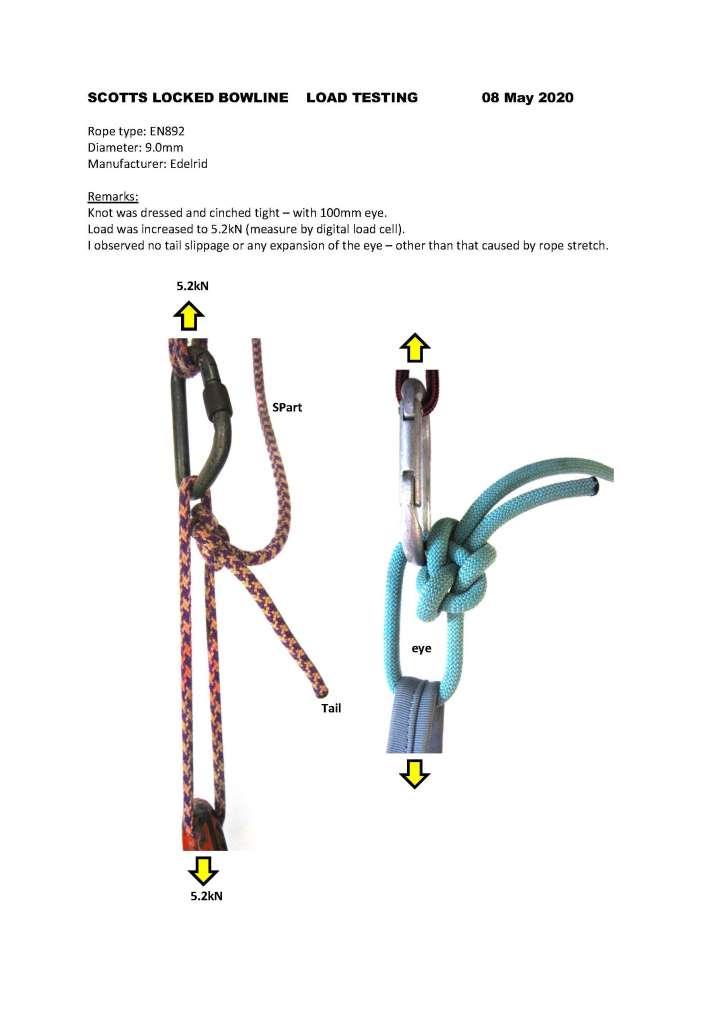
TEST REPORT
Note: This test configuration is not designed to snag the collar.
It is something of a completely different character…as per roos’ ‘Eureka moment’.

Image is attached of load test configuration using EN892 rope.
As I had already known through previous testing and real-world experience, there is no such failure mode.

I reached a force of 5.2kN - which is over 500kg (metric).
Note also that the knot is carefully dressed and cinched up tight - as would occur in real world climbing conditions.
The eye was set at 100mm.

The fact that I can’t repeat other peoples alleged experimental test results indicates something is fundamentally wrong with their reported failure mode.
It must be due to non EN892 rope or, the knot isn’t properly cinched tight (ie the tester deliberately ties the knot in a loose dressing state).

EN892 rope is correct for climbing applications.
However, EN1891 rope can also be used for anchoring situations (eg around a sturdy tree).
I had previously tested this knot using EN1891 - and can confirm there is no alleged failure mode in this rope either.

EDIT NOTE: It appears that roo has ignored the #1034 1/2 variant when making his Eureka moment declaration.
There are in fact 4 different variants of Scotts locked Bowline…and I am also unclear if ‘KnotLikely’ has also overlooked this fact?


Bowline_Scotts-lock_Test-config.jpg

Pictures or it didn’t happen. Proof is on you.

https://youtu.be/FdjatFCItHE

I noticed that once slipping starts, it is really easy to keep sawing away even if you pause and resume. The protrusion must be affecting the knot body in some way.

P.S. Thank you, moderators, for not censoring/deleting the incident report per agent_smith’s request.
https://en.wikipedia.org/wiki/Streisand_effect

Btw, did you try the snagged-collar situation,
which I believe IS what KnotLikely cited (I don’t
see him denying it, and is more likely to leave
the knot nub up high as SPart flows through
it, than your ring-loading case which could bring
the knot down from the upper apex) ?!

Ring-loading, btw, is something that in my somewhat
casual playing around with doesn’t always produce
the feared slippage in the common/#1010 BWL that
it CAN do --a YMMV case. So, different results shown
here (Roo’s vs. A_S’s) although contradictory still can
be the “YMMV”'d cases proving that “may vary” point.
(And can tickle the how-to-properly-SET-a-knot issue.)

And, I will reiterate to Scott, that we see not the SLock
failing to keep intact, but … slippage of the SPart through
the knot, which should be findable in other BWLs.

–dl*

Yes, I tried it in many different forms, but it was much more difficult, required special shapes that didn’t seem to match his blockish-corner description, and would stretch the collar. It was that last factor that made me try something else, and on the first or second try of that something else, I noticed the slide that did not affect the collar.

I think a blockish shape could make it easier to keep the knot body on the shelf, but even in my tests, as you’ll notice in the video, sometimes sliding really takes off after the knot wobbles off the shelf.

P.S. I think KnotLikely is gone for good from this forum. He did not like the treatment he got from agent_smith.