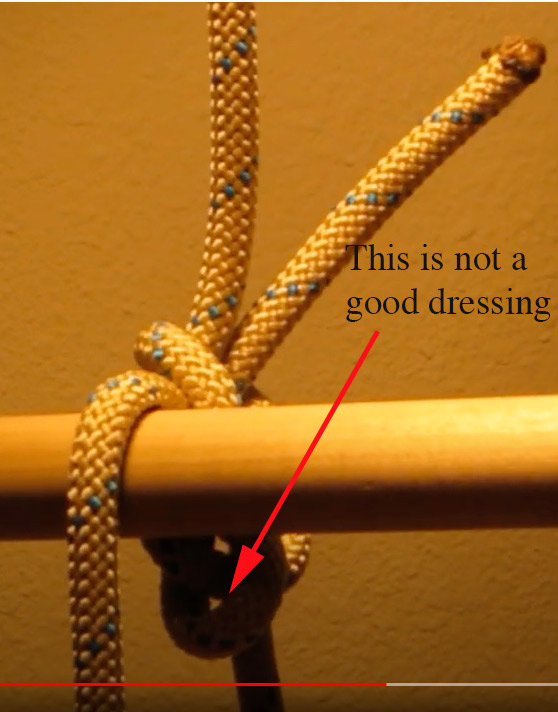
per roo:
P.S. Thank you, moderators, for not censoring/deleting the incident report per agent_smith's request.?
Thank you roo for posting a test video that bares no resemblance to a real-world climbing situation.
Testers have a duty to properly declare the application of their test to the context in which it applies.
Casual readers of your post will likely be misled into believing that Scotts locked Bowline is not fit for purpose in climbing applications.
I note that you didn’t use EN892 dynamic rope in your test - this makes the test invalid.
I note that the knot wasn’t properly cinched up tight - as it would be in real climbing activities.
I note that the eye of the knot was incredibly large (ie oversize). This is also incorrect.
I note that a climber would have to stop climbing, ask a gremlin to grasp the tip of the eye of the tie-in knot who would then pull down.
The climber would have to remain stationary and wait while the gremlin imitates some see-saw hack to eye legs of the knot - and then pulls the outgoing eye leg down.
I note that there cant be any load on the Standing Part (SPart) - this cant be replicated on a real cliff in a real climbing situation.
…
As the tester, you should type a conclusion as follows:
Conclusion:
The conditions to induce slippage of the SPart through the core of knot require an initial set of parameters that don’t exist in real climbing conditions.
There must be zero load on the SPart and something has to initiate a downward pull on the outgoing eye leg. Furthermore, the eye of the knot must be tied oversize (normally it would be approximately 100mm). The test video did not employ EN892 rope and the knot was loosely dressed - both of these parameters depict conditions that don’t exist in real climbing.
The effect produced in this video cannot occur in real climbing conditions - it is for academic purposes only.