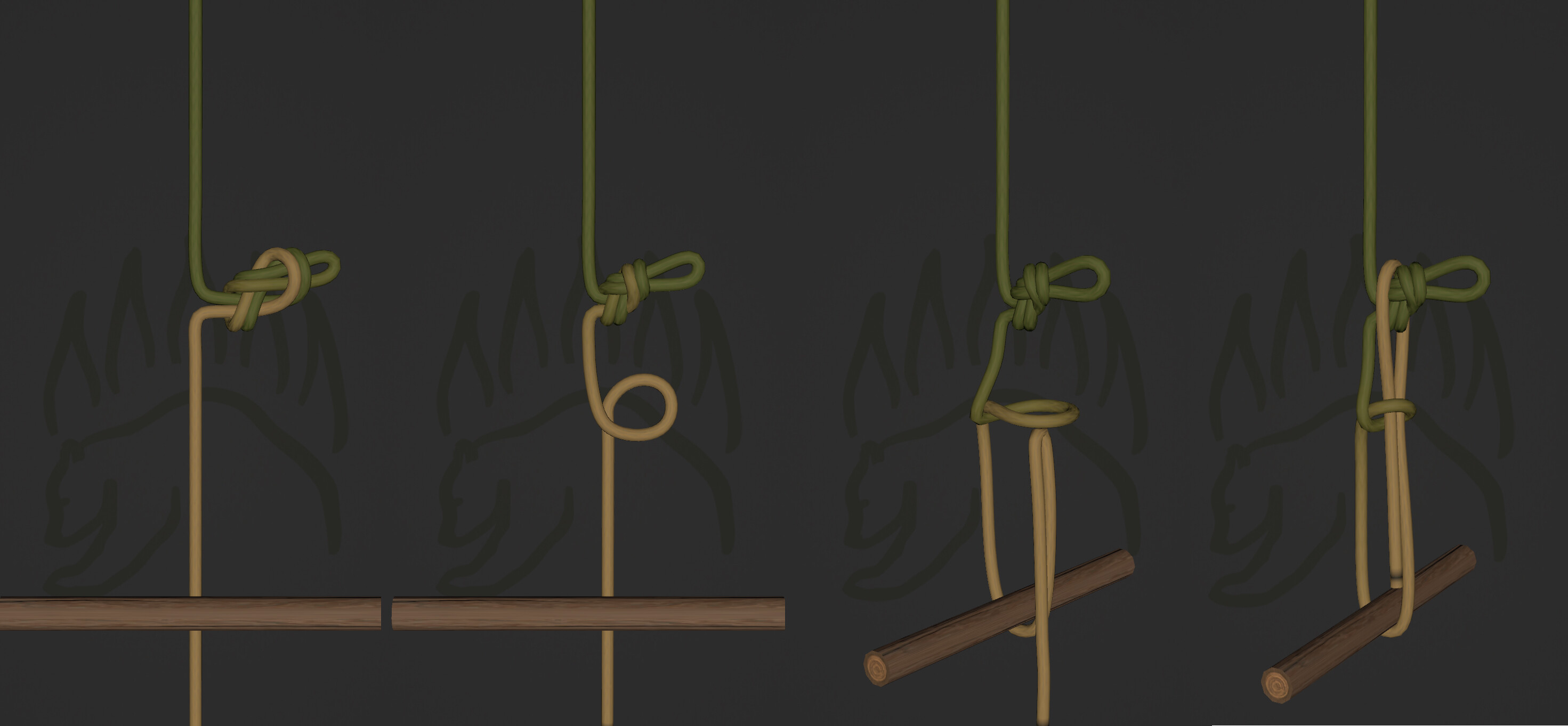
This is used as a Kamikaze hitch for a remote release that one can shake to retrieve their rope after either lowering an object or, in an emergency, themselves - (without having to have a tag end to pull on to release it).
This is, of course, if they don’t have enough rope to simply have a tag end come back to them, or loop the rope around the object and hold the other end. Imagine one span of rope that is near the exact distance you need lowered.
I compared a few known Kamikaze Knots, including variations of the Bellringer, Sheepshank (Kamikaze Knot), and others. I used a combination of them to produce what I believe is the most secure way to achieve its goal (highest resistance to accidental undoing). The downside is it is harder to release as well, but I believe this is a necessary tradeoff.
I have done some pretty extensive searching and haven’t seen a combination like this used previously in this application. But wanted to get the expert opinion on this forum. Cheers.
One of the few channels with some serious knotting content, among other interesting themes of course, it’s actually not the first time i come into contact with your work.
With absolutely no intention of modifying your remote release system, i just wanted to ask if there is any particular reason you are using an F8 for hooking on your bight.
I mean that the F8 knot, is not suggested for a through loading situation, because it gradually distorts depending on the load, and as far as i can see your line is loaded from SP to SP, with the F8 eye, not engaging in the loading procedure at all, but just functioning as a bitt for simply hooking on your final bight.
Therefore, would it be more legitimate, to use an inline knot as opposed to F8, such as 1053 butterfly knot?(stable and easily releasable when not eye loaded)?
I would put forward 1050 harness, the simplest inline knot , to reduce complexity to the minimum level, but unfortunately, it is not appropriate for through loading applications like yours.
After seeing it in a new light, i guess you are not so interested in loading directions of your fixed eyeknot (F8) in your system, but rather generating a large nub footprint in vertical fashion, to hook on your bight and avoid slippage as much as possible. Well, it appears that the F8 has served this purpose.
The main reason I use the Figure-8 (F8) here is because it naturally forms an acute angle toward the user, creating a slightly deeper “hook” for the final bight to rest on. That geometry seems to add a touch of security during movement or shaking, especially since the F8’s bulk and stiffness resist rotation under tension.
But I realize through loading isn’t the best practice for this one, and likely decreases the rope strength quite a bit. My testing on this was using body weight, shock loading it and various climbing rope.
While there wasn’t any sign of collapsing, I know the figure eight used this way isn’t generally recommended, maybe if using thinner ropes or if lower strength ones, this may be a bigger concern.
That hook can 100% swap out for simpler knots meant for through loading, the 1053 Alpine Butterfly would work, but it doesn’t have that bulky acute angle formed. It would fundamentally be a better choice for the in line through loading, but doesn’t have the beefy “Hook” and it’s closer to a true mid line so it wouldn’t have the angle either.
1057 Single Bowline on a Bight (or even 1058) might be a good sub in as well.
They both seem to hold the acute angle and are better for through loading.
Let me know what you think? Im 100% open to modifying this if there is a better or easier way which uses the same mechanics and is improved upon!
Using these mechanisms for human support can lead to severe injury or death. Be very clear on that point.
Generally, the difficulty here is that rope type and condition can have a huge impact on functionality, and so typically there has to be an element of tunability.
I have used an uncompleted bowline in the past with differing amounts and types of spiraling of the free end around standing part. But the occasion for use almost never comes up for me.
Depending on the object, a Munter Hitch or even a simple rope helix may allow the object to descend while expending some energy before impact.
Ya its VERY niche application to use one of these.
I couldn’t agree more with the warning / disclosure if using this on yourself for rappelling, which is not the primary intended use case unless absolute emergency.
My focus is sometimes skewed toward on camping/bushcraft/survival so this Hitch is a function of the survival/emergency idea.
The main use case I come across is lowering a big hiking pack down a ledge which I’d climb down afterward (unable to do it with a pack on my back) - and the rope cant be double back up to me.
Great idea on the munter as well.
Any suggestion for improving the mid-line knot on this one ?
Hey DJ. Nice work. Those animations are sick. Is that something you can teach me to do??
As for the knot I like it. The Figure 8 keeps the bellringer loop from collapsing accidentally, awesome.
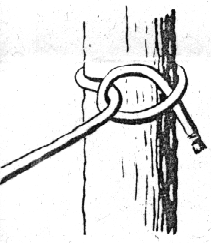
There is another approach that I forgot to mention. You can carefully arrange the nipped (clamped) end of a half hitch toward the far side of the object to hold until some slack shaking disrupts the arrangement:
I use this Alternative to the bellringer for lowering loads. Works great for buckets and gear. It will spill with cyclic loading though ( by design ) so not as “ bounce proof” as the Bears Grip. It could also be used as the first half of the bears Grip for a even stronger grip .. for certain situations, mabey a more “valuable” load .. then again you should not use anything either of these knots for anything truly valuable so it may defeat the purpose.