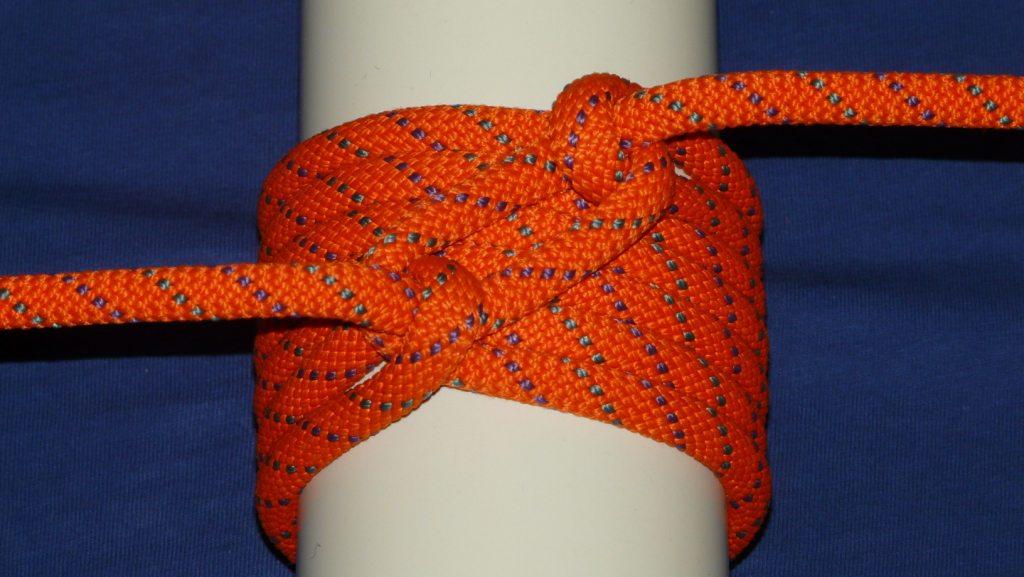
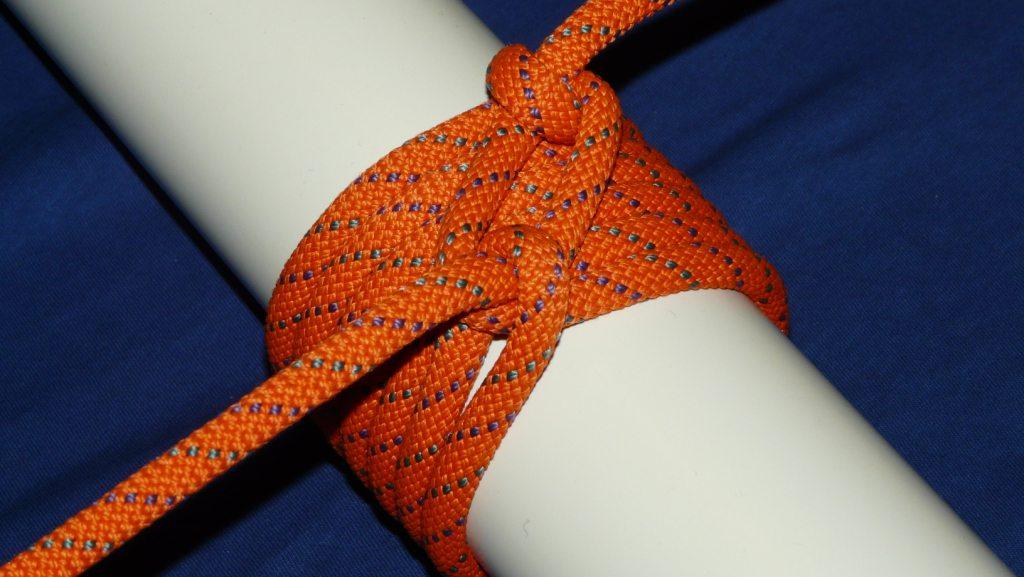
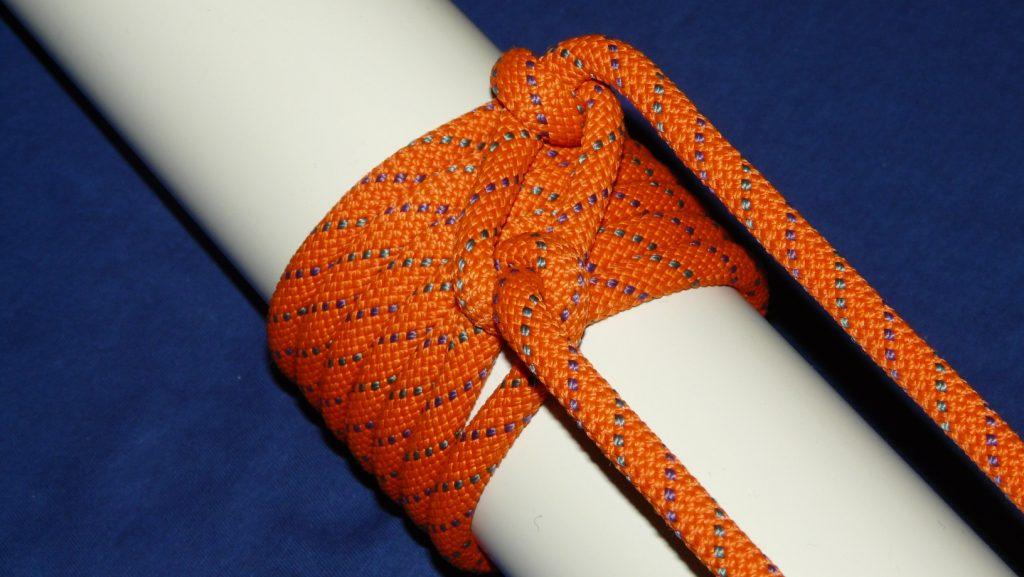
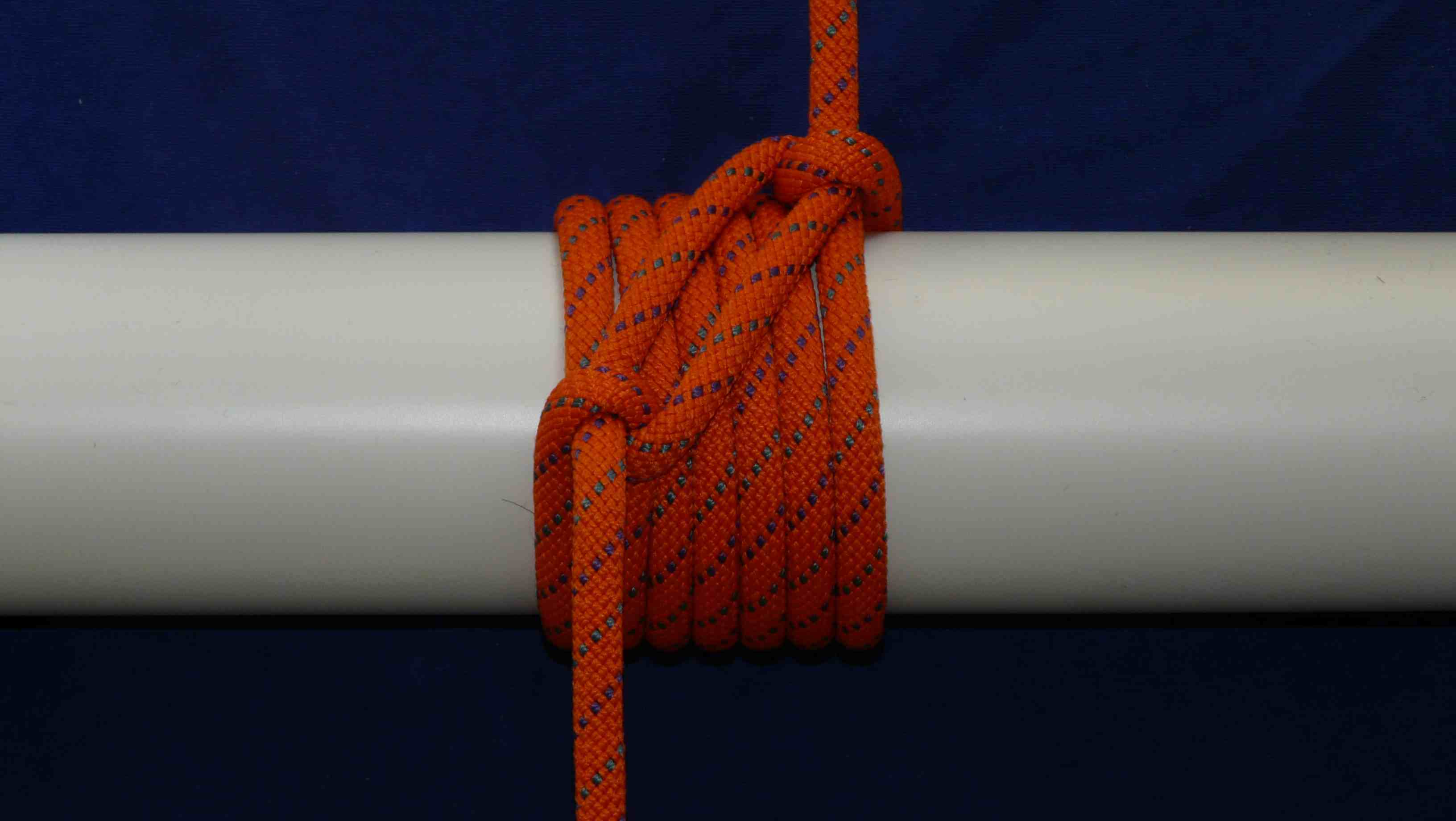
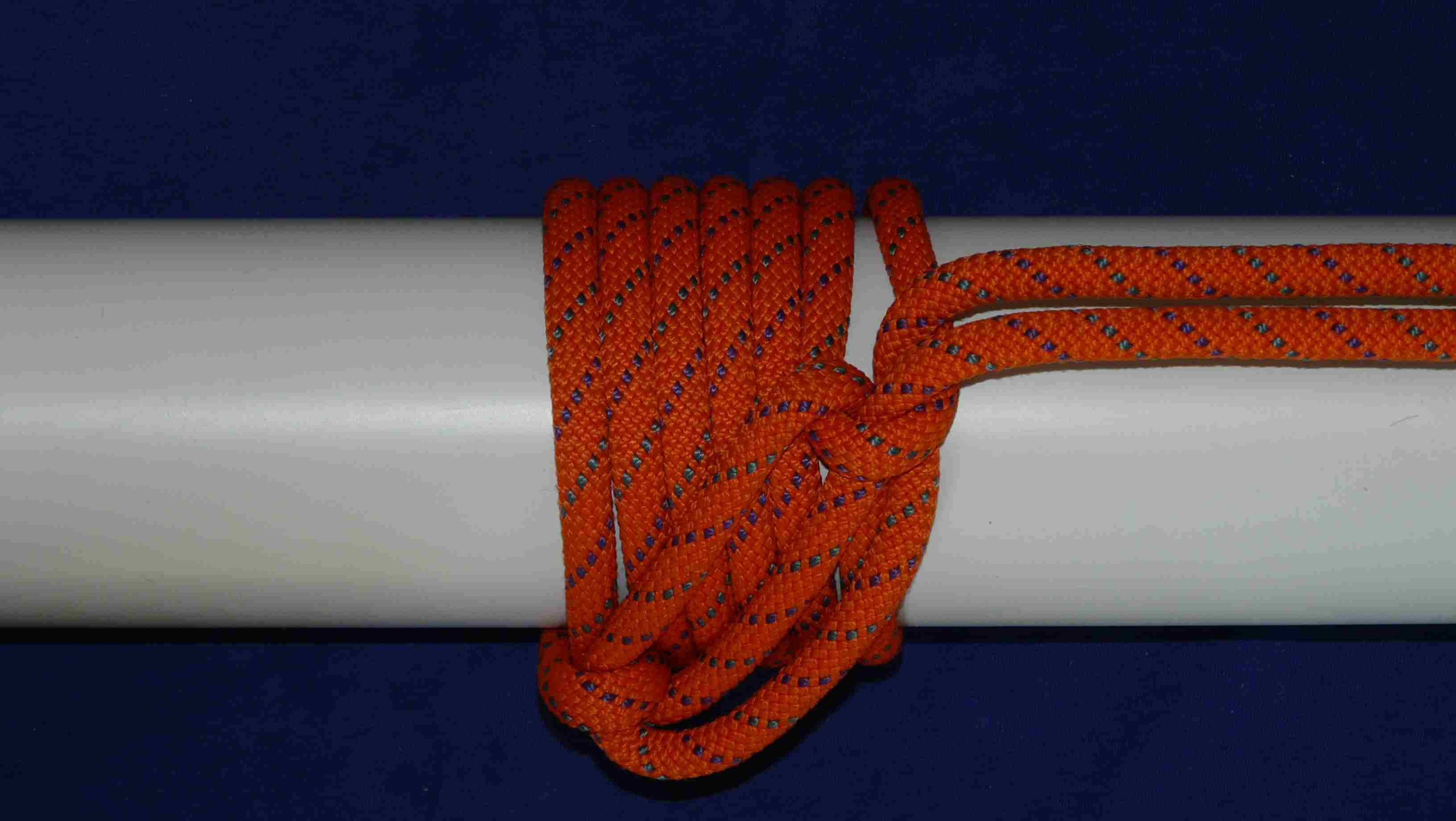
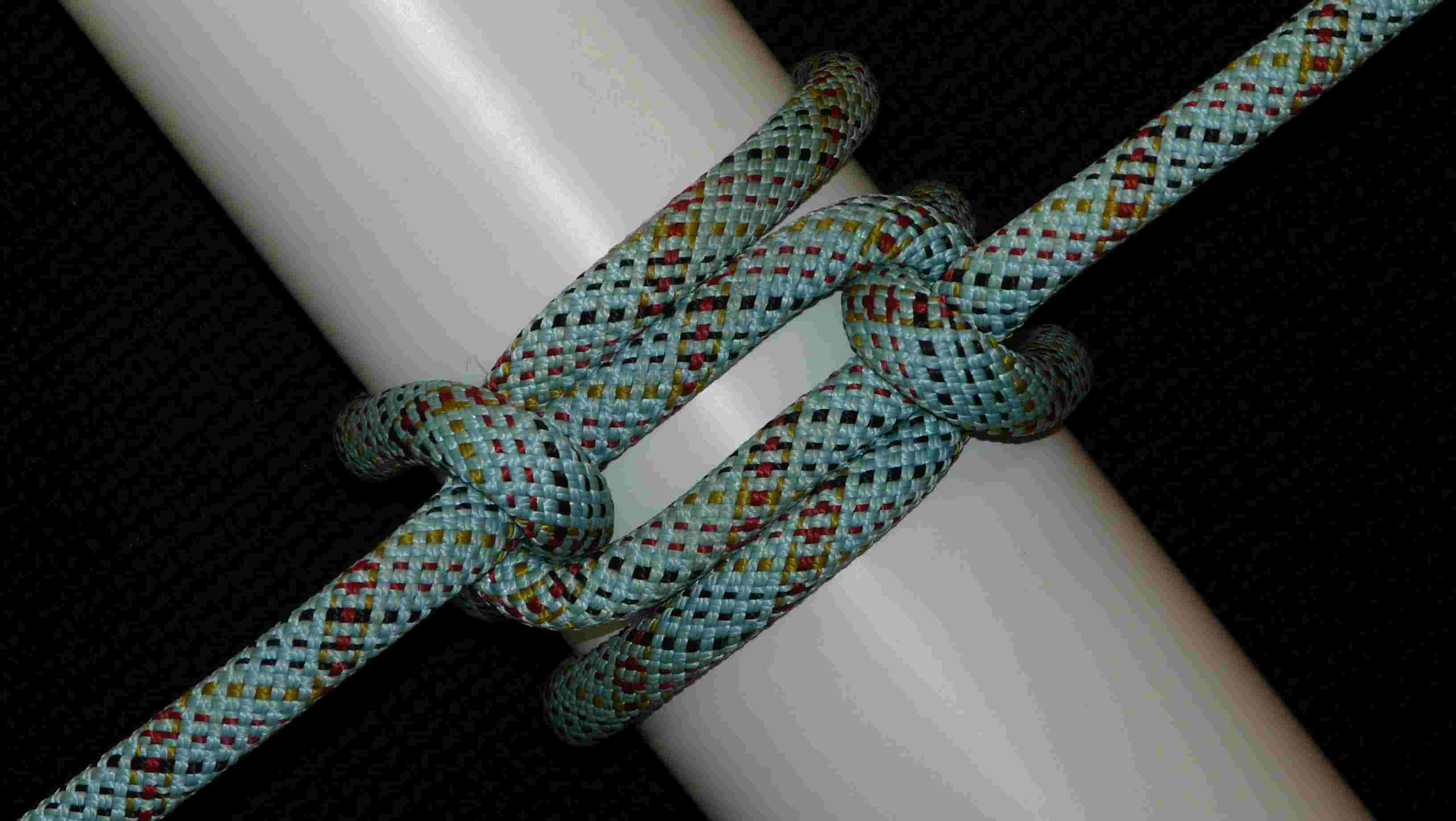
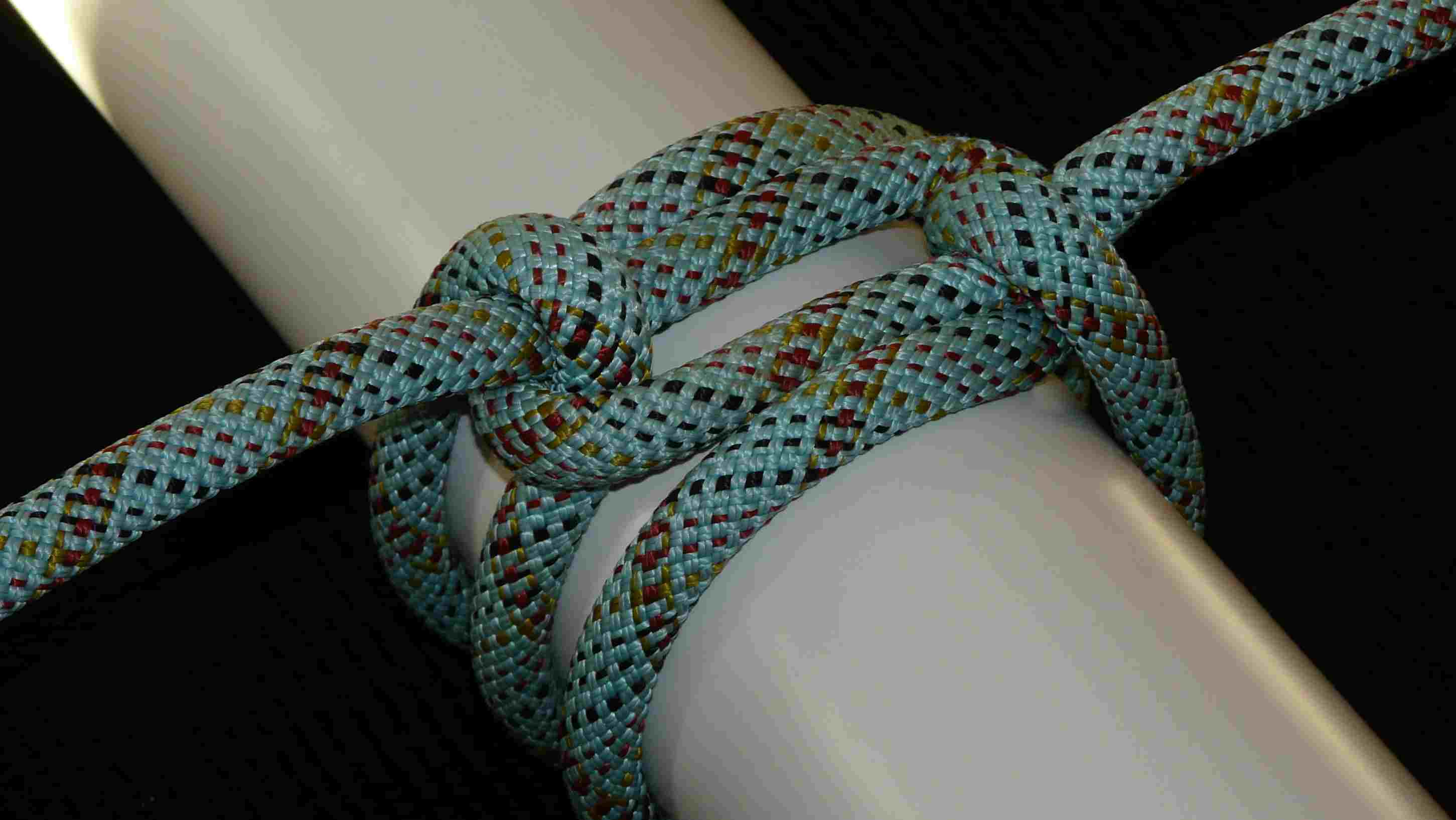
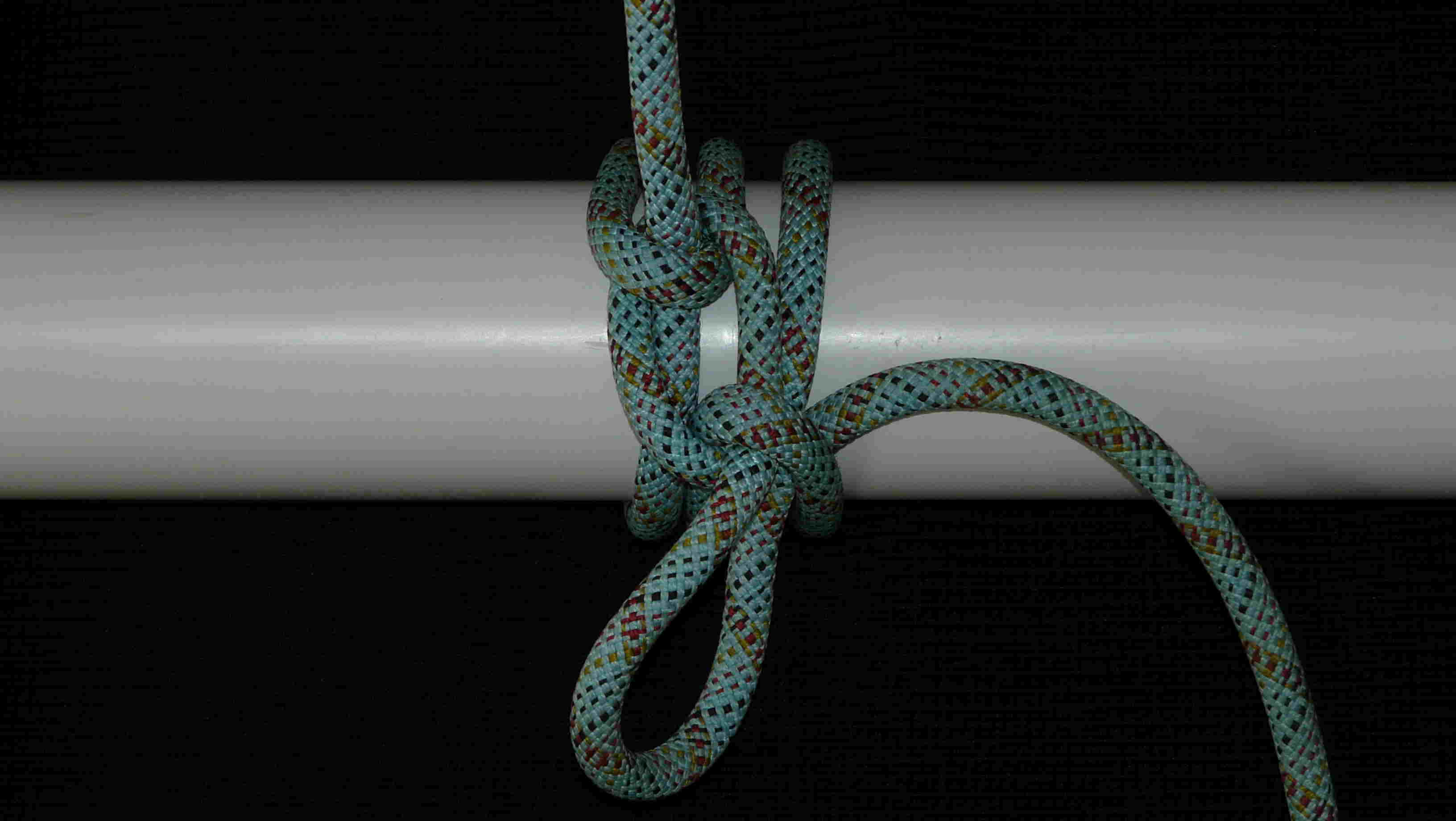
There are two ways we can enhance the effectiveness of a multi-wrap friction hitch, tied around a spar/pole, and used to withstand a lengthwise pull
Increase the number of wraps.
Increase the force with which those wraps nip the spar/pole.
Now, there are two ways we can achieve the 2.
A. Wrap the “under” wraps with other, “over” wraps - i.e. wraps that lie on an outer shell, on a second layer around the central core of the spar/pole.
B1. Increase the tensile force with which the ends of the wraps are being pulled , and,
B2. keep them under constant tension, so they nip the spare/pole at their core more forcefully.
B1. To pull the two ends of a rope segment more forcefully/effectively, we may use the “mechanical advantage” offered by a block-and-tackle rope mechanism. In fact, we do not even need the blocks/pulleys, because we can use bights formed on the ends of this segment (i.e, a bight-and-tackle rope mechanism).
B2. To secure the two ends of a rope segment that we want to keep under constant tension, we may drive them in between two interlinked opposed bights that are also kept under constant tension. The friction forces generated in the area in between the two tips of those bights from where ends pass through, are sufficient to not let them slip through.
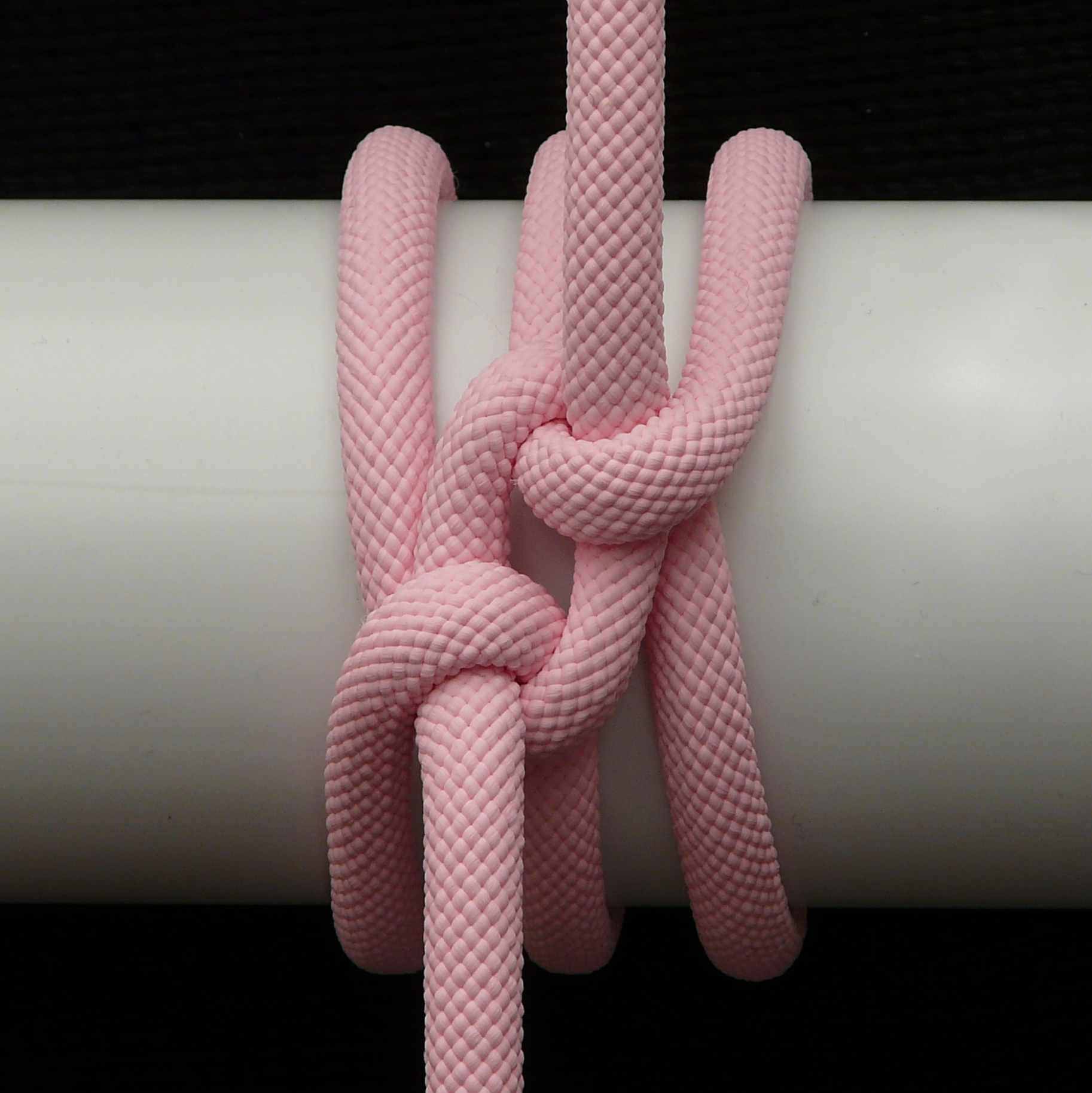
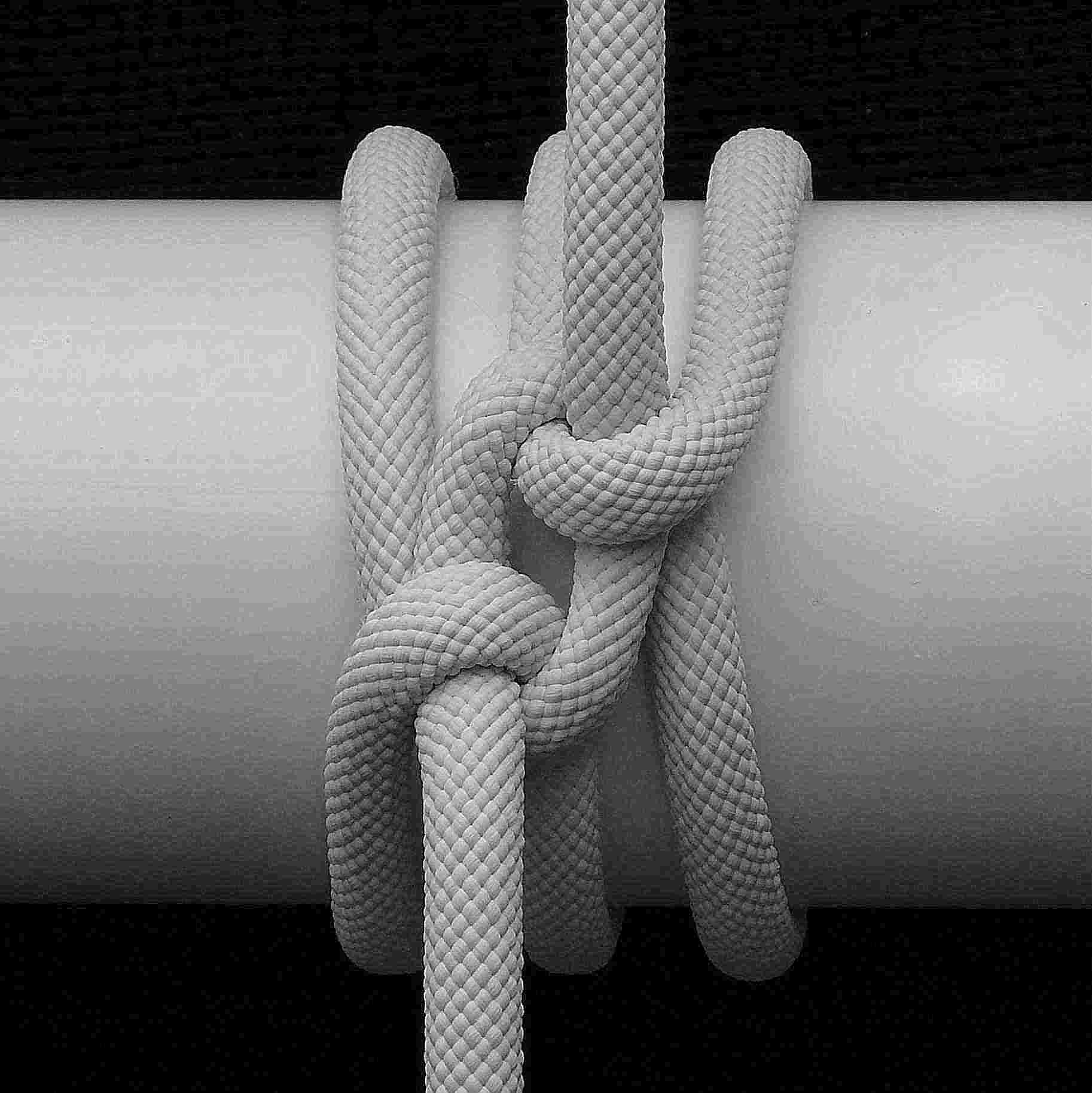
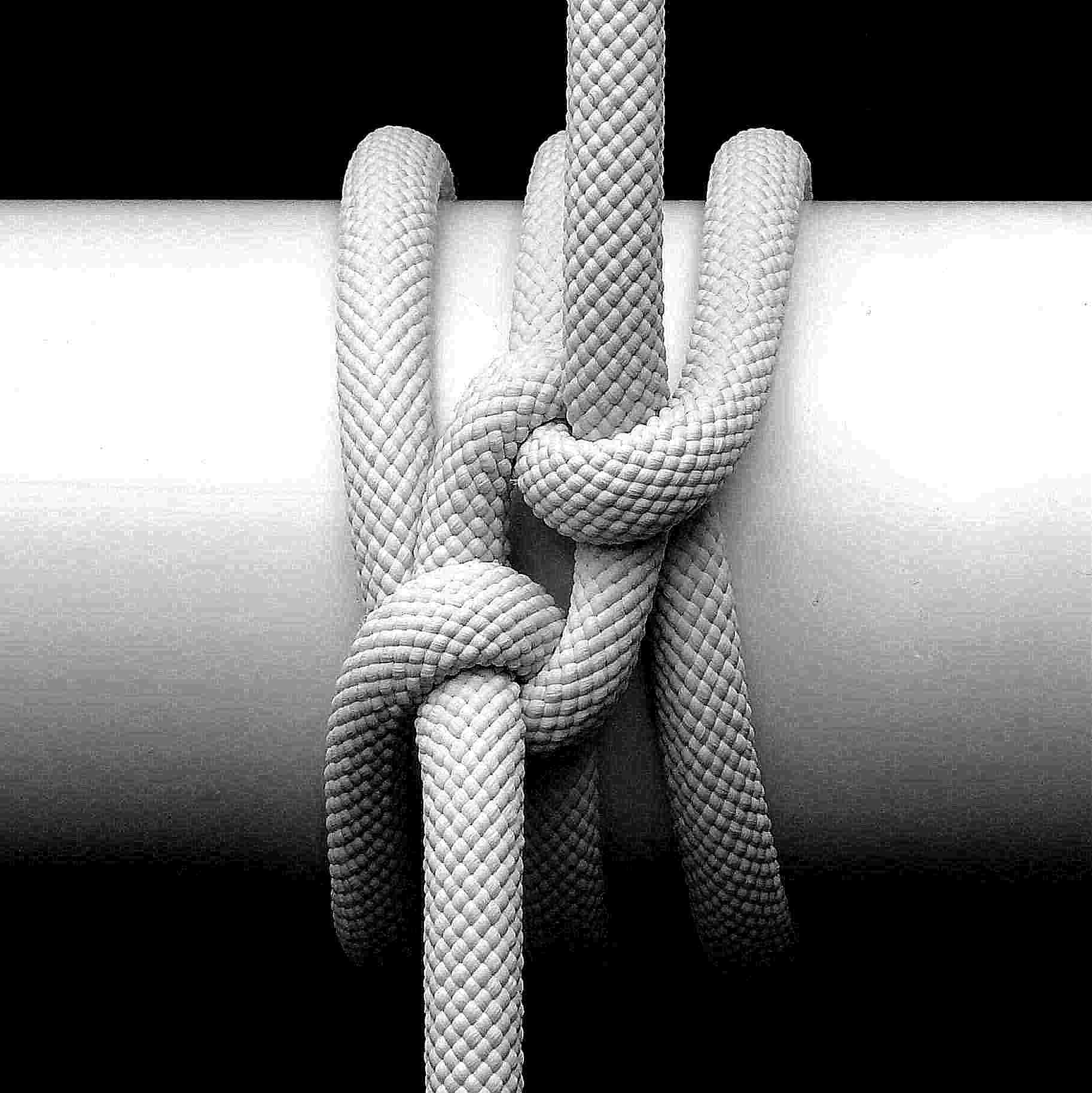
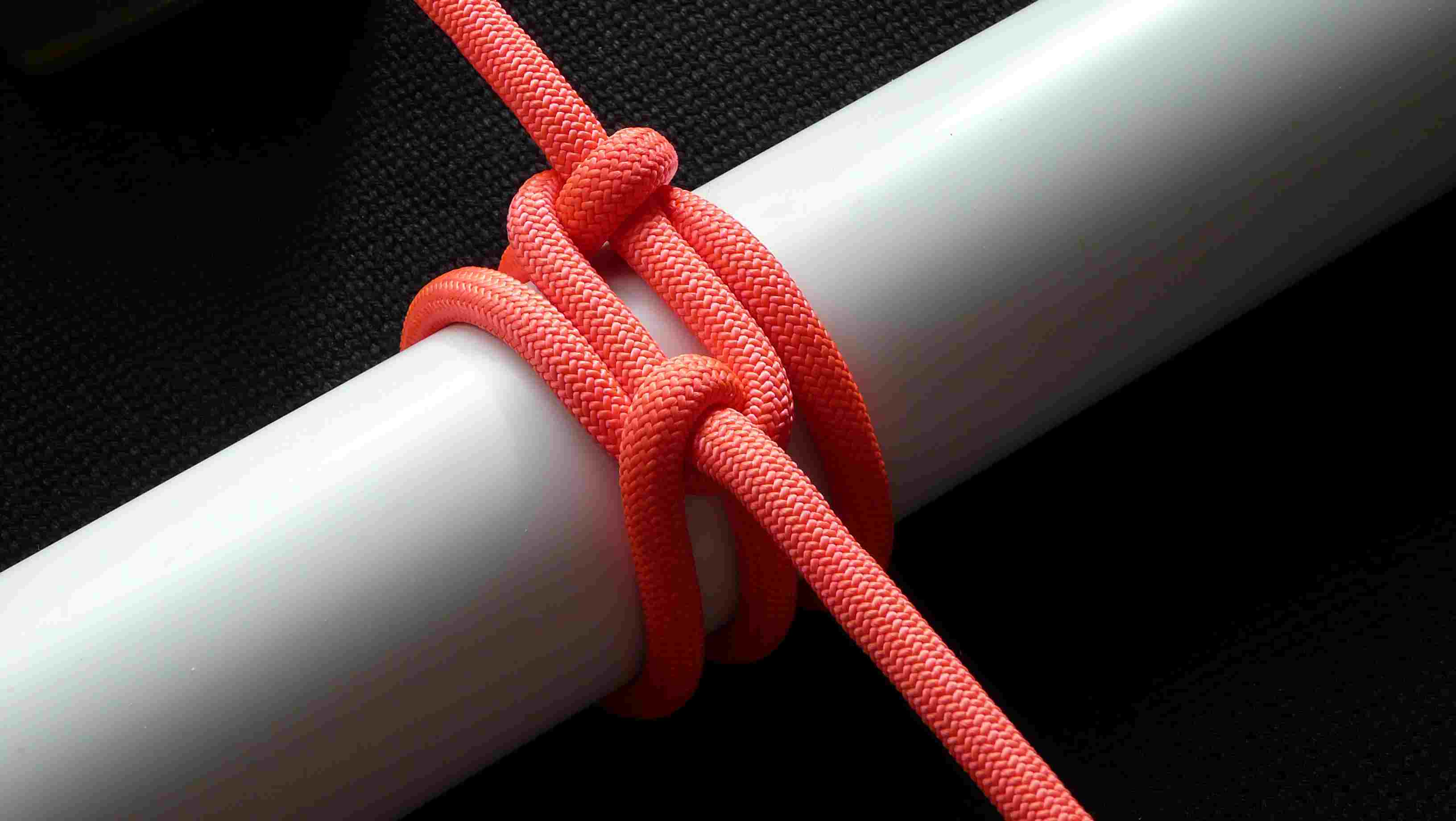
The “TackleClamp hitch” is a multi-wrap friction hitch that incorporates both mechanisms, B1 and B2, in order to increase the force with which the wraps nip the spar/pole they are tied around. Thus, the total friction forces induced by this hitch on the spar/pole are greater than by the other known friction hitches.
It should be stressed that, in order a segment of rope can accumulate tensile forces and not run the danger to release them with a small displacement of its ends towards each other,
The rope segment should be sufficiently long. Most of the times, with commonly used spars/poles and ropes, this requirement means that we should use as many wraps as we can, within the limits imposed by practical considerations. Certainly, one wrap would not probably be enough, most of the times.
The material of the rope should be able to be elongated under tension as much as possible. Nylon is a material that can be elongated a lot, yet retain its tensile characteristics, and, moreover, not suffer from creep or fatigue.
A slight modification that might be helpfull in some applications, is to let the “lower” end to pass through the “upper” bight once more, or vice versa. This is easily done, because those bights remain sufficiently wide open - as they already turn around one rope diameter, and their two legs remain parallel. By doing this, we have both standing ends pass through the same bight as they exit the knot s nub. I do not know which of the two alternatives ( i.e., to have them pass through the “higher” or the “lower” bight, at their last passage through them) will pull the hitch LESS effectively along the spar/pole.
( I have listened the song of the seductresses Sirens, and dared to place a name, as a label, for this hitch. ( Actually, this name was proposed by a friend of mine, who have tied the hitch…). I would be glad if there are any other proposals, which might be able to name this hitch even more descriptively.)
( I post here only the already published pictures. I plan to take new, better pictures with some new material that I will put my hands on in the near future. Here I had tried to repeat, in other words, what was the “ratio” that drove me to this knot, so it does not look something “random”, that had suddently fell from the sky…Knots are just rope mechanisms, there is nothing magical in the conception of their structure.)
P.S. I have just remembered a well known tool that is used on tubes and pipes, and which works in a very similar way the TackleClamp gripping hitch works : Not by increasing the contact area between the rope and the spar/pole ( as it is often done, by increasing the number of the wraps ), but by increasing the tension of the wraped rope segment. It is called “strap wrench”, and one can see many variations of it with the help of Google Images. The same tool is used to replace spin-on oil filters in cars, and it is called "oil filter wrench" (strap type). The TackleClamp hitch is nothing but a rope-made, multi-strap “strap wrench” - where the mechanism to pre-tension the straps is not a lever mechanism, but a bight-and-tackle rope mechanism.
The important thing to remember, is to pull the two ends and tighten the whole knot in two stages. At the first stage, the two bights should better be at diametrically spaced positions, as shown in picture/step 3. At this first stage, we do not have to pull the ends very forcefully. At the second stage, shown at step/picture 6, it is better if we pull the ends with all the power the morning breakfast had offered to us - and it pays if we are able to place our feet against the spar/pole, if possible, so we use the whole body power to tighten the knot. ( See picture 6b)( We can do it even if we are not row-men or weight-lifters, of course…)
Another thing I should perhaps mention, is that the step shown at pictures 7 and 8 might not be necessary. In this, we pass the one, “upper” end through the other, “lower” bight once more, ( or vice versa), so that both ends exit from the same point of the knot, and are oriented towards the same direction. We can then use the one end that has passed through the same bight twice - or we can use both ends. I believe that it is not necessary to connect them further, with another knot.
I dare to say that this is the tightest gripping hitch able to withstand a lengthwise pull we know till now. Of course, I am sure that nobody in this forum will accept this - as it is always the case with knot tyers - for complex reasons, well beyond the simple field of knotting :). However, I am also sure that it is a good thing this knot has been revealed to us - even with a fifty or a hundred years delay- and it will be presumably there, to common view, the next half century. The next generation of knot tyers will accept it, that is also for sure…
I am able to tighten this down to an absurd degree.
I was tightening this down on a highlighter marker with some small cord (not using the suggested gloves and boots…), and I had to stop for fear of bursting the marker.
This seems to work great as a binding knot in some instances (minus a few wraps, of course). It does impart a twist to whatever it is being tightened around. If it’s a pole, that isn’t a problem. If it is a bundle of poles, it might be hard to tighten without the poles splaying out and twisting. It doesn’t stay tight over a concave surface unless finished with a bend.
It takes a bit of trial and error to know where to start out the bights so that things tighten into place.
It doesn’t look much like the kind of structure I generally expect to load lengthwise. However, by keeping the loaded rope so far from the surface of the pole, this knot must impart a good deal of torque, which of course must help.
The first part reminds me a bit of the scaffold board hitch used to sling a plank (ABOK #2159, if I’m not mistaken. Whichever is based on the clove hitch, not the marlinspike hitch).
This knot is designed to be a hitch able to withstand a lengthwise pull. I have seen that the possibility of pre-tightening/pre-stressing the multiple wraps on any of the known multi-coil friction hitches had a great beneficial impact upon the gripping power of it. So, the starting point of the design of this knot was there, the multi-coil friction hitches. That was the origin and the purpose of the many wraps. ( I was trying it as a gripping hitch tied around a stainless steel pole, with some olive oil or butter on it… :)) Now, it can also used as a binder of many objects, of course, but this is not a difficult task for a knot…We have many other knots capable to deal with this relatively “easy” problem, in a quite satisfactory way.
So, if this knot is not loaded, and if it is not loaded lengthwise, it is not supposed to stay tight - unless, as you have noticed, it is secured further with another knot, be it a bend, some half hitches or whatever. The thing I do not yet know is if the final tuck of the one end, shown at pictures 7 and 8, is really necessary…I do not believe that loading it from the one or both ends will really make any significant difference - but I have shown it at the pictures 7 and 8 as loaded from the “lower” end (or from both ends) nevertheless - with the "higher"driven through the lower bight for the second time -, just because this is how most friction hitches are usually loaded.
Right ! That is why I propose the diametrically placed bights, which turns to be a a good starting point, for the diameters and the number of wraps shown in the pictures - or any other similar combination. The fact that we do not want, is to start tightening the bights when they are too close, so they run the danger to touch each other before the end of the pre-tightening/pre-stressing process. As a rule of thumb, the diametrically opposed bights is something that seems to work in most of the cases I tried, and it is an easily remembered and inspected position. With many more wraps, and nylon ropes, we will need an even greater distance between the bights, so they will be allowed to rreach the end of their route during the pre-tensioning/pre-stressing stage without getting too close and touch each other.
I know that most people will not believe or accept it, but it is the tightest gripping hitch able to withstand a lengthwise pull we know - far better than any other I have known and tried till now. You will be surprised by its efficiency, believe me !
Its “secret” is not the distance of the pivot point from the axis of the pole - it is the possibility of the pre-tightening/pre-stressing of the ends of the coil 'tube" - combined with the mechanical advantage that enhances the force we are able to apply to achieve it, and the self-locking mechanism. It is the tightest member of new class of gripping hitches - and I do not doubt that another knot tyer will be able to discover another knot that that uses the same mechanosms - perhaps even simpler and more powerful.
It may indeed be the tightest gripping hitch and under strain does not elongate at all. I tried it twice in 4mm accessory cord (quite stiff cord) around a plastic pipe about 1.5" in diameter (I can estimate better in inches!) and it does go on very tight and not slip when a moderate load is applied. However it started to move when I bent the ends together and put my weight on it - albeit it moved very slowly. I tried the same materials with a 3 wrap Klemheist and that elongated but I couldn’t move it. This is hardly scientific and until I have tried the TackleClamp hitch a few times I cannot be sure I dressed it as tightly as I might. So for the moment I don’t think I would use it as first choice (that may change after some more practice) - mainly because it has 2 free ends which need bending together to be able to attach a separate lifting rope whereas a Klemheist or Prusik can be kept on a hook in the garage ready for use with a carabiner.
The pictures showing how to tie this are very helpful thanks.
I am not going to “defend” this hitch, because it does not need me … :), and because I know very well, from past knowledge and personal experience, that knot tyers - in general - are conservative, and will never accept any “new” knot that is unlucky enough to be presented during their own life time ! This in not something that happens only in our field, of course. It is said that the new theories of physics can be really established only after the previous generation of physicists die, and the physisists of the new generation have nothing to loose if they will accept them . However, I would like to make two comments, one with a question mark and one with an exclamation mark.
(Twice is never enough ! )
I had used a 8mm kermantle nylon around a 3" plastic pipe - so the relation between the diameters of the rope and the pole in our tests were the same. However, I do not know if we can really scale things like this. It is a very difficult subject, because we use the length of the rope - to be able to pre-tension/pre-stress it-, but the surface of the pole…How hitches around poles are supposed to be scaled ? A question mark here…
No, it does not…because those two ends are not “free”, they are not independent - they are already bound together inside the knot ! ( An exclamation mark here). And they are even more tightly bound together by the final tuck of the one of them, shown at pictures 7 or 8 - which I think it might not be always necessary.
I think there is a misunderstanding here. What I meant is that you have a hitch which has 2 ends either or both of which can be used but I would use this hitch separately from a line I was using to exert a force on the hitch - in other words I would not seek to place this hitch at the end of a long line which I then used to exert a force. That would be clumsy to tie. It would be far easier to attach a separate line by bending the 2 ends together. The ends are “free” only in the sense that they are available to be used.
Thanks for giving me a ‘heads up’ on this evolution of a hybridisation between the Versatackle and Dan Lehman’s ‘S Hitch’, As Dan mentioned back in his post in 2009 http://igkt.net/sm/index.php?topic=1451.msg10074#msg10074 we often need a binding that can be significantly pretensioned when it is made and the Tackle Clamp certainly gives us this.
Of interest, when I made it in garden twine or baler twine it was harder to pull it up but gripped itself very effectively, becoming essentially permanent. But when I made it in smooth surfaced braid, I was able to get a much greater MA through the Versatackle component and so a much tighter binding, but the ends were then prone to slipping back out as, due to the substantial positive cogging of the Versatackle, its self locking ability is limited.
For strength as a binding it is exceptional. The tension imparted by the Versatackle component puts load into the multiple coils which then do all the work in taking the load of the binding, with very little of the binding load being fed into the tensioning component. [Note : anything more than ca 5 turns is a waste as the tension is effectively lost over the first two turns from each end see http://notableknotindex.webs.com/friction.html ]
As a hitch, i.e. to give a facility to apply a load along the hitched object, yes it works, but I would not use it for two reasons a) because other hitches are more effective (the Tackle Clamp has virtually no grip under load amplification system) and b) most other hitches are far easier to make (and remove).
Thank you for bringing a very useful tool to my knotting toolkit
I was thinking that we can utilize one or more of the intermediate riding turns, as a means to squeeze the (twisted) pair of the working ends (prior-to-the-tails) in between this(those) riding turn(s) and the surface of the pole, a la Strange/Constrictor. This way we might “lock” the tails even more securely, so we would probably not need to pass them through the bights for a second time ( as was shown at Replies#2-3, pictures 7-8). We can have a tighten-and-forget hitch, that will remain locked without the need of additional brute-force measures, like the tying of the tails together with overhand knots upon overhand knots and half hitches upon half hitches…
A disadvantage of this variation is that the bulk of the twisted-pairs-under-the-riding-turn(s) tangle would prevent the two bights from approaching each other beyond a certain point. The course that the two opposing parts/bights of the tackle would now be free to follow, as we tighten the hitch from the pre-tensioned initial position to the tensioned, final one, would now be shorter, so this would probably diminish its maximum gripping power. Of course, we can anticipate this, and start tightening the hitch with the two parts/bights being even further apart of what it is already shown at the previously posted pictures, so they will have enough room to move while they are approachng each other, without being hindered by the bulk of the twisted tails at the space between them.
(See the attached pictures .)
I have always posted pictures of the TackleClamp with 4 (at least) wraps - although it is obvious that it can be tied with 3, and 3 wraps only. The reason for this was the following : this is a most tight gripping hitch, designed to withstand heavy lengthwise loadings, by the accumulation - inside its multiple turns - of strong tensile forces, during a pre-stressing phase. Provided we use elastic materials that can be elongated quite a bid, ( like nylon, for example ), more turns can store more energy along a longer segment of the rope, that will remain in action even if the free ends slip through the opposing U s “locks” a little bid. The two-turns middle section was used for this purpose.
However, there might be cases where this longer, two wraps middle section would not be more efficient, because we would not be able to pull the free ends and tension those two wraps efficiently in the first place - due to the greater friction forces induced on them by the surface of the pole. So, the minimum or optimum number of wraps is a matter that depends upon the elongation of the material and the friction coefficient of the pole - among other things ! .
(See at the attached pictures the 3-wraps TackleClamp hitch, and compare it with other, “simpler”, 3 and 4 wraps hitches : http://igkt.net/sm/index.php?topic=4035.0
During the pre-tightening of a multi-wraps TackleClamp hitch, it is better to pull the one free end after the other - so the multiple middle wraps coil is tensioned through both ends. Otherwise, the friction forces between the multiple wraps and the surface of the pole could prevent a very tight grip of the hitch on the pole.
With a 3-wraps TackeClamp hitch, tied around a slippery enough pole, this is not required. Just place the one end at the right location, between the two opposed bights, leave it there, and pull the other against the pole - as hard as you can ! A word of caution : the impulse generated by the great potential of the tackle mechanism is almost irresistible : The knot tyer should remember that he, himself, is but a fragile mechanism. He should be aware of the danger to harm his spinal chord. (Human : Kingdom: Animalia . Phylum: Chordata…). Pulling the one end of the rope by both hands against the pole, while, simultaneously, pushing the pole by both feet, can tighten the hitch to un unbelievable degree, -but it can also harm the back of the careless knot tyer / would-be Oxbridge-rower…
Now, something else : When the hitch would be tightened, it may be difficult to pass the tail in between the last bight and the surface of the pole, in order to untie the knot, as I have said earlier in this thread. So, It is better to do it in advance : I would nt call this knot a slipped TackleClamp hitch ( it is nt, because the second/last leg of the tail is not nipped there, as the first, it is just squeezed a little bid ), but it looks like a slipped knot nevertheless. The moment we pull the bight, the Tackle Clamp hitch is released in a glimpse, independently of the degree it has been tightened. Because the pulling of this bight does not pull a niped segment of a rope along its axis, it just re-locates the perpendicular to the axis position of the tail, so the “lock” does not work anymore, it is unlocked, and the knot is untied instantly. ( See the attached picture).
The reader who have read (1) - where I have mentioned that the TackleClamp hitch is topologically equivalent to the overhand knot ( while the Double Cow hitch, presented there, is topologically equivalent to the unknot, so it is TIB ( tiable in the bight )) - would notice the useful change : the “slipped” TackleClamp hitch is TIB, too !!-- bonus, that, eh?!
I have seen some interest for the simple tight hitches recently - although I do not know what exactly stirred it, the mechanism of the knots, or the colour of the ropes on which those knot were tied :). Anyway, see more pictures of the tightest three-wrap hitch / binder we have - which, due to its symmetry, was characterized by somebody as " half clever" - probably because he has not understood, yet, that it is more than twice as tight - so, compared to other hitches, the net outcome can not but be positive :).
?!
By what method have you confirmed this bold
assertion (not just starry-eyed gazing for glory,
but some empirical method that others might
employ to see for themselves)? “twice as tight”!!
--which, due to its symmetry, was characterized by somebody as " [i]half clever[/i]" - probably because he has not understood, yet, that it is more than twice as tight - so, compared to other hitches, the net outcome can not but be positive :).
What has symmetry to do with “half clever”-ness?
Was some asymmetric binder claimed to be more clever?
Do not bother ! I will not ask you to tell me by what method have you reached this bold assertion of yours, that the TackleClamp hitch is "half clever" / "clever [divided] by half" (sic) ! Even if one knew it, he would need a special technique to apply it, I guess - which me, for one, I am happy I never wished to master.
When you will measure the tension on the wraps of this hitch, and compare it to the tension on the wraps of any other three-wrap tight hitch you know, give me a call, please.
Anyway, I hope you like the colour of the rope !
I am not sure if anybody can say that this tangle/thing/whatever, “described” at (1) and shown at (2) and at the attached picture, is more clever - but if you will ask me if it is more comical, I will be ! I wonder which colour the rope of this beauty contestant should had, to make KnotMe characterize it as “pretty” ! Griffin s colour, perhaps
More seriously, I would had mentioned that one can judge the tension of a rope by listening it ! After all, within the elasticity area, a tensioned rope is a string - like a violin s string, for example :). Tie the TackleClamp hitch and measure the pitch of the sound the rope makes, when it is tensioned as hard as shown in the picture. ( The frequency is proportional to the square root of the tension of the string / rope ).
Actually, the “twice” as tight should have been expected, because of the mechanical advantage 2 : 1 each end tigtens its corresponding one-and-a-half wrap, as it is pulled by the knot tyer, the one after the other - and each millimetre of rope pulled out of the wraps will remain out, as nothng escapes from this tight grip of the tensioned-opposed-bights locking mechansm.
More seriously, I would had mentioned that one can judge the tension
of a rope by [i]listening[/i] it ! After all, within the elasticity area, a tensioned rope is a string
--like a violin s string, for example :). Tie the TackleClamp hitch and [i]measure the pitch[/i] of the sound
the rope makes, when it is tensioned as hard as shown in the picture.
Really, plucking the *strings* of a binder
set tightly around an object --what sort
of orchestra do you play in? (Violins, and
all other stringed instruments, have strings
clear of objects but for where they might be
fretted, and a sound hole to boot!)
[quote="Dan_Lehman post:15, topic:4334"]
Was some asymmetric binder claimed to be more clever?
[/quote]
[quote="Dan_Lehman"]
the structures that Xarax touts... are so ineffective as to be comical (and, yes, I can recognize my contribution to the genesis of the 2nd). They go
towards winning the [i]Too Clever by Half[/i] prize
[/quote]
I am not sure if anybody can say that [u][i]this[/i][/u] tangle/thing/whatever, "described" at (1) and shown at (2) and at the attached picture, is more [i]clever[/i] - but if you will ask me if it is more [i]comical[/i], I will be ! :) I wonder which colour the rope of this beauty contestant should had, to make KnotMe characterize it as "[i]pretty[/i]" ! Griffin s colour, perhaps :)
Perhaps you've forgotten the point of that
contrivance --to be a HITCH, not a binder
(but a hitch that stays tightly set). Hence
its asymmetry matches the loading.
Now, back to your string theory: yes, I suppose one
could contrive some object that was spaced apart so
as to provide the plucky researcher means to assess
tension by sound.
And then to try for a fair comparison, one could arrange
to tie both hitches with a single line such that their
four ends formed two bights by which one could suspend
a given weight in hopes of equal setting tension. And
then play this instrument and see what sings the
higher notes! (But I have my doubts about rope doing
much sounding, and we’d like to test a reasonable
material.)
As for how one might a prior have doubts about the
3-wrap tackleclamp, recall your (& my) observation
of the imbalanced loading of the 3-wraps --i.p., that the
center wrap is pulled by both ends and so more quickly
taut, and I’m surmising this will work against getting
the entire binder set well tight.
Now, consider a double constrictor --or, more directly
for the point of delivered tension, a double clove h.–:
these knots receive direct tensioning from loaded ends
into their two outer wraps, and have the center one
hoping for flow from those two --but that seems better
than running into resistance quickly on the doubly
tensioned center one, hoping for some fall-out getting
to the outer two wraps?!
(The clove least impedes the loaded ends flowing
tension into the knot; they thus might least impede
the loss of that tension, but in time, not so immediately,
methinks (and YMMV per particular material). Whereas
the tackleclamp is rich in knotting entanglement,
which begets much friction.)
Perhaps there might be a result that shows the t. being superior in slick but worsening much
with frictive material --a steep decline–, vs. the c. having a less declined plot of tightness,
initially less than but becoming more than …
as friction of material increases? (I recall playing
with some hitches on PVC and finding their fluid
tightening to be just what I wanted, but then
tying them to another (thicker) rope --which was
the aim–, there was no such needed tightening!)
No, it is just your not willing to understand - even if we suppose you can. And, of course, you say nothing about WHICH three-wrap hitch is tighter than this… However, I am glad you have not brought this tangle/thing/whatsoever of yours this time - I would nt expect many starry-gazing eyes looking at her !
Please, next thing you do, tie the f knot placing it side by side around the same pole to whatever other same-wrap hitch you chose, tightening it with the same force, and pulling the ends against the pole - and then use those star-gazing eyes of yours - because it seems as you are not able to use your ears, and listen to the pitch of the sound the rope makes on the surface of the pole… OR, for that matter, you are not aware of the fact that, if you do not tie the slipped variation of the hitch, or if you do not tie it near one end of a slippery pole, you would have great difficulties to pull it lengthwise along the pole s surface and remove it.
On the contrary, I have tied and tried this hitch MANY times, side by side with every hitch I know - and I believe I know some, among them some you do not - as shown at the picture in another thread. Well, there is no comparison between the 3- or 4- TackleClamp hitch to any other hitch, the Double Cow hitch included. I imagine there are 4 main reasons for this :
1 The fact that one can use the mechanical advantage offered by the Cow hitch Zig-Zag arrangements of the wraps of BOTH ends ( the “too-clever-by-half” mechanism, as you understood it…). 2. The fact that one can pull BOTH ends against the pole. The difference in amount of the tension we are able to induce into the wraps during the pre-tightening phase, between this way/direction of pulling the ends, and the way/direction we pull them in the simple-hitch-a-la-Gleipnir or the 2U s hitches (1), is huge ! I use my hands AND feet to tighten the ends - but if you ever decide to really test the TackleClamp hitch ( instead of complaining this/your way, for something you could well have tied in the first place but missed it ) you have to be more careful than me ( this time ! :)). I still suffer from pains in my back, because this music this hitch makes as it is tensioned around the pole is enchanting, indeed. http://en.wikipedia.org/wiki/Siren 3. The fact that the tensioned, opposed bights “locking” mechanism is the best straight-Tail locking mechanism we have. 4. The fact that there are no riding turns, as in the snug hitches, for example, so the wraps do not leave the surface of the pole - they remain in contact with it alongside their full circumference.
However, I still do not know if you really have tied and tried this hitch and compared it to the other tight hitches you know, or you just gaze at it with your eyes - because I can not believe that there will be any knot tyer, however biased he can possibly be, to not acknowledge the tremendous gripping power of the TackleClamp hitch… Of course, human psychology is far more complex than any tangle, and I may be a mediocre knot tyer, but am also a lousy f psychologist !
I should perhaps inform you that a solid object vibrates, even when it is hit, and not plucked… And those vibrations can be listened, detected and measured - especially if they take place on the surface of a hollow cylinder, as the poles I use to tie hitches are.
Now, if you really wish to have a sound hole, drill one ! I have not done it, but I suppose that if you drill a small hole on the surface of a hollow pipe, directly under the three wraps, you will be able to play and listen, with your ears, the song I have written as an answer to you !
I fear no jamming knot
or lose the long-lost pride
or spill from the unicorn
on which I do not ride.
( Music from the movie " All that Jazz" ( 1979)
Any other linguistic improvements and rhythm s ideas are welcomed… )
Do not fear the tight hitches - and the TackleClamp hitch, in particular. Tie and try them !
No, I have not - how can one forget that tangle/thing/whatever ? On the contrary, you seem to have forgotten that I am equating the “tight hitches” (2) with the “binders”. So, many times in this thread, and elsewhere, I write “tight hitch” or “binder”, and I mean the same thing. A tight hitch and/or a binder can be pre-tightened and/or tightened by one or both ends, and it can be symmetric or not. Symmetry has nothing to do with a thing being a tight hitch or a binder, - but your thing has not incorporated that knowledge… The reason the TackleClamp hitches are symmetric, is that, by being so, they are able to take advantage of the mechanical advantage on both ends, of the multiplied-by-two tension induced within the wraps from both sides of the coil - so the distance between the ends of the wraps which we can pull directly, and the middle of the wraps which we can not influence so much, because of friction - is minimum. At the locked Cow hitch, a similar tight hitch with one only end able to be pulled, we have two only wraps, not three, so the friction of the surface of the pole does not hinder the tightening process so much, as when we have three wraps. Now, on that thing, you consume two whole wraps just to lock the Tail end, and you don’t even use the mechanical advantage Cow-hitch based tight hitches / binders use… But I will not bother you any longer for something which I am afraid that does not have many chances to win any tightness or beauty contest. Fetch the next hitch of yours, so we will be able to compare it with the TackleClamp hitch.
( I still wonder why Ashley missed them - after all, you, also, invented one by yourself, did nt you ? I suspect that by trying to silence the TackleClamp hitch s music, you decided to silence your beautiful S-binder, too…)
We have discussed this issue, and I have said that, if one is afraid of this, he can tie the TackleClamp hitch with one more ( one added central ) wrap. However, if you tie this 3-wrap hitch as tight as you can ( as I said, first taking out any slack, before the pulling - then pull alternatively, the one end after the other, starting from a proper position of the two opposed bights on the surface which will enable their tensioning right to the end, before they will have the chance to “kiss” each other ), if you do this, you will see that our fears were academic - the hitch/binder closes so tightly, you can not say one wrap is not as tightly tighten as any other. Certainly, to my ears, at least, the pitch they make when they are hit does not differ. It seems that, after some stage, the central wrap can not be tensioned any more, and the mechanism re-adjusts itself, so, after this stage, it is the end wraps that consume any material pulled by the free ends.
My favourite form of the TackleClamp hitch is the 3 / wraps one - where we have this interesting Janus image, a hitch with 3 wraps at the one side/face of the pole and 4 wraps at the other - perhaps just because it is so interesting, and it does not run the danger to be “closed” before it can be tightened to the extreme. I have published those pictures of the completely closed 3-wraps TackleClamp hitch just because I wished to offer to KnotMe - who wrote a king comment about the Bull-Clove hitch shown at the other thread - a present wrapped with pink colour ! As I was posting the pictures, I remembered your 'kind" comments about the TackleClamp hitch being “too-clever-by-half”(sic), and the rest was just a knee-jerk reaction, I have to admit…
Regarding your last comment about the relation of the TackleClamp hitch to the Double Constrictor ( and, for that matter, to the Double Clove hitch ), again, I have, somehow, to force you to understand the GREAT difference it makes when we are able to :
Use the mechanical advantage offered at the Cow-hitch type of hitches.
Pull the end(s) AGAINST the pole - meaning not only perpendicularly to the axis of the pole, but perpendicularly to its surface, too - so, pull end(s) that do not leave the pole being tangent to its surface. I have learned this by tying and trying - and I sincerely I hope that you, too, will learn it before you retire !
I AM NOT HAPPY, not happy at all, from the fact that I can not find any other tight hitch / binder that can be pre-tightened / tightened, and keep this tension locked within its wraps, as much as the TackleClamp hitch… It seems that my journey in that part of the KnotLand came to an end - and no Odysseus worth his salt is ever happy with an end… I keep a sweet memory of the S-turns I made until I met her - and a bitter one of the pains in my back, and the “kind” comments by other suitors / knot-tyers she generated …
The TackleClamp tight hitch/binder is tighter than the Double Constrictor ? No !! It is mush-much tighter !! ( To repeat a repetition - I wonder if, when you repeat something, and then repeat the repeated sentence, this is equivalent to having said the same thing three times, or four ( (1+1) x 2 ) times ? )
I take the risk to be condemned, again, as consuming valuable bits and bytes of the Forum s memory :), and I post two new pictures of the TackleClamp hitch - repetition is boring, but it is also the mother of all earning.