- Sheet Bend - it is ABoK #1 for a reason. http://www.youtube.com/watch?v=1ZBOLte9kXo
- Bowline http://www.youtube.com/watch?v=-8JtYMf1VXw
- Double Dragon http://www.youtube.com/watch?v=BIVU_38ol-8
- Rope Coil because what good is a knot if the rope is all tangled. http://www.youtube.com/watch?v=qGnL9wIHLBU
- Larks head http://www.youtube.com/watch?v=MWsXxyo3EhM
- Surgeons Bend because reef knots are not as reliable http://www.youtube.com/watch?v=a1Fr6HAyfzc
- Peg Hitch because a pocket full of pegs just makes rope better and you have to start somewhere. http://www.youtube.com/watch?v=GZfgakjUXEM
- Markingspike Hitch because pulling on a rope hurts my hands http://www.youtube.com/watch?v=sgb_ydwXO7U
- Eye Splice strongest loop http://www.youtube.com/watch?v=4ETjsIHLg0M
- Pole Hitch because rope is used to lift things and a pole is handy http://www.youtube.com/watch?v=-J3Y_TYqFKM
I’d like to present a totally different perspective with a sincere desire
not to offend anyone. I am I think the perfect novice and can say
at 50 years of age I have functioned all my life only knowing one
“fancy” ( meaning I kniew it had a special name ) knot
that was taught to me by my father ( not counting tying my shoes )
and two knots that I think everyone knows instintively.
I have used lots of rope in my life and have a good idea
of the possible common applications.
I think the two knots everyone knows instincteivly is an overhand
knot and a loop made in the end or the middle of of a rope
called I think an “overhand loop”. I fully acknowledge that
they cannot be untied if I have used the correct name for them.
I have designed built and flown my own airplanes, had some formal
engineering educaiton, and been a custom home builder. In all that
I have had the need to tie many things to trailers and boxes etc.
While I can see the beauty of many of the knots discussed and
indeed plan on selecting another 2 or 3 to learn. I can tell you
that with the realization that knots need to be able to be
untied, I have accomplished everything in my life with only
half hitchs and overhand knots to lock them along with
the loops at the end of the ropes which were ok to be
permanent. My constant frustration was never being
able to remove loops tied in the middle of lines.
Well I am rambling here… I just want to say that
for knot hobbiests probably all the knots mentioned
and suggested previously in this thread are wonderful but
for the common layperson with an above average need
to tie knots,
I doubt if more than four “purebred” knots
need to be known. In fact I am shooting
for only three and havent decided on what my fourth
important knot needs to be or why I need it yet.
Oh and also the overhand loop tied into the other end of my ropes.
I always used the overhand loop end of my ropes as nooses with the
other end of the rope slipped through the loops as once tied those
loops are permanent. I always thought that was just a given
constraint.
Haveing spent a couple of days and many hours reading all about the
dozens of different fantastic knots at about a dozen websites I think
I am fascinated most by the taught-line-hitch as I can see that the
adjustability of the size of the loop could have helped me in my life
by not forcing me to use the brute force methods of making the
ropes tight before I installed my half hitches. But it would
have been a convenience only as I made do with half hitches.
I can also see the need to be able to put a loop in the middle of a
line that can be untied because every time I ever tried it the
loop became permanent. I may be wrong but I think what
I was doing was using the overhand loop. I havent really
been able to determine just which knot will be the best
one for putting a loop in the middle of a line as it
is not abundantly clear which ones are easiest to
untie. There are so many to choose from it would appear.
So far these are the two additional knots I really want to learn
and practice with so I will remember always and would add
significantly to my effectiveness in the field of practical usage.
I guess that makes a total of three that I think I will
ever need in everyday life. I know there are maybe
one or two more that I might use but dont know the
names of such as when tying something around a post.
Well, no I always used maybe a few turns and then
a few half hitches ending with an overhand knot
to lock it all up.
Anyway, as the dumbest knot-tie-er here, I would point
out that everyone already knows an overhand knot
and an overhand loop and show the farmer or neighborhood
kid that the “half hitch” as the 1st and next most important
knot that he ever needs to know.
I am fascinated by it all for the first time in my life
and am anxious to learn but I merely wanted to point
out that it is unreasonable to expect a common laymen
to know more than 3 or 4 “proper” or “purebred” knots.
Hi Preventec,
This is the original question as presented. It would appear that your response is more aligned toward what might be the most important daily life knots which, I would venture to say, depends on your affinity for or against using a rope or a piece of string as a readily available tool that might be carried in any pocket or in the form of a knotted belt.
Having said that, of course, you have a valid question as to which knots would be important for a non-knot-tyer. I have heard it expressed by many that “If you cannot tie the right knot, tie lots” meaning that many half-hitches, single hitches or overhand knots might well hold an unimportant load, but will probably not stand up to ease of use, simplicity in accomplishing the purpose or ease of untying which, as you correctly have pointed out from your own experience, is a very important aspect of knot-tying.
Given all of that, does it not seem reasonable to:
a) Learn ten knots, in case the one you are using does not fit the purpose you need to fulfill,
b) Learn how to tie knots that are readily undone and yet hold the load effectively,
c) Not have to be reliant on other more expensive tools and gadgets that get lost, corrode and fall into disrepair?
If not, and I suspect this may be your answer, you have done well to have gone through five decades of life without their need. What your life might have become had you known this we can only surmise - and we can never know, because our avocation is to practice tying knots as if our lives depended on them (which they sometimes do). Yours appears not to be such and I applaud your paucity of knots for surely you must have enriched your life in some other more palatable way than learning a simple knot or two? Perhaps that way which you have enjoyed is for you, but I am unable to envisage a life in which knots, the right knots, do not figure. Maybe that is my loss or gain - only time will tell. I have had a wonderful time learning and growing in my physical abilities, dexterity, mental faculties, writing abilities, never having a lack of things to do, never wanting for some interesting twist to what is possible, and being able to share with my fellow knot-tyers in a skill that is arguably one of mankind’s oldest tools and oldest learned skills. Long live the right knot for the job!
SR ;D
This is an interesting development and made me think. Until I was about 28 the only knot I could remember was the reef or square knot taught to me by my mother at the age of about 6. Someone in a warehouse I supervised showed me how to splice an old piece of (real) hemp so I found a book on the subject of knots and the rest as they say is history. I do remember endless frustration at the inability of a reef knot to act as a hitch and found 2 half hitches the hard way! Then curiosity took over having found that the world has more than one knot. However I sometimes think that we approach knotting from the wrong end of the telescope - my son in law is a carpenter; he needs knots but his attempts range from amusing to downright dangerous. What he does appreciate is the method of achieving an objective and if that calls for a knot then he’ll have a go at learning one as long as its easy and quick (actually untying is not an issue as like many builders he uses very cheap polypropylene rope and “unties” with a knife).
But the pressure comes from the situation not the desire to learn a knot for what appears to be its own sake (OK so I and most others disagree but the reality is that knots are often used when all else fails - then they probably do too). Perhaps we should be looking for the 10(?) situations when a knot really is a very good if not the only answer and then suggest appropriate knots - you never know there might only turn out to be about 4! So perhaps we finish up with the 10 or so most useful knots for a would-be enthusiast and the 10 situations where a novice knot tyer would benefit from a little knowledge.
Preventec47 and Sweeney,
I believe that you are both right - here is a paste from reply No. 3 to this post -
[i]
Tying up bean poles in the garden – cable ties? Gaffa tape? or a simple constrictor in hairy garden string?
Tying on a load – Bungee cord? ratchet straps? (and yes, I have seen a load strapped on with Gaffa) or an Alpine loop and Z hitch?
Stabilising a Gazebo – Bungee straps? or Sliding Grip Hitch in 3mm braided polyester?
Fixing to a pole and don’t want it to slip – cable ties and Gaffa? or a KC Hitch using old bailer twine?
Temporary closure – Magnetic catch? or a Chinese button tied in elastic cord?[/i]
Preventec47, I would make a guess that you do not know what a constrictor is, how to tie one or what it is particularly good at – I would also hazard a guess that once I showed you how easy it is to tie over your thumb, how easy it is to remember and how astonishingly good it is at doing what it is best at - staying tight - that two things would happen. First, you would wonder why no one told you about this knot before and why you have had to waste so much of your life tying multiple overhand knots that never quite tie tight enough and ALWAYS seem to loosen when asked to do some real work. Second, you would think - if the constrictor is so simple to tie and remember and so amazing at its job - what other knots are there that are brilliant at others jobs that might also be quite easy to tie and to remember???
Then Preventec47 you will have a choice - Take your newly acquired constrictor knot back to the land of the sane people and their reef knots and overhand knots, - or you can do as so many who come here have done, think that you can perhaps learn just one or two more useful ones and then stop there - which one should you choose? The sliding grip hitch sound useful, but then the KC hitch sounds good as well, just the thing to fix that lantern onto a vertical scaffold pole –
BUT BEWARE
One minute you are a sane user of overhand knots, and then suddenly your friends are giving you funny glazed looks as you explain to them why they need to learn a few more knots and why your Biro has a Turks head finger grip on it and you keys jangle on a fob and your pocket knife has its lanyard and - oh yes - there is now ALWAYS a handy piece of fiddling string in every pocket of your trousers – then my friend, you will know what it is like to be a knotting nutter.
Is there a sane middle ground? Somehow I doubt it, but equally I am sure that I would rather know how to easily and safely use cord and rope than not know, so I am stuck with the challenge of picking my opportunities to help out a friend with a quick Constrictor or perhaps even the impressive Boa - watch them struggle with the realisation that that was both easy and unbelievably effective, then wait for the moment to bewitch them with the incredible KC hitch.
My mission is simple - I do not want to make people into knotting anoraks I just want to show them that a few very simple knots work incredibly well and can make their lives so much easier.
Oh, and Preventec, do not give up on that slipped overhand knot - it is really easy to make it into one of the easiest and nicest knots to untie while making it a little bit stronger at the same time – interested in finding out how???
Derek
i think knowing the knots is a step closer to understanding the dictating forces/ mechanics of all. You could carry twist ties, hose clamps, duct tape, ratchet straps and /or a generic slip of line to make do on the spot, in many forms.
i think too, one might look at knowing a few base forms, then their variances. Like, L-earn the Clove, to know the Constrictor, slipped Clove,Transom and Constrictor, Transom, Tautline, Bunt Line, Distel, Bag Knot etc. In that ‘family’ of construction, many spokes off the center hub; and many lessons in construction and use; covering many applications.
i lost my previous knot building set in a disk crash a while back. So, in trying to rebuild, only better i started with a Clove Animation for it’s basic usefullness, and basis of many knots.
You should find this voice called for in the thread I started entitled “Knots in the Wild”,
which seeks to focus on what actual rope users actually tie. One can be surprised at
the gulf sometimes between this actual set and what is presented in knots books.
I think the two knots everyone knows instincteivly is an overhand knot and a loop made in the end or the middle of of a rope called I think an "overhand loop".
Do you ever tie that eyeknot by using the END of the rope? (E.g., how would you tie the
knot to a telephone pole? --presumably not by making it in the bight and then removing
all the wires from the pole to slip the knot down around.  )
)
I have accomplished everything in my life with only half hitchs and overhand knots to lock them along with the loops at the end of the ropes which were ok to be permanent.
But “everything” might have been limited by circumstance or simply not being aware that cordage
could be employed to solve some task (though you don’t sound as though you had such feelings).
How would you join two ropes? I can of course see 2HH-ing each line to the other, but that strikes
me as a pretty unsatisfactory joint, esp. if the lines’ diameters were much different. --to wit:
I always thought that was just a given constraint.But it isn't, and a knowledge of knotting would "set you free" from this constraint.
just want to say that [b]for knot hobbiests[/b] probably all the knots mentioned and suggested previously in this thread are wonderful, but [b]for the common layperson with an above average need to tie knots[/b], I doubt if more than four "purebred" knots need to be known. In fact I am shooting for only three and havent decided on what my fourth important knot needs to be or why I need it yet.
Again, Knots in the Wild takes a l :ok at what IS done, from which we might then deliberate.
(Setting up conch pots entails a stopper in the pot side usually (Overhand or some Dbl. version),
your beloved Overhand Loop in the 1-2 legs of the pot bridle, and sometimes something as klunky
as a Clove hitch of the 3rd leg to the 1-2 legs’ eye & 2HH tying off its end (and THEN hogringed!),
and a Sheet Bend (or dbl) of haul line or snood to the eye --that’s 4-5ish; but I’ve seen the 3rd-leg
attachment to the Overhand loop done by reeving the end through the Oh. and stoppering it with
an Oh. Stopper–which stays within your set.
Having spent a couple of days and many hours reading all about the dozens of different fantastic knots ...Then go out "into the Wild" and try to find [i]living[/i] specimens of these knotters' fancies: it could be impossible! (Though I did once find a most enjoyably comical use of the Sheepshank (two, actually) in a climbing anchor!)
am fascinated most by the taught-line-hitchWhich you can find so misspelled, but it's not an educated knot but one able to be used when a line's taut. As with other friction hitches, YMMV on its efficacy. Alas, what books have yet to present is the notion of using this hitch [i]in conjunction with[/i] "guard" structures such as a (preceding) Half-hitch/turn (or double) on the line, or in tandem.
I can also see the need to be able to put a loop in the middle of a line that can be untied because every time I ever tried it the loop became permanent. I may be wrong but I think what I was doing was using the overhand loop. ... There are so many to choose from it would appear.The Overhand loop is I'll guess the most commonly tied eye knot, end or middle of line. When you NEEDED such a loop, did you know in what direction it was to be loaded or were there situations in which you would load it in opposition to both ends at some point? Because there is a subclass of knots known as "directional" eyeknots that have a one-way orientation--i.e.., the eye is to be pulled in opposition to only ONE end, not either (whereas the commonly known "Butterfly" knot can be loaded against either end). There are indeed many mid-line eyeknots, but few are publicly known; I'd guess that most "loopknots" are not well suited for such use.
So far these are the two additional knots I really want to learn ...
I’d suggest that the tautline H. become more of a knotting stucture that you learn
–i.e., that some turns brought tight around an object can grip, and that there are various
ways to set and secure them–rather than “a knot” (one version, called a “Camel Hitch”
by one author, can be seen as just a 3-turn grip secured by your 2HHitches, e.g.);
the mid-line eyeknot is more suitably simply a new knot for you. (I’ll suggest that you
look up “the farmer’s loop”, which is fun to tie and pretty easy to remember–and not
itself tied up with nautical mists/myths.)
I would make a guess that you do not know what a [b]constrictor [/b]is, how to tie one or what it is particularly good at -- I would also hazard a guess that once I showed you how easy it is to tie over your thumb, how easy it is to remember and how astonishingly good it is at doing what it is best at - staying tight - that two things would happen. First, you would wonder why no one told you about this knot before and why you have had to waste so much of your life tying multiple overhand knots that never quite tie tight enough and ALWAYS seem to loosen when asked to do some real work. Second, you would think - if the constrictor is so simple to tie and remember and so amazing at its job - what other knots are there that are brilliant at others jobs that might also be quite easy to tie and to remember???Or, you might wonder, if it's all so bloody brilliant, and was promoted so much by The Knot Tyer's Bible (aka "Ashley"), why is it not found In The Wild, employed by actual rope users?! --after all these years, and all those knots books hyping its indispensability!?? --as opposed to Clove & follow-on Half hitches, and other mundane structures. (But I did just put on a whipping--nice pink braided mason line on blue half-inch arborist rope--with a Dbl.Con. version, #1253 (something else on the other end, though--variety, the spice of life (gold cord, too)).)
–dl*
I don’t understand Dan,
Are you suggesting that if the only knots we find in the wild are things like this
http://knotbox1.pbwiki.com/f/JobKnot.jpg
that we should quit trying to introduce folks to knots of the ilk of the Constrictor?
Derek
. . . knots we find [i]in the wild[/i] . . .
Ahhhh, wow, that work of art; that je ne sais faux pas de deux par excellence, tres (or deux) manifique!
May we? Mai oui!
Or this:
We should wonder why the longstanding recommendation for this knot (as for various others)
does not show effect!? Because Ashley isn’t completely hidden, and many other books hype
the Constrictor as well; but it doesn’t seem to have found a life in practical knotting (though
we might wonder how well the search for in-use knotting has gone). I have yet to find it.
(Thought I had, as whipping, once; but it was Clove w/ends further HH’d–and damn tight!)
But, sure, I believe in knotting improvements–optimist of sorts, there. I’m less enthusiastic
about the Constrictor i.p., though, which pops up on many lists of essential knots, and I
can’t see its value, really. (As noted above, I have used it in whipping (and have found
such knots loosened!), but usually prefer the extended Strangle (w/extra buried twist),
and of late some play–for play’s sake & experience–with misc. HH-like components,
in a flat-profile material (thin strips from fribrilated PP fibres!).) I find it surprising that
none of the 3-leg conch-pot bridles I’ve seen had been tied what to my mind is both
simplest & most material-efficient: put the 3rd leg end w/1-2legs’ bight and THEN
tie the Overhand w/all three–yielding an eye to tie the snood or buoy line to, and
securing the 3rd leg. One fell soup. I have seen the case, as noted, of reeving the
3rd leg through the 1-2legs’ Oh. and then making an Oh. stopper in it (photo’d, too),
which is simple & m-efficient. And I’ve seen some rather comical joining, as shown!
And I’ve seen evidence of “untying with a knife” in cases where the knots COULD
be undone w/o much trouble, really. (Also, working w/some lobstermen putting up
new longlines and removing old hitched snoods (near-Groundline H. w/end tucked),
I found that I could untie the old knot faster than this other fellow was cutting it off.)
–dl*
Ummm, even away from climbing/rigging/rescue apps and knot ‘play’; a Constrictor or that bag knot variation is’are a favorite for me for mending and hose clamping, as wella s termintations. A lot of times going to bag knot or Groundline, especially for a slipped forms for holding temporarys well.
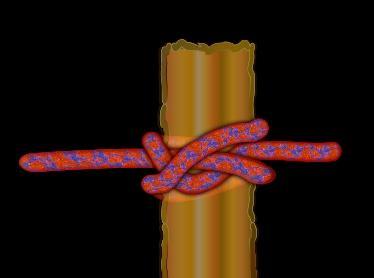
I thought I’d weigh in from a Scout’s perspective. I think your list of knots should be determined by your audience. In this particular case, you’re teaching knots to Boy Scouts and Girl Scouts so your list should include knots used for camping, hikng and other outdoor activities as well as emergency and rescue knots, climbing knots and some fishing knots. You may not be able to keep it 10. You also need to take into consideration what knots these Scouts are going to be “tested” on to achieve their various ranks and you need to teach them those knots regardless of your personal opinion of a particular knot.
Next week, my Webelos will begin working on their own knot boards. We’ll review the square, fisherman’s, overhand, bowline, half hitch, and sheet bend knots that they should have learned as Bears and Wolves. We’ll add to this the clove hitch and taut-line hitch. That’s 8 knots. All of these knots will be required when they cross over into Boy Scouts and are earning their Tenderfoot and First Class ranks.
I think you’ve got a pretty good list already, but I appreciate the fact that you want to fine tune it and stream line it. Just be careful what you cut.
Knotty Girl
Cadette Girl Scout Leader Troop 41934
Webelos Cub Scout Den Leader Den 5
Perhaps this is an indicator as to why we tend not to find the Constrictor in the wild, we just don’t teach it to our kids.
Two grades and no sign of the Constrictor, yet it is the knot I probably use more than any other (I also start with a Constrictor, poke the end through and dress with a pull to make the Myrtle loop, then tie out the end with a strangle).
I wonder how often we would see it in the wild if it managed to get on the list of ‘knots to be learnt’
Derek
And I wonder if the girls would take (more readily than boys) to tying decorative knots
(not excluding the practical, but in addition to …)!?
... some fishing knots. You may not be able to keep it 10."10" is an unfortunate number, based on its "roundness". And what can be learned should easily grow from some core, where the additional knots are seen as variations. As for "fishing" knots, I don't really see any in your list; the basic one might be the Angler's/Perfection Loop, fairly easily tied in monofilament line. I recommend that your "Overhand"--which I presume to be the stopper knot--be incorporated (or at least shown how to be so) in the Clove & taut-line (well, Rolling: tied to object) hitches as a way to prevent the locking HHitch from loosening (ditto for use w/2HHitches). If the Clove is show qua binder, it's a simple step to bring in part of the "Square" tying to yield the Constrictor.
You also need to take into consideration what knots these Scouts are going to be "tested" on
Oh, indeed the IGKT should: but with an eye to advising about the merit of that tested-on set,
not merely accepting it. Now, for some years (or some decade plus ago), the Surrey Six was a set
put forward and taught in just this spirit.
Thanks,
–dl*
Is that the same Surrey Six that recommended a re-threaded figure 8 loop as a hitch? LOL.
Google answers that (“yes”), nominally–then it’s up to interpreting “hitch”. (They show a round turn
in the Fig.8 eye around an object.) It could work qua ring hitch and as a minimal version of
the Timber hitch, and in a noose (in a few orientations, one shown by CLDay).) Interesting that the
single & not double sheet bend is presented, given the motivation for this set (slippery cordage).
(Sorry to see that their site suggests that one has “over 3800 [knots] to choose from”, alas.)

Now a re-threaded 8 with one or two round turns - that is a hitch to be reckoned with - if I wanted a ‘life anchor’ that’s what I would choose and you could laugh all you wanted.
Derek
Ok, I’ll bow to absurdity. I think I’ll put a round turn in all my loop knots just for fun and so I can call them hitches. (j/k) Well, except I still would avoid the figure 8. Too jammy.
I’m glad the IGKT website has chosen not to endorse or list the Surrey 6.
I think this discussion is starting to drift!
There are some uses of a “hitch”–a tying notion–in which the structure is so named
because it is a tying TO something (in contrast to making an eye that awaits employment).
Thus, in the case of some eyeknots, such “hitching” entails a “re-threaded” vs. “in the bight”
tying, by which it’s distinguished.
And, for some obviously OTHEReason (or bereft of reason!), the angler’s “Spider Hitch”
is named a hitch–I don’t know why.
But it’s this notion, I think, and not the turns present in the eye, for which “hitch”
is used. (You could raise the question to Howard Denyer.)
As for Derek’s assertion, I’m wondering: could you be meaning the Tensionless
Hitch (which in fact I recently photographed a matching pair of, at a climbing site
–it’s a structure I think is silly in most uses!)?
IMLHO the Tensionless Hitch is a model of superior strategy by professing not to let the Bitter End really deform the Standing. Then the only deformity is by the size of the mount, and how frictions go. Because the change in elastic stretch (and therefore diameter) etc. besides the most noted change from inline/unleveraged deformity by itself or mount while loaded \resisting such deformities) is another of suddenly impacting (thanx drLehman i believe) change as Standing goes to hitchings, it isn’t perfect, only better. But also a good target imagery of the holy grail of limiting impacting changes to fully loaded (and inline) Standing (Tension) Part for maximum strength. i’ve seen/used a Tensionless Hitch 2 ways, A) where the Bitter End is anchored to the Standing, and B) where the Bitter end is then anchored to something else/ not to the Standing (Tension) Part. Of course B) doesn’t bend/deform the Standing at all, no impacts or low(nor spin on that 1 dimension). This is where ‘strength’ is more dependent on host/mount size/ bending of Standing (deformity by Bitters is limited/Zer0), but then still would suffer from weaknesses per the other type of ‘upsetting the flow’ changes(and their suddenness) as stated earlier. Best is no change, force flowing in 1 dimension, as this changes to 2 dimensions etc. we have leverage(but then must recognize changes in 3 dimensions (not just inline pull altered by single, simple bend).
But, in using strategy A) i think in terms of impacting (which could lead to a more deformed Standing (Tension) Part than Cow, Clove Running Bowline etc.) or slick (surface) host/mount could give different results than a rough spar, by bending Standing more than other situations. i think the idea is to get such a reduction of force in line as it trails to Bitters, that the Bitter End doesn’t bend / deform the Standing (Tension) Part; so i like to think in terms of a Round Turn crossing itself under the main tension of the Standing, then another Turn or more, then attach to Standing by Bowline or ‘krab’(carabiner) for more modular setup/ breakdown, quick release. But, all these strategies can turn against ye, if the direction of the loading changes, and the line is set hard, so now eye can bend Standing more (if pull direction is away from the Standing). so, now the tables are turned; for the same non-slip for less tension in Bitter End that seems superior, can now (direction dependent) against us, as that means less self adjustmeant to lower loading (Nature would otherwise seek out). Strategy B) does allow this self adjustmeant.
As to the 10 most wanted, perhaps that is audience dependent (as a number), perhaps the youngest would have a target of 4 or 6 in scouts. Even later, could keep it low yet high, by learning Clove or almost Clove, at the point of a Crossed Turn + Turn) to make Constrictor, Bag Knot (if the Bitter tail finishes as a linear Round Turn, rather than Turn, could we call it a Double Bagger?), Groundline for 4 knots known(but really 1 base + 4 different ‘endings’ with Bitter End). But, then the wealth of background and knots to know for the scout leader hustling to L-earn these things, would be more to fill in blanks and adjust to specific uses etc., able to field questions etc. i think ye’ol Guilde should have a setup, tiered recommendations of such things perhaps extending to fishing specialties etc.(then ask that audience and grow, expand), and take their place as the authority of these things(on internet and elsewhere), to these youngest (deepest planted seeds of future) for own good as well as fighting these things from becoming extinct. Those that wandered in here with this question should have come to the right place, and have it waiting for them, if not at least the immediate place/places to go. They should not have to chase it down as we’ve had to; where else is an informed person going to look first? Who has a better chance of having that whole audience, doing the most good etc.? Perhaps in time evolve to recomended scenarios (camping etc.) to teach in fun setting and applications of actual use, downloadable pdf, whatever.