Two by Four knot (or what knot is this)

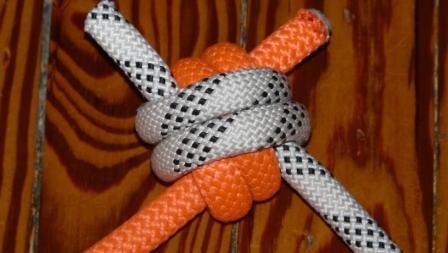
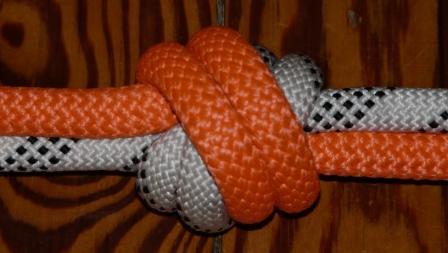
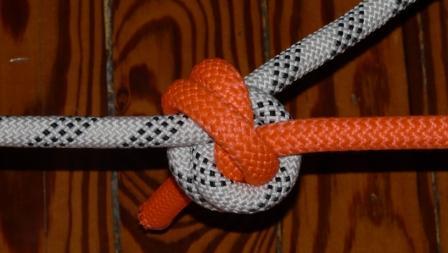
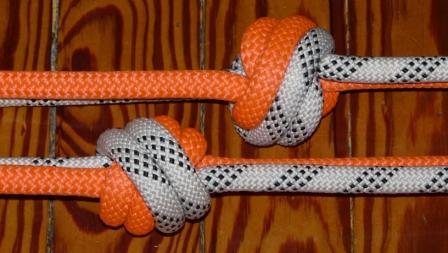
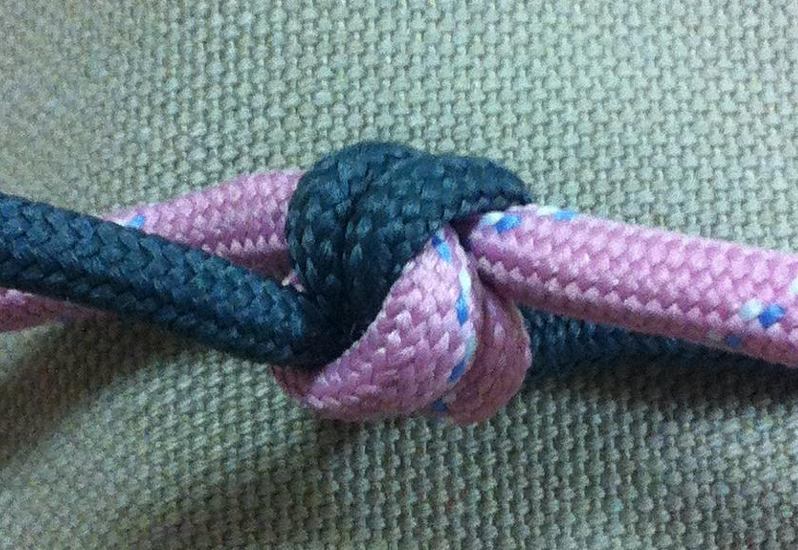
    While experimenting with ways of tying a bowline I somehow ended up with a loop tied with a whatknot -- ABOK 1406. This simply seems to be a round turn around a round turn. I doubled the knot and dubbed it the two by four (2x4) -- two round turns around two round turns. 

    It a handsome knot to my eye. It seems very secure, even in small monofilament, although very difficult to impossible to untie after loading. I hope to do some controlled load tests to check on its strength, used as a bend as well as a loop. I would expect it to be fairly strong since each set of loops pass

es completely around three diameters of the opposite cord.

    Has anyone seen this knot described or tied anywhere?

    Thanks, and best regards.

IMG_1353.JPG

Welcome to the Forum James. What you have tied is in effect what is known as the anchor hitch variant (sometimes anchor bend variant) where the first round turn is tied around a ring or pole and the second round turn applied as you have done. This is sometimes used by tree surgeons (arborists) as a harness tie in knot and having something inserted into the first round turn makes it less jam prone. This knot uses the working end of a single rope rather than 2 ropes and is a hitch (despite being called a bend by some) - no doubt it works as a bend without a ring etc but being so difficult to undo limits its use.

Barry

Hello James and welcome. Thank you for sharing.

I have finagled some cord as you have with this, but only in an eye-loop form. I have to say that when loaded it is a true bear to untie. I had to use a spike and round nose pliers! I tied it using 6mm accessory cord that has a fairly smooth sheath and is of a firm construction.
I can only imagine the difficulty of disassembling it in soft frictive rope.

It is a little bulky, but that is not a drawback to me.

It lends itself to a more “permanent use”, whether loop or bend, imo.

I will try it with other cords and ropes I have, especially the 5mm Titan Dyneema.

SS

Greetings, James ! :slight_smile:

The knot that you show is interesting, in being symmetric
whether loaded A-v-1 or A-v-2 (where the joined ends are
named by A-B & 1-2, B/2 being the unloaded tails in what
you show --only clearly indicated in the topmost image).

For an eye knot, I’d prefer to enter the “rabbit hole” nipping
loop from the opposite side to that in which the tail enters
for the bowline --i.e., to be reeving the tail in the opposite
direction. And thus I call such eye knots “anti-bowlines”.
The basic one(s) do show up in actual use, from time to time.

Trying your knot in some slippery small shopping-bag cord
(yes, I salvage that, occasionally), I see more rotational
movement upon tightening than is comfortable to me;
maybe it will eventually --tails long enough-- come to a
jammed conclusion and the knot hold, but I’d rather not
guess at that! Apparently you’ve gotten it to hold to breaking
in nylon monofilament fishline?

(I don’t see this as all so directly connected to the extended
fisherman’s /anchor bend although I see the matching wraps,
but note also the quite different loading of these structures.
And, as for Ashley’s urged nomenclature re “bend”, I decline
–too much going against that, as Day noted.)
:wink:

–dl*

What a difference a tuck can make !
I had tried all the possible hitch-to-hitch ( so to speak ) bends, but I have never tried this two-round-turns to two-round turns most simple one… :slight_smile:
Why ? Possibly because the two round turns are not sufficient to offer the gripping power of a hitch - so they are not considered as a knot, “a hitch”, at all. However, when those two very weak hitches work in tandem, the one enhancing the gripping power of the other, the two round turns turn out to be more than enough ! Moreover, at the same time, the tails of those two hitches are efficiently encircled and secured.
In a curious way that I can not predict in advance or explain, at some of those hitch-to-hitch bends, when they settle in their most compact form, the two standing ends are parallel / aligned to each other, and at some other they are perpendicular to each other. I think that, at the hitches where the standing ends are perpendicular to each other, their forced subsequent alignment will generate sharp first turns - and this may be a disadvantage.
See the attached picture for two forms of a Strange-to-Strangle bend. At the first, the Standing ends ( and the tails )of the compact knot are perpendicular to each other - like it happens in the Two-round-turns bend presented in this thread - while at the second they are parallel / aligned.


Strangle 4-ends bend (side front view).JPG

Strangle bend (front view).JPG

Two more hitch-to-hitch bends : The Clove bend, where the standing ends of the compact knot are perpendicular to each other, and the Trefoil bend, where they are parallel / aligned to each other.
Now, if it turns out that the Two-round-turns bend is sufficiently secure, and we do not care about jamming and untying, it will serve as a very useful, easy to remember and to tie permanent bend.

P.S. I have tried this bend with many different ropes. It works fine with the soft ones, it does not work at all with the stiff ones, but the main problem is that I could not predict in advance if it was going to work with something in between…It is too much material-depended. Also, on material of intermediate stiffness, it will work, but only after a careful dressing, where all fingers are needed - and then some ! :slight_smile: So, I conclude that, if I am to tie something like this, it will cost only a few seconds more to tie the Strangle bend - and then sleep like a baby.


Clove hitch bend (front view).JPG

Actually the simplicity of the 2x4 is what initially pleased me when I tried it out. It is virtually impossible to forget.

... P.S. I have tried this bend with many different ropes. It works fine with the soft ones, it does not work at all with the stiff ones, but the main problem is that I could not predict in advance if it was going to work with something in between...It is too much material-depended. Also, on material of intermediate stiffness, it will work, but only after a careful dressing, where all fingers are needed - and then some ! :) So, I conclude that, if I am to tie something like this, it will cost only a few seconds more to tie the Strangle bend - and then sleep like a baby.

I have to agree. I find the strangle on strangle you posted extremely handsome, especially the version with standing and working ends parallel. It looks very much like a two-strand Matthew Walker. It would make a very nice lanyard knot. I also like the naming potential for a strangle-on-strangle knot, the “SOS” knot.

As I mentioned, I have done some simple tests on 6# test fishing monofilament with the 2x4. When carefully drawn up, it hasn’t slipped and seems quite strong.

:slight_smile: You solved half of the puzzle…(1) ( See the attached pictures )

  1. http://igkt.net/sm/index.php?topic=1919.msg16859#msg16859

the answer.JPG

Not quite as easy to tie, the strangle bend with ends parallel to the standing parts might be used instead of the double fisherman’s eg in permanent (or at least semi-permanent) slings - it’s shorter and a little fatter but neat. I tried the original form with 30lb monofilament but it wouldn’t hold - it might need extra round turns something like the Jansik Special. The strangle version would no doubt be better but also very fiddly to tie in fishing line unfortunately. I’ll try again when I have some time.

Barry

Here comes the question :
The Strangle bend and the double fisherman s knot (=bend) are made by the “same” kind of links - the double overhand knots -, interlinked in two different ways. In this sense, these two bends are “similar” knots.
Now, let us suppose that we tie them on one material, where the Strangle bend is proved to slip less / be more secure than the double fisherman s ( or vice versa). If we tie them on a second, different material, will this continue to happen ? If the A bend slip less / is more secure than a “similar” B bend when both are tied on one material, will it slip less / be more secure when both will be tied on any other material ? In other words, is the form, the structure of two " similar" knots the only thing that determines their relative security, or the material can also play the decisive first role ?
If the Strangle bend does not hold when tied on a 30lb monofilament, but the double fisherman s does, this might imply that it will also be less secure / slip more than the double fishermsn s bend when tied on any other slippery material. Is this what is happening ? If it is, indeed, I suppose we should dismiss it altogether right away - why we should use a particular knot, when a very similar one will always do the same job much better ? As it might happen to us to have to join two ropes we meet / use for the first time, it is possible that we will not know, in advance, if those ropes are more or less slippery,- so I guess we should not take any chances.

I haven’t tried the Strangle bend in monofilament (only the OP’s bend) and it is not a knot which appeals for this material because of the difficulty of tying. However monofilament is an extreme case - it is so stiff and slippery that few rope or cordage knots will hold but at the same time most knots tied in monofilament will not be effective in rope or cord as they rely on the extreme slippery nature of the material especially hitches for attaching hooks etc which need to be lubricated to make sure they slide into place. The sort of material I had in mind for considering the Strangle bend against the Double Fisherman’s is accessory cord which although stiff is not particularly slippery. In any case there is certainly no guarantee that a Double Fisherman’s will always be secure enough - hence the use of the Triple Fisherman’s.

Barry

Come on ! :slight_smile: The Strangle bend is but two double overhand knots, interlinked to each other with the most simple way they could possibly be interlinked ! :slight_smile: I could argue that, in fact, it is easier in tying than the double fisherman s knot(=bend) - but it suffices to say that it has the same number of turns and tucks, and a much simpler interlocking mechanism of the two links. ( I had called the Strangle bend as a two simply interlinked overhand knots bend, and the double fisherman s knot a two interpenetrating overhand knots bend. )
The Trefoil bend has an added tuck, indeed ( the Working end goes through the central opening two times -, so, in a sense, it is more complex than a double overhand knot ), but one can not say, even for the Trefoil bend, that " it is difficult in tying". In fact, the pattern of tying it is even simpler than the Strangle and the double fisherman s bends : each time you form a round turn of each link, you pass the working end through the central opening of this link.

I like to test knots that I might use in slippery materials. Two other extreme cases are tying knots in shock cord (bungee cord) and in rubber bands. Again, with several quick tests, the 2x4 holds very well in 1/8" shock cord, and can hold well in rubber bands (my rubber bands are made from natural rubber and are approximately 8" when cut) when very carefully drawn up. The strangle bend also holds like a champ in my 1/8" shock cord. I haven’t tried it in rubber band – tying the 2x4 in the rubber bands was fiddly enough, as simple as the knot is.

I do not know anything about knots on those elastic materials - and I even doubt that a “knot” tied on such very elastic material belong to what I have tried to define as a “knot” (1). If we allow the deformation of very elastic material to all dimensions, we end up with knotted membranes, knotted amorphous masses, knotted amoebae s pseudopodia, and all that… :slight_smile:

  1. http://igkt.net/sm/index.php?topic=3610.0

Have you tried tying a Fisherman’s Knot or Strangle Bend in monofilament fishing line? Neither are knots I would use in this material which has its own set of knots with generally a lot more wraps. Incidentally the Grinner Knot used in fishing line is not the same as the Double Fisherman’s Knot even though the name “Grinner Knot” is used to describe the Double Fisherman’s in rope/cord.

Barry

I suppose that the first question is a rhetorical one…
Of course, no fisherman, be him a knot tyer or not, :), would ever use those knots in his monofilament fishing lines !
However, that was not what I replied to your statement, that :

I replied to this “difficulty of tying" . :slight_smile:
The Strangle bend is very easy to tie, perhaps even easier than the double fisherman s knot (=bend). It was meant to be a bend for ropes, not a fishing knot ! I do not know if it will hold better if tied on monofilament, than a double fisherman s knot(=bend), tied on the same monofilament. And I do not know if it will hold better or worse than the double fisherman s knot (=bend), if both knots are tied on another kind of slippery material, Spectra/Dyneema for example.
However, my question was not this… I wonder if the fact that a knot holds better or worse than another, " similar” knot when both are tied on a very slippery material, can be extrapolated in the case where the same knots will both be tied on another, less slippery material.
Why am I asking this ? Because, if it turns out that we could answer this question in the affirmative, we can test out knots in monofilament, see which knots hold better than the others, and then suppose that the same knots will also hold better than the others when they will be tied on the common materials we use in everyday life. So, we could possibly measure the degree of slippage of knots when they are tied on monofilament, and use the results as a means of predicting a similar behaviour when the same knots will be tied on less slippery materials.

Thank you to all who have responded to the original post about the knot tied with two round turns around two round turns. Your replies have all been very informative and interesting, and it is easy to get carried away in discussions about other more or less related knots.

I agree with many of the replies that there are probably better loops and bends for most purposes. I especially like the strangle knot on strangle knot posted by X1. I further agree that the 2x4 knot has some similarities to a variation of the anchor bend (ABOK 1843, if I am not mistaken), I don’t really see it as being a variation of that knot – each part only encircles two diameters of the opposing part.

However, I am still left with the original question, to wit, whether anyone has actually seen this knot described or in use. I had thought that this knot was too simple to have been overlooked, but it seems that may not have been the case.

Thanks again to all who have responded for your warmth and erudition.

You are not alone ! Ashley thought the same thing… :slight_smile:
“I supposed that everything of so simple a nature had already being discovered.” ( ABoK. p. 7 )

Who knows how many more “too simple knots” are still hiding under our noses…

I do not quite use this knot, but i use an extremely similar knot, to make rope nets. The only difference between what i use and what you use is that when i tie it, i have the two loops going the opposite direction to pass through each other, while you use the loops going in the same direction (what i mean by this is that i use two loops like the two loops you would use to tie a cow hitch, while you use two loops like those you would use to tie a clove hitch.). I also tie it by thing the last carrick bend in abok (i forget the number- it’s in the bends chapter and described as the worst possible carrick bend) and then doubling the loops from there. When i say net, what i mean is that it is the knot i use to tie together a bunch of ropes in a pattern of squares; at every point where two ropes intersect, i tie one. There are a lot of knots that do this nicely, but this is my favorite one. Also, I had never seen anyone else tie it before.

Just a note on this forum: when there are as many knots as there are, it is very hard to remember all of them and use all of them. Everyone has their own preferences when it comes time to actually tie something, and most other knots are more for fun. That said, people still do tie all sorts of knots, and those are the people here. So, when you ask a question like that, it’s very, very hard to conclusively determine if anyone else has tied the knot before and described it. New knots are invented every day, so the fact anyone can even know anything about all the knots our members know of is impressive. However, those questions are notoriously hard to answer. I find it better to think about the real question “what would i use this knot for?” and then tell everyone else about it. Chances are, the knot will have tons of other uses, and tons of similar, equally interesting knots, and those are some of the funnest things to find.

Also, even if the knot has been tied before, chances are it was not formaly described at any length. In addition, nothing is ever too simple to be overlooked. Almost all knots of any theoretical or practical interest are simple, and we have described only a fraction of all of those.

As an example, I have tied almost the same knot that you show here, in almost every detail, hundreds of times, yet i have never before tied this knot. On some level, the fact that something so simple is so often overlooked is one of the greatest things about knots.
More often the reasons knots are not documented is not because they were overlooked, but rather because they were looked at and rejected for one or more reasons.

That’s not necessarily a bad thing. If all knots are equally covered, you’d soon be so buried in countless tangles, you’d have a much harder time finding good knots.