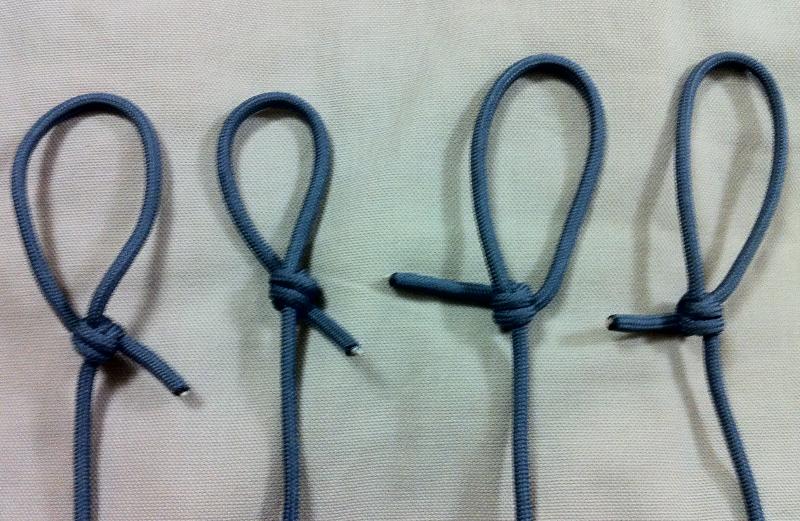
Two by Four knot (or what knot is this)

How do you support this assertion?
(How does one go about researching this proposition?)

And what do you count as “(not-over-)looked” ?! --e.g., is it
a matter of publication, or rather some awareness (of we who
are counting) of existence.

We can see, IMO, cases of things in common usage but not in
books (e.g., what I call the “reverse ground-line hitch” binding
hitch of commercial fishing, to bind lines & netting, to attach
netting; yes, the geometry is published, but not this common
application, to my awareness),
and some things well-published in books that aren’t found
“in the wild” (e.g., the sheepshank is something foreign to my
observation, and also the interlocked-overhands knots).

.:. I surmise that the greatest number in our counting will be
of structures simply not considered --we have the infinity of
things on our side, here, or some large number, however one
works “simple” into the counting as a constraint on number.

One should wonder about what sort of process(es) knots endure
in coming to be known, to be part of the state of the practice.

–dl*

There’s not many of us, but knot enthusiasts evaluate thousands of knots and pass on, in my experience 99%+ of them for real practical use. I’ve evaluated and rejected the knot in this thread over a decade ago, as an aside.

These thousands of discarded knots far exceeds the number of new knots that are being put to use. I can’t imagine this even being a close call.

There's not many of us, but knot enthusiasts evaluate thousands of knots and pass on, in my experience 99%+ of them for real practical use. I've evaluated and rejected the knot in this thread over a decade ago, as an aside.

These thousands of discarded knots far exceeds the number of new knots that are being put to use. I can’t imagine this even being a close call.

I feel James posted his offering in the correct place. It was new to him and he could not find reference to it in his searching and I believe he wanted to discuss it.

I also constructed this form of knot, but as a loop and found it to have some merits, although it does jam easily in the cordage I tied it with. But, that is not necessarily always a bad thing, imo.

We sometimes look at various “new (to others)” knots, not because they fail with ropes of yesteryear, but because they may lead to a knot or knots that can work with the upcoming difficult ropes.

This Board is for exploration and if and when an offering is confirmed sufficiently by some consensus it can be entered into the practical hall of fame.

SS

I was replying to a comment by Dan. I was not intending to weigh in on any of the issues you’re discussing here.

True, we are a small group; but do folks such as us
even matter --what WE do/don’t, so what?
Ashley has published some of his whims, but to what effect
that, even? --that he published what Day christened “Ashley’s Bend”
and which publication has been now echoed elsewhere,
does it make a dent in the Wild?

Re B, that’s a powerful figure, which I doubt. I’d count now
some 2000 --just a rough guesstimate, with some actual
counting of segments of the work-- knots for myself
that are urecorded[/u] and figure maybe another 25-50%
(ha : I’ve a low standard!) not so? I really wonder that many
others can do as much, and then of what the overlap is.

Re C, “pass on” first manifest in me as “give to”, but you
mean “ignore”, “pass by”!

Re D, yes, this sort of knot one would expect to have seen
some hands & consideration play. Can’t say that I did so.

:slight_smile:

I would like to be able to make a difference in the wild, even if it seems impossible. The Guild does not exactly advertise; i went years before i found out about this group, and i am sure there are several knot tiers who know nothing about anyone else like them. Also, to learn knots of their own means, these people may provide invaluble new viewpoints on knots. I would say our best chance to educate more people would be to go to schools, and teach knots. Besides which, an education is hardly complete if someone lacks such crucial skills as how to tie a bowline. Personally, i think that organizing something like this http://igkt.net/sm/index.php?topic=4141.0 is our best option. In this way, we could appeal to vast audiences of students, and perhaps even impact “the wild”. At the very least, we could get the guild’s name out there a little more, and appeal to those who are already interested.

After looking more carefully at ABOK, I realize that I gave the incorrect number (ABOK 1406) for the knot that led me to discover the knot that is the topic of this thread. The correct number should have been ABOK 1407, which Ashley characterizes as “at all times unpredictable.” Having doubled each of the round turns, I arrived at the current knot, which is to the extent that I have experimented with it, at all times predictable, easy to remember, and secure – bordering on impossible to untie if heavily loaded, especially in frictive material and shock cord.

It occured to me that if I were to take this single-round-turn bend/loop (one arrangement of the whatknot (ABOK 1407), and pass the working end under the standing end on each cord, I would end with four additional variations, two of which turn out to be two strand Matthew Walker knots – an overhand knot on an overhand knot. So one could argue that ABOK 1407 and the two strand Matthew Walker are members of a group of knots having a round turn with or without a tuck on each turn.

Having doubled each of the round turns in ABOK 1407, I arrived at the knot which is the subject of the current thread. X1 was so kind as to post pictures of similar ans related knots (the strangle bend, the trefoil bend, and the clove hitch bend – have any of these been officilally described? If they haven’t, they deserve to be). I would propose that these knots bear the same resemblance to the 2x4 (two-round-turns) bend/loop as the Matthew Walker bears to the whatknot (ABOK 1407) – the most basic form of the knots in each group start with round turns and progress to more complex forms when the working end rides over or is passed under a previous turn or turns in the same cord.

round turn > overhand knot

round turn on round turn (ABOK 1407) > Matthew Walker knot

two round turns > clove hitch
> strangle knot
> constrictor knot
> picket line hitch
> etc.

two round turns on two round turns > strangle bend
> clove hitch bend
> etc.

Also, if only one of the round turns is doubled, we arrive at an knot that seems equally as predictable, very stable, and perhaps nearly as strong as the two-round-turns bend/loop, although I prefer the loop variant in the photo.

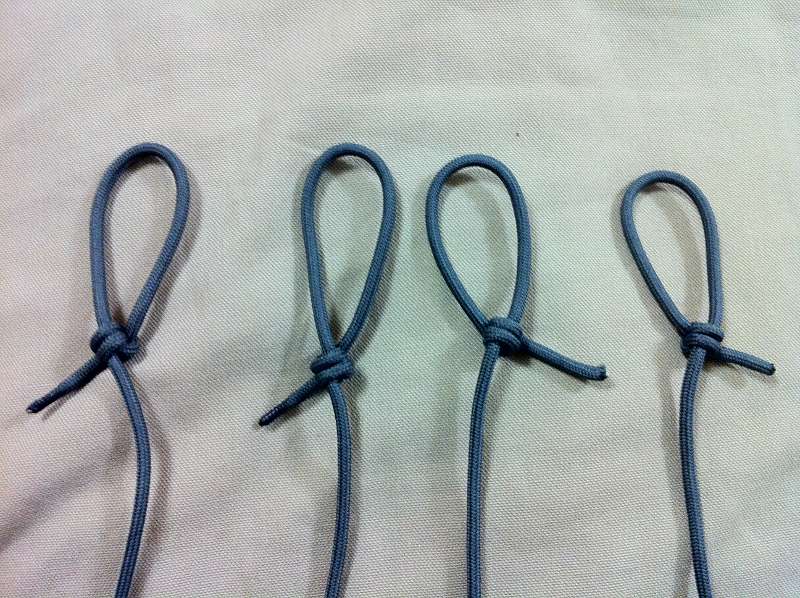
After more fiddling with tying the two-round-turns loop, I realized that there are actually eight possible configurations, with four being mirror images of the other four. Those where the working end passes over the round turns before passing through the center tend to sit more squarely when loaded, while those where the working end passes through the center beginning on the same side of the knot sit more diagonally.

Up to this point, I don’t know which kind of loop is stronger. But this weekend, I got myself set up to start testing the strength of the knots. I plan to test them in various types of string and small cordage, including small diameter shock cord.

I began doing some strength testing on one of the strings I had planned to use to test some knots, and to my dismay, having carried out the same test 30 times, found that it broke anywhere between 3.7 - 8.0 kg, averaging 5.87 kg. The length of the string under testing was approximately 40cm. With that much variation in the breaking strain of the string, how many tests should I conduct on the string without knots until I have what would be an acceptable average breaking strength? Or would it be better to test a longer length of string each time? And how many times would I have to test each knot? Or would it be better to simply try to find a more consistent string? Any thoughts or guidance would be greatly appreciated.


IMG_1485-scaled.jpg

IMG_1481-scaled.jpg

My gut feeling tells me that if you should use a thicker cord, of a larger diameter - say, of 1/4 of an inch, at least. In such a cord, a minor local default would not be able to play a major global role, and your results will be more consistent. You can plot them, and exclude the one or two that may happen to lie way outside an expected smooth, dense bell curve. 20 results per knot per material would be more than enough I guess - provided you will be careful to dress the specimens with the same way, and load them with the same (very slow) pace.
If you use a solid braid rope, you will not have to test the mirror symmetric knots, and your segments will remain round. Easily flattened ropes can lead to very different results - because most probably they will not be flattened at the same points, to the same degree. The more individual characteristics and “memories” a material can have, the more different the results that it is likely to generate. To address this issue, I have thought of using nylon ropes. Nylon can be stretched a lot, so it would probably produce more consistent results - because the distribution of tensile forces inside the knot s nub would be more balanced, and any local maxima would be spread and smoothed out, on a larger area.
I believe that comparative tests are always more useful. It would be great if you could test your knots against the golden standards of bends - the Zeppelin bend, the Water bend and the double 8 bend.
At last, a knot tyer that does not only TALK about his knots, but TESTS them ! A miracle ! :slight_smile: Good luck !

I have completed a small test of the two-round-turns bend/loop (I originally called it the 2x4 -- not sure what I was thinking, because 2x2 would have been more logical). I used 3 strand fairly loosely Z-laid nylon twine, each strand having 10 filaments. Over the course of the tests, the twine had an average breaking strength of 34.98 kg. I tested only the bend form of the knot and in only one configuration -- that with both round turns following the lay of the twine.  As X1 suggested, I tested other knots as well, including the zeppelin bend, the water/tape knot, and the figure 8 bend. 

Testing was carried out by first loading the twine until it failed. Next, the four knots were tested -- the zeppelin bend, the two-round-turns bend, water knot or tape bend, and the figure 8 bend. I followed this  procedure throughout the testing to (hopefully)  mitigate any gradual variance in the breaking strength of the twine. 

The two round turns bend can be made in several ways in relation to the lay of the rope or twine. I tested it with the round turns made in the direction of the lay. That is to say I tightened the lay of the first twine until a round turn formed then doubled it in that direction. The second line was laid parallel and the round turns were made around the first line in the same direction. I had originally planned to test knots tied with the other two orientations -- one set of round turns with the lay and one against the lay, and both sets or round turns against the lay --  but I found that they ran in all instances and stopped testing them with the current twine. 

I first discovered this knot while fiddling with ways of tying the bowline and was/am most interested in it as a loop knot, but I thought I would start out by testing it as a bend. I plan to do further testing as a bend in braided line before starting testing as a loop in both twisted and braided line. Since a variation of the knot can also be tied with one round turn on two round turns, I feel it is probably better to refer to them as 2x2-round-turns bends/loops and 1x2-round-turns bends/loops.

All of this having been said, the results were as follows:

Average load at failure:

twine…34.98 kg
zeppelin bend …27.15 kg or …77.63 %
2x2-round-turns bend …70.95 kg or …70.95 %
figure 8 bend…31.10 kg or …88.91 % – amazing!
water/tape bend…24.25 kg or …69.33 % **

** The water bend slipped badly in 6 out of 20 tests, two of which later jammed and failed at the knot, which were included in the data. The other four instances were left out of the data for the average failure load for the knot. The average is based on the other 16 tests.

Overall, I was impressed with the performance of the 2x2-round-turns bend as tested, in the medium it was tested. I hope to do further tests in other media, specifically, in tighter-laid synthetic and natural cordage and in natural and synthetic braided cordage.

If you have the data still, would you be willing to post the minimum loads at failure?

Great ! Congratulations, J.P.

Let me make some suggestions.

  1. It would me much better if you use solid braid rope - otherwise the “helicity” of the laid rope can interfere with that of the knot, and the result could become unreliable. Also, if you could use thicker ropes, with more stands, which generate more consistent results. Take a big breath, and go to the 1/4 inch ! :slight_smile:
  2. It would be useful to publish some more characteristics of the rope, as diameter and weight per unit of length.
  3. You should calculate and publish the standard deviation of your results.
  4. It would be very useful if you classify the exact point of rupture at each knot, and publish the relevant statistical results for this parameter, too.
  5. It would also be very useful if you refer to the specific temporal pattern of loading. How slowly or quickly was it applied on the standing end ? How much time elapsed between the start of the loading and the moment of rupture ?
  6. The Water bend can be dressed in a number ways. You should specify the exact way you used. ( I have conjectured that the way shown at the first attached picture would lead to stronger knots). I suppose you dressed the fig.8 bend in the most “common” way, shown at the second attached picture, because it can also be dressed it in a number of different forms.

Thank you J.P. This is the only article I have seen in this Forum that has NUMBERS on it ! Thank you too, KnotGod. Please, help me, too, write such articles, when I will grow up !

How did you measure the weight it could hold to hundredths of a kg? What type of device did you use to get the numbers?

Also, could you get data for a triple fisherman’s knot? That is the only bend I have ever seen used by climbers, and I’d like to see if it is really so strong as they say…

twine ALAF…34.98 kg MLAF: 33.00 SD: 1.52
zeppelin bend ALAF…26.98 kg MLAF: 24.00 SD: 1.86 SOK: 77.13 %
2x2-round-turns bend ALAF…25.12 kg MLAF: 23.10 SD: 1.44 SOK: 71.80 %
figure 8 bend ALAF…31.10 kg MLAF: 28.00 SD: 1.78 SOK: 88.91 %
water/tape bend ALAF…24.25 kg MLAF: 18.90 SD: 2.38 SOK: 69.33 %

Key to abbreviations:

ALAF Average Load At Failure
SOK Strength Of Knot
MLAF Minimum Load At Failure
SD Standard Deviation

The scale I used measures weight to 1/10 kg. After testing, I entered the numbers in a spreadsheet, which calculated to two decimal places. Rather than round or those numbers, I simply left them alone. I apologize for any confusion this may have caused.

Still, did you just weigh a bunch of objects and attach them to the twine? Do you have a spring scale attached to the rope? Also, how did you get the twine to attach to the weight?

In short, what exactly would i do to mimic your test?

How very embarrassing. First I say (accurately, BTW) that it consists of a round turn around a round turn. Then in the next breath, I say it is (it isn’t!) “two round turns around two round turns.” Either nobody noticed it – not highly likely --, or you were all to polite to mention it. Thanks. I think I’ll just start calling it the “lazy dog loop/bend,” since it just goes round and round.

Today I began some testing on the loop forms of the knot, both two round turns around a single turn, and two round turns.. Still using Z-laid nylon with 30 filaments for the sake of continuity. X1 suggested that I test the bend form of the knot as well as at the same time testing several other knots for comparison, including the water knot/bend, the figure 8 bend, and the Zeppelin bend, since these are “the golden standards of bends”, which I have done. Thanks for the guidance, X1. Now my question. What are the golden standards for end of line fixed single-loop knots? I have started testing along with the overhand loop(ABOK 1009), the bowline (ABOK 1010), the round-turn bowline (ABOK 1013), the figure-8 loop (ABOK 1047). What other knots would make good comparisons. Once again, any guidance will be much appreciated.

Thanks all, and Happy Christmas!

There was a lengthy thread in this Forum, about what is “a round turn”. To me, a round turn is a 360 degrees turn of the one leg of the loop relatively to the other. When we have one and a half round turn ( 540 degrees ) we sometimes call it - inadvertently - “two round turns”. If you want to be precise, mention the number of degrees, not the number of “round turns”.

The “king of knots”, of course, the bowline. The retraced fig.8 loop comes second, because, although it has some shortcomings, it is still used by the majority of climbers, and its security and strength have been tested and are reported to be superb. If I would have to choose a third one, well known to most knot-tyers, I would have picked the Anglers/Perfection/Tugboat loop(s) (?). I do not believe that the overhand loop (ABoK#1009) you mention is used very often by knot-tyers, because it may be difficult to untie, but, as the most simple loop of all ( a double line overhand knot ), it, too, can serve as a standrd.

Actually, the reason I went back and looked at my original post was that while perusing ABOK I happend onto page 13, knots 40, 41, and 42. Ashley seemed pretty clear on “loop, round turn, and two round turns.” But I guess those who used that particular vocabulary/semantics have for the most part died, and the language continues to evolve. But for pure brevity in speech, Ashley still wins. “360 degrees” (seven syllables) -vs- “a loop”(2), or “720 degrees” (8 syllables) -vs- "a round turn (three). Perhaps if we wanted to use smaller numbers, I guess we could use radians. :wink:

http://igkt.net/sm/index.php?topic=710.msg4811#msg4811

Cast your vote here… :slight_smile:

I made a 3x3 version when I wanted to make a bend based on the Monkey’s Fist. It jammed up solid. I removed turns and rearranged coils and eventually re-invented the Rosendahl Bend 9 years before the publication in Boating. There are a lot of variations of where the ends go into the coils. Do the coils of one rope go toward the standing part of the other rope or away from it? One of the 1x1 variations is a Granny Knot. Graumont and Hensel, in The Encyclopedia of Knots and Fancy Rope Work, page 24, call a 2x2 variation the Jam Bend and say it “is of no proctical value.”