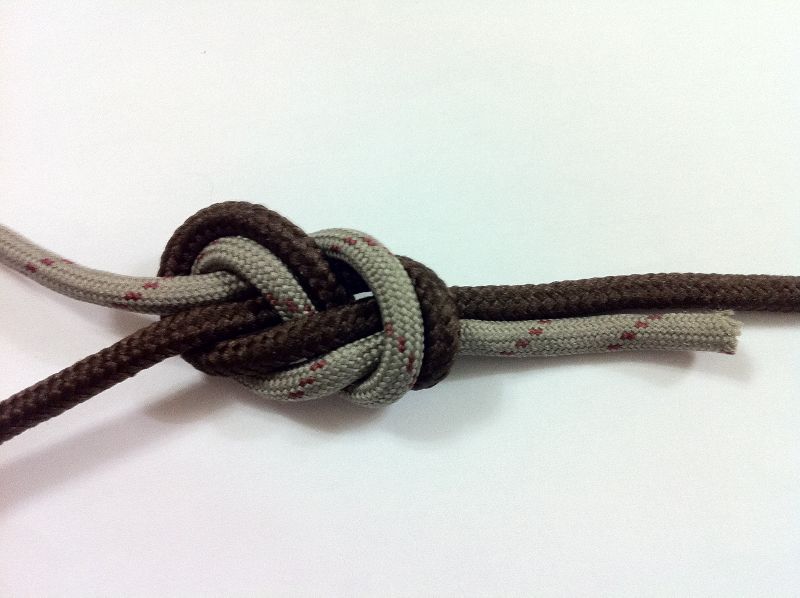
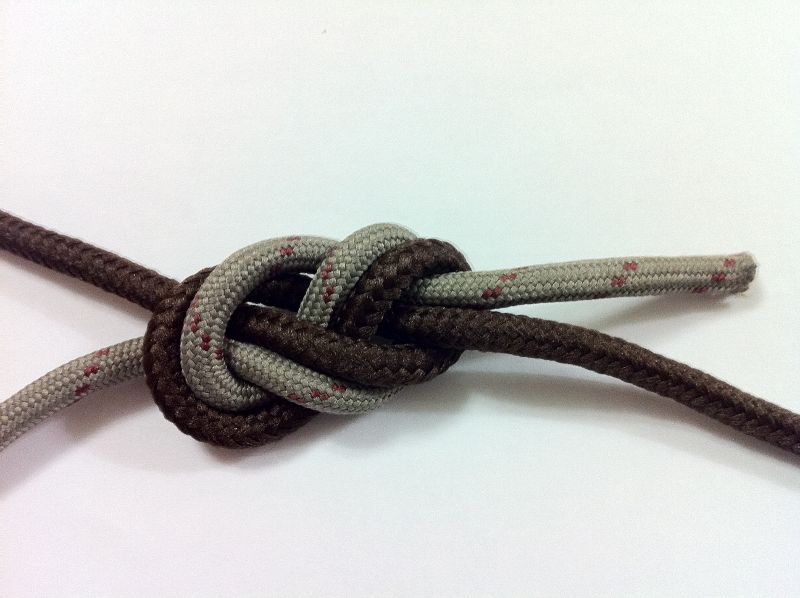
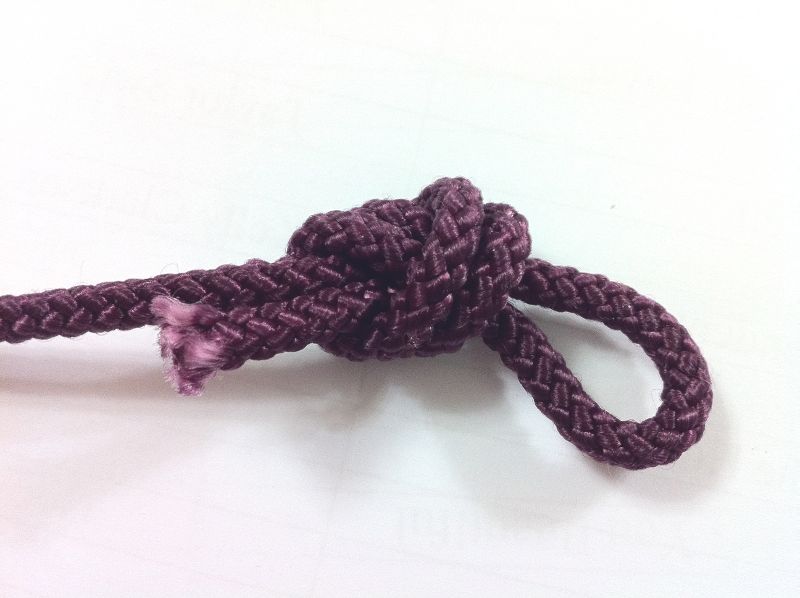
In the version of the bend I have been testing the coils have been made with the lay. The way that if you tighten the lay a loop will form. I guess that would mean that the coils move away from the standing end of the rope. (In this configuration it can be dressed to look very much like a two-strand Matthew Walker and exactly like X1’s strangle bend). In the nylon twine I have been testing it on, it runs every time if any of the coils are made against the lay. This might not be an issue in natural cordage. I am currently doing some testing on the loop form(s) of the knot, in the same Z-laid nylon twine.
One of the 1x1 variations is a Granny Knot...
Sure enough. I had noticed the whatknot form but hadn't pursued it any further. The granny knot turns out to be the version with the coil moving away from the standing end of the opposite rope and the whatknot (ABOK 1407) is the variation where both coils move toward the standing end of the opposite rope..
The Encyclopedia of Knots and Fancy Rope Work, page 24, call a 2x2 variation the Jam Bend and say it "is of no proctical value."
Finally, a reference to it. A seized version, no less. Thank you. I can see where if this were tied in natural fiber rope and loaded, it would be impossible to untie, especially after becoming wet. I can't imagine such a knot actually being used in the days when sailing ships ruled the seas. But times change. Someone in a fairly recent post asked for a loop knot that is very hard to untie.
This bend is evidently much “simpler” than the Zeppelin bend - iff by simplicity we mean things that are related to its topology, or its structural mechanism, or the conceptual image we have to memorize/remember in order to tie it. However, if we measure the simplicity of a knot according to how much convoluted is the path the working end(s) follow in space going around and into its nub (1), we will see that, in fact, the difference between this bend and the Zeppelin bend is very small. Having said that, I proceed to my next point :
Although I have to admit that I am seduced by the maximal simplicity of the Symmetric Sheet bend, I do not believe that knot tying is some “competition”, with “winners” and “losers” - and that we should not explore a knot which is less simple, less strong, less secure, less easy to tie and untie , or “less” whatever, than another… The same happens with any artefacts, so we are watching movies and reading novels that may be “less” something than the ones we have already seen or read - to say nothing about the most beautiful artefacts of this world, women… Knot tyers are exploring all the interesting knots that might exist, within some very broad limits, which are put so to keep their total number reasonable - not infinite or huge, but not ONE either ! We are collectors : even if a collector can not collect all the butterflies of the world, he would not manage to continue to live a creative, fruitful and interesting life if he reduce his collection too much. Of course, knot users, in general, and knot consumers, in particular, will always wait in the line to acquire the “#1”, the “best”,“simplest”, “strongest”, “safest”, “most easy to tie and untie”, etc. knot - i.e., the cheapest one ! I suspect that our tendency to dismiss some knots is a consequence of the fact that our human brain is not evolved to remember convoluted paths of 1D curves in 3D space. Then, we COVER this limitation of ours by various excuses, the easiest and “a la mode” one being " practicality". When I listen that a knot “is of no practical interest” , I immediately, automatically, become very suspicious… and I also become interest in this knot right away ! One can simply say " I do not like this knot, because…", “… so I am not interested in this knot”. That is OK, and it is the natural thing to do. No collector would be satisfied if his collection would be exactly the same as that of another s - if all the items of his collections had been already collected, so his collection itself is not but a copy!
There are more than 200 bends already known, and I reckon that the total niumber of interesting bends would be somewher in between, say, 500 and 1000 ( I have recently became aware of the large number of the asymmetric bends, so I inflate the number a little bid to remain in the safe side…). So what ? We have watched many more than 500 or 1000 movies, but we are still watching new ones… An average chess player knows many more variations of openings, and when I was a kid I had a much larger collection of ( printed cards with ) cars than that !
J.P., can you answer X1’s question above about the particular orientation/form of the fig.8 & overhand knots?
Looking at X1’s photos, there, the overhand is in a form
unlikely to obtain, though proposed by Heinz Prohaska
for joining tape ends so that each tail would finish
lying interior --to preclude being snagged loose,
and also should avoid slippage in low-force cyclical loading.
The fig.8 knot is in what I have called “the perfect form”,
and if one loaded the what rope from the left and orange
from the right, … “the strong form” --“weak” is vice versa.
(In my “strong form”, the loaded strands bear into their
traced twins; in the “weak form” they pull away, interior
to them, and bear into other parts. My terms arose from
one tester’s assertion of about an 8 %-point difference
in strength between the loadings --which is something
I now regard as yet to be verified, and esp. across different
materials, and so on. But it spawned those monikers.)
But for pure brevity in speech, Ashley still wins. "360 degrees" (seven syllables) -vs- "a loop"(2)
But that brevity is (a) in sounded reading and (b) at the cost
of clarity. It’s better to avoid ambiguity (and I think we can
find that Ashley is inconsistent, here (just as “bight” can mean
“without ends, somewhere along the rope” or otherwise
“a folded (‘doubled’/‘halved’) (‘loop’) part of rope”).
Haven’t you noticed Knot4U’s .sig? --“Winners / Losers” write large,
for the lorry lashings! ;D
But in regarding the history of knots in the wild, one can
put their evolution, their appearance & use, in such terms of
competition, as a perspective to view in trying to understand
how certain things came to be. Not to say that it’s decisive,
inevitably determinant, but it might have influence … .
the [i]Jam Bend[/i] and say it "is of no practical value."
Finally, a reference to it. A seized version, no less. Thank you.
I can see where if this were tied in natural fiber rope and loaded, it would be impossible to untie,
especially after becoming wet.
I can't imagine such a knot actually being used in the days when sailing ships ruled the seas.
Beware of Hansel & Gretel and their world of make-believe!
I really believe that they just tossed into their big batch of
“knots” things they dreamed up, for who-knows-why!
Their frequent use of “of no practical value” begs the question
“Then, WHY do you present it?!” --to which I know of no good
answer given by them, hence my belief above. (To have a seized
end-2-end knot be “of no practical value” really begs the question!)
It needs a careful, perhaps difficult dressing, yes - but it is not “unlikely” to obtain ! It is not as easily obtained as the “common” form. The crossing of the standing parts at the belly of the knot is meant to help the first curves remain wider than they would have been without it. It has its price in the easiness of tying the knot, sure, but what counts is if it has any significant effect on the ultimum strength, or not. Has it ?
I thought it was quite evident where I was referring to. Although my intentions were misunderstood repeatedly, I do not believe that “success” dictated by natural or social evolution has anything to do with value. In particular, the “survival” of some knots “in the wild” does not mean that they are the “best” possible, and the absence of some others ( for example, most members of the interlocked overhand family of knots, as you had mentioned - such as the Zeppelin knot ) does not mean that there is anything “wrong” in them.
Although one can understand a slight difference - in the “weak” form the second collar of each link is neither very tight nor is it utilized very much - I wouldn’t even imagine an 8%! So, I am afraid that I have to see it to believe it … On the other hand, that means that all knots, and all their variations, however similar to each other, should be tied, examined and tested. The knot tyers paradise !
I had assumed that I dressed the figure 8 in the most “common” way, as shown in X1’s photo above. Actually, just to be sure, I went back and set up for testing the bends again so that I could be sure of the way I dressed the knot. As it turns out the knots were dressed in the “weak form” mentioned by Dan above. The overhand knots were dressed in the most common/normal form.
Also, I discovered that some of the numbers in reply #33 were calculated for the first ten tests in the series, while others were for all twenty tests. This was due to an error in setting the range for calculations in the spreadsheet program. I have corrected this error and the numbers shown are calculated for all twenty tests.
I will also be posting results for a series of tests using loop forms of the knot(s) along with some standard end-of-line loops.
Thanks, but there is the same aspect of loading (which
of the two twin ends takes the load, which is “tail”)
for the overhand --and here, X1’s image is beside
the point, showing a special, other orientation. There
has been some seeming consistency in saying that
what would be the “strong” form is indeed that
–where the loaded strands run to the farther extreme
than their twins.
Also, re
I had assumed that I dressed the figure 8 in the most "common" way,
as shown in X1's photo above.
to be clear, what X1 shows is typical of illustrations
of these knots : there is no indication of [u]loading[/u]
--ALL ends run out of the image, and the viewer is
none the wiser as to their function (and there is
never verbal instruction to remedy this ambiguity)!
Whereas, for his [i]overhand version[/i], one can see
tail ends, with the other exiting strands running
out of the view, presumably distinguishing thus
tails & SParts, respectively. (NB: even where there
is no ambiguity of image, one should wonder whether
the clear image is accurate of intentions --being clear
is not ipso facto a guarantee of that (and is likely to
slip by our caution)! The author might have not
considered that there was any difference.)
And thanks for catching your calculations issue and
redressing that.
Yes, indeed, the author is always sooo ignorant and dumb, and the reader is always sooo omniscient and clever ! Just another miracle… The field of knots ( or should I say : " the field of knot- tyers" ?) is really miraculous !
In some of those 17 variations the difference in strength would be much more significant, not because of any "loaded strands [that] run to the farther extreme, than their twins" (sic) :), of course… but because the two collars of each link of the bend are loaded differently. However, none of the 17 retraced double 8 knot variations was presented otherwise (1). I can not speak of the intention of the reader, but the intention of the author was to show the unloaded form differences ( the pictures show dressed, but not loaded knots ), and, in particular, as the title of the thread tells, to present the odd “4 Rings” variation, that neither the reader nor anybody else was aware of at that time…
Apart from the silly comment above ( intentional ambiguity of reference ), the serious question remains : Would the ultimum strength of those variations differ by as great a percentage as 8 % ? I would need to see it to believe it, I am afraid. It sounds too great a difference to me…
P.S. I was forced to present the Water bend X that way, because when I had presented the Water 8 bend (2), I was critisised for not showing “which ends are the standing parts and which are the free ends”. Since then, I have learned more about the itrue ntentions of the reader who made this comment, in particular, and about true intentions and true readers, in general… The interested reader should also read (3).
I have completed a series of tests on the loop forms of the Lazy Dog (I had previously been referring to it as the round-turns loop/bend, but since there are varying opinions on what a round turn actually is, I think it might be better to avoid that term in the knot name.)
The current series of tests were conducted with the same twine as was used in the tests on the bend form of the Lazy Dog – 3-strand Z-laid nylon line withe each strand composed of 10 threads/filaments. X1 has indicated that it might be better to test in larger, braided line, and I concur. I intend to do that at a later time. Currently however, I felt that using the same medium for the tests would maintain continuity. In addition, where I live, rope made from the exact same material is available in a great range of sizes, the only difference being the number of threads/filaments per strand. I plan to conduct the next series of tests on 3-strand Z-laid nylon line with 20 threads/filaments per strand – double the nuber of strands in the line for the current tests. After that I can move to the same with 50 threads/filaments per strand, and (perhaps) continue upwards (or downwards – there is one smaller line with 5 threads/strand) from there.
In testing the bend, I made the first turn/coil with the lay. That is to say if you tighten the lay, a loop will form. The first loop/loops were made in this direction. After that, I note whether the second set of coils enters the first set from the same side that the first set ended on or from the opposite side, and whether the second set moves toward the standing end of the line or towards the loop. Using this nomenclature enabled me to specify which forms of the loop knot (there are sixteen possible different forms with laid line – more if the initial turn or turns are made against the lay) were tested.
The knots I have completed testing in this line are as follows:
Bowline
Overhand Loop
Angler’s/Perfection Loop
Figure 8 Loop
2x2s: the Lazy-Dog-two-by-two with the second set of turns moving toward the standing endof the line. The second set of turns enters the first from the opposite side.
2x2l: the same withe the turns moving toward the loop.
2x2sss: the two-by-two with the second set of turns entering the first set from the same side and moving toward the standing end.
2x2ssl: the same with the turns moving toward the loop.
1x2s: the one-by-two with the first turn made with the lay and the second set of turns moving toward the standing end.
1x2l: the same withe the second set of turns moving toward the loop.
1x2sss: the same as the 2x2sss but with one turn followed by a round turn, entering from the opposite side.
1x2ssl: the same as the 2x2ssl but with one turn followed by a round turn, entering from the same side.
In addition to testing the forms of the Lazy Dog with the initial turn(s) made with the lay, I also tested the following knots: the bowline, the overhand loop (the “common” dressing/form), the angler’s/perfection loop, and the figure 8 loop.
The figure 8 was dressed consistently the same way. However it was neither the “common” form nor the most beautiful form. To tie it I made a bight, laid the standing end and working end parallel and began as if I were making an overhand loop, but continued aroud to form the figure 8. In this form, the loaded/standing end rides over part of the working end on the loop-side of the knot. This was simply the easiest/most efficient way if tying the knot, as the relatively small line I was using does not lend itself to the fiddling required for perfect dressing. When I test in larger line, I should be able to dress the knots in the common way. Again, this form of the knot is not the most beautiful, and may or may not be the strongest. It simply is what it is.
All of the above being said, here are the test results:
ALAF = Average Load At Failure
MLAF = Minimum Load At Failure
SOK = Strength Of Knot
SD = Standard Deviation
The first picture shows some of the nylon line readily available where I live and which I presume will be ideal for comparison testing knots in different sizes of cordage.
The second and third picture are the of the dressing of the figure 8 loop used in these tests.
P.S. The retraced fig.8 variation you used ( pictures burried somewhere in the Forum, where nobody looks… So, are they there ? )
( The label explains how it formed - it is a left-side B and a right-side A variation, and the Standing end/tail pair of the left side is “upside down” at the rifgt side )
Apparently you chose to read my words as having
a particular rather then general (local rather than distant) referent; you chose poorly, as I was speaking
of the ubiquitous imagery of knots information one
finds promulgated in society --and, i.p., where image
and text are made by different persons (with the
image-maker sometimes a hack just stealing from
available sources, no less!).
Would the ultimum strength of those variations differ by as great a percentage as 8 % ?
I would need to [i]see[/i] it to [i]believe[/i] it, I am afraid.
It sounds too great a difference to me...
Note that speaking here is really best done with “POINTS”
–e.g., “8%-points”, which amounts to a greater pure
percentage (since either figure is less than 100%).
Sometimes the variance in a given knot’s testing will
differ by quite some amount, so 8%pt.s for some
limited results should not seem terribly surprising.
The current series of tests were conducted [u]with the same twine[/u]
as was used in the tests on the bend form of the Lazy Dog
-- 3-strand Z-laid nylon line withe each strand[s] comprised of[/s] comprising 10 threads/filaments.
...
Currently however, I felt that using the same medium for the tests would maintain continuity.
Okay, I concur in favoring continuity, but some diversity
which comes of course in moving larger as desired by X1
will also be a nice slice of insight.
BUT HOW ARE “TWINE” & “LINE” OF SUCH DIFFERENT STRENGTHS
if they’re the same?!
If indeed there were the stated (but see above) continuity,
we should remark at the variation seen for the end-2-end
knots contrasted with the greater similarity (and the
higher values) of the eye knots!? The fig.8 end-2-end
knot stood out starkly in strength over others; but in
the eye knots, many are of like strength. Interesting
(I can understand how the fig.8 & overhand eye knots
would be stronger than end-2-end knots (as one need
only treat one part (the single “SPart”) just so, not
having to be able to reciprocate for another; and yet
these results don’t show that --both are strong!
[ I’ve altered labels (“LAF” gets in the way of recognition,
and can be understood as what all values are for --failure–);
average strength is given in two ways, which I put together. ]
Again, how is it that strengths of the medium are so
different if the medium is the same?
The figure 8 was dressed consistently the same way. However it was neither the "common" form nor the most beautiful form. To tie it I made a bight, laid the standing end and working end parallel and began as if I were making an overhand loop, but continued aroud to form the figure 8. In this form, the loaded/standing end rides over part of the working end on the loop-side of the knot. This was simply the easiest/most efficient way if tying the knot, as the relatively small line I was using does not lend itself to the fiddling required for perfect dressing. When I test in larger line, I should be able to dress the knots in the common way. Again, this form of the knot is not the most beautiful, and may or may not be the strongest. It simply is what it is.
And the end-2-end fig.8 was tied as X1 showed and
I described (to his image)?!
We still don’t know how the overhand is tied/loaded
–it, too, had twin/parallel strands, either of which might
be loaded or tail.
I have no explanation for the difference in strengths of the line/twine (sorry for the naming inconsistency, I should have caught that). The twine was from several different but identical rolls. I kept the average twine strength from each set of tests local to that set of tests. The cumulative average for both sets of tests which would have been 37.38kg. For the bend tests, the maximum load at failure was 38.0 kg. The maximum load at failure for the loop tests was 42.9 kg.
If indeed there were the stated (but see above) continuity,
we should remark at the variation seen for the end-2-end
knots contrasted with the greater similarity (and the
higher values) of the eye knots!?
I agree. This is one of the things that struck me as well. Given these results, it would seem that the strongest means of bending two lines together should be with two end-of-line loops.
The [i]fig.8[/i] end-2-end
knot stood out starkly in strength over others; but in
the eye knots, many are of like strength. Interesting
(I can understand how the [i]fig.8 & overhand[/i] eye knots
would be stronger than end-2-end knots (as one need
only treat one part (the single "SPart") just so, not
having to be able to reciprocate for another; and yet
these results don't show that --both are strong!
[ I’ve altered labels (“LAF” gets in the way of recognition,
and can be understood as what all values are for --failure–);
average strength is given in two ways, which I put together. ]
I do think your way is clearer. I’ll have to use that format in the future. Thanks.
Again, how is it that strengths of the medium are so
different if the medium is the same?
And again, I cannot explain it. The twine used in the first and second sets of tests were of the same brand, packaging, size, color, etc., etc. They were bought at different locations however and may have been from different batches from the factory.
One thing I have discovered during the course of testing these knots is that there is a hope that the results will conform to the tester’s expectations. And when they do not, there is a temptation (resistible but real) to make them conform.
You may have noticed that the standard deviation for the bowline was much greater than for any other knot. This is a result of one test. In that one test, the bowline tested at higher than at any time before or after. Without that one test included, the standard deviation for the bowline was 1.51 and the average was 34.15, both nicely within the expected range. So the dilemma was whether to just skip that result and have numbers that conformed to my expectations and the rest of the test results. I chose to leave the test in question in the data.
The figure 8 was dressed consistently the same way. However it was neither the "common" form nor the most beautiful form. To tie it I made a bight, laid the standing end and working end parallel and began as if I were making an overhand loop, but continued aroud to form the figure 8. In this form, the loaded/standing end rides over part of the working end on the loop-side of the knot. This was simply the easiest/most efficient way if tying the knot, as the relatively small line I was using does not lend itself to the fiddling required for perfect dressing. When I test in larger line, I should be able to dress the knots in the common way. Again, this form of the knot is not the most beautiful, and may or may not be the strongest. It simply is what it is.
And the end-2-end fig.8 was tied as X1 showed and
I described (to his image)?!
That is correct. In the loop form, I did not rethread the knot. I made a bight and used it as the working end.
We still don't know how the [i]overhand[/i] is tied/loaded
--it, too, had twin/parallel strands, either of which might
be loaded or tail.
I have chosen to read your words as having a relation to the past rather than to the present (?) :). I was misled by my experiences. I apologize for my harsh tone, apparently I had misunderstood your comment.
No ! When you will use two loops, the reduction in the strength of the compound bend will be larger than the avrerage you have reported. From any pair of loops / links, you will have to take into account only the weakest, and then to calculate the average of the weakest links, and the weakest links only.
My view is that you should have ignored that single test, just follow the expected bell curve, and so keep the standard deviation low.
The nylon molecules that made the yarns at the particular point of the bowline were olympic champions - we are interested in the average athlete.
Okay, this is interesting, and a little troubling --one could
as much wonder at the scale’s consistency, perhaps?!
Btw, following up on kd8eeh’s question (p.2 above?), could you
describe in detail how the specimens are configured, to what
on the scale end (and is this a spring scale of some sort?),
and to what anchorage & how --those ends aren’t breaking,
are they?
FYI, when I got a chance for some rope-maker testing of
eye knots, I had each specimen terminated by the same
knot, so I’d have one broken and the other presumably
quite near to rupture --loaded geometry to scrutinize for
gaining some understanding as to what…/why… . And
I sewed (tucked might be better term!) into the rope
in a couple places some bright thread as markers,
so to assess what changes came during testing --how
much rope was pulled out of eye legs, SPart, in knot
compression (and any slippage); where the break point
was (lotta guesswork here, but markers help).
NO, I don’t expect that in such small material this would
be possible --maybe not all so revealing. In 5mm and larger,
it has more viability.
If indeed there were the stated (but see above) continuity,
we should remark at the variation seen for the end-2-end
knots contrasted with the greater similarity (and the
higher values) of the eye knots!?
I agree. This is one of the things that struck me as well. Given these results,
it would seem that the strongest means [u]of bending two lines together[/u]
should be with two end-of-line loops.
side note re underscored phrase : this is how “to bend”
was used historically (pre-Ashley’s influence), as noted by Day;
given Ashley’s urged sense, “together” would be redundant.
But one spoke also of, e.g., “bending the sheet to the clew”
or “… to the anchor”. And in light of this, why I’ve abandoned
Ashley’s cause of (re-)defining “a bend” as an end-2-end knot,
and my use of this latter term, for now.
(Am I bent out of shape over this?) :o
Now, to the point about what should be the strongest
means of joining lines : well, tying eye-2-eye is viable,
and more assuredly workable over differently sized/natured
lines. But an interesting point to recall on this is one
fellow’s informal, break-by-pulling-with-truck testing
of small lines (PP & nylon solid braid? --don’t have that
info in hand) was that in all cases fig.8 eyeknots
terminated each specimen for anchorage of his tests
of two competing (A vs. B) end-2-end knots, and
one of the knots tested was the “twin fig.8s”
–i.e., essentially opposed eyeknots sharing an eye
(knot-A’s initial leg reaches to finish knot-B, and
vice versa (could be different knots, but then one
needs a different name than “twin s”))–,
and yet this wasn’t the strongest knot tested! ??
(One might expect at least that it would better other
end-2-end knots, even if the pure like-formed
eyeknots kept an edge over it.)
Then, again, I don’t know that the actual geometries
matched --the end terminations could’ve been tied in the bight vs. traced which is necessarily how
the end-2-end joint would be tied.
(I.e., it is a valid research topic to observe how rope users
tie fig.8 eyeknots in the different circumstances when
going in-the-bight and traced. (A local indoor climbing place
–viz., SportRock-- had a FULL HOUSE last week when I went
in to observe knots, and apparently requires tying in with
a fig.8 eyeknot + strangle back-up ; the general form
was (a) imperfectly dressed with an interior (“weak form”)
loading --this tends to make the loaded knot draw up more
parallel with the axis of tension; loading the exterior strand
will compress the knot into roughly a 45deg angle to the axis.)
Now, were these same people asked to “TIB” the knot,
would we see the same orientation? Would we maybe
get more well-dressed knots, or some common departure
from this, say, where the eye bight/legs made their U-turn?!
)
The [i]fig.8[/i] end-2-end
knot stood out starkly in strength over others; but in
the eye knots, many are of like strength. Interesting
(I can understand how the [i]fig.8 & overhand[/i] eye knots
would be stronger than end-2-end knots (as one need
only treat one part (the single "SPart") just so, not
having to be able to reciprocate for another; and yet
these results don't show that --both are strong!
What I’m thinking of here is that to the eye knot’s SPart
the twin eye legs bear around it both (a) in half the force
–or less, per force mitigation on knot entry-- and (b) in their
twin/adjacent spread of force over the SPart, vs. a single
strand’s double load and sharper bite should result in
some better reception of the fully loaded strand into the
knot. Whereas, in the end-2-end knot, one must replicate
such a kind, gradual-increase-of-nipping pressures for the
opposite end as well --which can imply very clever knotting
or more material in which to work this magic!
But in these quick tests, we don’t see such a difference;
indeed, by the thinking above, we should be amazed at
the end-2-end version’s performance. (And might this
be a result only available in such small sizes of material
–but why?)
[ I've altered labels ("LAF" gets in the way of recognition,
and can be understood as what all values are for --failure--);
average strength is given in two ways, which I put together. ]
I do think your way is clearer. I'll have to use that format in the future. Thanks.
Another pet peeve : why do some folks think that it
is at all sensible to present “strength lost” figures?!
–having e.g. “34%” as a datum is less useful, even,
isn’t it? I.e., in figuring a system’s ability, one would
want the corresponding “66%” to use in multiplication,
and it is this figure that quantifies “efficiency” !?
(The latter is also what is immediately resulting of
the test device’s read-out.)
I should remark here that one thing I wanted to do
for a published table was to point out the discrepancy
of the base, “tensile” value, but comparing it to the
material’s rated strength --so, one would see e.g. “95%”
here --indicating that actual testing found that the rope
wasn’t as strong as promised (or, maybe it was more so,
if rating assumes a minimum value, as has been
recommended I think by the Cordage Institute).
One thing I have discovered during the course of testing these knots
is that there is a hope that the results will conform to the tester's expectations.
And when they do not, there is a temptation (resistible but real) to make them conform.
Good point! And when things are as expected, we accept
them; when not, we question --which is natural, but we
should be more vigilant overall, of the expected results.
You may have noticed that the standard deviation for the [i]bowline[/i]
was much greater than for any other knot. This is a result of one test.
In that one test, the bowline tested at higher than at any time before or after.
Without that one test included, the standard deviation for the [i]bowline[/i] was 1.51
and the average was 34.15, both nicely within the expected range.So the dilemma was whether to just skip that result and have numbers that conformed to my expectations and the rest of the test results. I chose to leave the test in question in the data.
One can speculate that somehow in the one test case
there was some slippage that gave more/less? force
to the collar!? One can see the wisdom of Roo’s seeking
SD values.
I have included photos of the [i]overhand loop[/i].
Ah, this would be the “weak form” --loaded strand being interior, and for strength this has been found, in some
testing, inferior/lesser.
Thanks,
–dl*
postscript :
I should give a note --pet peeve thing–: “comprise” denotes
the entirety of constituent parts (or whatever’s listed),
in contrast to “include”; it should never appear in the form
crossed out --with “-ed of …”. My guess is that newspeak morons
like the sound of it, and as they seem chosen more for looks
& sound vs. smarts, lacking regard for the instrument of their
business --i.e., language– (and as imagery & hype push
substance to the side), so the population of this solecism grows;
and then there’s Merriam-Webster’s adopted descriptive vs. prescriptive follow-the-leader stance, losing another guard
of the language.
Yes, not “no”! Look at the values : except for the fig.8
end-2-end knot, the other such knots are way below
the strengths of the eyeknots --weaker values or not!
My view is that you should have ignored that single test,
just follow the expected bell curve, and so keep the standard deviation low.
The nylon molecules that made the yarns at the particular point of the [i]bowline[/i]
were olympic champions - we are interested in the average athlete.
Boo, bad researcher! “Ignore <what isn’t convenient>”?!
While I might be sympathetic to your suggestion that
result is not right, somehow --I don’t agree with
your mused rationale of material variance (could be knot
geometry or test-device variance?)–,
we still are better served by knowing what happened,
if so far as the tester is aware, there was no obvious
departure in test method. (In contrast, e.g., there was
a published Practical Sailor article in which they reported
a supposed result for the bowline in some hi-mod rope,
but a footnote (!) explained that, no, actually it was the eye splice on the opposite end of the specimen
(argh, used same knot both places!) that had pulled out (!!!).
Now, that result has simply no bearing, other than to show
that the knot survived whatever force was reached,
which if it’s low, is irrelevant (but to really question the
splicing technique … !).)
Here it’s worthwhile to bring up my prior remark about
how we naturally resist the unseemly and accept the seemly,
rather than giving BOTH equal scrutiny. Granted, here we
are dealing with a one-case vs. several, but … .
““No””, not “yes” !
( I expected you should had understood this, without me explaining it , or explaining it once more…)
Let me try with other words. The values of the strengths of the eyeknots are average values of the one link of the possible compound two-eyeknots bends. You can not compare them with the average values of the bends, which are average values of both links of each bend working together. When you chose two eyeknots as two links of one compound two-eyeknots bend and bind them together, the probability of choosing a lower value for one of them is duplicated - so the averages values would tend to be pushed towards the lowest values of the two individual eyeknots chosen - which we do not know ! There are many pitfalls one can fall in when he deals with averages of not-performed experiments ! J.P. should test the actual two-eyeknots bends, and then, and then only, we can tell about them. Till then, let us not jump into premature conlusions.
There is another thing pointed to me by SS369 : The procedure of the rupture of the one link of a bend is a gradual one. During this phase, the vibrations or sudden dislocations of the one link can influence the other in ways we can not foresee, i.e. the one link influences the other. So, we can not even say that, given two links, when the one will break at A and the other at B, A being higher than B, the compound bend made by those two links bend will break at the value of the weakest link, the B. The rupture of the strong link could well start before the final rupture of the weak link, and the physical effects of this might influence the final rupture of the weak link, reducing B even further. That is why he dismissed my naive idea of testing two bends tied on the same rope the one after the other and see which is stronger - there may be a severe influence between the two ready-to-break bends, as there might be a severe influence between the two links of a bend, or the two eyeknots of a compound two-eyeknots bend.
I admit I am a very bad researcher - a “lazy dog” , if you like this name…However, I just want to prevent the inclusion into the scientifically meaningful data of a “miracle” - because miracles can not happen too often so we should take them into account. The only way I see we can achieve this is to have a theory about what the “average” means in this particular set of data - and the 'average" is never the mean value of all the data, miracles included ! Since we are dealing with the strength of materials inside the elastic region, I suppose they would obey a bell-curve distribution, so we have to be suspicious about what is not following such a distribution. I know very few things about testing of materials, and that is one reason I hesitate performing knot strength experiments… but I believe that the elastic behaviour of the rope materials ( especially of nylon ) point towards a Gaussian bell curve distribution of the expected values…
I heve read somewhere - I do not remember where - that even colour “marks”, that is, pure paint, can somehow influence the strength of the threads… So, I understand the attention of J.P. in the details - he used same colour ropes. Would nt be reasonable to expect that those added threads / marks will influence the location and value of the breakage point inside ( or near) the knot ?
I have a naive “theory” about it…With the small sizes, the pull of the ends can not be so slow / gradually increasing, as with the larger ones ( rate of loading, in comparison to the cross section area . Same rate of loading would be “fast” in comparison to a small size, and “slow” in comparison to a larger size ). So, the relativelly abrupt / “fast” pull will tend to increase the values of the one-link knots, the eyeknots, while at two-link knots, the bends, this effect might be halved. Just a naive thought…
 Knot tyers are exploring all the interesting knots that might exist, within some very broad limits, which are put so to keep their total number reasonable - not infinite or huge, but not ONE either !