If you arbitrarily exclude certain data points without some hard evidence of testing error, you are artificially and wrongly narrowing the shape of your bell curve. Bell curves can be narrow or very wide.
True, but the exclusion of a far-away point is not arbitrary… You plot the bell curve with ALL data taken into account ( miracles included ), then you see the pattern, and only then you are getting suspicious with the one point that happens to be so far-away from the others. If, excluding this one point, the rest data would be more consistent with the theoretically expected distribution, I would say one should exclude it… I am no mathematician, so I can not describe this in more concrete/precise terms. I am not even sure if there is an expected distribution in this case, and, if there is, if it would be a Gaussian distribution leading to a bell curve or not ! However, I am sure J.P. would search this issue further.
If you conduct enough tests (say hundreds or thousands), you’ll likely find that this extremity is part of the pattern of the bell curve, but that pattern, especially at the fringes, only shows up with enough data points.
Rather than look at this extremity as a nuisance, you should look at it as a valuable data point that might ordinarily take many more tests to find. Lucky you!
Again, if you find that this extremity is due to some error, that is another issue.
Not true - simply because that will mean that any result is acceptable… For example, if you find a result that corresponds to a 99.99 % value for the strength of a knot, you would have to accept it, because it, too, can fit into a wide enough bell curve…
“It is theory which decides what we can observe.” Without a theory, you can observe and understand nothing. If the theory of the strength of materials tells you that an experimental result should probably be a miracle, or an error, do not swallow it, just perform the experiment again and again. “Particle physics uses a standard of “5 sigma” for the declaration of a discovery. At five-sigma there is only one chance in nearly two million that a random fluctuation would yield the result.” We will not demand a 5 sigma / two million tests, but, of course, a lot more than 20 results, to accept/believe a 99.99% strength result !
The miraculous/false results are called outliers (1). I read from the Wikipedia article, how one can get rid of them ( It s all Greek to me… :))
Chauvenet’s criterion
Grubbs’ test for outliers
Peirce’s criterion
Dixon’s Q test
ASTM E178 Standard Practice for Dealing With Outlying Observations
Interquartile range
Diustance-based cut-off
Density-based cut-off
…
Good luck, J.P. ! 
That might be evidence of error (measurement, rope fabrication, calculations, etc.) At this point, you might investigate what is going on rather than sweeping it under the rug without explanation and forging ahead.
We will not demand a 5 sigma / two million tests, but, of course, a lot more than 20 results, to accept/believe a 99.99% strength result !How do you know what your standard deviation is if you're rejecting data points ahead of time?
What “I” do, in my complete lack of proper knowledge of how to handle experimental data, is described at Re# 61:
Of course, the decent/correct way to do this is to exclude the outliers right from the beginning, using one of the methods mentioned at my previous post.
The twine that has been used in this series of tests is, I believe, what is used here as a kind of mason line. It is used for keeping walls (and other structures that should be straight) straight during bricklaying, etc.. I don’t think that there is even a "tested strength for this line, so the difference in strengths between batches didn’t surprise me that much. But in order to rule out problems with the scales I will be testing it against a known, standardized weight during future testing. That should rule out (or confirm) the scales as the source of the variation.
Apparently you’re not big on statistics : for we do know
the SD for the knots in question, and that shows that
we have a high confidence that the eyeknots’s strengths
will lie within 3xSD of the mean, and this puts them
stronger than what was recorded for the end-2-end knots
(themselves subject to variations in actual strength,
not all of that at or above average).
With the fig.8 eyeknot, we have a mean strength of
34.6 and SD of 1.7 (rounding up!); 3 x 1.7 = 5.1
and substracted from 34.6 one gets 29.5, which is ~77%,
which matches the avg. for the zeppelin; this is
better --worst case for one approx.= avg. for other.
“(I expected you should had understood this, without me explaining it ,
or explaining it once more…)”
I will keep my expectations here in the statistical ones.
–dl*
I should put together this description of line
–i.e., the small count of filaments–
with the further information about available lines
–to wit:
The first picture shows some of the [b]nylon line[/b] readily available where I live and which I presume will be ideal for comparison testing knots in different sizes of cordage.... and conclude that you're mistaken : what is shown, and what is of countable filaments, is [u]polypropylene or polyethylene[/u] --definitely not nylon. The first two are typically monofilament in nature while nylon is multifilament (and 10 of such fine things amounts to little!). (All of these can be otherwise, with some rather thick monofil nylon used somehow in marine settings (alone, or as a component, I've seen) --along with angling lines-- and the "polys" extant in multifilament form (esp. HMPE, where it's probably ONLY in this form).
–dl*
That is precisely why I am eager to listen to a really BIG guy like you ! ( Who has illusions of grandeur now, I wonder ! :)) Please, do not fall from the back of your unicorn, because the history of knots would have to be written again !
Apparently you have not understood anything of my one-link half-bend (eyeknot) vs two-link bend (bend) argument… OR of my conjecture about the effect of the relatively abrupt pull of the ends, in comparison to the small size of the line. Sorry, big tree, I will not going to repeat it for you once more…I suggest you read again my posts ( while your unicorn will not be running too fast ) and try to see my point. I am sure you can… but I am not sure ( to tell it politely…) that you will ever admit that you did nt get it ! ( I make a global, not a local judgement here - in temporal sense. I do not remember you managed to admit that yours highness did not get something, ever.)
We do not want you to be any big ( or should I say “bigger” ?) in statistics than you already are! Or be a bigger pilot, a bigger lawyer, a bigger linguist, an so on… We just want you to remain a good knot-tyer, and PUBLISH your notes, for KnotGod sake, before the next century - or the next bicycle/airplane/unicorn accident !
( I will remind you to reply to the actual experiments and results of the two-eyeknots bends J.P. will perform - that will also test your riding abilities a little bid, I am afraid.)
I do not expect many bends to be weaker than the two-eyeknots joints/bends - if any… In most of the common bends, the paths of the lines can distribute the tension along a longer segment than the one-point contact area that bears the total load in the case of the two-eyeknots joints/bends. It is amusing that people who claim their respect for the traditional “wisdom” of the “knots in the wild”, had not noticed the ways people join two lengths of cords all over the world. If it turns out that the common bends are always inferior to the two-eyeknots joints/bends, then, if knot-tyers do respect themselves, they should put here the sign “for sale by owner”.
Once again, thank you for your attention to detail. In the past I had heard (once or many times – I really don’t know, but it stuck) this type of line referred to as nylon and had never questioned it’s identification. It feels bit like tying your shoes with a granny knot until your mid-30’s and then learning that there is something called a square knot. After looking up some field identification information and burning several samples of the twine, I agree that it is either polypropylene or polyethylene. I lean toward polyethelene based on several burn tests. I will try to find out exactly what it is the next time I return to where I purchased it.
J.P., I have yet another suggestion to you… if you can excuse my stubbornness.
You had said that :
I had questioned this interpretation of your results, on many grounds - but my arguments were again shadowed, as it happens too often… We knot tyers, we are sooo traditionalists !
Now, a two-linked-eyeknots / loops joint ( bend, link, connection ), has one single characteristic that makes it different from a common bend : The two lines in such a knot have only one point of contact ( or, strictly speaking, only one small area of contact ) - while the two lines of the two links of a common bend have many. So, even if we suppose that the strength of each eyeknot is 100% in comparison to the strength of the unknotted rope, we should accept the fact that such a two-loops link will suffer greatly at this point/small area, which would have to bear 100% of the tensile forces. ( Strictly speaking again, at this point/area, each pair of legs of each loop would bear 50% of the load, and there would be compression as well as tension forces present ).
If we could measure the strength of the compound “knot”/system of two linked bights, and the linked bights only, this would give us a first indication of one more weakness of such a two-loops link . Of course, there are other considerations that we should also take into account, before we start “adding” and “subtracting” fictional averages of not-performed experiments on imaginary pairs of loops, in a rather naive/wrong way. I have tried to explain those factors that would further reduce the strength of such a compound bend, and would alter any simplisic expectations based upon the results of one, at a time, and one single eyeknot/link at a time only, in Reply#54, #57 and #59 - apparently without been able to persuade anybody. However, hic Rhodus his saltus : You can first measure the strength of the pair of the linked bights, and then I predict that your future actual results of the two-loops compound bends would not be so unexpected.
No! … Yes, not no. … No, not yes. Yes, but I just tested rethreaded loops thrice. Sorry, X1, but all three broke in the standing part, at the entrance to the knots, not in the loop. The knots that broke are the ones on the left, but that should be obvious. Of course, that is just three quick trials, but I was being lazy. If you want to test it yourself, you could try it in thread, but it might not hold true for smaller or larger stuff than I used. 
— I have added another photo with some natural fiber and (dare I suggest it – catch me if I am wrong, Dan ) nylon cordage. Yes 9, No 0.
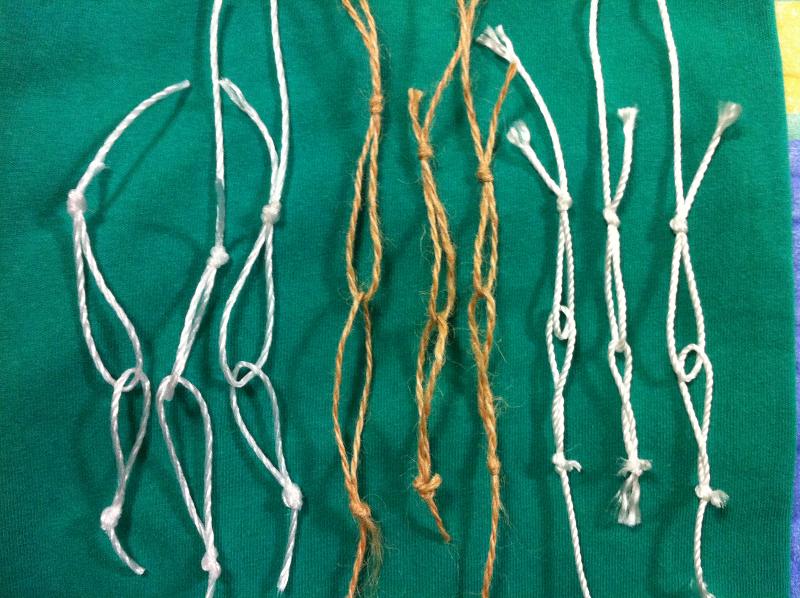
I know I will have to explain it again, and with other words, but that is the beauty of a good educational system !
1 .The fact that some knot broke at some point, does not mean that the weakest point of this knot was at that point ! It may sound odd to somebody, to the point it will make him sure/sorry :), but that is what happens ( i.e, the real fact, not the appearance ). The threads are starting to weaken ( break, melt, thin, etc. ) at the point of maximum load ( by tension, compression. torsion ), but that can have an influence on some other points of the same threads, and those other points can break before the points from where the disruption was “transmitted” from at the first place. ( There have been many knot strength experiments that show this. Knots are breaking well before - or sometimes even after - the standing part s first curve, and this is even the case of boiled spaghetti ! )
2. The fact that some knots break at one of their weak points, does not mean that this is the only weak point, or that the rope is NOT weakened at other points ! It only means that this weak point might ( but we can not know it for sure, as I tried to explain above ) have been weaker than the other weak points, that this was the weak-est link, and there is where the chain of links happened to break.
3. The inclusion of LONG legs of bights ( as anybody can see at your pictures…) can change the results ! Why ? Because those legs can work as shock absorbers of sudden increases of tension, and leave the external points, which are not “protected” by them, to bear the full load at the moment of interruption. If you test those LONG loops, you do not test two knots /links placed the one next to the other, but three ! The core of the first eyeknot, the second bight-to-bight link, and the core of the second eyeknot. I have described why it is wrong even to test TWO knots tied on the same line, the one next to the other, at Reply#57, which I have to repeat here (any good educational system is based on repetition - but not only on repetition ! :))
The procedure of the rupture of the one link of a bend is a gradual one. During this phase, the vibrations or sudden dislocations of the one link can influence the other in ways we can not foresee, i.e. the one link influences the other. So, we can not even say that, given two links, when the one will break at A and the other at B, A being higher than B, the compound bend made by those two links bend will break at the value of the weakest link, the B. The rupture of the strong link could well start before the final rupture of the weak link, and the physical effects of this might influence the final rupture of the weak link, reducing B even further. That is why he dismissed my naive idea of testing two bends tied on the same rope the one after the other and see which is stronger - there may be a severe influence between the two ready-to-break bends, as there might be a severe influence between the two links of a bend, or the two eyeknots of a compound two-eyeknots bend.
So, if you put not only TWO knots/weak points of rope in one line, the one next to the other, but THREE, you should multiply my comment above by 1.5 !
J.P., just read my lips, not only anybody s else s :
So, thank you for those tests, but those tests are not what I have asked, is it ? They are tests of two linked long-leg eyeknots, not tests of two linked bights !
For commercials, let me describe how I had spent my New Year evening : I was trying to explain, with other words each time, the well-known “paradox” of the choice between three closed doors. Somebody shows you three closed doors, and tells you that behind two of them you will find a knot-tyer ( not the same knot-tyer, a different knot tyer ! :)), but behind one of them you will find a rare copy of ABoK . You are allowed to choose one, and one door only, and he will open it for you.
You choose one door, at random, because you do not have any other information ( and you do not have X-rays vision like Superman / dan Lehman … :)), but then he does not opens the door for you, but tells you that one particular door from the other two, the ones you had not chosen, DOES NOT lead to the desired rare copy of ABok ( I assume you wish to acquire that item, and not to make company to a knot-tyer, ANY knot-tyer ! :)). Then, he asks you to reconsider your first choice, and to alter it or insist on it. What would you do ?
Most knot-tyers ( sorry, most people… :)), would say that they do not have any reason to change their initial choice. They would say that the "probabilities’, the expectation of the “statistics”, will remain the same : 1/3 - so why bother to change their first choice when they learn that a choice they had NOT made does not lead to the treasure ?
They are wrong (“yes”), of course, and I had tried to explain it with general terms - as I will try to do with the experiments of many knots tied in a row on the same line.
The second time they were offered the opportunity to choose, and retain or alter their initial choice, they had acquired a new knowledge, a new piece of information, that they had not at the first time they had chosen - and this information was relevant / related to the issue ( somehow, we do not need to know exactly how, but it was nevertheless a relevant/related new information, it was not an information about what is in the knot-tyer s mind, for example…), So, this was a new / added piece of information, and just because it is new and additional to the only piece of information they had at the first place ( that the treasure is behind one only of the three doors ), it will be better for them to use it, and alter their initial choice.
This is a general explanation, which does not require any calculation, addition or subtraction of probabilities - i.e, it does not require any riding on dangerous bicycles, unicorns, or one s ego.
So, let me return to our issue, which is somehow related to my lost New Year s evening.. (…in particular, and to my lost years, in general ).
We are given three piles of knots, and we are able to choose one of them. One third of them have a measured average strength of 1, one third of 2 and one third of 3 , but we do not know which is which in advance. Which will be the average strength of the knot we will choose ?
Two ? Of course, “yes” :). We will chose in random, and the “statistics” tells us that the average strength of all the knots is 2, so the expected value of the knot we will chose at random will be 2. Now, we are told to choose again, but this time to choose two knots, but put them the one next to the other, on the same line. What will be the average strength of the compound knot, made by the two knots we will chose used as links, the one next to the other, in a series ?
Two ? Two ? Of course ““no””, not “yes” ! It will be lower than 2. ( Actually, it will be 14/9, lower than 18/9 =2, but the exact expected value does not need to bother us here…) .Why ? The average strength of the first knot will remain two, and the average strength of the second knot will remain two, so the “careful in details” client will suppose that the average strength of their pair, will again be two.
I will try to explain what I had tried at Reply#54, in other words, without any “statistics” involved. The second knot will be added to the first one, it will be tied on the same line, in a row. If its strength will be higher than the strength of the first knot, nothing will change. The compound knot will still have the strength of the weakest link, which is the strength of the first knot. That will happen in half of the cases, because, in half of the cases, the second knot we will chose in random will have an expected strength lower than the first one we had already chosen.
However, at the other half cases that will not happen. The second knot we will chose will have a strength lower than the first knot we have chosen already. So, the strength of the compound knot will now be lowered, because the strength of a chain equals the strength of its weakest link, as everybody knows , and the addition of a weaker knot/link will alter the expected value. It will push the average strength of the compound knot lower, towards the strength of the weaker link of each pair. And, for this second half of the cases, the weaker link would be the second knot we will chose. The addition of the second knot will alter the average strength of the pair in half of the cases, while it will not alter it at the other half. So, for the sum of all cases, the average strength of a pair of weak knots/inks will be lower than the average strength of single one-knot link.
Let us watch two scientists, who perform those two experiments side by side. The first one tests the one-link chains ( the single eyeknots ), using the same links as the second one, who tests two-link chains ( linked eyeknots - without the addition of those LONG legs in their bights, please - without the addition of a THIRD element acting as shock absorber that can alter the results of the tests on the pair ). Will those two scientists find the same average,strength of their chains, if they start from the sample of single knots ?
No, they will not, and I believe that should be obvious (by now …). So, in conclusion, I repeat that :
UNPERFORMED EXPERIMENTS HAVE NO RESULTS
We should wait for the results of the two-loops bends ( with short bights. please …), before we hurry to jump into any conclusions, and state any premature general statements, like the :
After reading reply #74:
I’m getting dizzy. If I had known I could do that without alcohol, I would have joined the guild years ago. But the fact that my knots were tied with long loops, which makes wrong, only makes me right. If the knots had been tied with short loops, they would have behaved differently, making my assertion wrong. But nobody cares about knots in such small stuff anyway, so to be taken seriously, they should have been tied in larger stuff, which, again, behaves differently, making me right, right? ??? :o
How about this:. it is just as easy to test two interlinked bights without knots as it is to test a knot or a loop or two interlinked end-of-line loops. I could do that with the same twine and report the results. Lets all make predictions about what the results would be. I’ll go out on a limb and off the top of my head say at least 140% twine strength. Any takers?
“No”. You should tie the knots with the same proportions. A double-the-diameter rope corresponds to quadruple-the-length-of-its-bights eyeknot… so you can imagine how long your two-loop bends would have been, if you had used a 1/2 inch rope… I do not know the magnitude of the effect, if any, of the “shock absorption” of those two looong bights, because I do not even know if your pull is abrupt, compared to the size of the rope, or not. I only wish to exclude this parameter as much as I can - because we already have so many others to consider !
We are interested to see if your general statement …
the strongest means of bending two lines together should be with two end-of-line loops.
…is correct, or not. If you link two eyeknots with one mile long bights, your experiments will not be able to tell anything about it… They would be experiments of amother compound system, of four (or even five, if the pairs of bights of the two eyeknots will not have the same length…) different-in-strength rope mechanisms / "links. put the one next to the other on the same line: One core-knot of the first eyeknot, one one mile long double line rope ( the two legs of the first eyeknot s bight ), one bight-to-bight link, another one one mile or so long double line rope, and a second core-knot of the second eyeknot. It WOULD HAVE NOT been an experiment on “two end-of-line loops” linked together to form one “bend”.
Welcome to the Land of the Knot Spirits !
First things first. Two interlinked bights. In the same twine that I used to do the reported tests. What percentage of line strength? Predictions please. We have wagered neither money nor chattel. The only thing you have to lose is face. :
Oh, in the Land of the Knot Spirits, THAT is the most valuable thing - because values are subjective, and the subjects here are the knot-tyer s pride : evidently ( and apparently ) invaluable ! Size matters !
I have no knowledge or experience with serious testing of any material object beyond spangetti ( and the like :)), be it a knot or not… so my gut feeling tells me that the average strength of this compound “knot”(?)/ rope system, would be around 50 % of the ultimum strength of the system of two straight unknotted lines.
I have placed my bet, let the wheel spin !
( Be careful how you tie the ends on your apparatus - I suggest you wrap them around wide enough diameter drums, so the ropes will not be harmed there. It would also be better if you wrap them around two properly grooved pulleys. This way the cross sections of the ropes will not be able to be flattened while they turn around the drum/pulley.)
I was unclear. Since we were talking about two interlinked end-of-line loops (two bights, each having two lines approaching the contact point of the bights) being or not being stronger than a bend (essentially two lines joined in matrimony to become one), my prediction was based on one hundred percent of one line thickness. If we are calling the two bights a system of two lines with additive strength, then I say no less than 70%. Anyone else? Place your bets. Please base your predictions on the strength of one line, or specify otherwise..