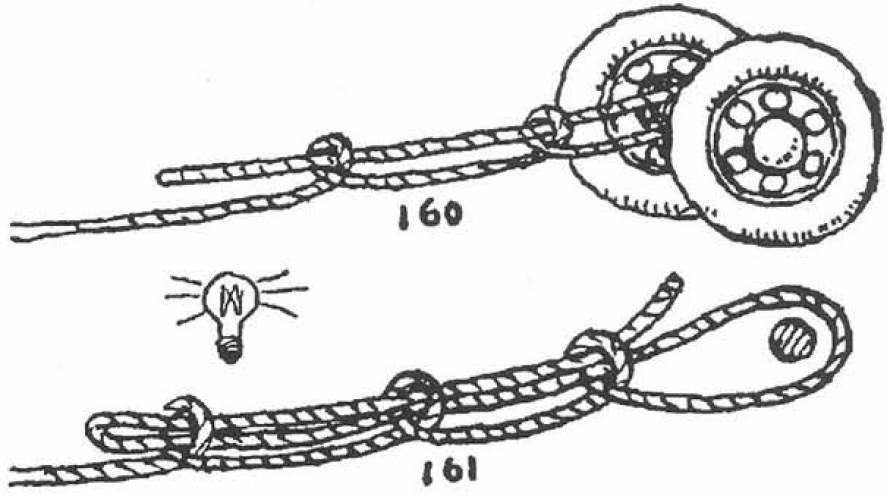
" Secondary" function, only in comparison to the primary function of the collar : to help the nipping loop prevent the slippage of the tail - because that is what any end-of-line loop ( indeed, any knot ) is supposed to do ! To firmly attach the tail on the standing part. How does the collar achieves this ? By just being a collar, i.e. a U turn around a stable element, such as the standing end - in the case of the common bowline - or the eye-leg-of-the-standing-part - in the case of the “Eskimo” bowline. ( The U turn of the Sheepshank is not a collar, it is a bight in mid air…) What an ingenious invention of the human species was this U turn ! However, as said, the primary element of the bowline is the nipping loop, and this is clearly revealed in the cases of the collar-less " half-bowlines’ , the ABoK#160, the " Hitch series" and , of course - how did I forget to mention it ? - the Sheepshank.
Adding some photos to illustrate key theoretical concepts:
Sr. Member ***** Posts: 1951Re: Myrtle Hitch not in ABOK?
? Reply #12 on: October 17, 2009, 05:41:06 AM ?
Quote from: Andy Asan on October 16, 2009, 06:21:56 PMDan, which one is the Myrtle, and which one is the Anti-Bowline?The left one, if properly oriented/dressed, is an anti-bowline (my term);
you show it in odd (dis)array, instead of with the bowline-characterizing
(and here “bowline” in inclusive of “anti-”) nipping loop of the S.Part. The
right one is easier to see, it being in better form.ORRRRrrr, just referring to your righthand image, loading the right end
makes an anti-bowline, loading the left end a bowline (Myrtle).
The sheepshank has elements of a bowline but, it is not a bowline on account of no fixed connective eye loop.
The photo of the ‘Myrtle’? is poor (from a previous post in this forum) - I will re-photograph it in high resolution.
The Carrick loop (“ABoK #1033”) also has elements of a bowline but is not a bowline on account of the nipping turn not encircling the bight component and applying equal tension on both legs of the bight. However, it does have a fixed connective eye loop.
The Eskimo bowline fulfills the criteria to be awarded the title of ‘Bowline’. It has a bight component that is encircled, gripped and stabilized by the nipping turn component.
I note Dan Lehman’s point re the servant and master - that is, the bight serves to stabilize the nipping turn. It is true that if the bight is removed from the nipping turn - the nipping turn no longer encircles and grips anything. I still take Derek Smith’s view that you need both components to form a bowline.
Note: (added)… the images of the ‘Myrtle’ and sheepshank are not meant to imply qualification for the title of ‘Bowline’. I am simply presenting the images to show the (possible) presence of a ‘bight’ component and a ‘nipping turn’ component.
…
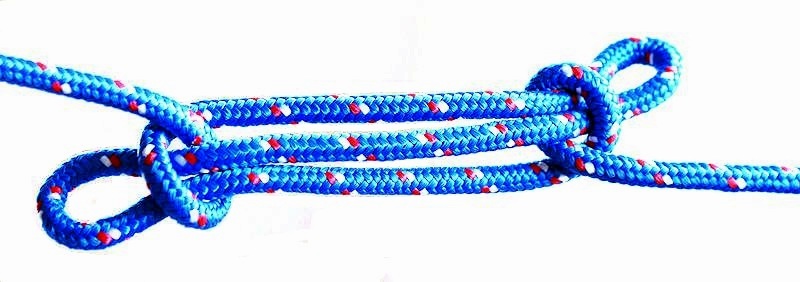
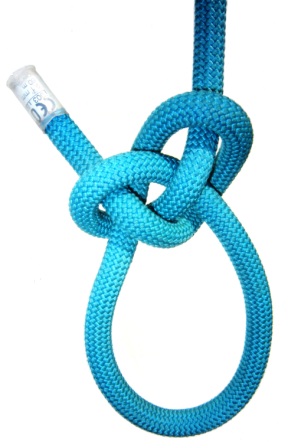
The image given for “Myrtle Anti-Bowline” is grossly misleading
as to the nature of the knot --more resembles (in its open form)
a crabber’s eye knot in implying a mere “U” in the SPart
vice a nipping loop (which tends towards a helix). AND it wrongly
fuses the names of distinct knots. (The tail for Myrtle enters the
nipping loop as does that for the common bowline and then differs
by making just a loop-wrap/turn vs. bight/collar ; whereas the
entry is from the opposite side for an “anti- [hence this prefix!]
bowline”.
Swapping which side of the tail-wrap gets loaded, as I’ve indicated
in my quote, nicely swaps between the two knots, as the one works
well with the tail finishing towards the eye, the other (Myrtle) away
(re stability, nip).
The sheepshank has elements of a bowline but,
it is not a bowline on account of no fixed connective eye loop.
Well, duh, yes; which brings an unmade criticism : that THIS
aspect is most fundamental ( = “#1”) of the definition (and
could well be overlooked in presumption).
The [i]Carrick loop[/i] ("ABoK #1033") also has [i]elements [/i]of a [i]bowline[/i] but is not a [i]bowline[/i] on account of the nipping turn not encircling the bight component and applying equal tension on both legs of the bight. However, it does have a fixed connective eye loop.
Well, you’ll not sell this perspective to me. It fits my definition
of “bowline” fine, if not hauled to the point that the “nipping
loop” becomes a crossing knot base.
The [i]Eskimo bowline[/i] fulfills the criteria to be awarded the title of 'Bowline'. It has a bight component that is encircled, gripped and stabilized by the nipping turn component.
Here, too, there are disturbing variances for those who care to look
and explore differences in setting --loose can see “loop”=>“helix”
(well, it’s always that, but more so); tight … crossing knot base.
I note Dan Lehman's point re the [i]servant [/i]and [i]master [/i]- that is, the bight serves to stabilize the nipping turn. It is true that if the bight is removed from the nipping turn - the nipping turn no longer encircles and grips anything. I still take Derek Smith's view that you need both components to form a bowline.
But what I said wasn’t removing the bight entirely, but just removing
it from “collaring” the SPart --which goes also against X1’s remark :
the primary function of the collar : to help the nipping loop prevent the slippage of the tail ... By just being a collar, i.e. a U turn around a stable element-- is that a [i]sheepshank[/i] shows that this "U"/bight could-be "collar" can be deprived of the asserted stabilizing (or U-turn-around...) functions and a knot still works, from the behavior of the nipping loop alone.
Now, I see that I, too, once had stronger feelings for the “collar” bight,
and thought about naming my “Lehman8” “bowlinEight” on
account of a more easy-to-pry loose collar of the fig.8 base than
is normally the case (it being now a single strand, of the base component,
and not also a “rewoven” twin). But then I thought otherwise, and am
not compelled in recollection to relent : no, the strong characteristic
of bowline to me is the nipping loop --at least I see that as a good
binding aspect for some named genus/family/order of knots, which
at the moment I’m feeling fits “bowline” (and “anti-bowline”, with
thus “bowline” overloaded).
–dl*
ps: I quite agree that continuing the dormant thread was the right thing
to do, vs. starting a new one only to have to refer to all this one’s ideas.
Hi Mark,
As you were the creator of this thread, I would hope other members would be happy enough to have you develop it further.
Well done on your ‘Analysis of Bowlines’ document. It is a nice piece of work. I would make one comment which is hopefully constructive - you publish a strength test on the EBSB, declaring it to be ca 73% to 77% which implies that the knot is a significant improvement over the basic bowline. But then one notes that the calculation is performed against the declared minimum rope strength - not the actual rope strength, so these results will have been overstated by some amount by which the tested rope actually exceeded the declared minimum value. You would have made this test a little more valuable if you had included a test on the basic bowline under the same test conditions so a genuine comparison could have been made if indeed the EBSB is stronger than the basic.
It has made interesting reading going back over this topic again. I learned a lot from other posters, but I am afraid that I still cannot countenance the concept of a Myrtle bowline or a Sheepshank bowline, so to preserve my sanity I will abstain from further discussion on the subject.
Derek
Let me try to re-phrase some things, in order to better express what I believe about the matter.
The sheepshank has elements of a bowline, but it is not a bowline on account of no collar .
The Carrick loop (“ABoK #1033”) also has elements of a bowline, but is not a bowline on account of the collar not being like the common bowline s “proper” collar.
Thy collar is not just “a bight” , it is a loaded bight, a U turn of the working end around a stable element. So,
This loaded bight = collar serves to :
- Help the nipping loop keep the tail from slipping through it.
- Keep the nipping loop retain its closed loop form, and do not degenerate into an open helix.
( I think that the #1 function is more important /primary than the #2, but this is not such an important thing anyway. It may be only a matter of semantics.)
An obvios missunderstanding looms here.
The (loaded) bight that we call collar can well be removed from the nipping loop, as a loaded bight - the nipping loop will continue to encircle the eye-leg-of-the-bight, i.e, only the one strand, that which was one of the two legs of the collar before that removal. When I say that we may remove the collar, and be left with a half-bowline, I mean remove the second leg of the collar, the “proper” tail.
Both the ABoK#160 and the Sheepshank are " half-bowlines" in the sense that they have no collar - but, of course, there is something left, that the nipping loop encircles and grips ! 
The problem is that this “point” is, in fact, a grey area.
If we would allow ourselves to go beyond the common nipping loop, and consider instead any nipping structure ( that is topologically equivalent to the unknot and can be untied at exactly the same time the tail is removed from its passage through it, in other words, a " nipping structure + collar" compound knot that can be untied in one step) - then we can achieve a more general definition of the bowline. Of course, doing this, we run on the reverse problem ; how do we can now rrestrict that definition, so it does not include too many end-of-line loops that do not resemble the common bowline at all.
I have explained what I mean in the previous post.
I wouldn’t describe as nipping loop a bight that encircles nothing but thin air , of course, - as I do not describe as collar a bight that encircles thin air ( The Sheepshank s bight(s)).
When I say " we can remove the collar" from a bowline, and leave a half-bowline that has only a nipping loop in the place where the bowline was before this removal , I mean ( and, indeed, I could not have meant anything else, could I ?) to remove the one leg of the collar, the “proper” tail - so the loaded U turn around the standing part or the eye-leg-of-the-bight is not loaded, not U turn around something any more !
( I had said " ABoK#160" “half-bowline”, and Sheepshank “half-bowline”, in purpose !
Please, reconsider your abstain - I am convinced that knots bring us close to insanity, indeed… but, at the same time, they keep us from falling into it - iff they are tied and dressed properly !
What happens in a bowline if, intentionally or by accident, one of its two essential elements, the collar, cease to exist altogether ? Will this half-bowline still be capable to hold some loading ? This is a somewhat far-fetched measure of the security of the bowline, but I think that is not completely irrelevant. The thought that a knot would still function adequately well - at least for some brief moments. and when loaded with a small only percentage of its maximum capacity - even if/after it is severely de-structured, brings piece to mind...
An interesting proposition.
I did take a sequence of photos at various milestone loadings of a Bowline (“ABoK #1010”) - up to 10kN force then stopped.
Although I am dissatisfied with the photos - because I should have taken them from the ‘front’ (ie the front as defined by Dan Lehman - which properly shows the operation of the nipping turn) - I also could have woven those darn little tracer threads into the knot structure as per Dan Lehman. However, the act of sewing and the fine motor skills and effort required to weave those tiny threads are a PITA! (I honestly believe that Dan invented the idea of the cotton threads purely to cast his cruel sense of humor on poor unsuspecting fools such as myself who are willing to do his bidding).
My next effort at photography will show the Bowline from the ‘front’ - and I hate to say it, I’ll weave those cotton threads (I will chant a curse to Dan while threading my needle) - and hopefully finally come up with some useful photographic data.
But, of greater interest is the idea from X1 (alias our esteemed colleague xarax) and I will attempt to cut various sections of the structure (eg collar) with a razor sharp blade while under load. Hopefully the act of cutting will not place my life at risk should the knot suddenly explode in my face! If I don’t post back here again, it probably means that I am in heaven looking down upon X1 and smiling :o
Mark
This is a catastrophic idea / action ! Are you sure you are going up, to heavens ?
If not, I would suggest to simply untuck the tail / second leg of the collar, ( pull it out of the two nipping loops - so leave those nipping loops encircle and grip only the one, the first leg of the collar, the direct continuation of the eye-leg-of-the-bight ), and then measure what percentage of the initial maximum load of the complete bowline this “halved-bowline” can now bear.
(I expect that we will be surprised by the numbers in the cases of the Water bowline and the Gith-hitched bowline. I also believe that the initial separation of the two nipping loops would matter quite a bit. If they are placed close to each other in the first place, they will have a greater chance to remain close to each other during the whole phase of the loading. In such a case, the " half-bowlines" would be able to withstand a much heavier loading, I guess. ).
It has made interesting reading going back over this topic again. I learned a lot from other posters, but I am afraid that I still cannot countenance the concept of a Myrtle bowline or a Sheepshank bowline, so to preserve my sanity I will abstain from further discussion on the subject.Derek
Heh Derek,
The only reason I posted images of the that weird structure called a ‘myrtle’ and the sheepshank was purely to show some more bight components and nipping turn components. I certainly did not intend to suggest that these structures are ‘Bowlines’.
I am continuing to look at structures that have these core elements (ie bight + nipping turn) - simply so I can test the theory and see if it holds up.
In my view, the primary features of a Bowline include:
- possessing a fixed connective eye loop.
- does not jam under load and can be easily untied - even after a high loading event
If the specimen knot cant meet these first 2 criteria, it wont even be a contender for ‘Bowline’.
The sheepshank is instantly dismissed - it doesn’t pass the first test (no fixed connective eye loop).
As for the ‘Myrtle’ - that photo I uploaded is an abomination…I lifted it off the IGKT site - because I couldn’t find any other images. I will re-photograph my own tying effort and re-present it in a proper orientation in accordance with Dan Lehman’s notion of ‘front’ and ‘rear’ view.
Essentially, I am clinging to your theory regarding the bight component and the nipping turn component since it appears to me to be logical and elegantly simple. By adding the above 2 criteria, it appears to me to be a reasonable working hypothesis. As you know, all theories have to be tested.
I guess what I’m saying is that your absence from further commenting would be a significant loss…
Derek Smith:
I would make one comment which is hopefully constructive - you publish a strength test on the EBSB, declaring it to be ca 73% to 77% which implies that the knot is a significant improvement over the basic bowline. But then one notes that the calculation is performed against the declared minimum rope strength - not the actual rope strength, so these results will have been overstated by some amount by which the tested rope actually exceeded the declared minimum value. You would have made this test a little more valuable if you had included a test on the basic bowline under the same test conditions so a genuine comparison could have been made if indeed the EBSB is stronger than the basic.
Fair comment… from memory, I had a tight budget and limited time during the period of these original tests. I purchased a limited quantity of accessory cord - and had to make some hard decisions on how best to utilize that quantity. I did consider performing break tests on “ABoK #1010” as a control, but didn’t proceed because I also wanted to test the Rosendahl/Zeppelin + a few other knots. In the end, I ran out of time and cord and the tests ground to a halt. Also, a series of 3 pull tests is not sufficient - I should have performed at least 5 x tests to get a better statistical sample. Again, I went with 3 tests for the same set of reasons i outlined above (ie limited quantity of cord, limited time, limited money…). In any case, at least I was able to compare the ‘EBSB variant’ breaks against the manufacturers stated MBS…so it least I’ve got something of a (tiny) data set. I will try to find some time (and cordage) to go back and perform a control test on “ABoK #1010”…
Mark
Hi Mark,
Thank you for the compliment, but I am sure that I cannot contribute much more of value of your challenge.
When I first read your post title, I felt there was an answer and after much discussion, arrived at the proposal outlined back in post #164
1. A Bowline is an end of line [note 1] fixed loopknot {.EyeKnot}
[note 1 - a Bowline may be tied inline on a bight, in which case the bight is considered as an inline device to create a doubled ‘end of line’ element]
and carry on a little with :-
2. A Bowline is defined and described in ABoK as 1010
3. A Bowline construction comprises a load line, a knot, a fixed loop and an end
4. A Bowline knot has two components, a Half Hitch Component connected to the load line and a loop leg and a Bight Component connected to a loop leg and the end [note 2]
[note 2 - the Half Hitch component transfers load into both loop legs through the turn element and the high nip force generated causes frictional entrapment of the end. The Bight component acts as the core for the Half Hitch component and stabilises it via its bight collar made around the loaded line]
5. A Bowline’s Operational characteristics are :- …
6. A Bowline’s Usage characteristics are :- …
7. A Bowline’s Historical characteristics are :- …
8. A Bowline’s Aesthetic characteristics are :- …
9. …
But now I realise that had your question been 'What defines THE Bowline (#1010), the above answer might have held, but when it comes to answering your actual question ‘What defines A Bowline’, then I am afraind I have to opt for a perhaps more cynical answer –
i.e. A Bowline is defined by - History and the whimsy of the trade or user that names it.
As if by way of demonstration we have proposals of the Zeperlin Bowline and the Myrtle Bowline, let alone the whimsy from Dan and Constance of the ‘Sheepshank Bowline’.
Anything can be called a bowline and if then pressed into use, the name will stick irrespective of structure, characteristics or topology.
It would be nice to think that the combined ‘Knotterati’ of the venerable IGKT could make 2012 the year to propose a consistent definition for Bowline and Bowline Variants, and in doing so take a large step forward in cleaning up a little of the chaos which litters the historical naming of knots. Driving our standard into the ground and declaring that henceforth members of the IGKT would only use the term Bowline to describe knots which complied to xyz… but perhaps even that one step would require the wearing of ‘seven league boots’ by most of our illustrious members.
Still, enough on the topic of definition, could I turn briefly to the thorny subject of the importance of the bight component, and your proposal to take a razorblade to a loaded #1010. Instead, could I suggest that you simply make up #1010 with a very long bight collar (ca 10 diameters). If you then load this knot SP to Bight loop leg, the colar will pull up and form a normal Bowline. If however, you load the SP and the nipping loop leg, then you willl see the nipping loop rotate the bight legs into a nice slipping noose arrangement. What you will have seen is the mode of failure for the Bowline when the bight collar becomes excessively elongated and the loop is then subjected to ring loading on the nipping loop leg.
Conclusion == the bight collar is an absolutely essential part of the Bowline knot.
Derek
An interesting example of how loading can / will influence a basic knot structure is given by the Eskimo
http://igkt.net/sm/index.php?action=dlattach;topic=3233.0;attach=7344;image
The standard SB Core loaded from the SP into the side arm of the nipping turn, converts the nipping turn into a Carrick component which in turn holds and is stabilised by the bight collar.
We might denote this knot as a ‘Half Carrick loop knot’ which is a very close sister to the one in which the bight component is replaced with a round turn which then creates the Carrick/Myrtle loop knot.
Or if we are feeling perverse, we could call the Eskomo a Half Carrick Bowline and its sister the Half Carrick/Myrtle Bowline.
But then, as the Myrtle is the working shape you get when you load a simple Carrick, we might have to call the latter of these two loop knots the Half Carrick/Half Simple Carrick Bowline…
But then again, as the Myrtle is most easily made by making a Constrictor and passing the WE through the constrictor loops before pulling it up, we might have to call the Myrtle the Constrictor Bowline… which would make the Eskimo sister knot into the half Carrick/Half Constrictor Bowline…
Ho Hum
Derek
However, if you load the SP, and both the standing " bight loop leg" and the " nipping loop leg at the same time, ( i.e, the “eye-leg-of-the-standingpart” and the " eye-leg-of-the-bight" , if we use your terminology), you will see what I mean. You will see how the ABoK#160 “half-bowline” works, and how the Sheepshank “half-bowline” works, and how the “Hitch series” works !
( P.S. And this will prove to you that the bowline can work even if the legs of the collar are not crossed in any degree, and remain parallel to each other right after the U turn of the collar. So, there is no hitch element in the bowline, if we are looking for such an element in the tail - and there is no hitch element in the bowline, if we are looking for such a hitch element in the nipping loop either - because, of course, the nipping loop is a nipping loop, it is not a hitch !
The bowline does not have a hitch in it.
The bowline is a close relative of the Gleipnir, not of the Sheet bend.
I argue for some obvious simple things with my wife for 35 years now. I guess I can bear to argue with Derek the next 35 years, for the bowline ! :)))
Hi Constant,
You have demonstrated a number of things quite nicely for me here.
First - you have called ABoK #160 a ‘Half Bowline’. In Ashley’s description of of #160 he states “the end is easily pulled through the hitches whenever it is necessary to adjust the length” [emphasis mine]. Now if Ashley can see that these two components are hitches, and I see they are hitches, why can’t you? And if the ‘Half Bowline’ has a hitch component in it, then presumably so does the whole thing- vis #1010.
Second, without meaning to cause offence or antagonism, I think you may have missed my point re the colar experiment. Mark was going to take a razor to the colar of a loaded #1010 to demonstrate if the collar had any function within the knot. If the collar was not there, then even pulling up both legs as you advocate would result in the demonstration I proposed, i.e. the knot would collapse into a noose, while load on the end leg would simply pull it out of the knot because shedding load in the collar turn around the SP is an important part of #1010 functionality.
Finally, you agree with my earlier statement that this thread is a matter of opinion, or rather a matter of differing opinions, and while some of my opinions have been revised by accepting rational arguments, some ‘others’ remain obdurate and indifferent to rational argument, and while you and your lovely wife have the stamina to bicker over ‘simple things’ for 35 years, you will not find my dear Constant that I share your tenacity nor your good wife’s patience.
Derek
I believe that repetition is the mother of all learning, but I also believe that exceptions prove the rule …
You have a theory, inherited from Ashley, that the bowline is related to the Sheet bend. No surprize here : A whole generation of knot tyers had inherited the same theory - I dare to say: they were brainwashed by this theory. To support this theory, you have discovered a hitch where there is only a nipping loop. Of course, now you can not say what a nipping loop is, and you have to call any nipping loop “a hitch”… I would nt be happy to be in your position - but your tenacity is impressive, indeed - that is for sure -, so I suppose you will elaborate this theory a little more, so it will start to look a little more plausible.
Well, I have said time and again that Ashley was wrong on this - as God himself was wrong, when He said that the ratio of the circumference to the diameter of a circle is 3 ( speaking about the dimensions of the circular basin at the Temple). I do not have to prove that π is not 3 for you to accept my point, do I ? One can not really argue with a mathematical theorem.
The nipping loop is not a hitch. When a bight has both its ends loaded, and it is nipping a line that goes through it, it is a nipping loop. When a bight has only one of its ends loaded, it is a hitch. BIG, HUGE difference !
The false theory of the close relation of the Bowline with the Sheet bend was, in fact, initiated by Ashley, who had not paid much attention to ABoK160 and ABoK#161 as structures that could be evolved even further : that is why he missed the Gleipnir ! Had he met the Gleipnir, I am sure that he would have seen its close relation with the Bowline, at once.
The Gleipnir proved that the primary element of the Bowline is the nipping loop, and the secondary element the collar. If we did not know the Gleipnir, ( and the ABoK#160 and ABoK#161 ), we would be justified to see the relation of the Bowline with the Sheet bend, indeed, a relation that is more remote and less important that the relation between the Bowline and the Gleipnir.
I have stated time and again this simple distinction :
a. A hitch has one leg loaded and one not, because the second leg has gone under the riding turn, and has escaped as a free end. The hitch is asymmetric.
b. A nipping loop has both legs loaded, to a more or less same degree. The nipping loop is symmetric.
a, b., not even c ! SO simple...
Of course, we can find cases where the distinction is not so clear, where the second leg of a “hitch” which should not be tensioned, is not a free end either. Also, we can find cases where the second leg of the nipping loop leaves the crossing point with the first leg at a much larger angle - so it is not loaded as much as the first leg any more. Generally, the “hitch” is a more vague term than the “nipping loop” . In ABoK#1821, Ashley is calling even a complete overhand knot tied around a ring as a “Half Hitch”.
What I have stressed is that the " nipping loop" is a very fundamental element of knots, and it should not be confused with the " hitch" - which is another fundamental element. At a hitch, we have the one leg going UNDER the second, so the one leg is not loaded ( or it is now much less loaded) than the other. At a nipping loop we have two legs that touch or cross each other at a point- most of the times - but they remain loaded at about the same degree as they leave this point.
So, any “half-bowline” DOES NOT have a hitch in it, and this is true for the Glkeipnir, the ABoK#160 and the Sheepshank. And if the Gleipnir, the ABoK#160 and the Sheepshank do not have a hitch in them, so, presumably, the whole thing , vis#1010, does not have a hitch in it either.
The ABoK#160 and the Sheepshank do not have a (loaded) collar. Do they collapse into a noose ?
I wonder what are the “some” and what are the “others” !
(The fact that you feel you have to refer to a line in a holy bible as some kind of " proof", tells something about the " rational" character of your arguments. )
Constant
So then, let us take a little look at this So simple distinction.
In THE Bowline #1010, the SP enters the knot bearing 100% of the load. If we ignore any load shedding as the SP passes under the collar, then we may assume that the SP enters the Nipping loop with virtually 100@% load.
In the normally loaded Bowline each loop leg carries 50% of the load, and of course, any ring loading can completely unload the SP loop leg.
So by your definition, the Nipping loop which is ( b. A nipping loop has both legs loaded, to a more or less same degree. The nipping loop is symmetric.), so in practice the nipping loop within the Bowline fails your stipulated definition, and is therefore not a nipping loop (even though it clearly is…)
Furthermore, you have stated that (The hitch is asymmetric.), so as the nipping loop in the Bowline is asymmetric (unless the Bowline is ring loaded 100% onto the SP loop leg), then the Bowline nipping loop is asymmetric and is by your definition a hitch...
As you see Constant, making definitions can be a bitch, but at least you are trying to justify your opinion.
Anyway, to end this argueing over a name, let me rename the component to the Single turn Component - and please dont forget - it is not a bend or a hitch or any recognised knot - it is a component…
Happier now?
Derek
I guess that YOU are happier- but that does not makes you less wrong... :)
You have carefully expanded your “stipulated” counter - argument into many words and paragraphs, trying to make it look reasonable. Well, many words do not make a false claim true - unfortunately.
In an “ideal” bowline, where there would be no friction, what you describe is what would have happened, indeed. The nipping loop, being in equilibrium ( as the tension forces on the one leg would be the same with those on the other) , would have been free to move , to “walk”, to wherever the eye-leg-of-the-bight would have dragged it - i.e., downwards, towards the tip of the bight. And this is what is happening even in this not-so-ideal world ( where knot tyers do not understand each other…), when the ropes are very slippery ( Spectra/Dyneema) and the load is very heavy. It has even been documented in videos, but you have forgotten to mention it…
When there is friction, and the loads are not so heavy, the nipping loop can not walk down the standing part, because it can not rotate around the legs of the collar that penetrate it. If the pair of legs of the collar , on the one hand, and the rim of the nipping loop, on the other, were not “glued” together due to friction, if they behaved like the two parts of a ball bearing - the one free to rotate in relation to the other - then the nipping loop would have been incapable to prevent the bowline to shrink like a noose, indeed.
So, the one leg of the nipping loop does not squeeze the other underneath anything, as the one leg of a hitch does to the other. The fact that the 100% of the load on the one leg becomes 50% on the other HAS NOTHING TO DO WITH THE INTERACTION OF THE TWO LEGS, as it happens in the case of the hitch. It is due to the friction between the rim of the nipping loop and the two legs of the collar ( the continuation of the eye-leg-of-the-bight, and the continuation of the tail ). If there would have been no friction there (or if we had been able to insert a roller bearing between the nipping loop and those two legs that go through it ), the nipping loop would have walked down the standing part, right till the tip of the bight .
I understand that you have jumped out of joy when you have discovered this apparent counter-argument of yours…Well, next time you should better try harder ! And with fewer words, because if something is true, it penetrates deeper into your opponents happiness if it is brief. I would have said that :
" The 100% of the load on the standing part becomes the 50% of the load on the eye-leg-of-the-standing-part. So the nipping loop is, according to your definition, not a nipping loop, but a hitch." Period
To which argument, I would have replied as such:
" The reduction of the load on the nipping loop s legs, from the 100% to the 50% has nothing to do with the one leg riding over the other and absorbing a part ( or the whole) of its load, as it happens in the case of the hitch. It is due to the friction between the rim of the nipping loop and the pair of the collar s legs that penetrates the nipping loop. Were there no friction there, the nipping loop would have walked down towards the tip of the loop, dragged/pushed by the collar, because the tensions on each of its two legs would have been perfectly equal."
Derek, we are both trained as engineers, but it seems we have been going to different schools together ! :)
What brings peace in my mind is this ; Whatever we say, any paradoxes we are discovering the one to the other s theory, are only subjective. The real world is there, independently of our semantic blah-blah, and works fine ! The bowline works, thank KnotGod, and neither me nor you can change this by arguments, however "rational’ we think they are. Oh, yes, when I see the real world, when I see a bowline or a Zeppelin bend working, I am happier !
Constant
" Single turn component" for the part of the bowline I call “nipping loop” , sounds fine to my ears…It describes something that makes a turn, but also something that can turn, that can rotate. A “nipping loop” on a tensioned line can rotate, and “walk” towards the one or the other direction. In the case of the bowline, it tends to walk downwards, towards the tip of the loop, because that is the direction to which the collar and the eye-leg-of-the-bight drag it, the first pushing it from above and the second pulling it from below.
Why this does not happen in the real world ? Why does the nipping loop remain fixed, placed at one point of the standing part, even if the collar and the eye leg of the bight are pushing and pulling it downwards ? Because of friction. But not because of the friction between its two legs, as it happens in the case of a hitch. Because of the friction between the rim of the nipping loop and whatever penetrates through the nipping loop, i.e, the two legs of the collar.
Of course, the nipping loop squeezes the two legs of the collar together, the one upon the other, and this forces them to behave as a more or less unified object. However, this is something that can be achieved with the help of other means - with a bowline s simple “lock”, for example. Let us suppose that this has been achieved already, and that the two legs of the collar are “glued” together, metaphorically or literally ! If that is so, now these two legs can drag the collar, and the collar, by its turn, can push the nipping loop. What will happen ?
In an " ideal" world and in an"ideal" knot, where there is no friction, the push of the rim of the collar will force the nipping loop to rotate around the axis formed by the legs of the collar, just like the outer rim of a ball bearing rotates in relation to the inner one. Rotating like this, the nipping loop will walk down the standing part, and nothing will stop it from reaching the tip of the bight - and the bight itself to shrink, like a noose, and finally disappear !
However, this is not what happens in the real world, thank KnotGod ! Because of the friction between the rim of the nipping loop ( the rim of the wheel) and the legs of the collar that go through it ( the axle of the wheel), the nipping loop can not rotate, so it can not walk, even if it is pushed by the collar from above, and it is pulled by the two legs of the collar from its centre. Of course, friction is all over the place. There is also friction between the two legs of the nipping loop, and between the rim of the nipping loop and the two legs of the collar. However, those effects are less pronounced, and secondary, I believe This is indicated, if niot proven - by the fact that a " half-bowline " where the nipping loop will not open up into a helix, will work surprising well, even without the help of a collar ( with a very loose collar, or even with a collar bight cut into two !) The two nipping loops, in the cases of the Water bowline, the Girth-hitched bowline, the ABoK#160,161 and the Sheepshank, do not need a collar to remain closed - and so they work very well, because their nipping loops, although they are pulled toward one direction, will NOT walk on the line. The lines around which they are " turned" prevent them from rotating, and so they can not move.
We all have played with such toys when we were kids, but it seems we have forgotten it ! :). If we make a " turn" with a string around a pencil, and keep the two ends of the string tensioned, we can “walk” the pencil from the one end to the other - provided the pencil is very slippery, or we enable this “axle” to rotate freely into our palm as we drag it towards the one or the other end. If the string is tensioned, if it does not slip on the surface of the pencil, and the if the pencil itself is not allowed to rotate the turn will not move, even if the pencil is pushed or pulled. I have called such a toy a “half-bowline”, and its main component as “nipping loop”, but I will be also happy with the name of a “single turn component”. The Double bowline has a “double turn component”, and the particular double, crossed nipping loops bowline I have presented yesterday will be a loop based upon a " double crossed turns" component, or something like that, I guess.
It would be interesting to study the " single turn component " of the bowline knot in isolation, independently from the presence of the collar.
Let us first examine the simplest case, where :
a. the " single turn" is a 360 degrees turn around one round object - be it a pencil, or a one or more segments of rope, held there by the nipping action of the turn, by being glued together, or whatever.
b. the two legs/limbs of the turn are aligned - they leave their contact point to opposite directions. So, the former standing end and the former eye-leg-of-the-standing-part lie on a straight line.
c. the turn itself and both its legs/limps lie on the same plane.
This picture is only approximative, of course. In fact, even in this case, the turn is but a helix, only this helix has the smallest possible pitch, of one rope diameter. So the turned rope is never a ring, it is segment of a helical coil, although the helical path of this coil has a small pitch, in comparison to its width. To speak of a plane on which this 360 degrees turn lies, it is only a convenient abstraction, for the sake of a simplified description.
As the reader who was brave and patient enough would have read by now, in the two previous posts, if we push this turn to the one or the other direction, it will rotate together with anything it encircles, and so it will “walk” alongside the tensioned line. ( However, if it is NOT free to rotate around the objects it encircles, or if these objects are NOT free to swivel around themselves, it will NOT walk ! That is why the turn of bowline does not walk towards the tip of the bight ).
Here comes the interesting part. What will happen if, instead of keeping the plane of the turn parallel to the tensioned line, we twist it a little bit ? ( Twist it so that the two legs/limps of the " single turn component" are also twisted around each other, and get are more embraced around their contact point, not less. We wouldn’t twist it so that it would open up to an open helix …)
It is evident that, as we twist the plane of the turn in relation to the tensioned line, around the contact point of its two legs/limbs, the friction between the legs would start to get greater and greater. So, the rotation of the turn and its walk alongside the tensioned line would now be restrained more and more by friction forces betewwn the two legs/limbs. On the area around the crossing point, the two legs would now be forced to embrace each other more, along a longer segment, and this will induce greater friction inside the whole rotating and " walking" mechanism.
When the “single turn component” of the bowline knot is twisted ( due to the direction of the lines that pass through it, or for whatever other reason that has to do with its position/orientation inside the knot s nub), then it remains more steadily fixed on a certain point of the standing part, and it does not run the danger to walk downwards, towards the tip of the bight. So, a clever effective strategy is to force the plane of the turn to twist more, to settle to a position where it would be as much inclined in relation to the standing end axis as possible. At some point, we may argue that we should not speak of a common s bowline s turn component any more, but of a crossing knot s turn component. That transformation would be more evident if the turn is also re-positioned upwards or downwards, so that a large part - or the whole- of it lies well above or below the crossing point. In that case, we have a genuine crossing knot bowline.
Hi Constant,
No, I am not an engineer, that accolade is yours not mine, I am a chemist.
I am sorry that you found my post excessively lengthy, I try to communicate clearly and so use however many words I feel are necessary to eliminate ambiguity. After all, there is no point in posting words if all they do is confuse.
I am glad that simply changing the name of the component has resolved your problems with it. However, it is worth mentioning that if I take four of these components, I will have created the Frictionless hitch… Indeed, If I use cordage and former with a suitably high coefficient of friction, I could produce a Frictionless hitch out of just one Single turn Component and in that special case the component would indeed be the hitch.
The concept of ‘Hitch’ is a weak one, historically featuring cordage bound to a non cordage static object, but many instances show that a ‘hitch’ can be made to cordage objects as well. Indeed, in compound cordage constructions, one part of the construction can be ‘hitched’ to another, so is it not reasonable that the term could be extended to describing the hitching of one component of a knot to another?
Derek